student loans

Time to Fill Out the 2020-2021 FAFSA Application

Kali Hassinger Contributed by: Kali Hassinger, CFP®

Time to fill out the FAFSA application

Just as parents and students are getting back into the groove of another school year, it’s already time to start thinking ahead! The Free Application for Federal Student Aid, better known as the FAFSA, opened for the 2020-2021 school year on October 1. The form helps determine financial aid eligibility for both current and prospective students. Although this is a federal application, it may also be used to apply for many state loan, grant, and scholarship programs.

The sooner the better!

A large portion of available funds are distributed on a first-come, first-served basis, so the earlier you file the FAFSA, the more money is available for loans and grants. While you have until June 30, 2021 to file the FAFSA for the 2020-2021 school year, most state and school deadlines differ. It doesn’t matter whether a student has been accepted by a school at the time of filing. You’ll need to elect at least one college to receive the application information, but you can add multiple schools in which you may be interested.

What information do I use?

For the 2020-2021 school year, the FAFSA will use 2018 tax return information. Regardless of your household income level, however, it’s important to file the application. Some schools will only consider students for scholarships if they have filed the FAFSA.

Visit https://studentaid.ed.gov/sa/fafsa to start the process.

Kali Hassinger, CFP®, CDFA®, is a CERTIFIED FINANCIAL PLANNER™ professional at Center for Financial Planning, Inc.® She has more than a decade of financial planning and insurance industry experience.

3 Reasons to Get an Early Start on College Savings

Robert Ingram Contributed by: Robert Ingram

Get an Early Start on College Savings

The back-to-school season is right around the corner. And if you have school-aged children, the thought of planning for their college education may be enough to cause your own case of back-to-school jitters. Costs of a four-year education at many colleges and universities are already well into the six-figure range (per child!). For many families hoping to cover a large portion of the costs, significant savings goals are likely required. That’s why, more than ever, you should create a college savings plan as early as possible. 

College Costs Keep Rising

When planning to fund an education goal that may be years away, focusing on today’s costs is (unfortunately) just the beginning. Like the prices of many other goods and services, college costs have increased over time. These costs, however, have been rising much faster than those of other household expenses. According to JPMorgan Asset Management’s research, tuition costs have grown by an average annual rate of 6.4% since 1983. At this rate, today’s cost of tuition would double in about 11 years. Even if this rate of inflation slowed somewhat, potential college costs are eye-opening.

The illustration below shows projected total tuition, fees, and room and board expenses for a four-year, public or private college education, with a 5% annual increase in costs.

Source: JPMorgan Asset Management College Planning Essentials, using The College Board, 2018 Trends in College Pricing. Future college costs estimated to inflate 5% per year. Average tuition, fees and room and board for public college reflect four-y…

Source: JPMorgan Asset Management College Planning Essentials, using The College Board, 2018 Trends in College Pricing. Future college costs estimated to inflate 5% per year. Average tuition, fees and room and board for public college reflect four-year, in-state charges.

As you can see in this example, a child who is 10 years old today could expect a total cost of $136,085 at an in-state public college or university. Her education at a private college could cost over $308,000.

The power of compound growth on your savings and invested earnings can be one of your best allies as you save for these potential future costs. Let’s say the family of our 10-year-old child began saving $3,600 each year. At 7% growth compounded annually, they would have $36,935 by the time she turned 18. What if, instead, they began saving that same amount eight years earlier, when the child was age 2? At the same 7% annual return, they would have $100,396. The sooner you can begin saving and investing, the more time compounding has to work its magic.

The Burden of Student Loan Debt

As the costs of college have continued to rise, the amount of student loan debt has grown as well. A recent report from the New York Federal Reserve Consumer Credit Panel showed that outstanding student loan debt totaled $1.44 trillion as of September 30, 2018. In addition, studies from the Institute of College Access and Success found that 65% of students graduating in 2017 from public and private, non-profit colleges had student loans, and the average borrower owed $28,650.

Loans can help provide students the funds to complete their educations, but a large debt balance can have serious implications for a graduate’s personal finances. As new graduates begin their careers, servicing this student loan debt can take up a large portion of their budgets. More dollars going to pay down debt means fewer dollars available for other needs, for building an emergency fund, saving for a house, or saving for retirement. (Click here to see some financial tips for new graduates). Parents managing student loan debt can also feel similar constraints. Often, parents in the home stretch toward retirement are paying down debt instead of funding their own retirement plans. 

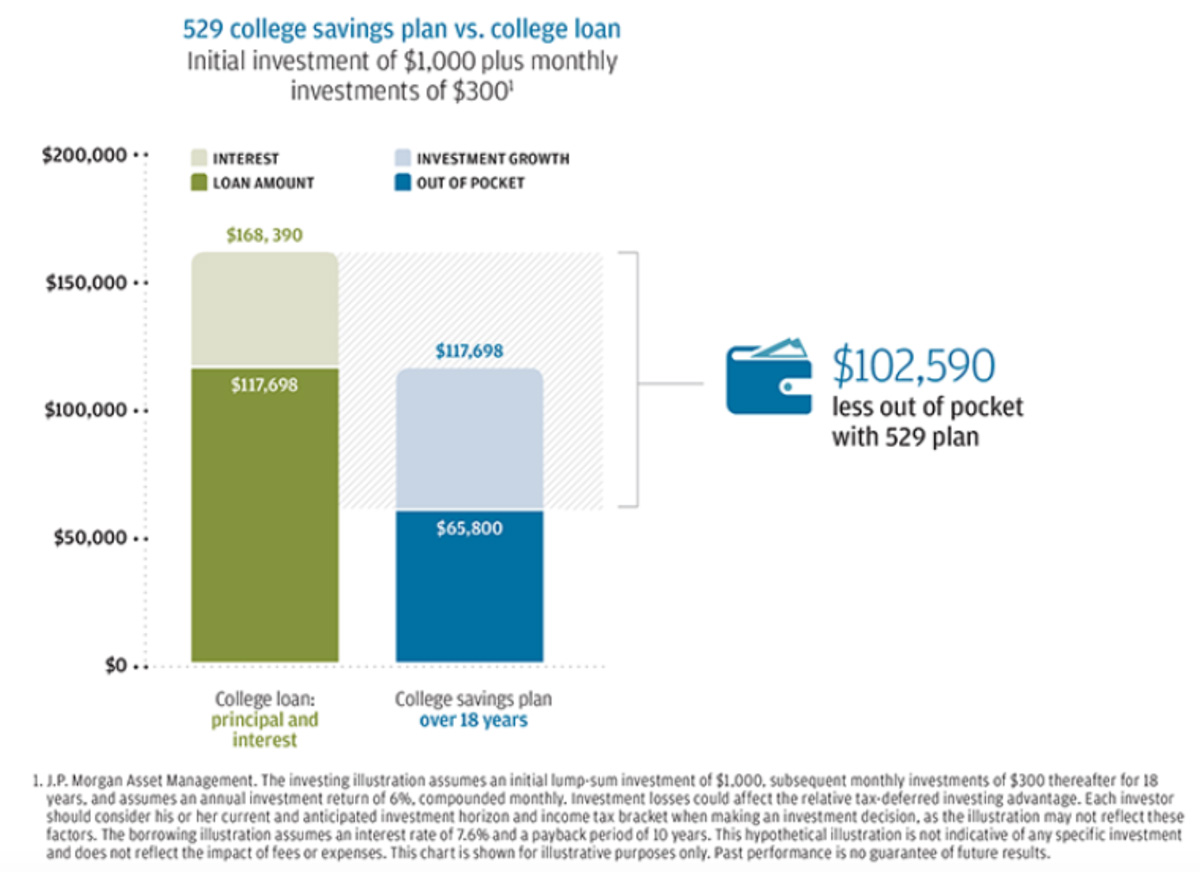
Of course, every dollar of college expenses paid from savings can mean one less dollar of debt to service. More than that, the longer you have to build college savings, the greater the difference between the out-of-pocket cost of paying for college with debt and the out-of-pocket cost of saving. Take a look at the following chart, which compares the cost of funding education through loans (the principal borrowed and interest) with the cost of saving over 18 years.

529 college savings plan vs. college loan

In this hypothetical example, the total out-of-pocket amount of $65,800 contributed to the savings plan combined with investment earnings of 6% annually provided the total balance of $117,698. Borrowing that same $117,698 could result in total spending of $168,390 for the loan principal and interest.

What about Financial Aid?

If you’re like many clients thinking about college planning, you may be concerned that your savings and investments will negatively affect your eligibility for college aid. You might be worried that the more you save, the less likely it is that you will receive assistance.

To determine financial aid eligibility, schools use an Expected Family Contribution (EFC), which is a measure of a family’s financial strength. The EFC formula takes into account the incomes and assets of both the student and the parents. While the amount of savings and investment assets are considered, assets – and particularly those held in parents’ names – are a much smaller factor than incomes.  

The EFC formula includes up to 50% of the student’s income and 47% of parents’ income. On the other hand, the EFC considers up to 20% of the student’s assets and only 5.64% of the parents’ non-retirement assets, above a protected amount. Although balances in college savings plans are counted along with other non-retirement assets, the smaller percentage applied to parental assets can allow parents to build some meaningful savings without drastically affecting their student’s EFC. For a closer look at the financial aid process, check out our college planning webinar.

As with other areas of financial planning, college savings involves balancing your goals and priorities in order to most effectively align your resources. Your own unique circumstances will determine the right amounts to save, and when and where to save. If we can be a resource for any of your college planning needs, please let us know!

Robert Ingram, CFP®, is a CERTIFIED FINANCIAL PLANNER™ professional at Center for Financial Planning, Inc.® With more than 15 years of industry experience, he is a trusted source for local media outlets and frequent contributor to The Center’s “Money Centered” blog.

5 Financial Tips for Recent College Graduates

Robert Ingram Contributed by: Robert Ingram

financial tips for recent college graduates

Congratulations Class of 2019! This is an exciting time for recent college graduates as they begin the next phase in their lives. Some may take their first job or start along their career path, while others may continue their education. Taking this leap into the “real world” also means handling personal finances, a skill not taught often enough in school. Fortunately, by developing good financial habits early and avoiding costly mistakes, new graduates can make time an ally as they set up a solid financial future.

Here are five financial strategies to help get your post-college life on the right path:

1. Have a Spending Plan

The idea of budgeting may not sound like a lot of fun, but it doesn’t have to be a chore that keeps you from enjoying your hard-earned paycheck. Planning a monthly budget helps you control the money coming in and going out. It allows you to prioritize how you spend and save for goals like buying a home, setting up a future college fund for children, and funding your retirement.

Everyone’s budget may be a little different, but two spending categories often consume a large portion of income (especially for younger people early in their careers): housing costs and car expenses. For someone who owns a home, housing costs would include not only a mortgage payment, but also expenses like property taxes and insurance. Someone renting would have the rental cost and any rental insurance.

Consider these general guidelines:

  • A common rule of thumb is that your housing costs should not exceed about 30% of your gross income. In reality, this percentage could be a bit high if you have student loans, or if you want more discretionary income to save and for other spending. Housing costs closer to 20% is ideal.

  • A car payment and other consumer debt, like a credit card payment, can quickly eat into a monthly budget. While you may have unique spending and saving goals, a good guideline is to keep your total housing costs and consumer debt payments all within about 35% of your gross income.

2. Stash Some Cash for Emergencies

We all know that unexpected events may add unplanned expenses or changes to your budget. For example, an expensive car or home repair, a medical bill, or even a temporary loss of income can cause major financial setbacks.

Start setting aside a regular cash reserve or “rainy day” fund for emergencies or even future opportunities. Consider building up to six months’ worth of your most essential expenses. This may seem daunting at first, but make a plan to save this over time (even a few years). Set goals and milestones along the way, such as saving the first $1,000, then one months’ expenses, three months’ expenses, and so on, until you reach your ultimate goal.

3. Build Your Credit and Control Debt

Establishing a good credit history helps you qualify for mortgages and car loans at the favorable interest rates and gets you lower rates on insurance premiums, utilities, or small business loans. Paying your bills on time and limiting the amount of your outstanding debt will go a long way toward building your credit rating. What goes into your credit score? Click here.

  • If you have student loans, plan to pay them down right away. Automated reminders and systematic payments can help keep you organized. To learn how student loans affect your credit score, click here.

  • Use your credit card like a debit card, spending only what you could pay for in cash. Then each month, pay off the accumulated balance.

  • Some credit cards do have great rewards programs, but don’t be tempted to open too many accounts and start filling up those balances. You can easily get overextended and damage your credit.

4. Save Early for the Long Term

Saving for goals like retirement might not seem like a top priority, especially when that could be 30 or 40 years away. Maybe you think you’ll invest for retirement once you pay off your loans, save some cash, or deal with other, more immediate needs. Well, reconsider waiting to start.

In fact, time is your BIG advantage. As an example, let’s say you could put $200 per month in a retirement account, like an employer 401(k), starting at age 25. Assuming a 7% annual return, by age 60 (35 years of saving), you would have just over $360,000. Now, say you waited until age 35 to begin saving. To reach that same $360,000 with 25 years of saving, you would need to more than double your monthly contribution to $445. Starting with even a small amount of savings while tackling other goals can really pay off.

Does your employer offer a company match on your retirement plan? Even better! A typical matching program may offer something like 50 cents for each $1 that you contribute, up to a maximum percentage of your salary (e.g. 6%). So if you contribute up to that 6%, your employer would add an extra 3% of your salary to the plan. This is like getting an immediate 50% return on your contribution. The earlier you can contribute, the more time these matching funds have to compound. 

5. Get a Little More Educated (about money and finances)

Ok, don’t worry. Forming good financial habits doesn’t require an advanced degree or expertise in all money matters. To build your overall knowledge and confidence, spend a little time each week, even just an hour, on an area of your finances and learn about a different topic.

Start with a book or two on general personal finance topics. You can find reference books on specific topics, from mortgages and debt to investments and estate planning. Information offered through news media or internet searches also can provide resources. And you can even find a blog not too far away (Money Centered Blog).

Robert Ingram, CFP®, is a CERTIFIED FINANCIAL PLANNER™ professional at Center for Financial Planning, Inc.® With more than 15 years of industry experience, he is a trusted source for local media outlets and frequent contributor to The Center’s “Money Centered” blog.