Investment Planning

Three Legged Stool Strategy

Generating income in retirement is one of the most common financial goals for retirees and soon to be retirees.  The good news is that there are a variety of ways to “recreate your paycheck”. Retirement income might be visualized using a “Three Legged Stool”.  The first two sources or legs of retirement income are generally social security and pensions (although fewer and fewer retirees are covered by a pension these days). The third leg for most retirees will come from personal investments (there is a potential fourth leg – part time work – but that’s for another day).  It is this leg of the stool, the investment leg, that requires preparation, planning and analysis. The most effective plan for you depends on your individual circumstances, but here are some common methods for your consideration:  

  1. Dividends and Interest
  2. 3 – 5 Year Income Cushion or Bucket
  3. The Annuity Cushion
  4. Systematic Withdrawal or Total Return Approach 

Dividends & Interest:

Usually a balanced portfolio is constructed so your investment income – dividends and interest – is sufficient to meet your living expenses.  Principal is used only for major discretionary capital purchases.  This method is used only when there is sufficient investment capital available to meet your income need after social security and pension, if any. 

3-5   Year Income Cushion or Bucket Approach:

This method might be appropriate when your investment portfolio is not large enough to generate sufficient dividends and interest. Preferably 5 (but no less than 3) years of your income shortfall is held in lower risk fixed income investments and are available as needed. The balance of the portfolio is usually invested in a balanced portfolio. The Income Cushion or Bucket is replenished periodically.  For example, if the stock market is up, liquidate sufficient stock to maintain the 3-5 year cushion. If stock market is down, draw on the fixed income cushion while you anticipate the market to recover.  If fixed income is exhausted, review your income requirements, which may lead to at least a temporary reduction in income. 

The Annuity Cushion

This method is very similar to the 3-5 year income cushion. A portion of the fixed income portfolio is placed into a fixed-period immediate annuity with at least a 5-year income stream.  This method might work well when a bridge is needed to a future income stream such as social security or pension. 

Systematic Withdrawal or Total Return Approach

Consider this method again if your portfolio does not generate sufficient interest and dividends to meet your income shortfall. Generally speaking, a balanced or equity-tilted portfolio in which the income shortfall (after interest income) is met at least partially from equity withdrawals.  Lastly, set a reasonably conservative systematic withdrawal rate, which studies suggest near 4% of the initial portfolio value adjusted annually for inflation. 

After helping retirees for the last 27 years create workable retirement income, we have found that many times one of the above methods (and even a combination) works in re-creating your paycheck in retirement.  The key is to provide a strong foundation – or in this case – a sturdy stool. 

Any information is not a complete summary or statement of all available data necessary for making an investment decision and does not constitute a recommendation.  Any opinions are those of Center for Financial Planning, Inc., and not necessarily those of RJFS or Raymond James. Investments mentioned may not be suitable for all investors.  Dividends are not guaranteed and must be authorized by the company’s board of directors.  There is an inverse relationship between interest rate movements and fixed income prices.  Generally, when interest rates rise, fixed income prices fall and when interest rates fall, fixed income prices generally rise.  Investing involves risk and you may incur a profit or loss regardless of strategy selected.

Salad Surprise

A friend of mine, let’s call him Tom, is constantly put on a diet by his wife.  One of the ways Tom appeases her is by ordering taco salads in a restaurant instead of a traditional entree.  She assumes he’s being healthy, but little does she know, some of the worst taco salads can pack in as many as 1,700 calories and over 100 grams of fat! Someone needs to do her homework.

As important as it is to the success of dieting to understand what you are eating, it is equally important to understand what you are buying when making an investment.  The due diligence process is initiated with the establishment of current tactical allocation, which you can read more about here.  With the asset classes identified, it is time to start doing your homework by researching to identify the appropriate securities to fill each asset bucket.

  • Define and Research:  Review asset category and characteristics of the category.  Consider opportunities and risks.
  • Know what you own:  Look at a prospectus or Statement filed with the SEC to make sure you are buying what you think you are buying (is it a healthy salad or, in Tom’s case, the equivalent of 37 strips of bacon?). 
  • Quantitative Review: Review of performance and risk characteristics of investment options within the category.  Criteria may include:
    • Look at performance standouts over different time periods – 1, 3, 5, 10 years.
    • Review performance in difficult time periods (bear markets or periods of performance difficulty for the asset category). 
    • Check out standard deviation, or risk, relative to similar investments.
  • Establish reasons for conviction:  This can prevent you from falling into a common investor behavior of selling the investment when it is out of favor (which is usually the best time to purchase it).

Do your investment “waistline” a favor and do your homework. Don’t be fooled by taco salads, make sure you are really getting what you want when it comes to investing by having a defined buying process or talking to your financial planner today about establishing one that is appropriate for you!

The information contained in this report does not purport to be a complete description of the securities, markets, or developments referred to in this material.  Past performance may not be indicative of future results.

Talkin’ Tuna . . . A look at historical stock v. bond valuations

If the price of tuna doubled over a three-year period, you would expect consumption to plummet.  Even people who loved the “Chicken of the Sea” would look elsewhere for their protein.  But, come a sudden 30% to 50% markdown, buyers would flock back in to the store shelves.  That’s because, in every aspect of our economic life, our unconscious mantra is -- High Prices = bad.  Low prices = good.   And 2 for 1 is even better!

But when people walk through the magical door marked “investments”, something profoundly weird happens.  Suddenly (though still unconsciously), it is high prices = good.  Low prices = bad. 

So, I have searched through history for a measurement tool to provide more “meat” to the conversation than price alone can provide.  Today people are very uncertain.  Unemployment still looms over 9 percent for the 3rd year, we have weak consumer confidence and many economists and investors predicted a double dip recession over the last year.

While these factors are certainly concerning, they are secondary or tertiary indicators. They influence the future, but do not predict it with much certainty. In the end, the stock market has, and always will be, about price compared to value.

American companies have finished 2011 with historically strong profits thanks to effective management, cost cutting and postponing some projects.  Add to that strong balance sheets and some strategists I listen to regularly (we’re talking people who have been at it for 40 years) have said that American companies are in the strongest position ever in their careers.

The recent fear last fall about the future of the US economy has caused a significant dislocation between the government bond market and S&P 500 earnings. US government debt has been bid up to record-low yields while S&P 500 earnings continue to increase. To illustrate the dislocation, we prepared the following charts.  Chart 1 gives a very long-term historical perspective and chart 2 zooms into modern day.

CHART #1 Source: Forbes.com

The earnings yield of the S&P 500 shows the percentage earned by the company for each dollar invested in the stock.

Money managers often compare the earnings yield of a broad market index (such as the S&P 500) to prevailing interest rates, such as the current 10-year Treasury yield. If the earnings yield is less than the rate of the 10-year Treasury yield, stocks as a whole may be considered overvalued. If the earnings yield is higher, stocks may be considered undervalued relative to bonds.

Economic theory suggests that investors in equities should demand an extra risk premium of several percentage points above prevailing lower risk rates (such as T-bills) in their earnings yield to compensate them for the higher risk of owning stocks over bonds and other asset classes.
 

And investors typically purchase Treasury securities when they are worried about markets and the economy, which moves the yield on the note down (remember price and yields of bonds move inversely). 

Think about it for a moment, when the government reduces interest rates investors are forced to find their required income from some other place.  So they need to take on more risk.  The average retiree gets it because they live it, but many forget that institutions are also required to satisfy unfunded liabilities like pension payments and endowment returns. 

Take a closer look at both charts and you will also notice the date of the worst time to own stocks vs. bonds.  You can see the EYS dove to -5.7 below on October 9th 1987.  That was 10 days before the worst stock market crash in modern history. So while this is not infallible by any stretch of our imagination, I think it has some validity to overweighting one asset class vs. another when it signals along with some other gauges. 

CHART #2 Source: Forbes.com

Chart #2 provides a closer viewpoint of our current spread.  I have heard indications by strategists of the spread approaching 8 in the last quarter.  A reading of 8 would be of historic proportions, because it has only happened 3 times in the last 140 years of stock market history.

  1. Around the time of Francis Ferdinand Assassination 1914 (beginning of WWI).
  2. Post WWII recession period 1946/48 when demand fell out of bed (since the war machine was being dismantled and yields on bonds were low but fear was still on the minds of investors). 

During the first two instances, just like now, there was a good reason for fear in the world and we went into two very ugly world wars.  However, in hindsight, they were very good points to enter the equity markets.  

In general, long-term investors were handsomely paid if they began to purchase and continued to purchase equity positions vs. bond positions when the Earnings Yield Spread was high.  That disparity between equity return expectations is one of the reasons The Center determined to stay fully invested in our equity exposure during the summer and fall of 2011.  So, the moral of the story is to buy tuna (or stocks, as the case may be) when it is being sold at a discount.  And if the price is considerably less than your other protein options and you like it…maybe buy a little more.  But for heaven sakes, it’s not time to give up tuna altogether!


The Death of Diversification

I’ve got three words for you: “Diversification, Diversification, Diversification!”

Since the dawn of Modern Portfolio theory, the benefits of non-correlation with favorable impact to risk and return have created a mantra for investors. At Center for Financial Planning, we agree!

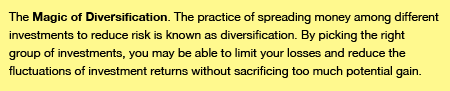
We’re not alone. As I worked on this blog, I did a quick Google search for diversification and investing. At the top of the list was a post from the SEC on “The Magic of Diversification”. Here’s an excerpt:

Source: sec.gov, Beginners Guide to Asset Allocation, Diversification, and Rebalancing

At this point, the mantra is ringing in your head and you’re saying, “Yes! I know this. This is a fundamental lesson for investors.”

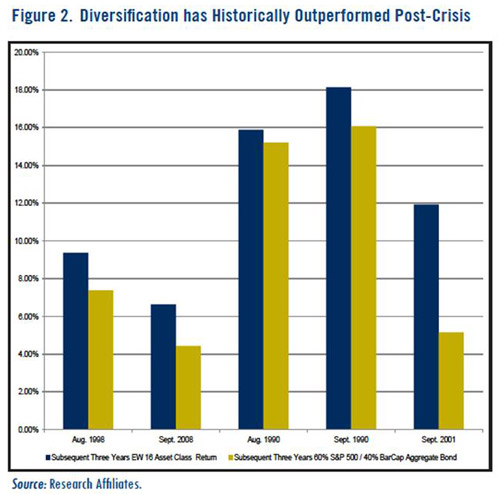
But, wait! In 2011, diversification largely left investors begging for more. A plain vanilla, decidedly undiversified mix of the S&P 500 and Bar Cap Aggregate bond indexes outperformed a more broadly diversified mix of assets including portfolios that included international investments, small company stocks, diversified types of bonds, and commodities.[1]

What’s an investor to do? As with anything, no investment strategy is foolproof including diversification, especially in the short run. But what your heart tells you in a period of underperformance is to stick with what’s worked recently (or bail on the mantras if they aren’t working right now). This time is different! After all, Europe looks scary! Historically, periods of diversification underperformance have been followed by outperformance. Investment thinker Robert Arnott of Research Affiliates tracks a diversified portfolio of 20 asset classes. After the 3rd quarter of 2011, the year’s worst, Arnott noted the significant underperformance of his diversified benchmark as compared to a 60/40 S&P/Bar Cap Agg portfolio.

The question for investors today is what may happen going forward. Past performance cannot predict future turns. Arnott notes, though, that in the past, following significant periods of underperformance for diversification, diversified portfolios have outperformed.


[1] Comparison of 60% S&P 500/40% Bar Cap Aggregate Bond to 30% S&P 500/10% Russell 2000/15% MSCI EAFE/5% DJ UBS Commodity/30% Bar Cap Aggregate/10% Bar Cap US Corporate Index. All index returns via Morningstar.com. Index compositions: The Barclays Capital U.S. Aggregate Index represents securities that are SEC-registered, taxable, and dollar denominated. The index covers the U.S. investment grade fixed rate bond market, with index components for government and corporate securities, mortgage pass-through securities, and asset-backed securities. The Dow Jones-UBS Commodity Index is composed of futures contracts on physical commodities and represents nineteen separate commodities traded on U.S. exchanges, with the exception of aluminum, nickel, and zinc. The Barclays Capital Corporate Bond Index is the Corporate component of the U.S. Credit index. The S&P 500 Index is a representative sample of 500 leading companies in leading industries of the U.S. economy. The Russell 2000 Index ® measures the performance of the 2,000 smallest companies in the Russell 3000 Index. The MSCI® EAFE (Europe, Australia, Far East) Net Index is recognized as the pre-eminent benchmark in the United States to measure international equity performance. It comprises 21 MSCI country indexes, representing the developed markets outside of North America. Index definitions via JP Morgan Asset Management Guide to the Markets January 2012.

 Building the 3-D Shelter, Rob Arnott, October 2011

* Diversified benchmark refers to the EW 16 Asset Class Portfolio composed of the following 16 components in equal weights: DJ UBS Commodity TR, Credit Suisse Leveraged Loan, BarCap US Corporate High Yield, BarCap US Treasury US TIPS, BofAML Convertible Bonds, FTSE NAREIT, JPM ELMI+, MSCI Emerging Markets, Russell 2000, MSCI EAFE, S&P 500, JPM EMBI, ML US Corp & Govt, BarCap US Long Credit, BarCap US Agg Bond, BarCap US Treasury Long. 

Will 2012 restore your faith? Don’t count out the potential benefits of broad and divergent investments within a single portfolio. As your head bargains with your heart for patience, keep historical lessons of diversification in mind!


The information contained in this report does not purport to be a complete description of the securities, markets, or developments referred to in this material.  The information has been obtained from sources considered to be reliable, but we do not guarantee that the foregoing material is accurate or complete. Any information is not a complete summary or statement of all available data necessary for making an investment decision and does not constitute a recommendation.  Any opinions are those of Center for Financial Planning, Inc., and not necessarily those of RJFS or Raymond James. Expressions of opinion are as of this date and are subject to change without notice.  Past performance may not be indicative of future results. Please note that international investing involves special risks, including currency fluctuations, differing financial accounting standards, and possible political and economic volatility.  Investing in small-cap stocks generally involves greater risks, and therefore, may not be appropriate for every investor.  There is an inverse relationship between interest rate movements and bond prices.  Generally, when interest rates rise, bond prices fall and when interest rates fall, bond prices generally rise.  Commodities and currencies investing are generally considered speculative because of the significant potential for investment loss. Their markets are likely to be volatile and there may be sharp price fluctuations even during periods when prices overall are rising.  Dividends are not guaranteed and must be authorized by the company’s board of directors.  Every investor’s situation is unique and you should consider your investment goals, risk tolerance and time horizon before making any investment.  Investing involves risk and you may incur a profit or loss regardless of strategy selected.  The foregoing is not a recommendation to buy or sell any individual security or any combination of securities. 

Where is the Love?

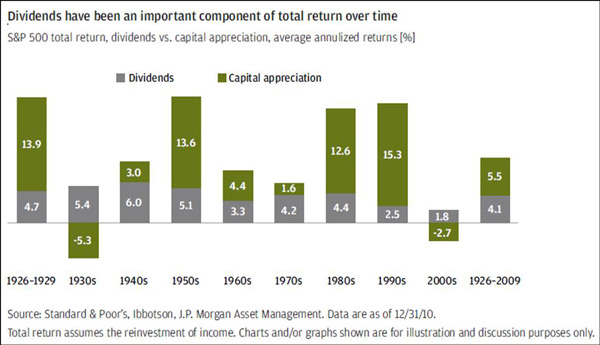
At least for dividends, there doesn’t seem to be any love in the headlines.  From CNBC at the first of the year they wrote, “Market’s Flat 2011 Could Imply Rally This Year.  Following last year’s pancake-flat finish on the S&P 500…”  And there were many others like this.  If you didn’t investigate further you probably wouldn’t even realize that the S&P 500 was up last year.  The S&P finished positive 2.1% on a total return basis. 

How, you may ask, did this happen?

Many of the stocks in the S&P 500 index pay dividends.  The total yield on the S&P 500 was 2.3% as of 12/31/11 and these are payments made directly to the shareholder in cash, or one can choose to reinvest them.  This must also be counted in your return, but many seem to overlook this fact. 

Dividends can provide a potential source of income to help cushion portfolios in down markets and potentially bolster returns during up markets.


While 2% may seem like a pittance compared to fluctuations in stock values, between 1926 and 2009 these small payouts have generated about 40% of overall return in the S&P 500 (WSJ, A Time for Dividends, 10/5/11) and can be vital to achieving long term financial planning goals. 

* Investor’s cannot invest directly in an index.  Past performance is not indicative of future results.The information contained in this report does not purport to be a complete description of the securities, markets, or developments referred to in this material.  The information has been obtained from sources considered to be reliable, but we do not guarantee that the foregoing material is accurate or complete.  Any opinions are those of Center for Financial Planning, Inc., and not necessarily those of RJFS or Raymond James.  Expressions of opinion are as of this date and are subject to change without notice.  Dividends are not guaranteed and must be declared by a company’s board of directors.

Time to Declutter?

Do you ever feel like this when thinking of your portfolio?  Making investments without factoring in your investment process could end up adding more clutter to your portfolio without adding any value.

As you might recall the investment process starts with Strategic Asset Allocation, which is the establishment of your mix of stock, bonds and cash (see my post from 11/4/11).  Followed by layering in tactical allocation, overweighting or underweighting asset classes as the opportunity arises (see my post from 12/2/11).

Choosing the proper type of investment is vital to the continuation of your process.   There are many different types of investments that may be appropriate for you.  Individual company stock is usually the first that comes to mind for investors.  Common stock represents direct equity ownership in a corporation.  Returns can come from dividends paid or price appreciation.

One could also purchase bonds issued by many of these same companies, as well as governments or municipalities.  This means the entity owes you your principal at a specified date in the future and interest in the mean time in exchange for borrowing from you.  Many factors need to be considered when investing in a stock or bond and this can be overwhelming even for many investment professionals.  So many investors turn to professional money management.

Professional money managers can take two basic approaches to investing.  First, active management is simply an attempt to "beat" the market as measured by a particular benchmark or index.  Passive management is more commonly called indexing. Indexing is an investment management approach based on investing in exactly the same securities, in the same proportions, as an index.

So if you find yourself buried in stacks of paper every month talk to your Investment Professional to de-clutter your portfolio and determine which types of investments may be appropriate for you.

Dividends are not guaranteed and must be authorized by a company’s board of directors.  Bond prices and yields are subject to change based upon market conditions and availability.  If bonds are sold prior to maturity, you may receive more or less than your initial investment.  Holding bonds to term allows redemption at par value.  The information contained in this report does not purport to be a complete description of the securities, markets, or developments referred to in this material.  Any information is not a complete summary or statement of all available data necessary for making an investment decision and does not constitute a recommendation.

No Free Lunch – But Maybe a Free Capital Gain?

fThe financial and investment profession is full of acronyms, jargon, and common phrases such as “buy low – sell high” and is “there’s no free lunch when it comes to investing”.  Believe it or not, some things are free in personal finance (and our role is to help you find them) such as the 0% capital gain rate for many taxpayers.  Yes…..0%....and hopefully we don’t have to argue that that is a good rate! 

Single taxpayers with taxable incomes of less than $34,500 and married couples filing jointly with taxable incomes below $69,000 are considered to be in the 10% or 15% marginal bracket.  One of the luxuries of being in the 10% or 15% marginal tax brackets is a 0% capital gain rate through the end of 2012. Those in marginal brackets higher than the 10% and 15% currently are subject to a 15% capital gain rate.   

Here are a few examples of who might benefit from such a rate: 

  • Those holding appreciated securities that have been hesitant to sell because of the tax implications.
  • Those interested in selling an appreciated security in order to reset the cost basis. (Don’t forget to avoid the wash sale rules)
  • Those in higher tax brackets looking to make gifts to relatives that are in lower brackets (say a child that has moved back into their high school bedroom). 

Example:   John and Mary’s son Steven recently graduate and is finding full time employment illusive.  John and Mary expect to help Steven out with expenses for the near future.  John and Mary are in the 28% marginal bracket and Steven (with little income) is in the 10% marginal bracket.  John and Mary can gift Steven appreciated securities….Steven can then sell them and take advantage of the 0% capital gain rate. 

As always, work with your professional advisors before implementing any tax strategies….and possibly enjoy a free lunch thanks to a free capital gain.


Note: Changes in tax laws may occur at any time and could have a substantial impact upon each person’s situation.  While we are familiar with the tax provisions of the issues presented herein, as Financial Advisors of RJFS, we are not qualified to render advice on tax or legal matters.  You should discuss tax or legal matters with the appropriate professional.

Deck the Halls with Tactical Allocation

One of my favorite things during the Christmas season is to decorate my house.  When driving down the street, my house tends to be the eye-catching one... think the Griswold house. As we string lights, hum Christmas tunes, and watch my husband crawl around on the roof with his staple gun, we really get into the holiday spirit. 

Now, let's put my slightly over-the-top "ode to the holidays" in investment terms. I recently explained that strategic investing, when you pick the mix of stocks, bonds and cash to make up your portfolio, serves as the foundation of your house. Well, I like to think of Tactical Allocation as decorating or changing for the season.  Of course, it shouldn’t be as drastic of a transformation as the Griswold’s (we don't want to blow a fuse or catch the tree on fire). Rather, a Tactical Allocation approach provides for overweighting or underweighting asset classes as perceived market opportunities arise. In yard decorating terms, you're not leaving the inflatable Santa out in the yard all year, that would be the traditional investing “buy and hold on for dear life” approach. You're watching conditions and judging when it's the opportune time to deflate old Saint Nick,  pack him away and move on to the next holiday. The goal of Tactical Allocation is to reduce risk, increase returns or both. 

While we believe that the relationship of valuation between markets over long periods will be efficient and will correspond to fundamentals, we also acknowledge that over shorter periods, some markets may become overvalued, while other asset classes will become undervalued. This is where Tactical Allocation can be considered. A somewhat modified asset allocation can potentially offer better returns and less risk when executed correctly.[1]

A tactical asset allocation strategy can be either flexible or systematic.  In a flexible approach an investor modifies his portfolio based on valuations of different markets or sectors (i.e. stock vs. bond markets).  Systemic strategies are less discretionary and more model based methods of uncovering market anomalies.  Examples of these are trend following or relative strength models. 

All of these methods require knowledge, discipline and dedication to execute successfully; it's not like throwing a single strand of lights over a tree branch and calling it festive. And with Tactical Allocation, less can be more, which is an approach I sometimes wonder if I should apply to my Christmas decorations. So, talk to your Financial Planner to determine what may be appropriate to incorporate into your portfolio.


[1] Keep in mind that all investing involves risk, and there is no assurance that this or any strategy will be profitable nor protect against loss.

Building Your Foundation

Contributed by: Angela Palacios, CFP® Angela Palacios

Asset allocation is like the foundation of your house. It is the most important structural part of your investment process. Without it, your home or your financial plans could become extremely unstable. 

Many investors either become paralyzed and unable to make decisions, or make decisions by constantly chasing the recent past and, thus, earning dismal returns.  To avoid those mistakes, one of the first and most important steps in investing is determining your Asset Allocation. 

An Asset Allocation Model is usually the outcome of the financial plan you complete with your investment professional. Its goals are normally to identify the mix of assets that best balances an investor’s desire for return with the desire not to take undue risk.  Studies have shown that asset allocation decisions account for a significant amount of the variation of total returns, while security selection accounts for a relatively small portion of the variability of total returns.  The most notable study was done in 1986 by Brinson, Hood and Beebower.  The researchers found that the asset allocation policy explained 93.6% of the average funds’ variation over time. 

In its simplest form, Asset Allocation is the percent of stocks, bonds, and cash you would own in a world of normal valuations.  Generally, allocations with more stocks than bonds would be in the “High Risk/High Return” area of the line on the “Efficient Frontier” chart below.

Efficient Frontier_1_Asset Allocation Post.jpg

Disclosure:  The “Efficient Frontier” is a concept derived from Modern Portfolio Theory.  According to the theory, it is possible to construct an “efficient frontier” of optimal portfolios offering the maximum possible expected return for a given level of risk.

This chart can change greatly depending on the time period you use to draw it.  The following is how the above chart varies in actuality decade to decade.

© Dorsey Wright & Associates

© Dorsey Wright & Associates

In the 1960s, 1980s and 1990s stocks significantly outperformed bonds. While the 1970s and the 2000s show a much different story. Not only were stocks an underperforming asset, but the risks involved were very high using standard deviation as our risk scale. (The Weiss Report, Vol. 13)

While careful Asset Allocation can help make your investment portfolio structurally strong, unlike the foundation of your house, shifting investments can be a good thing. In practicality your Asset Allocation, rather than being static, can be changed tactically to reflect current market conditions as shown above.  Watch future posts to find out more about using asset allocation and other investment strategies. 

Angela Palacios, CFP® is the Director of Investments at Center for Financial Planning, Inc.® Angela specializes in Investment and Macro economic research. She is a frequent contributor The Center blog.


Any information is not a complete summary or statement of all available data necessary for making an investment decision and does not constitute a recommendation. Any opinions are those of Center for Financial Planning, Inc., and not necessarily those of RJFS or Raymond James. Every investor’s situation is unique and you should consider your investment goals, risk tolerance and time horizon before making any investment. Investing involves risk and you may incur a profit or loss regardless of strategy selected. Asset allocation does not ensure a profit or protect against a loss.