Tax Reform Series: Changes to Standard Deduction, Personal Exemption, Misc. Deductions, and the Child Credit

Contributed by: Matt Trujillo, CFP® Matt Trujillo

20180115.jpg

The Tax Cuts and Jobs Act (TCJA) is now officially law. We at The Center have written a series of blogs addressing some of the most notable changes resulting from this new legislation. Our goal is to be a resource to help you understand these changes and interpret how they may affect your own financial and tax planning efforts.

Key Highlights:

  • Personal exemptions, which were previously used to reduce adjusted gross income, have been eliminated entirely

  • The standard deduction has been increased to $12,000 for single filers (previously $6,350) and $24,000 for joint filers (previously $12,700)

  • Several deductions that used to be available to tax filers that itemized their deductions have been eliminated or reduced such as:

    • The deduction for state and local taxes is now capped at $10,000 as opposed to the unlimited amount that was deductible under previous tax law

    • Lowers the threshold for mortgage interest deductibility; now only the interest on debt up to $750,000 is eligible to be deducted as opposed to $1,000,000 under previous tax law

    • Miscellaneous itemized deductions have been eliminated entirely as a category; these deductions included things like unreimbursed business expenses, tax preparation fees, and investment fees.

  • The child tax credit is expanded to $2,000 per child and is refundable meaning even if you have zero tax liability you can still get a check back from the IRS for this credit

    • This credit was previously $1,400 per child and would begin to phase out for joint filers at $110,000 of adjusted gross income; the credit now doesn’t begin to phase out until you reach $400,000 of adjusted gross income (for joint filers)

If you are curious to know more about how the changes may impact your specific situation please contact our office to discuss!

Matthew Trujillo, CFP®, is a Certified Financial Planner™ at Center for Financial Planning, Inc.® Matt currently assists Center planners and clients, and is a contributor to Money Centered.


The information contained in this blog does not purport to be a complete description of the securities, markets, or developments referred to in this material. The information has been obtained from sources considered to be reliable, but we do not guarantee that the foregoing material is accurate or complete. Expressions of opinion are as of this date and are subject to change without notice. There is no guarantee that these statements, opinions or forecasts provided herein will prove to be correct. This material is being provided for information purposes only. Any information is not a complete summary or statement of all available data necessary for making an investment decision and does not constitute a recommendation. Please note, changes in tax laws may occur at any time and could have a substantial impact upon each person's situation. While we are familiar with the tax provisions of the issues presented herein, as Financial Advisors of RJFS, we are not qualified to render advice on tax or legal matters. You should discuss tax or legal matters with the appropriate professional.


Tax Reform Series: Changes to Federal Income Tax Brackets

Contributed by: Robert Ingram Robert Ingram

20180111.jpg

The Tax Cuts and Jobs Act (TCJA) is now officially law. We at The Center have written a series of blogs addressing some of the most notable changes resulting from this new legislation. Our goal is to be a resource to help you understand these changes and interpret how they may affect your own financial and tax planning efforts.

The TCJA brings many changes to both corporate and individual tax laws in 2018.  You may be asking yourself, “what do these changes mean for me?” A good place to start may be with the new personal income tax brackets.

How tax brackets work

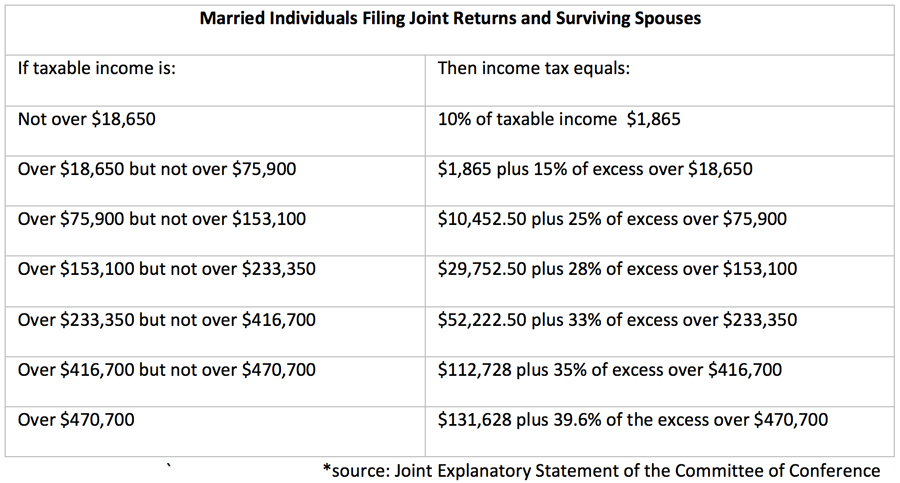
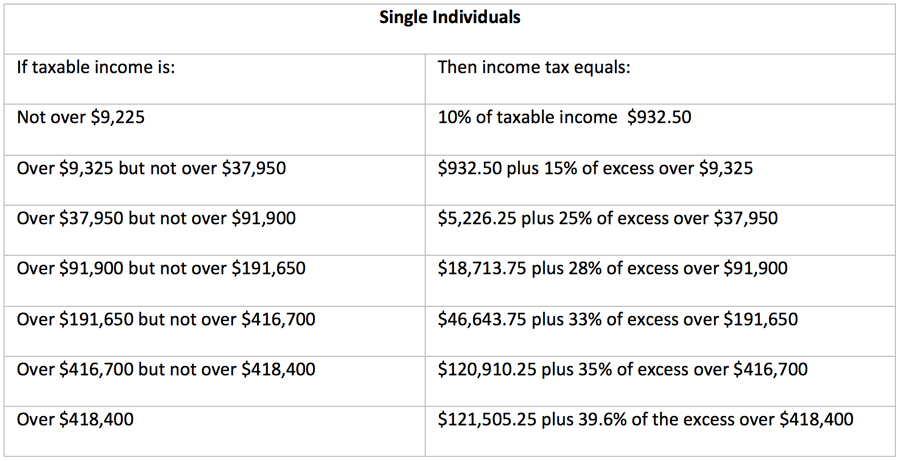
When calculating our Federal tax liability on regular income, we apply a tax rate schedule to our taxable income. The taxable income is a filer’s income after any adjustments and exclusions (adjusted gross income) and after subtracting applicable deductions and exemptions. Specific rates are then charged on different ranges of income (tax brackets) as determined by tax filing status. Currently, in 2017 there are 7 brackets where the rates are 10%, 15%, 25%, 28%, 33%, 35%, and 39.6%. The tax bracket structures and how the taxes would be assessed for two of the most common filings statuses (single and married filing joint returns) are as follows:

Current 2017 Individual & Married Tax Brackets

20180111aa.jpg
20180111bb.jpg

Under the current 2017 tax brackets, for example, a married couple filing jointly with taxable income of $150,000 would have the first portion of their income up to $18,650 taxed at 10%.  The amount from $18,651 up to $75,900 would be taxed at 15% and then the remaining amount of their income from $75,901 up to the $150,000 would be taxed at 25%.

What is changing?

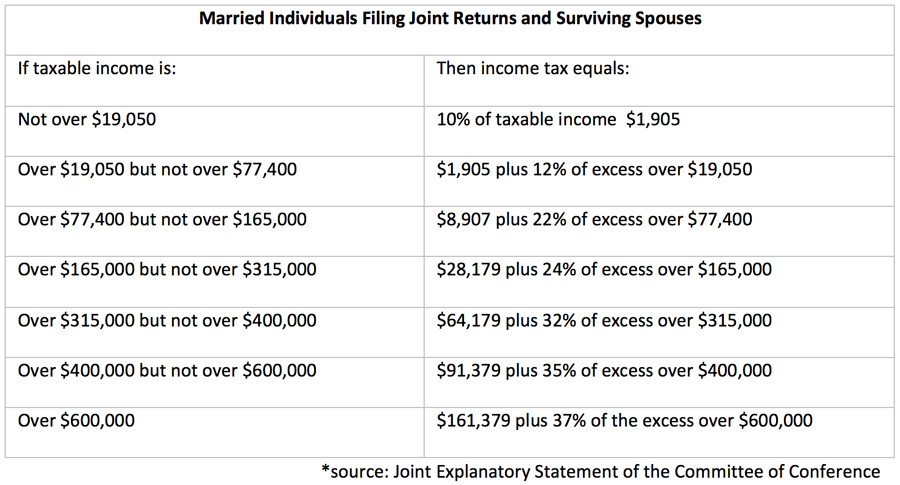
While the House of Representatives’ original tax reform proposal would have consolidated the 7 brackets down to 4, the final Tax Cuts and Jobs Act retains 7 brackets but reduces the tax rates on most the brackets by a couple of percentage points and adjusts the income ranges within them.  The examples for those filing as single and for married couples filing jointly are below.

New 2018 Individual & Married Tax Brackets Under the TCJA

20180111cc.jpg
20180111dd.jpg

If the bracket rates are generally lower, does that mean my taxes will be lower?

Well, the good news is that the answer is…maybe.

If taxpayers apply the new tax rates in 2018 to the same level of taxable income they would have in 2017, many people would see a lower overall, effective tax rate on that taxable income. (Good news, right?)  However, other changes outlined in the TCJA, such as the new standard deduction amount, the elimination of the personal exemptions, and the cap on the amount of state and local taxes that are deductible could have an impact on your taxable income amount.  As a result, the actual taxes applied may or may not see as much of a reduction. 

Ultimately, how your own tax situation may change in this new tax landscape will depend on a combination of factors and decisions.  It is important to consult with your advisors.  As always, if you have any questions surrounding these changes, please don’t hesitate to reach out to our team!

Robert Ingram is a Financial Planner at Center for Financial Planning, Inc.®


This information and all sources have been deemed to be reliable but its accuracy and completeness cannot be guaranteed. Neither Raymond James Financial Services nor any Raymond James Financial Advisor renders advice on tax matters. Tax matters should be discussed with the appropriate professional.

Is it Time to Re-Imagine Your Retirement?

Contributed by: Sandra Adams, CFP® Sandy Adams

20180109.jpg

You are sitting with your financial planner discussing the cash flow projections for your upcoming retirement at the beginning of 2019.  You seem to have everything in place — you and your spouse are maximizing your retirement contributions at work and you are able to save additional funds into an HSA, as well as into individual IRAs and a sizable amount into your after tax investment account.  You have already been trying to live on one of your salaries — simulating what you expect to spend in retirement — and things are running smoothly.  Your estate planning is up-to-date and you have recently been approved for Long Term Care Insurance.  All of the technical aspects of your upcoming retirement seem to be in place.  There is nothing more to do except work your final year and get ready to “hang up the spurs”.  Right?

It just so happens that there might be a little bit more to preparing for retirement that the “technical” side of the planning. The transition you are about to embark on is one that will take some planning from a personal standpoint.  You won’t just wake up the first day of your retirement and know what to do.  In fact, many clients feel somewhat lost at first. 

We recommend intentionally giving some thought, or re-imagining, what you want your retirement to look like:

  • Give some real time and attention developing a “Bliss List,” or list of goals, dreams and desires that you would like to achieve in your retirement years will get you started. Once you have your list, you may need to build out some specifics: when, how much time, how much money, other resources and people that need to be involved.

  • Some of the things on your list may require you to start NOW to put in some practice, lay some groundwork, or make some connections so that you can hit the ground running when retirement day arrives. (i.e. hobbies, volunteer work, a new charitable business venture).

  • Coordinate your list with your spouse to make sure your list is feasible (from a time and money standpoint) and that it works for both of you. You want to make sure you have room for both your individual goals and your joint goals to make things work for your dream retirement.

The transition into retirement can be a bumpy one if you haven’t planned well both on the technical side AND on the personal side. The Center planners are trained to help you with both sides of this planning, and have the tools and resources available to assist you. If you are approaching retirement and find that you need assistance with either the technical or the personal side of retirement (or both), don’t hesitate to give us a call.  We are here to help!


Sandra Adams, CFP® is a Partner and Financial Planner at Center for Financial Planning, Inc.® Sandy specializes in Elder Care Financial Planning and is a frequent speaker on related topics. In addition to her frequent contributions to Money Centered, she is regularly quoted in national media publications such as The Wall Street Journal, Research Magazine and Journal of Financial Planning.

New Team Member: Peggy Hall-Davenport, CFP®

Contributed by: Timothy Wyman, CFP®, JD Tim Wyman

20180102.jpg

The Center is pleased and honored to announce the addition of Peggy Hall-Davenport to The Center team.  After faithfully serving clients through her own practice for over 30 years, Peggy joins The Center as a Senior Financial Advisor.  In this role, Peggy will continue to provide technically advanced financial planning to individuals and their families in a new team setting. “What a gift to have someone of Peggy’s integrity and experience join The Center team. Peggy, and former colleague Sandra Tutro, Registered Assistant, have taken great care of clients over the years and we look forward to supporting Peggy and clients in the future.”

In her personal time, Peggy enjoys gardening, swimming, genealogy and spending time with family.  Peggy also gives back to the community through service in local Rotary and Optimist clubs.

Timothy Wyman, CFP®, JD is the Managing Partner and Financial Planner at Center for Financial Planning, Inc.® and is a contributor to national media and publications such as Forbes and The Wall Street Journal and has appeared on Good Morning America Weekend Edition and WDIV Channel 4. A leader in his profession, Tim served on the National Board of Directors for the 28,000 member Financial Planning Association™ (FPA®), mentored many CFP® practitioners and is a frequent speaker to organizations and businesses on various financial planning topics.

Branding Your New Year

Contributed by: Kimberly Wyman

20171230.jpg

*Originally posted December 30, 2015

A New Year is traditionally a time to set resolutions you hope to accomplish over the coming year. At The Center, we encourage you to Live YOUR Plan™ every day, but what a better time of the year to reinforce and embrace all that you wish to be, do and have.

Identifying the lifestyle that best suits you is similar to crafting a personal brand and crafting a personal brand can be greatly supported by setting goals a.k.a. setting New Year’s resolutions.

A personal brand is about:

  • Realizing you already have a personal brand – everyone does. Your existing personal brand is someone’s gut feeling about you and your existing perception of yourself. Does your brand say what you want it to say?

  • Acknowledging where you currently are. What is your gut feeling about yourself? What do others say?

  • Recognizing where you want to be. How do you want to be perceived, by yourself and by others?

  • Bridging the gap between the two points. This is your personal brand journey and an excellent lead-in to your desired lifestyle.

5 Ways to Brand Your New Year

  1. What are you passionate about? Most of us know what gets us up in the morning. If you don’t, consider spending time exploring this. If you truly aren’t passionate about anything, how about if you pick something and stick with it for 3 months? By eliminating things that you’re not passionate about, it just may lead you to what you are passionate about. Knowing this passion will help you set a resolution that is sure to make you proud of yourself.

  2. Where do your strengths lie? Sometimes we’re good at things that don’t interest us. But, understanding what we’re good at can help us leverage what we truly want by taking some of the extra legwork out of the equation.

  3. What do you want to learn about? Are there a million things that come to mind? Just pick one to focus on. If you have nothing that comes to mind, then just pick something and stick with learning all about it for a designated period of time. Eventually, you’ll discover things you truly want to learn about via process of elimination.

  4. Where do you want to explore? Your neighborhood? You community? Your state? Your country? The world? Pick a place. Read about it, learn about it, visit…even if only virtually. This world is pretty big and pretty small at the same time. Take time to learn about another tiny corner besides that in which you live.

  5. Be consistent. As with any type of branding – personal or professional – branding relies on consistency. Be faithful. Be reliable. Be steadfast. 

Having a clear vision of your desired lifestyle can help you make very good decisions about which paths you follow and which you choose to decline. Having a clear vision of your desired lifestyle will also make planning for your everyday and your future easier. Make life count. Live YOUR Plan™ and Happy New Year!


Any opinions are those of Kimberly Wyman and not necessarily those of Raymond James.

Top 5 Reasons You Need an Intern

Contributed by: Jaclyn Jackson Jaclyn Jackson

20171226.jpg

As you are wrapping up your business’ year end numbers and planning next year’s budget, consider adding “internship” as a line item.  Offering an internship is a budget friendly way to lighten heavy workloads, tackle projects, and bring youthful enthusiasm to your team. Still on the fence?

These reasons may convince you to seriously consider starting an internship program.

  1. Leverage Time – Let’s get the most obvious out of the way.  An intern can make two hands four and turn twenty four hours into forty eight. Simply stated, interns can take routine or odd tasks off your plate, so you can actually get through your to-do list.

  2. Power Through Projects – If you’re like most, there are usually one or two projects on the backburner that you don’t have the time, experience, or manpower complete. Why not hire an intern to get those projects in motion? Take advantage of the opportunity to temporarily hire someone with a specific skillset that may not be needed permanently. For example, if you are implementing a new technology, it may be more appropriate to hire an intern studying information technology than one studying a topic related to your field.  Perhaps there are operational or logistical projects, marketing or media projects, etc. than an intern can develop and train you/others to maintain.

  3. Trial Hire - Hiring an intern gives you time to discern whether someone is a good fit for your office. You can evaluate one’s ability to manage responsibilities or see how well an individual blends with your current team. Additionally, internships can help you refine a new hire role. Through the internship, you can explore the specific needs and responsibilities most helpful to taking your business to the next level as well as determine if a seasonal, part-time, or full time employee is necessary.

  4. Save Money – If your business is small or just starting, hiring a full time employee can be quite expensive. With interns, you don’t have to worry about the overhead costs associated with a full-time employee. Furthermore, if you decided to hire an intern fulltime, you save time and money on recruiting efforts.

  5. Move Forward – Interns can ignite forward thinking. Since most interns are college age/young adults, they are likely familiar with and comfortable using new technologies. They may assist you in identifying where you can be more productive with the use of technology. Moreover, many interns dabble in related but different fields as they endeavor to find which they’d like to pursue professionally. If you work with someone who’s had multiple internships, they can also offer insight as to how other businesses solve the problems your business is currently facing. In other words, they can provide a unique perspective that may help you maintain competitiveness with industry peers or surpass them with out of the box (outside industry) thinking. 

Jaclyn Jackson is a Portfolio Administrator and Financial Associate at Center for Financial Planning, Inc.®

Webinar in Review: Part 3: Divorce & Finance 101 for Michigan Women

Contributed by: Jacki Roessler, CDFA® Jacki Roessler

20171212_webinar2.jpg

I’ve been working with divorcing clients and their attorneys for well over 20 years now. Although every single case I’ve worked on has had its own unique issues and challenges, most initial appointments follow a similar trajectory. First and foremost, I always want to hear what the person in front of me is most concerned about.  In fact, I want to hear ALL of their financial concerns and questions relative to the divorce.

Once their concerns are on the table (and in my notepad), I find that most clients need education on the basics.  In fact, it’s been a rare first meeting that doesn’t end with me stepping up to a white board to present what I call “Divorce Finance 101”. If my client doesn’t understand the key issues that surround child support, alimony and property division, we can’t even begin to address concerns about handling a family-owned business, paying for college costs, substantiating the need for alimony or what may or may not be considered separate property.

The webinar that follows is a compilation of my favorite topics from “Divorce Finance 101”. A few words of warning. This information is fluid. It changes over time as State, Federal and tax law changes occur.  There are always exceptions to all the “basic rules” too, of course. Most importantly, I am not a lawyer and therefore cannot provide legal advice. I can only give information based on my professional experience. My most important piece of advice to any client is how critical it is to hire a qualified, experienced family law attorney that practices often in your county court system.

As always, please feel free to contact me at jacki.roessler@centerfinplan.com for any questions that are specific to your case or if you have any future webinar topics you’d like to suggest.

Jacki Roessler, CDFA® is a Divorce Financial Planner at Center for Financial Planning, Inc.®


Any opinions are those of Jacki Roessler and not necessarily those of Raymond James. Raymond James and its advisors do not offer tax or legal advice. You should discuss any tax or legal matters with the appropriate professional.
Webinar in Review: Grief and Healing

Contributed by: Sandra Adams, CFP® Sandy Adams

20171212_webinar.jpg

According to the U.S. Census Bureau, over 24% of the U.S. population over the age of 65 is widowed.  But widowhood impacts people of all ages, and the effects are often more painful and long lasting when the loss happens earlier in life.  At The Center, we have worked with clients of all ages that have, expectedly or unexpectedly, been impacted by the loss of a spouse. Each person goes through a different grief process and has his or her own individual experience with grief and loss.  The transition is one that is difficult and can take years — but there is light at the end of the tunnel.

On December 12th, Dr. Peter Lichtenberg joined us to present a webinar on Grief and Healing.  Dr. Lichtenberg, who was twice widowed by the age of 55, shared his own personal experience with grief and loss — twice.  While each experience was different in its own right, he was able to learn about himself while learning to honor and keep with him the spirit of two women that he has loved so deeply in his life. Dr. Lichtenberg provided information about patterns of grief, feelings to be aware of when experiencing loss, and advice on how to get through the hard times to get to a point of acceptance and rebuilding of a new life. 

Dr. Lichtenberg’s Lessons Learned from his Grief and Loss experiences:

  1. Don’t underestimate the power of loss early on.

  2. Have the right person stay with you after the death.

  3. Plan and be prepared (estate planning documents, etc.)

  4. Arrange the funeral or memorial service the way you want it, and let others help you with the final details.

  5. If you have children, find a way to keep the same routine, and keep them in their routine.

  6. Communicate, communicate, communicate — especially during the first month.

  7. Find a professional skilled in dealing with death and dying who can listen and help you on your journey.

  8. Think about how you want to talk about your loved one.

  9. The journey of grief will bring you in touch with your frailties; try to view this as a journey of growth and exploration.

  10. Revisit notes, letters and pictures from your loved one. These affirmations are a powerful force in healing.

  11. Experience as much gratitude as you can. Gratitude is a powerful healing force that allows you to live in the present.

  12. Know what depression is, and how it differs from grief.

If you were unable to listen to the webinar on December 12th, we encourage to listen to the replay. And if you or someone you know has experienced the loss of a loved one and needs assistance or resources, please feel free to reach out to us at The Center.  We are here to help!

Sandra Adams, CFP® is a Partner and Financial Planner at Center for Financial Planning, Inc.® Sandy specializes in Elder Care Financial Planning and is a frequent speaker on related topics. In addition to her frequent contributions to Money Centered, she is regularly quoted in national media publications such as The Wall Street Journal, Research Magazine and Journal of Financial Planning.


The information has been obtained from sources considered to be reliable, but we do not guarantee that the foregoing material is accurate or complete. Dr. Litchenberg is not affiliated with Raymond James.

Holiday Online Shopping Scams

Contributed by: Nicholas Boguth Nicholas Boguth

20171212.jpg

Tis’ the holiday season, which means plenty of online shopping for a lot of us. For those of you who have been or will be online shopping for the holidays, we want you to take special care to avoid attempted fraud.

Most of these online shopping scams will come through your email in the form of a fake offer, receipt, or shipping notice.

The most important thing is to avoid clicking on anything that seems out of the ordinary, and if you get an offer that seems too good to be true – it probably is.  You may also see these “too good to be true” offers on social media, and they could even look like a friend shared it with you. In these cases, do some research before clicking, and avoid filling out personal information on non-reputable websites.

Protect yourself by shopping with a credit card; it is easier to deal with fraud if you ever do fall victim.

If you are emailed a receipt or shipping notice for something that you did not purchase, do not click the email. Instead, check your credit card transactions to see if this purchase actually did happen. If it did happen, contact your credit card company immediately to report the fraud.

This is also a good time to remind everyone to periodically change your passwords for online accounts, and be sure to use different passwords for different accounts. If possible, only shop at well-known online stores, or retailers that you have had success with in the past. Be on the lookout for anything out of the ordinary. If you do come across something you believe to be fraudulent, report it to the FBI’s internet crime complaint center (https://www.ic3.gov/default.aspx).

Keep these tips in mind and happy holiday shopping!

Nicholas Boguth is an Investment Research Associate at Center for Financial Planning, Inc.® and an Investment Representative with Raymond James Financial Services.


Third party links are being provided for informational purposes only. Raymond James is not affiliated with and does not endorse, authorize or sponsor the listed website or its respective sponsor. Raymond James is not responsible for the content of any website or the collection or use of information regarding any website's users and/or members.