Social Security Planning

What the End of “File and Suspend” and “Restricted Application” Means for You

Contributed by: Nick Defenthaler, CFP® Nick Defenthaler

On November 2nd, President Obama signed the Bipartisan Budget Act of 2015 into law. It contained the first major change in Social Security since 2000, eliminating popular Social Security strategies “file and suspend” and “restricted application”.  The result of this legislation is less lifetime Social Security benefits for many who planned on delaying retirement benefits until age 70.

Let's take a look at an example of how the strategies were most widely utilized:

Mark and Carrie are 65 years old and recently both retired from Microsoft.  They were both highly compensated and paid the maximum into Social Security for several decades, thus creating a $30,000/yr benefit for Mark and a $32,000/yr benefit for Carrie upon reaching full retirement age (FRA) – in their case, age 66.  Because they are both in great health, have longevity in their family and have accumulated a $1.5M portfolio to supplement retirement income, they planned to delay filing until age 70 to both get the highest possible annual benefit for life (benefits increase 8% each year you delay until age 70).    

Mark and Carrie’s financial planner suggested one change to this plan.  If Carrie were to file and immediately suspend her benefit at her Full Retirement Age  of 66, this would allow Mark to file a “restricted application”.  Filing the “restricted application” would entitle Mark to 50% of Carrie’s FRA benefit, or $16,000/yr (50% of $32,000) from age 66 until age 70.  During this same time frame, Carrie would not be receiving any benefit because she “filed and suspended” in order to receive an 8% annual benefit increase until age 70. 

When Mark turns 70, he would switch from the “restricted application” benefit of $16,000/yr to his own maximized benefit of approximately $41,000/yr (compared to $30,000/yr at age 66). At 70, Carrie would finally start to collect on her own benefit that has now grown to approximately $43,000/yr (compared to $32,000/yr at age 66) after receiving no benefits from age 66 – 70. 

It made perfect sense for Mark and Carrie to both delay benefits until age 70 because of the reasons mentioned earlier, however, by taking advantage of the “file and suspend” and “restricted application” strategies, they were able to bring home another $64,000 in total lifetime benefits ($16,000 x 4 years)! 

So why are these strategies going away? 

Lawmakers saw “file and suspend” and “restricted application” as unintended loopholes that emerged from legislation in 2000.  An additional $64,000 in total lifetime benefits really adds up, especially as more and more retirees are maximizing their benefits using this strategy.  The reforms in this year’s budget bill are projected to save Social Security an estimated $168 billion over 75 years – WOW!

Some important things to consider:

What if I’m currently receiving benefits from the “file and suspend” or “restricted application” strategies?

Don’t panic!  You are “grandfathered” in and your benefits will not change or be interrupted whatsoever.

When will the “file and suspend” strategy be eliminated and is there an age requirement?

If you attain age 66 (full retirement age for those born between 1943 and 1954) by April 29, 2016 you are eligible to still take advantage of the strategy but you must also apply for this benefit strategy by the same date.  If you wait beyond April 29, 2016 or attain age 66 after this date, you will not be able to “file and suspend”.  

When will the “restricted application” strategy be eliminated and is there an age requirement?

If you attain age 62 by the end of 2015, you are “grandfathered” in and are able to take advantage of this filing strategy if it makes sense for your situation.  Those who will not be 62 by year-end will unfortunately not be able to employ this filing strategy.

Obviously with this being a very new piece of legislation, there are still questions that need to be answered and details that need to be shaken out.  Keep your eyes open for additional communication regarding this important change in Social Security and as always, don’t hesitate to reach out to us directly if you have questions about your own personal situation!

If you are interested in more on this topic, register for our April 7th webinar here.   

Nick Defenthaler, CFP® is a CERTIFIED FINANCIAL PLANNER™ at Center for Financial Planning, Inc. Nick is a member of The Center’s financial planning department and also works closely with Center clients. In addition, Nick is a frequent contributor to the firm’s blogs.


The information has been obtained from sources considered to be reliable, but we do not guarantee that the foregoing material is accurate or complete. Any opinions are those of Nick Defenthaler and not necessarily those of Raymond James

Where is my Social Security Benefits Statement?

Contributed by: Melissa Parkins, CFP® Melissa Parkins

You may recall that Social Security benefits statements used to be mailed out to workers every year a few months before your birthday. Then in 2011, due to budget cuts, the Social Security Administration (SSA) decided to stop mailing annual statements to save money. Another change came in 2014 when the mailing of paper statements partially resumed. Since then, paper statements are mailed at five-year intervals to workers who have not signed up to receive their statements online. These annual mailings are sent to workers at ages 25, 30, 35, 40, 45, 50, 55, and 60 and over.

Why Wait 5 Years? Sign up Online!

An easy alternative to waiting every 5 years to receive a Social Security benefits statement is to sign up for a My Social Security account. You can follow the easy step-by-step directions Jim Smiertka shared in his recent blog on how to sign up.  Once you are enrolled, you will no longer receive paper statements in the mail at the five-year intervals. Instead, you will have access to them on a continual basis through your My Social Security account. You will need to log in first, but then your statements are always at your fingertips.

The Benefits of Tracking Your Benefits

No matter your age, reviewing these statements annually is important. They provide a valuable reminder of what you can expect to get back in the future from payroll taxes paid. It is also important to review your earnings history to make sure there are no missing years or discrepancies. It is better to catch it early and get it corrected than having it go unnoticed for years and having to deal with getting it corrected when it is time to apply for benefits. Whether you are still working or not, your social security benefits are an important part of your financial plan. Please share your statements with us on an annual basis so we can better help you plan for your future!

Melissa Parkins, CFP® is an Associate Financial Planner at Center for Financial Planning, Inc.


This material is being provided for information purposes only and is not a complete description, nor is it a recommendation. The information has been obtained from sources considered to be reliable, but we do not guarantee that the foregoing material is accurate or complete. Any opinions are those of Melissa Parkins, CFP® and not necessarily those of Raymond James. Links are being provided for information purposes only. Raymond James is not affiliated with and does not endorse, authorize or sponsor any of the listed websites or their respective sponsors. Raymond James is not responsible for the content of any website or the collection or use of information regarding any website's users and/or members.

Impact of the 2016 Medicare Part B Premium Increase

Contributed by: Matt Trujillo, CFP® Matt Trujillo

You may have heard of the pending Medicare part B premium increase for 2016.  If this is news to you, the most recent Medicare Trustees Report is estimating the baseline premium to increase from $104.90 to $159.30 beginning in 2016 (approximately a 52% increase). The reason why premiums are estimated to increase so much next year is mainly attributable to the way the program is currently structured.

Hold Harmless Clause May Protect You

Currently, the law does not allow higher premiums for all participants. In fact, if you are currently receiving social security benefits, have an adjusted gross income under $170,000 (or $85,000 if single), and are having your Medicare part B premiums taken directly from your social security benefit, then you probably won’t see any increase in your Medicare part B premiums for 2016. This is due to the “hold harmless” clause that protects current Medicare recipients from large rate hikes.

Ordinarily the increase in Medicare premiums is pegged to the annual cost of living adjustment from the social security administration. However, next year the administration says there will be no cost of living adjustment, which has left the Medicare Trustees unable to raise the premiums on 70% of current Medicare recipients.

Am I at Risk for a Medicare Part B Rate Hike?

So how will the Medicare Trustees keep up with the rising cost of healthcare? Simple: they will pass along the costs to future recipients. If you’re not currently receiving social security benefits, but are slated to start soon, you might be in for an unpleasant surprise.

You might be a candidate for a rate hike if:

  • You pay your Medicare Premiums directly and don’t have them deducted from your social security benefit.

  • You have filed for social security benefits but have suspended payment to take advantage of delayed retirement credits (i.e. file and suspend strategy).

  • You have an adjusted gross income higher than $170,000 filing a joint tax return or higher than $85,000 as a single filer.

Talk to your financial advisor to find out more about this pending rate hike, and whether or not you will be affected.

Matthew Trujillo, CFP®, is a Certified Financial Planner™ at Center for Financial Planning, Inc. Matt currently assists Center planners and clients, and is a contributor to Money Centered.


This material is being provided for information purposes only and is not a complete description, nor is it a recommendation. The information has been obtained from sources considered to be reliable, but Raymond James does not guarantee that the foregoing material is accurate or complete.

How to Increase Your Social Security Benefit by 8% per Year

Contributed by: Nick Defenthaler, CFP® Nick Defenthaler

Most people have either received their Social Security statement in the mail or have reviewed it online but do you know what your “full retirement age” is and what it actually means?  Full retirement age (FRA) is defined as the age at which a worker is entitled to 100% of their Social Security benefit.  Below is a summary of the current full retirement age “schedule” according to year of birth:

Source:  ssa.gov

Source:  ssa.gov

The earliest you can collect benefits on your own earnings record is 62, however, the benefit will be permanently reduced, and in most cases, is not something we recommend to clients.  Each year benefits are delayed, you are entitled to a permanent, 8% increase in benefit.  You can also continue to delay beyond your full retirement age until age 70 to fully maximize your benefit. 

Knowing your full retirement age, given your date of birth, is very important because it can impact when you ultimately decide to file and what your actual benefit will be.  As many of you have noticed, several years ago, the Social Security Administration stopped mailing annual Social Security statements out to most Americans as a cost savings measure.  However, creating an account and checking your Social Security statement online has become very easy and is something we recommend to all clients who are still working.  You should check the statement for accuracy as it relates to your wages for the year and to see if your benefits have changed in any way. For step-by-step instructions to quickly set up your own online Social Security account, click here.

Social Security is a critical part of most retirees’ financial game plan, so knowing things such as your full retirement age, is important to make sure you are making the most of the benefits that you’ve earned.  If you have questions about Social Security, we’ll find the answers.  We have a team of CERTIFIED FINANCIAL PLANNER™ professionals who can help guide you through one of the most important financial decisions you will make in your lifetime.  

Nick Defenthaler, CFP® is a CERTIFIED FINANCIAL PLANNER™ at Center for Financial Planning, Inc. Nick is a member of The Center’s financial planning department and also works closely with Center clients. In addition, Nick is a frequent contributor to the firm’s blogs.


This material is being provided for information purposes only and is not a complete description, nor is it a recommendation. Any opinions are those of Nick Defenthaler, CFP® and not necessarily those of Raymond James. Prior to making an investment decision, please consult with your financial advisor about your individual situation.

How to Apply for Social Security Retirement Benefits

Contributed by: Matt Trujillo, CFP® Matt Trujillo

20150804.jpg

There are a few different ways you can apply for social security retirement benefits. The easiest and most time efficient is simply to set up an account at https://secure.ssa.gov/iClaim/rib and apply for benefits online.  You can also apply over the phone by calling 800-772-1213 (or 800-325-0778 if you are hard of hearing). 

Of course, you can always stop down to a social security office and apply in person.  For some of the more advanced social security strategies like file and suspend and restricted application, you will have to stop into a branch as these options are not available online. You can find your local social security office by clicking this link.

If you are currently living outside of the United States you can apply for benefits by contacting the Office of International Operations. For more information visit their website here.

When to Apply for Social Security Benefits

It’s a good idea to apply for benefits a month or two earlier than you want your benefits to actually start. This is because social security benefits are paid the month after they are due.  For instance, if you want your benefits to start in July, you will receive your first benefit check in August. If you want to receive your first benefit check in July, you need to be eligible for benefits in June and tell the SSA that you want your benefits to start in the month of June so that you will actually receive a check in July.

Social security can be a very confusing topic. It’s a great idea to consult with a qualified professional before applying for benefits as your decisions in this area can be permanent and irreversible.

Matthew Trujillo, CFP®, is a Certified Financial Planner™ at Center for Financial Planning, Inc. Matt currently assists Center planners and clients, and is a contributor to Money Centered.


This material is being provided for information purposes only and is not a complete description, nor is it a recommendation. Any opinions are those of Matthew Trujillo, CFP® and not necessarily those of Raymond James. The information has been obtained from sources considered to be reliable, but Raymond James does not guarantee that the foregoing material is accurate or complete.

Links are being provided for information purposes only. Raymond James is not affiliated with and does not endorse, authorize or sponsor any of the listed websites or their respective sponsors. Raymond James is not responsible for the content of any website or the collection or use of information regarding any website's users and/or members.

“My Social Security” Online Account Access

Contributed by: James Smiertka James Smiertka

Did you know you can now take advantage of the My Social Security benefits site? When you visit, you simply sign up for an account. It is a free service, and as of May 29, 2015 more than 19 million accounts have been opened.

The Benefits

If you are currently receiving benefits and/or have Medicare, you are able to:

  • Get your benefit verification letter if you need proof of income, Medicare coverage, retirement status, disability, or age
  • Check your benefit & payment information and view your earnings record
  • Change your address and/or phone number
  • Start direct deposit of your benefit or change your direct deposit info
  • Get a replacement Medicare card
  • Get a replacement SSA-1099 or SSA-1042S for taxes

If you do not currently receive benefits, you are able to:

  • Review your Social Security Statement including estimates of your future retirement, disability, and survivor benefits
  • Review your earnings once annually to verify the amounts are correct
  • Review the estimated amounts of social security and Medicare taxes you have paid
  • Receive a benefit verification letter if you need proof that you have never received Social security, Supplemental Security Income (SSI) or Medicare

How to Create an Account

Below is a screenshot of what you can expect to see when you visit the website:

When you select “Create an Account” you will be re-directed to the following page:

Since you are a new user, click on the blue  “Create An Account” and enter your personal information:

On the following page you will confirm some information that is provided, such as your mortgage company, auto loan company, license plate, and current vehicle, etc. The confirmation of this information is used to verify your identity.

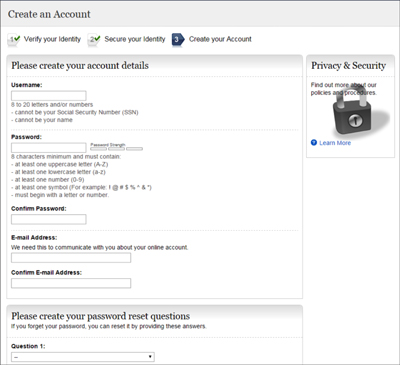
Next you will create your username & password as well as choose your password security questions:

Now you are ready to sign in to your My Social Security account. Below you’ll see an example of the information you can access when you sign in (included are the Overview & Estimated Benefits pages):

Keeping Your Information Secure

It is always important to keep your information safe and secure. Here are some important things to keep in mind:

  • Emails about “My Social Security” and other government agencies always come from a “.gov” email address. Use extreme caution if the email you received is not from a “.gov” sender.
  • Links, logos, & pictures will always direct you to an official Social Security website
  • DO NOT respond or click any links when dealing with a phishing scam email message
  •  Look for poor grammar, wording, phrasing, and/or spelling in all email correspondence
  •  Look for outlandish claims that could not possibly be true
    • If a “foreign prince” emails your from overseas offering to share his gold bullion reserves in exchange for you wiring him a few hundred dollars now for safe border passage between war-torn countries, it’s probably not a legit email
    •  If an email includes the name of a business and/or contact information, such as telephone number or website link, you can attempt to verify the legitimacy via a search engine like Google
  • Speak to friends and family members if you are questioning the validity of a strange email
  • DO NOT respond with any of your personal information if you believe the email may be a scam

I hope this information will be useful for signing up and realizing the benefits of a “My Social Security” account, as well as keeping your information safe. If you have any further questions, you can utilize the www.ssa.gov website or contact your local Social Security office directly.

James Smiertka is a Client Service Associate at Center for Financial Planning, Inc.


The information has been obtained from sources considered to be reliable, but we do not guarantee that the foregoing material is accurate or complete. Links are being provided for information purposes only. Raymond James is not affiliated with and does not endorse, authorize or sponsor any of the listed websites or their respective sponsors. Raymond James is not responsible for the content of any website or the collection or use of information regarding any website's users and/or members.

Don’t Make a Costly Mistake

 If you knew that meeting with a financial planner regularly might help you find opportunities and avoid costly mistakes, would you do it? While that might sound like another financial planner’s pitch to get you in for your annual meeting, it’s not. And I have the story to prove it.

Uncovering additional income

I recently sat down with a same sex couple for a routine financial Annual Review. The federal government has found same sex marriage to be legal for filing a joint tax return and for drawing Social Security marriage benefits. These clients are in their late 50s and are both retired. One was a high-income earner throughout her career. The other fell 10 quarters short of the 40 quarters you are required to pay into FICA taxes in order to receive Social Security benefits.

Going back to work for 10 more quarters just didn’t seem worth it to my client since it only meant $2,000-$3,000 a year in benefits. But what she wasn’t thinking about was that, if she did work 10 more quarters, she would be legally entitled to spousal benefits. Her partner had maxed out the Social Security benefit after paying into the system for many decades. We did some quick math:

So, does working for 10 more quarters to become eligible for half of your spouse’s Social Security amount seem worth it? The answer was easy for them. And they realized, without sitting down for an Annual Review, they could have missed the boat entirely.

Your Own Annual Review

This is a very unique circumstance and your situation may not be similar. But there is no denying that Social Security is complex and it makes sense to pay attention to the rules for qualification and how the strategies apply in different circumstances. Could you do it alone? Think of it like going to the dentist. You might not know you have a cavity … that could turn into an abscess that threatens your life … unless you get a regular cleaning. So stay on top of your financial health, just like you do your dental health. Visit your financial planner regularly, discuss issues, and communicate. You might just uncover unforeseen benefits and it will hopefully be less painful than a trip to the dentist!

Matthew E. Chope, CFP ® is a Partner and Financial Planner at Center for Financial Planning, Inc. Matt has been quoted in various investment professional newspapers and magazines. He is active in the community and his profession and helps local corporations and nonprofits in the areas of strategic planning and money and business management decisions. In 2012 and 2013, Matt was named to the Five Star Wealth Managers list in Detroit Hour magazine.


Five Star Award is based on advisor being credentialed as an investment advisory representative (IAR), a FINRA registered representative, a CPA or a licensed attorney, including education and professional designations, actively employed in the industry for five years, favorable regulatory and complaint history review, fulfillment of firm review based on internal firm standards, accepting new clients, one- and five-year client retention rates, non-institutional discretionary and/or non-discretionary client assets administered, number of client households served.

The material is being provided for information purposes only and is not a complete description, nor is it a recommendation. Any opinions are those of Center for Financial Planning, Inc. and not necessarily those of Raymond James. The information has been obtained from sources considered to be reliable, but Raymond James does not guarantee that the foregoing material is accurate or complete. The example provided is hypothetical in nature and is to be used for illustrative purposes only. C14-038027

How Singles Can Use File and Suspend

 There are certain advanced social security income strategies available for married couples that can help to maximize income in retirement. It’s a different story for single people who have fewer opportunities to use some of these more advanced strategies.  But there’s a strategy called “filing and suspending” that may work for you, no matter your marital status. 

File & Suspend: Not just for married couples

This strategy is sometimes used by married couples because it allows for one partner to defer taking benefits and gain credits on their benefit for doing so. In the meantime, the other partner receives a spousal benefit. But if you’re single, there is no “spousal benefit” so the rationale for utilizing such a strategy is different.  A single person might use this strategy by filing for benefits retroactively.

Retroactive Benefit Payment Limits

Under the “normal” social security rules, those who are full retirement age can only file to receive back payment benefits retroactively for up to 6 months. For example, let’s say George plans to wait until age 70 to collect benefits so he doesn’t go through the process of filing and suspending those benefits. Then, at age 67, George changes his mind and wants to file and suspend. He is only entitled to receive a lump sum payment for the last 6 months of benefits that he could have received.  If George had filed and suspended benefits at his full retirement age and later changed his mind, he would be entitled to receive all of the benefits he would have been entitled to receive going back all the way to the date that he originally filed and suspended.

When File & Suspend Can Pay Off

Now you might be asking, “Why does any of this matter if my game plan is to wait until age 70 to collect benefits?”  Your skepticism is justified because in most cases it will make no difference.  However, in some cases, your health might change from the time you are 66 to 70. Then, it would make a lot of sense to go back to social security and ask for a lump sum payment for benefits you would have received from 66 to 70.  If you filed and suspended, you are entitled to get all of those benefits. If you didn’t file and suspend than you are only entitled to receive 6 months’ worth of back payments.

The rules surrounding social security are vast and very complex.  As with any complicated financial decision, it’s often best to seek the help of a qualified financial professional to help navigate the waters.

Matthew Trujillo, CFP®, is a Certified Financial Planner™ at Center for Financial Planning, Inc. Matt currently assists Center planners and clients, and is a contributor to Money Centered.


The information contained in this report has been obtained from sources considered to be reliable, but we do not guarantee that the foregoing material is accurate or complete. Any information is not a complete summary or statement of all available data necessary for making a n investment decision and does not constitute a recommendation. Any opinions are those of Center for Financial Planning, Inc. and not necessarily those of RJFS or Raymond James. Examples are for illustrative purposes only. C14-028511

Social Security: Delaying vs. Collecting Retirement Benefits

 The wonderful and frustrating Socratic Method I learned in law school taught me that, for most issues, there were two plausible sides or conclusions.  Much to the chagrin of my colleagues (and dare I say my family at times) this perspective can be downright maddening.  So, as I apologize to those that have to deal with me every day! But in many instances, I also believe that it has served clients well.  As much as we’d all like a simple rule or answer at times, many of life’s decisions, and certainly financial decisions, are best contemplated based on the specific facts and circumstances. 

There may not be a greater example than this financial dilemma:

When do I begin receiving Social Security retirement benefits?

The majority of Americans take Social Security benefits at the earliest date possible, age 62, for the mere fact that they require the funds for everyday living expenses.  For those that have the financial flexibility, implementing the maximum social security strategy comes down to your specific circumstances.

Both Sides of the Social Security Coin

Financial Advisor Magazine recently published two articles on social security.  The first, Many Retirees Wish They Had Waited To Take Social Security and the second, Taking Social Security Early Can Make Sense. Your immediate response might be like mine, well wait a minute, which one is it?  Both articles do a fine job representing the pros and cons as I have shared in the past; and ultimately conclude that the “correct” decision is very individualized.

Delaying vs. Collecting at 66

The benefit of waiting past age 62 is that you will receive more each month.  And, if you wait until age 70 you will receive an 8% Delayed Credit each year from age 66 (technically from your full retirement age for people born between 1943 and 1954).  For those with a long life expectancy, waiting can add substantial dollars; but they are not realized until age 80 in most calculations.

However, delaying comes with a risk too.  If you delay and pass away early (and I say any age is considered too early), this will result in a substantial loss at best and a total loss at worst.  Also, is it reasonable to perhaps take funds from your own investments that ultimately pass to your heirs, while you wait to cross over the breakeven point?   

As shared in an earlier blog post of mine, couples have additional variables to consider due to what essentially amounts to joint life expectancy decisions.  

Whether you are single or a couple, getting the Social Security decision correct can be substantial.  I promise to go easy with the Socratic Method … but considering all of the questions and variables of your individual circumstances may lead to better decisions for you and your family.  Give us a call if we can help!

Timothy Wyman, CFP®, JD is the Managing Partner and Financial Planner at Center for Financial Planning, Inc. and is a frequent contributor to national media including appearances on Good Morning America Weekend Edition and WDIV Channel 4 News and published articles including Forbes and The Wall Street Journal. A leader in his profession, Tim served on the National Board of Directors for the 28,000 member Financial Planning Association™ (FPA®), trained and mentored hundreds of CFP® practitioners and is a frequent speaker to organizations and businesses on various financial planning topics.


The information has been obtained from sources considered to be reliable, but we do not guarantee that the foregoing material is accurate or complete. Any information is not a complete summary or statement of all available data necessary for making an investment decision and does not constitute a recommendation. Any opinions are those of Center for Financial Planning, Inc. and not necessarily those of RJFS or Raymond James. Links are being provided for information purposes only. Raymond James is not affiliated with and does not endorse, authorize or sponsor any of the listed websites or their respective sponsors. Raymond James is not responsible for the content of any website or the collection or use of information regarding any website’s users and/or members. C14-019070