Clients and Friends: Please Join Us


WHAT:
2012 Financial Planning & Investment Opportunities

FOR:
Clients and Friends of The Center
Clients are encouraged to bring a guest

WHEN:
Offered at two convenient times.
Please choose which time works best for you!
Tuesday, February 14th, 10:30 am - noon
Wednesday, February 15th, 7:00 pm - 8:30 pm

WHERE:
Bloomfield Twp Public Library
1099 Lone Pine Road, Bloomfield Hills, MI 48302
www.btpl.org

CONTACT INFORMATION:
Gerri Harmer at (248) 948-7900 or
Gerri.Harmer@CenterFinPlan.com


Register Online Now!


Our Health & Wellness Crew Are at It Again!

Last week The Center got a reality check by inviting our insurance provider Blue Care Network to come in and to do individual Body Mass Index (BMI) assessments on most of staff.  Armed with some added motivation, that same week we listened to personal trainer Mark Floria from Franklin Athletic Club give advice, answer questions & demonstrate simple exercise techniques adding to our fitness toolbox.

We are back to our Souper Thursdays now that the holidays are over.  Planners, Tim Wyman and Laurie Renchik, cooked up some delicious soup for staff with donations going to the Cystinosis Research Network.  We would like to share a couple of our more popular recipes.


This is Not Your Mother’s Retirement

Women are redefining the face of their retirement, especially when compared to generations before.  In 2010, the US Bureau of Labor Statistics reported that women comprised 47% of the total US labor force.  That figure is forecasted to grow to 51% by 2018.  Bye-bye glass ceiling. 

One result of this growing trend for women is that many are choosing to work outside the home longer than their mothers and actively pursue interests such as travel, volunteerism, and higher education.  Add increased longevity to the mix and it is not a stretch to understand that in addition to hopes and dreams for a healthy and happy life, living longer means retirement will cost more. 

Envisioning a future retirement and the costs associated with bringing your personal retirement story into focus can seem like a big task (not all that different from starting an exercise program, really).  As with any important goal the most important part is to write it down.  When you are ready to set goals and get results a financial plan is your “go to” document for all important financial decisions.  

The good news is that women are heeding the call for more active financial planning.  With more education and greater participation in management and professional occupations than ever before, women now also have more reason to learn about the value of personal finance and financial planning.   

Here are three important areas in the financial planning process that tie money to quality of life. 

1.  Don't Wait

  • Follow your dreams -- they know the way
  • Start now -- don't assume financial planning is for when you get older.

2.  Consolidate

  • Even if the individual areas of your finances are under control, you gain an advantage when they are pulled together.
  • By viewing each financial decision as part of a whole, you can consider its short and long-term effects on your life goals.

3.  Balance is Key

  • Re-evaluate your financial plan periodically and adjust along the way.  Life events frequently interrupt an otherwise perfect plan.  Incremental adjustments along the way keep you headed in the right direction.

As you begin to dream and plan for your own future, I am reminded of a favorite quote:  Your imagination is the preview to life’s coming attractions.  Albert Einstein

Tackling Your Credit Card Debt

Do you watch the Super Bowl for the game or for the commercials?  For me, it really depends on which teams are playing, but I can’t deny that those million dollar ads often keep me in my seat through the commercial breaks.  This year, Comcast reports that advertisers will pay about $3.5 million for a 30 second spot, but that figure seems like a drop in the bucket compared to $798 billion…that’s the amount Americans now owe on their credit cards.

Recent released Federal Reserve data indicates that consumer borrowing is again on the rise.  With increased spending in the last quarter of 2012, U.S. consumer credit card debt has now reached a staggering $798 billion.  In my last post, I recommended that each of us should access and review our free annual credit report at AnnualCreditReport.com.  If your credit report shows that you have credit card debt that contributes to this enormous U.S. consumer debt total, now is the time take action!

In the spirit of the upcoming NFL Super Bowl, now is the time for you to tackle your own credit card debt.  Follow these steps to move you down the field and toward the goal line of a (credit card) debt-free future:

(1)  Huddle up. Assess your current credit card debt status.  Use your credit report to gather information on your outstanding credit card balances, interest rates, minimum payments and due dates.

(2)  Review your playbook.  Assess the minimum payments on all outstanding credit cards and make sure cash flow allows you to stay current; determine if/how much cash flow allows for more than minimum payments.

(3)  Narrow down your potential plays and make the call.  Check into the possibility of combining outstanding card balances to a card with a 0% interest or at least one with a lower rate.  Determine your strategy for tackling outstanding balances.  From a purely numbers perspective, you will end up paying the least by directing allowable cash  flow to making extra payments on highest interest rate cards first.  However, you must choose the strategy that keeps you moving forward, so if paying off the smallest card first (even if the interest rate is lower) makes you feel like you’re making the most progress, that may be the best strategy for you.

(4)  Keep moving forward by avoiding penalties.  Keep making payments against your outstanding debt AND avoid moving backwards by charging more.  Put your credit card spending in time out until your credit card debt has been paid down.

As Tim Wyman mentioned in his recent post about your Net Worth, one way to positively affect your financial wealth is to decrease your debt.  Set yourself up to score on your Net Worth and plan to tackle your credit card debt in 2012.


Source:  http://online.wsj.com/article/SB10001424052970203899504577130940265401370.html

Where is the Love?

At least for dividends, there doesn’t seem to be any love in the headlines.  From CNBC at the first of the year they wrote, “Market’s Flat 2011 Could Imply Rally This Year.  Following last year’s pancake-flat finish on the S&P 500…”  And there were many others like this.  If you didn’t investigate further you probably wouldn’t even realize that the S&P 500 was up last year.  The S&P finished positive 2.1% on a total return basis. 

How, you may ask, did this happen?

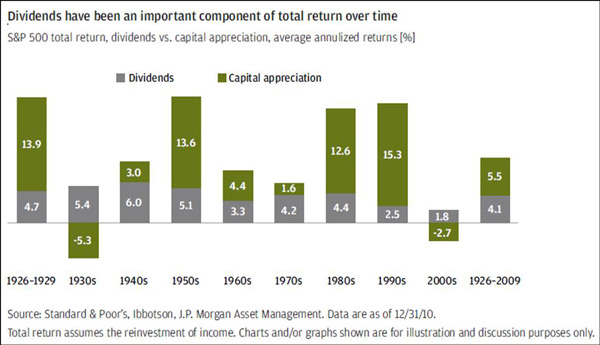
Many of the stocks in the S&P 500 index pay dividends.  The total yield on the S&P 500 was 2.3% as of 12/31/11 and these are payments made directly to the shareholder in cash, or one can choose to reinvest them.  This must also be counted in your return, but many seem to overlook this fact. 

Dividends can provide a potential source of income to help cushion portfolios in down markets and potentially bolster returns during up markets.


While 2% may seem like a pittance compared to fluctuations in stock values, between 1926 and 2009 these small payouts have generated about 40% of overall return in the S&P 500 (WSJ, A Time for Dividends, 10/5/11) and can be vital to achieving long term financial planning goals. 

* Investor’s cannot invest directly in an index.  Past performance is not indicative of future results.The information contained in this report does not purport to be a complete description of the securities, markets, or developments referred to in this material.  The information has been obtained from sources considered to be reliable, but we do not guarantee that the foregoing material is accurate or complete.  Any opinions are those of Center for Financial Planning, Inc., and not necessarily those of RJFS or Raymond James.  Expressions of opinion are as of this date and are subject to change without notice.  Dividends are not guaranteed and must be declared by a company’s board of directors.

Summer Internship Opportunity

When:   May -August 2012 (Flexible)

Apply By:  February 28th, 2012

Description:

Intern(s) will work primarily with the Investment and Financial Planning Departments to complete research projects, mutual fund performance reporting, and database updates. Career development opportunities offered through education on basic financial planning concepts, self assessments, and staff shadowing. Looking for current college student(s) or recent graduate(s) seeking summer employment with a strong interest in investment research and financial planning. Applicants must have a strong desire to learn, be able to work independently, manage multiple tasks responsibly, and take initiative.

Part-Time & Paid: Yes  

If interested, please email your resume to:   

Jaclyn Jackson, Summer Internship Program Director 

Jaclyn.Jackson@CenterFinPlan.com

Phone: 248-948-7900 

Keep Score with Your Own Net Worth

In my January 4, 2012 post I shared nine steps to get a start on improving your financial health in the New Year.  At the top of the list was:

Take score: review your net worth as compared to one year ago

I must admit, I don’t find myself playing too much golf these days.  However, when I do, I keep score to see how I am doing. A net worth statement is your financial scorecard.  In its simplest form, your net worth statement lists what you own, subtracts what you owe, and the balance is called your Net Worth.  While there is no ideal Net Worth, it certainly is better to have a larger positive Net Worth – thus owning more than you owe.  Next to establishing personal financial objectives, an evaluation of what you own and owe is probably the most important ingredient in creating a plan your financial future. 

From the information contained on your Net Worth statement, you can measure whether or not you have sufficient liquidity, calculate your debt/equity ratio, review the nature and diversification of your assets, and determine the impact of federal estate taxes on your estate.  Your Net Worth statement is also used in your Financial Independence analysis and in evaluating your insurance needs.  With proper planning, discipline and careful monitoring, your Net Worth is likely to appreciate in value over time. 

Even in a year when investment returns are flat, your net worth can increase if you are saving money and/or paying down debt such as a mortgage, college loans, auto loans, or dreaded credit card debt.  There are many resources online to help you keep score.  Even better yet, you can work with your financial advisor to begin tracking your progress. 

Zingerman's Shares Leadership Philosophy


What do Zingerman’s and The Center have in common? 

Zingerman’s is, of course, the renowned Ann Arbor company noted for its great food and service.   The Center recently hosted a half-day presentation by Zingerman’s at its annual staff retreat, exploring a philosophy known as “servant leadership.”

Giving great service to staff is one of the important components of Zingerman’s great service to its customers.   At its Dec. 16 retreat The Center team learned about this leadership philosophy, and how it can supplement The Center’s long-standing commitment to client service.

An added bonus were all the tasty Zingerman’s  foods we all shared during breakfast!

Gregg Bloomfield, Matt Chope, Amanda Toia, Troy Wyman, Tim Wyman

Jaclyn Jackson, Melissa Cyrus