What is Elder Care Planning?

 What do you think of when you hear the term Elder Care?  For most, the term springs to mind thoughts of care for older adults who are in need of assistance…at home care or care in some type of assisted living or other care facility.  In reality, Elder Care encompasses a much broader spectrum of planning issues for older adults, including legal and financial planning in addition to traditional care and assistance.

Individuals work with their financial planners to plan for retirement.  To most, this means making sure that they have enough income and savings to maintain their lifestyles after their work lives are over.  This can mean traveling, pursuing hobbies and spending time with family that was not possible during working years.  What most people fail to plan for are later years of retirement that might involve health and or cognitive issues that can cause changes in lifestyle and expense. 

It is never too early to start planning for these later life issues.  It is never too early to think about the challenges you might have as you age and your preference for how to address those challenges, should they occur.  Many people, however, delay this type of planning not wishing to think about what might happen in later life.

How do you know if it is time for you to talk to your financial planner about Elder Care Planning?  Answering these few simple questions can help you decide if you need to start planning.  If you can answer YES to all of the questions on this checklist, congratulations…you’ve planned well.  If you answer NO or NOT SURE to any of the questions, it might be time to talk to your financial planner and start planning now.  

In my upcoming blogs I’ll walk you through some of the top Elder Care Planning mistakes.

Sandra Adams, CFP® is a Financial Planner at Center for Financial Planning, Inc. Sandy specializes in Elder Care Financial Planning and is a frequent speaker on related topics. In 2012 and 2013, Sandy was named to the Five Star Wealth Managers list in Detroit Hour magazine. In addition to her frequent contributions to Money Centered, she is regularly quoted in national media publications such as The Wall Street Journal, Research Magazine and Journal of Financial Planning.


Five Star Award is based on advisor being credentialed as an investment advisory representative (IAR), a FINRA registered representative, a CPA or a licensed attorney, including education and professional designations, actively employed in the industry for five years, favorable regulatory and complaint history review, fulfillment of firm review based on internal firm standards, accepting new clients, one- and five-year client retention rates, non-institutional discretionary and/or non-discretionary client assets administered, number of client households served.

Any opinions are those of Center for Financial Planning, Inc., and not necessarily those of RJFS or Raymond James.  You should discuss any legal matters with the appropriate professional.

Why Estate Planning isn’t just for Multimillionaires

 Putting an estate plan in place is so much more than saving taxes.  It provides a roadmap for folks who want to better preserve, protect and transfer wealth to the people they care most about. Last year, the American Taxpayer Relief Act (ATRA), made permanent the gift and estate tax exemption amount. In 2013 that amount is $5,250,000 for individuals and $10,500,000 for married couples.  But you don’t have to leave behind millions to still need careful planning.  

Key takeaways to consider:

  • Having an estate plan, including a will, generally means a family can avoid much of the intestate probate process.  Proceedings vary state to state, but without a proper estate plan, many families could experience costs, including time, money, and loss of privacy.         
  • An appropriate solution designed to avoid any probate process is often the creation of a living trust, which helps maintain control over assets and seeks to avoid uncertainties for the family and designated beneficiaries.         

 Other important considerations:

  • Designating guardianship for minor children and grandchildren will reduce the court’s control over both the minor’s inheritance and caretaker.
  • Establishing a charitable plan as part of the estate plan ensures designated assets will be distributed to the charity of choice rather than by state law.

Finally, while an estate plan protects assets and family, it also provides the opportunity to pass on cherished values through gifts to family members or favorite charities.  A written reflection of hopes for the future and life lessons learned can be conveyed through legacy letters and ethical wills. Putting an estate plan in place addresses legal and tax issues and ultimately ensures assets will be used according to your wishes.

Laurie Renchik, CFP®, MBA is a Senior Financial Planner at Center for Financial Planning, Inc. In addition to working with women who are in the midst of a transition (career change, receiving an inheritance, losing a life partner, divorce or remarriage), Laurie works with clients who are planning for retirement. Laurie was named to the 2013 Five Star Wealth Managers list in Detroit Hour magazine, is a member of the Leadership Oakland Alumni Association and in addition to her frequent contributions to Money Centered, she manages and is a frequent contributor to Center Connections at The Center.


Five Star Award is based on advisor being credentialed as an investment advisory representative (IAR), a FINRA registered representative, a CPA or a licensed attorney, including education and professional designations, actively employed in the industry for five years, favorable regulatory and complaint history review, fulfillment of firm review based on internal firm standards, accepting new clients, one- and five-year client retention rates, non-institutional discretionary and/or non-discretionary client assets administered, number of client households served.

The information has been obtained from sources considered to be reliable, but we do not guarantee that the foregoing material is accurate or complete.  Any opinions are those of Center for Financial Planning, Inc., and not necessarily those of RJFS or Raymond James.  You should discuss any tax or legal matters with the appropriate professional.

Our Favorite Cup

 When you’re reaching into your cabinet to grab a coffee cup, you’re likely looking for that one special mug. It fits just perfectly in your hand, maybe one of your kids made it for you, or maybe it holds special memories … but in any case, it holds your morning coffee. Well, here at the Center, we have a special kind of cup, too. Our clients will recognize them because the John Glick Plum Tree Pottery mugs are stashed in our coffee supply cabinet just for you. And just like there’s meaning behind your favorite mug, there’s also meaning behind the locally-made Plum Tree Pottery. Our social committee decided it was time to uncover the meaning with a field trip (we still get to do those … but now we don’t need a signed permission slip).

Just a few miles down the road from the Center office we found Plum Tree Pottery and artist John Glick. We have known John for years and he was happy to give us a tour of his studio, showroom, and lovely home. Speeding down 10 Mile Road in Farmington Hills, you would never guess that such a serene, peaceful home and studio were nearby. After we ogled John’s unique ceramic collections, trying hard not to break anything, we got to hear how passionate he is about his work (it’s not exactly financial planning, but not everyone can have as great a job as we do!). Our social committee had done it again, proving that though we love bulls, we don’t act like bulls in a china shop when you take us out of the office.  Check out www.johnglick.com to learn more about John and Plum Tree Pottery.


Links are being provided for information purposes only.  Raymond James is not affiliated with and does not endorse, authorize or sponsor any of the lsited websites or their respective sponsors.  Raymond James is not responsible for the content of any website or the collection or use of information regarding any website's users and/or members.

Practicing What We Preach When it Comes to Investing

 When choosing a money manager one of the aspects we utilize to evaluate if they are worthy of our client’s money is whether or not they eat their own cooking. 

According to Morningstar research, money managers who had invested $1 Million or more in the portfolios they managed outperformed 58% of their peers over the 5-year period ended July 2009.

Having their own money on the line is a great incentive to perform putting the managers on the same side of the table as their investors. This is also a belief we carry over to our own practice. Many of us here at the Center invest in the same portfolios we build for our clients.

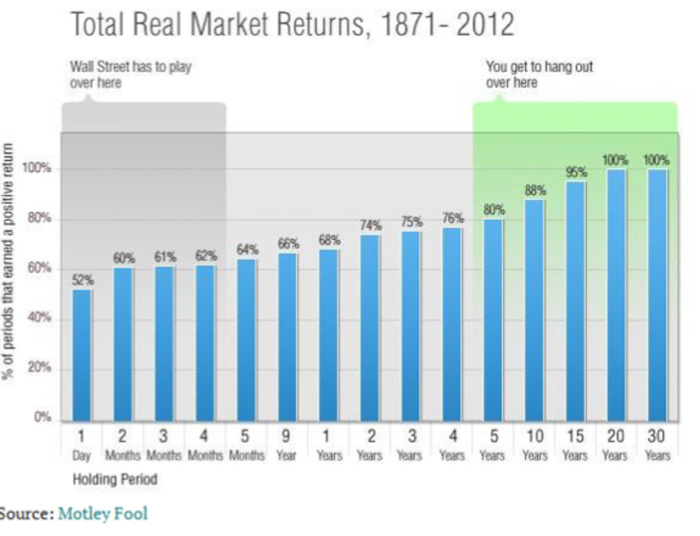
We also like to understand how our managers are compensated. We find it is very important to choose managers that are compensated heavily on longer term returns as opposed to the most recent year’s performance. This aligns the managers with the clients’ long-term goals such as retirement or education funding. The chart below shows how difficult it is to achieve consistently positive returns over short time periods. The longer the time frame you have, the more likely it is to have positive returns. Most investors get to “hang out” in the green section meaning we have a longer period of time to invest to achieve those positive returns and we like money managers who focus on these time periods as well.

It is important for your Financial Planner to practice what they preach. For example, I just recently met with my financial planner (yes financial planners also need financial planners from time to time!). We evaluated my overall financial plan including retirement and education funding to make sure that our family’s investment and savings goals are appropriately aligned with our overall plan. This is the exact same process we believe in following with our clients.  Our firm encourages this for all of our employees and many take advantage of this excellent benefit.  It is human nature to care more about the process and the investments when you have your own future and money on the line!

Angela Palacios, CFP®is the Portfolio Manager at Center for Financial Planning, Inc. Angela specializes in Investment and Macro economic research. She is a frequent contributor to Money Centered as well asinvestment updates at The Center.


The information has been obtained from sources considered to be reliable, but we do not guarantee that the foregoing material is accurate or complete. Any opinions are those of Center for Financial Planning, Inc., and not necessarily those of RJFS or Raymond James.

Curtain Call


The Center's Team enjoys sharing their knowledge with the press to help stories come to life, share facts and bring important topics to the forefront.  We are also honored when we are recognized by media and publications for our work and service to our profession. Here's what's new:

Detroit Free Press

Timothy Wyman, CFP®, JD was quoted in the Sunday Free Press on June 27, 2013, in an article titled, “Pension safety net won’t help City of Detroit retirees” by Susan Tompor.

Online Trading Academy

Laurie was quoted on Online Trading Academy on July 8, 2013, in an article titled, “Finance Advice for Grads” by Paige Reinsel.

Old Habits Die Hard: Are You Spending Enough?

 I received an intriguing question from a client recently.  His query: “We who are savers struggled initially as young earners to develop the discipline to pay ourselves first.  We have spent the first two thirds of our lives making spending decisions based on debt avoidance rather than conspicuous consumption; all with the goal to make sure we would achieve financial independence in our retirement years.  But now that we’re retired, that deep-rooted discipline comes back to haunt us as we transition into our spending years.  I'm finding it difficult to spend the money now, even though we are financially secure.  Any advice?”

Actually, this is not an uncommon issue with our retired clients at the Center.  There is an element of self-selection that occurs for our long-time clients—they tend to be both forward-thinking “planners” by nature and they have generally demonstrated excellent self-discipline over the years.  It is not unusual that this results in having more financial resources than they might have expected or imagined, and the careful spending habits developed over decades don’t change quickly.

For many, many years, I have defined “financial planning” as the process of finding an appropriate balance between spending now and investing for the future to ensure that all of your financial goals are accomplished throughout your life.  Most people tend to err on one side or another—they either spend so much now that they jeopardize their future goals; or they have far too aggressive savings goals, giving up current quality of life unnecessarily.  In planning, we can quantify what it takes to meet future financial goals, and making sure that we are doing what is needed to help reach those goals—whatever is left can be spent freely and without guilt on those things that are of highest priority.

There are some that find themselves in the enviable position of having more than they need at retirement. Here again, we can quantify what it takes to maintain financial security with some cushion for unforeseen contingencies—

The excess is available for other priorities, which can include:

  • Gifting: to family members or to charities
  • Creating a meaningful financial legacy
  • Increasing one’s annual income to incorporate some “luxury” items or experiences
  • Pursuing passionate interests such as collecting art, fine wine, or extensive travel

My advice to you, if you are in this position, is not to “deny yourself” if there is something you would like to do.  This is not to recommend spending money frivolously; but on the other hand, if there is an expenditure that would improve the quality of your life or the lives of those you care about, don’t hesitate to spring for it—even if it seems “unnecessary”.  The ultimate goal here is to pursue those areas of interest because they are meaningful and important to you, unconstrained by financial concerns.  That, friends, is true financial freedom.


Any information is not a complete summary or statement of all available data necessary for making an investment decision and does not constitute a recommendation. Any opinions are those of Center for Financial Planning, Inc., and not necessarily those of RJFS or Raymond James.


Keys to Weight Loss Can be Keys to a Successful Financial Plan

 For the last several months, I have been watching my weight with the goal of improving my long-term health.  I have been following the Weight Watchers plan, which has helped me to create some solid habits for weight loss success. 

These same healthy habits can help individuals achieve financial planning success:

  1. Track – Much like dieters should track what they eat, it is important for individuals to track where they spend; this helps to identify areas where overspending might be occurring.
  2. Maintain Discipline – Like dieters need to stick to a plan, individuals with long-term financial goals should have a plan for saving and be committed to it.
  3. Splurge Once in a While – Like a dieter who deprives him or herself for too long and then binges, individuals that have been disciplined at savings should occasionally spend on something fun to enjoy the present … but as a reward rather than a binge.
  4. Be Accountable – Like a dieter should weigh in regularly and be honest with the results, individuals should meet with their financial planner at least annually to check progress and to make any needed adjustments to the plan.

If you have already formed these habits for your financial life, don’t be afraid to meet with your financial planner to check the scale.

Sandra Adams, CFP® is a Financial Planner at Center for Financial Planning, Inc. Sandy specializes in Elder Care Financial Planning and is a frequent speaker on related topics. In 2012 and 2013, Sandy was named to the Five Star Wealth Managers list in Detroit Hour magazine. In addition to her frequent contributions to Money Centered, she is regularly quoted in national media publications such as The Wall Street Journal, Research Magazine and Journal of Financial Planning.


Five Star Award is based on advisor being credentialed as an investment advisory representative (IAR), a FINRA registered representative, a CPA or a licensed attorney, including education and professional designations, actively employed in the industry for five years, favorable regulatory and complaint history review, fulfillment of firm review based on internal firm standards, accepting new clients, one- and five-year client retention rates, non-institutional discretionary and/or non-discretionary client assets administered, number of client households served.

Any information is not a complete summary or statement of all available data necessary for making an investment decision and does not constituteinvestment advice.  Any opinions are those of Center for Financial Planning, Inc., and not necessarily those of RJFS or Raymond James.

How investor access keeps you in the loop even when you are on the Go

 We, here at the Center, love to use the latest technology and we’re excited to be able to put it at your fingertips.  Many of you know about Investor Access, the free, online portal designed exclusively for Raymond James clients.  It offers a secure platform to view and navigate your Raymond James accounts.  This is a free service and it is quite user friendly and it is now portable.  Raymond James offers an app so you may use this service on the go!  Designed with the busy client in mind, this app incorporates the features you would have on the full website.  Your detailed information can now be accessed through your mobile device and is just as safe and secure.

Obtaining the app is easy.  Just visit Apple’s App Store, Google’s Play Store, or Window’s Marketplace to sign up.  You will need to be enrolled in the desktop version of Investor Access before adding the application to your mobile device.  Access to the full website can be found on our website under the “Clients” tab.  Need help?  Call us – we would love to help set you up with this technology to make your life easier even when you are on the go.

The app is just one tool in our technology toolbox, enabling us to keep in contact with our clients and each other.  We have the ability to increase our productivity with the help of software programs and databases that allow retrieval of information at a moment’s notice.  We are able to personally communicate with clients via email and through voice over IP services like Skype. Our broad communication is accomplished through Facebook, Twitter, LinkedIn, our company website, and even YouTube.  While these features help make our day a bit easier, it is even more exciting when we have technology that will make your life easier!  

Breaking the Mold of a Broke College Kid


This blog is contributed by the Center’s summer intern, Zach Gould, who is a senior at the University of South Carolina. He shares his take on how students can take charge of their finances:

Let’s face it, college students are notoriously broke. During the school year, I don’t have a job because I plan and budget so I can focus all my attention on school. That means, when summer rolls around, I work at least 40 hours a week for 10 weeks or more, which is what I’m doing at the Center this summer. While I’m working, I try not to spend much money. My goal is to save at least 80% of my summer earnings so I’ll have it to spend during the school year. Because who wants to eat cafeteria food for 9 months? And you have to have cash for dates, movies, and a very occasional trip to the bars (wink).  So, once school starts I see how much money I have left from summer and budget that over the 9 months that I’m in school. I also plan for extra spending in December because of the holidays. Can you tell one of my majors is finance?

It is not impossible to maintain a job during the school year. A lot of my friends work part-time while going to school and are, in many cases, more organized than me because they are forced to be. This also provides income during the school year, which if you are paying for college yourself, certainly is necessary. If you’re not paying for college out of pocket, it is simply more expendable income. But holding down a job while going to school does have drawbacks, like limiting your ability to be a part of a lot of clubs or teams. Either way, after three years of making ends meet on a college student budget, I've learned a few things.

This is what I’ve learned:

  1. Start saving early for spending money in college. You are on your own and expenses previously covered by your parents are now funded by you.
  2. Budget the money you make while working during summer so it can last you throughout the school year, especially if you don’t plan to have a job while in school.
  3. It is possible to work and attend school, which will give you more flexibility with income. You must, however, be very organized and limit your hours to make sure you are achieving social and academic balance as well.

I’ll head back to college in a month with most of my summer earnings in the bank. It takes budgeting and careful planning not to blow it before the end of the first semester, but I know the skills I’m using now will really pay off in May when I graduate and am truly on my own.


Any opinions are those of Center for Financial Planning, Inc., and not necessarily those of RJFS or Raymond James.