Cash Flow Planning

Consider these options and strategies to pump up your Social Security benefits

Nick Defenthaler Contributed by: Nick Defenthaler, CFP®

As a frequent speaker on Social Security, I’ve had the pleasure of educating hundreds of retirees on the nuances and complexities of this confusing topic. Over the years, I’ve come to realize that, unfortunately, many of us do not take the decision about when to file as seriously as we should.

your social security benefits

In 2018, the average annual Social Security benefit was roughly $17,000. Assuming a retiree lives for 20 years after receiving that first benefit check, you’re looking at a total of $340,000 in lifetime benefits – and that’s not accounting for inflation adjustments along the way!

We work to help our clients receive nearly double that amount each year – $33,500 – which is close to the maximum full retirement age (FRA) benefit one can receive. Assuming the same 20-year period means nearly $700,000 in total lifetime benefits. It’s not unreasonable for a couple with earnings near the top of the Social Security wage base to see a combined, total lifetime benefit amount north of $1,500,000 as long as you are award of the decision process.

As you can see, the filing decision will be among the largest financial decisions – if not THE largest – you will ever make!

Longevity risk matters

Seventy-five percent of Americans will take benefits prior to their full retirement age (link #1 below) and only 1 percent will delay benefits until age 70, when they are fully maximized. In many cases, financial and health circumstances force retirees to draw benefits sooner rather than later. But for many others, retirement income options and creative strategies are oftentimes overlooked, or even taken for granted.

In my opinion, longevity risk (aka – living a really long time in retirement) is one of the three biggest risks we face in our golden years. Research has proven, time in and time out, that maximizing Social Security benefits is among the best ways to help protect yourself against this risk, from a retirement income standpoint. Each year you delay, you will see a permanent benefit increase of roughly 8 percent (up until age 70). How many investments offer this type of guaranteed income?

Let’s look at the chart below to highlight this point.

20190409a.jpg

You can see a significant difference between taking benefits at age 62 and at age 70 – nearly $250,000 in additional income generated by delaying! Keep in mind, this applies for just one person. Married couples who both had a strong earnings history or can take advantage of the spousal benefit filing options receive even more benefits.

Mark’s story

I’ll never forget a conversation I had with a gentleman named Mark after one of my recent educational sessions on Social Security. As we chatted, he made a comment along the lines of, “I have just close to $1.5 million saved for retirement, I just don’t think Social Security really matters in my situation.” I asked several probing questions to better understand his earnings record and what his benefit would be at full retirement age.

We were able to determine that at age 66, his benefit would be nearly $33,000. Mark was 65, in good health, and mentioned several times that his parents lived into their early 90s. Longevity statistics suggest that an average 65-year-old male has a 25 percent chance of living until 93. However, based on Mark’s health and family history, he has a much higher probability of living into his early to mid-90s!

If Mark turned his benefits on at age 66, and he lived until age 93, he would receive $891,000 in lifetime benefits. If he waited until age 70 and increased his annual benefit by 32 percent ($43,500/yr.), his lifetime benefits would be $1,000,500 (keep in mind, we haven’t even factored inflation adjustments into the lifetime benefit figures).

I then asked, “Mark, if you had an IRA with a balance of $891,000 or even $1,000,000, could we both agree that this account would make a difference in your retirement?” Mark looked at me, smiled, and nodded. He instantly understood my point. Looking at the total dollars Social Security would pay out resonated deeply with him.

All too often, we don’t fully appreciate how powerful a fixed income source can be in retirement. It’s astounding to see the lifetime payout provided by Social Security. Regardless of your financial circumstance, it will always make sense to review your options with someone who understands the nuances of Social Security and is well educated on the creative ways to draw benefits. Don’t take this decision lightly, too many dollars are at stake!

Feel free to reach out to us if you’d like to talk through your plan for Social Security and how it will fit into your overall retirement income strategy.

Nick Defenthaler, CFP® is a CERTIFIED FINANCIAL PLANNER™ professional at Center for Financial Planning, Inc.® He contributed to a PBS documentary on the importance of saving for retirement and has been a trusted source for national media outlets, including CNBC, MSN Money, Financial Planning Magazine, and OnWallStreet.com.


Sources: 1) https://www.ssa.gov/planners/retire/retirechart.html 2) https://money.usnews.com/money/retirement/social-security/articles/2018-08-20/how-much-you-will-get-from-social-security The information herein has been obtained from sources considered to be reliable, but we do not guarantee that the foregoing material is accurate or complete. This information is not a complete summary or statement of all available data necessary for making a decision and does not constitute a recommendation. You should discuss any tax or legal matters with the appropriate professional.

What happens to my Social Security benefit if I retire early?

Kali Hassinger Contributed by: Kali Hassinger, CFP®

Did you know that the benefit shown on your Social Security estimate statement isn’t just based on your work history?

what happens to my social security benefit if I retire early

The estimated benefit shown on your statement assumes that you’ll work from now until your full retirement age.  And, on top of that, it assumes that your income will remain about the same that entire time. For some of our clients who are still working, early retirement has become a frequent discussion topic. What happens, however, if you retire early and don’t pay into Social Security for several years? In a world where pensions are quickly becoming a thing of the past, Social Security will be the largest, if not the only, fixed income source in retirement for many. 

Your Social Security benefit is based on your highest 35 earning years, with the current full retirement age at 67.

So, what happens to your benefit if you retire at age 50? That is a full 17 years earlier than your statement assumes you’ll work, which effectively cuts out half of what is often our highest earning years.

We recently had a client ask about this exact scenario, and the results were pretty surprising! This client has been earning a great salary for the last 10 years and maxing out the Social Security tax income cap every year. Her Social Security statement, of course, assumes that she would continue to pay in the maximum amount (which is 6.2% of $132,900 for an employee in 2019 - or $8,240 - with the employer paying the additional 6.2%) until her full retirement age of 67. She wanted to make sure her retirement plan was still on track even after stopping her income and contributions to Social Security at age 50.

We were able to analyze her Social Security earning history, then project her future earnings based on her current income and future retirement age of 50. Her current statement showed a future annual benefit of $36,000. When we reduced her income to $0 at age 50, her estimated Social Security benefit actually dropped by 13%, or $4,680 per year. That’s still $31,320-per-year fixed income source would still pay our client throughout retirement. Given the fact that she’s working 17 years less than the statement assumes and she has the assets necessary to support the difference, a 13% decrease isn’t too bad. This is just one example, of course, but it is indicative of what we’ve seen for many of our early retirees. 

Social Security isn’t the only topic you’ll want to check on before making any final decisions about an early retirement.

You’ll also want to consider health insurance, having enough savings in non-retirement accounts that aren’t subject to an early withdrawal penalty, and, of course, making sure you’ve saved enough to reach your goals! If you’d like to chat about Social Security and your overall retirement plan, we are always happy to help!

Kali Hassinger, CFP®, CDFA® is a CERTIFIED FINANCIAL PLANNER™ professional at Center for Financial Planning, Inc.® She has more than a decade of financial planning and insurance industry experience.


Any opinions are those of Kali Hassinger, CFP and not necessarily those of RJFS or Raymond James. The information contained in this report does not purport to be a complete description of the securities, markets, or developments referred to in this material. There is no assurance any of the trends mentioned will continue or forecasts will occur. The information has been obtained from sources considered to be reliable, but Raymond James does not guarantee that the foregoing material is accurate or complete. The case study included herein is for illustrative purposes only. Individual cases will vary. Prior to making any investment decision, you should consult with your financial advisor about your individual situation. Any information is not a complete summary or statement of all available data necessary for making an investment decision and does not constitute a recommendation. Raymond James and its advisors do not provide tax or legal advice. You should discuss any tax or legal matters with the appropriate professional. Investing involves risk and you may incur a profit or loss regardless of strategy selected. Certified Financial Planner Board of Standards Inc. owns the certification marks CFP®, CERTIFIED FINANCIAL PLANNERTM, CFP® (with plaque design) and CFP® (with flame design) in the U.S., which it awards to individuals who successfully complete CFP Board's initial and ongoing certification requirements.

Why Retirees Should Consider Renting

Nick Defenthaler Contributed by: Nick Defenthaler, CFP®

“Why would you ever rent? It’s a waste of money! You don’t build equity by renting. Home ownership is just what successful people do.”

Sound familiar? I’ve heard various versions of these statements over the years, and every time I do, the frustration makes my face turns red. I guess I don’t have a very good poker face!

why retirees should consider renting

As a country, we have conditioned ourselves to believe that homeownership is always the best route and that renting is only for young folks. If you ask me, this philosophy is just flat out wrong and shortsighted.

Below, I’ve outlined various reasons that retirees who have recently sold or are planning to sell might consider renting:

Higher Mortgage Rates

  • The current rate on a 30-year mortgage is hovering around 4.6%. The days of “cheap money” and rates below 4% have simply come and gone.

Interest Deductibility

  • Roughly 92% of Americans now take the standard deduction ($12,200 for single filers, $24,400 for married filers). It’s likely that you’ll deduct little, if any, mortgage interest on your return.

Maintenance Costs

  • Very few of us move into a new home without making changes. Home improvements aren’t cheap and should be taken into consideration when deciding whether it makes more sense to rent or buy.

Housing Market “Timing”

  • Home prices have increased quite a bit over the past decade. Many experts suggest homes are fully valued, so don’t bank on your new residence to provide stock-market-like returns any time soon.

Tax-Free Equity

  • In most cases, you won’t see tax consequences when you sell your home. The tax-free proceeds from the sale could be a good way to help fund your spending goal in retirement.  

Flexibility

  • You simply can’t put a price tag on some things. Maintaining flexibility with your housing situation is certainly one of them. For many of us, the flexibility of renting is a tremendous value-add when compared to home ownership.

Quick Decisions

  • Rushing into a home purchase in a new area can be a costly mistake. If you think renting is a “waste of money” because you aren’t building equity, just look at moving costs, closing costs (even if you won’t have a mortgage), and the level of interest you pay early in a mortgage. Prior to buying, consider renting for at least two years in the new area to make darn sure it’s somewhere you want to stay.

Every situation is different, but if you’re near or in retirement and thinking about selling your home, I encourage you to consider all housing options. Reach out to your advisor as you think through this large financial decision, to ensure you’re making the best choice for your personal and family goals.

Nick Defenthaler, CFP® is a CERTIFIED FINANCIAL PLANNER™ at Center for Financial Planning, Inc.® Nick works closely with Center clients and is also the Director of The Center’s Financial Planning Department. He is also a frequent contributor to the firm’s blogs and educational webinars.


Any opinions are those of Nick Defenthaler, CFP® and not necessarily those of RJFS or Raymond James. The information contained in this report does not purport to be a complete description of the securities, markets, or developments referred to in this material. Investing involves risk and you may incur a profit or loss regardless of strategy selected.

New Year Financial To-Dos Help Keep You on Track

Kali Hassinger Contributed by: Kali Hassinger, CFP®

As we settle into 2019, the fresh calendar year provides an ideal opportunity to make plans and adjustments for your future. Instead of setting lofty resolutions without a game plan in mind, might I suggest that you consider our New Year Financial Checklist? Completing this list of actionable, attainable goals will help you avoid the disappointment of forgotten resolutions in February, and you’ll feel the satisfaction of actually accomplishing something really important!

20190103.jpg

New Year Financial Checklist

  • Measure your progress by reviewing your net worth as compared to one year ago. Even when markets are down, it's important to evaluate your net worth annually. Did your savings still move you forward? If you're slightly down from last year, was spending a factor? There is no better way to evaluate than by taking a look at the numbers!

  • Speaking of spending and numbers, review your cash flow! How much came in last year and how much went out? Ideally, we want more income than spending.

  • Now, let's focus on the dreaded budget. Sure, budgeting can be a grind, so call it a “spending plan”. Do you have any significant expenses coming up this year? Make sure you're prepared and have enough saved.

  • Be sure you review and update beneficiaries on IRAs, 401(k)s, 403(b)s, life insurance, etc. You'd be surprised at how many people don't have beneficiaries listed on retirement accounts (or have forgotten to remove their ex-spouse)!

  • Revisit your portfolio's asset allocation. Make sure your investments and risk are still aligned with your stage in life, your goals, and your comfort level. I'm not at all suggesting that you make changes based on market headlines. Just be sure that the retirement or investment account you opened 20 years ago is still working for you.

  • Review your Social Security Statement. If you're not yet retired, you will need to go online to review your estimated benefit. Social Security is one of the most critical pieces of your retirement, so make sure your income record is accurate.

Of course, this list isn't exhaustive. The final step to ensure your financial wellbeing is a review with your advisor. Even if you don't work with a financial planner, at a minimum set aside time on your own, with your spouse or a trusted friend, to plan on improving your financial health. Do it even if you only get to the gym the first few weeks of January!

Kali Hassinger, CFP® is an Associate Financial Planner at Center for Financial Planning, Inc.®

Social Security Increase Announced

Kali Hassinger Contributed by: Kali Hassinger, CFP®

The Social Security Administration recently announced that benefits for more than 67 million Americans would be increasing by 2.8% starting in January 2019. This cost of living adjustment (COLA for short) is the largest we've seen since 2011 when the benefits increased by 3.6%. 

20181030.jpg

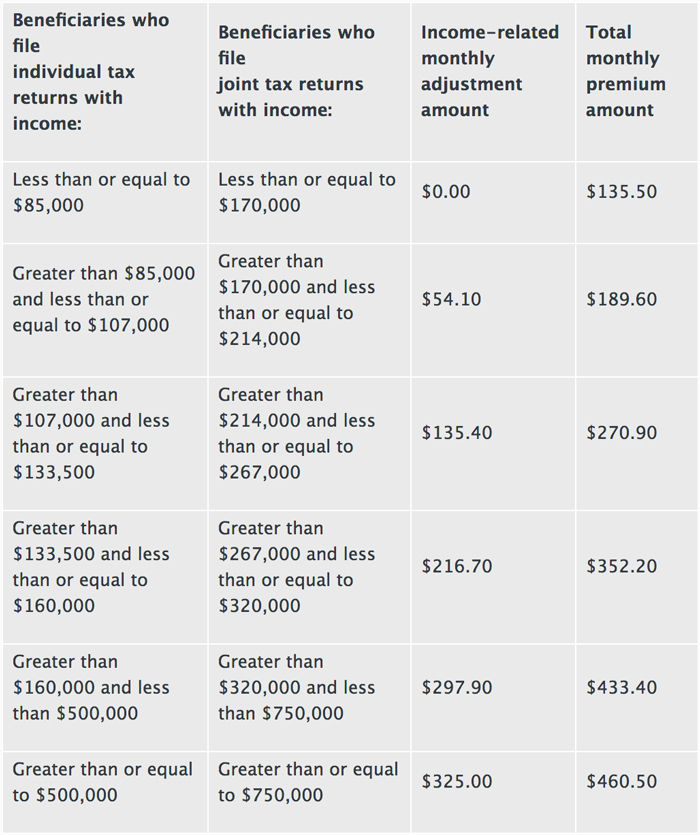
The Medicare Part B premium increase was also announced, and it will only be increased by a modest $1.50 per month (from $134 to $135.50).The premium surcharge income brackets have also seen a slight increase in the monthly premium on top of the $1.50 standard.These surcharges affect about 5% of those who have Medicare Part B.The biggest change, however, is the addition of a new premium threshold for those with income above $500,000 if filing single and $750,000 if filing jointly. This will affect:

20181030a.jpg

While the Social Security checks will be higher in 2019, so will the earnings wage base you pay into if you're still working.  In 2018, the first $128,400 was subject to Social Security payroll tax (6.2% for employees and 6.2% for employers).  Moving into 2019 the new wage base grows by 3.5% to $132,900.  Those who are earning at or above the maximum will pay $8,240 in Social Security tax each year.  With the employer's portion, the maximum tax collected per worker is $16,780.  

Social Security plays a vital role in almost everyone's financial plan.  If you have questions about next year's COLA or anything else related to your Social Security benefit, don't hesitate to reach out to us.

Kali Hassinger, CFP® is an Associate Financial Planner at Center for Financial Planning, Inc.®


Source: https://www.cms.gov/newsroom/fact-sheets/2019-medicare-parts-b-premiums-and-deductibles

When the Rubber Hits the Road: Steps to Take When you Find that you are Behind on your Retirement Savings

Sandy Adams Contributed by: Sandra Adams, CFP®

20180925.jpg

So here you are.  You find yourself happily on cruise control — you seem to be making more money every year, you have the house and cars you always wanted, the kids are now in college and you take the family vacations you want when you want to take them.  And then — bam — traffic comes to a stop.  What?  How can this be?  How can we already be in our mid-50’s?  How can retirement be so close? How is it possible that we haven’t saved more towards our own retirement by now?  What do we do to make it to our goal on time?

If this sounds anything like you, you are not alone.  We find that many clients come to us looking for assistance with their retirement late in the game. They may not have balanced their multiple financial goals as evenly as they should or could have and they find themselves behind in their retirement goals as they approach their retirement years. 

The good news is that it is possible to get yourself back on track by taking few action steps:

  1. Make sure you have a strong savings/emergency reserve fund. At a minimum, this is 3 - 6 months’ worth of living expenses.

  2. Make sure all unnecessary and high interest rate debt is paid off; if this has accumulated, it is likely a result of no emergency reserve fund.

  3. Attempt to maximize your contributions to your employer retirement plans (start by making sure you are meeting any company match, and increase your contributions over time to meet the maximum contribution as cash flow allows; ramping up contributions is more crucial if your time frame towards retirement is shorter). *See here for our blog on 2018 retirement plan contribution limits.

  4. If you are able to save beyond your maximum employer retirement plan contributions, consider savings in either a ROTH IRA (if you are eligible under the current income limitations) or in an after-tax investment account to create diversification in your retirement investment portfolio. What we mean here is that we want to have different tax buckets to draw from in retirement — we don’t want every dollar you access for income in retirement to be taxable in the same way.

  5. And lastly, partner with a financial planner to keep yourself and your retirement savings plan on track until retirement. Having an accountability and decision making partner to help you determine where best to save, when and how to save more, when you might realistically be able to retire and how much you might be able to spend is crucial to a successful retirement.

It is easy to cruise through life and forget how quickly time is passing us by.  Before we know it, important life milestones are creeping up on us before we are prepared for them.  With the help of a financial planner, you can get yourself back on track and ready to meet the goals you’ve always dreamed of.  If we can be of help to you or anyone you know who might be in this situation, give us a call.  We are always happy to help!

Sandra Adams, CFP® is a Partner and Financial Planner at Center for Financial Planning, Inc.® Sandy specializes in Elder Care Financial Planning and is a frequent speaker on related topics. In addition to her frequent contributions to Money Centered, she is regularly quoted in national media publications such as The Wall Street Journal, Research Magazine and Journal of Financial Planning.


Any opinions are those of Sandra Adams and not necessarily those of RJFS or Raymond James. The information has been obtained from sources considered to be reliable, but we do not guarantee that the foregoing material is accurate or complete. There is no assurance any of the trends mentioned will continue or forecasts will occur. Any information is not a complete summary or statement of all available data necessary for making an investment decision and does not constitute a recommendation. Roth IRA owners must be 591⁄2 or older and have held the IRA for five years before tax-free withdrawals are permitted. Like Traditional IRAs, contribution limits apply to Roth IRAs. In addition, with a Roth IRA, your allowable contribution may be reduced or eliminated if your annual income exceeds certain limits. Contributions to a Roth IRA are never tax deductible, but if certain conditions are met, distributions will be completely income tax free. Diversification and asset allocation do not ensure a profit or protect against a loss. You should discuss any tax or legal matters with the appropriate professional. Raymond James is not affiliated with any of the companies listed above. Certified Financial Planner Board of Standards Inc. owns the certification marks CFP®, CERTIFIED FINANCIAL PLANNERTM and federally registered CFP (with flame design) in the U.S., which it awards to individuals who successfully complete CFP Board's initial and ongoing certification requirements.

The Mystery Surrounding Public Service Loan Forgiveness

Contributed by: Kali Hassinger, CFP® Kali Hassinger

20180501.jpg

The Public Service Loan Forgiveness program started in 2007, and in the fall of 2017, the first round of borrowers became eligible for possible loan forgiveness.  This program, however, has been the subject of confusion and frustration by those who were hoping to qualify, and, in some cases, planning for the reprieve of student loan forgiveness.  So confusing that the recent federal spending plan earmarked $350 million to help those who would have been eligible to receive loan forgiveness but may have unknowingly enrolled in the wrong repayment plan.  The Public Service Loan Forgiveness (PSLF) rules are stringent and require that the qualifying conditions are met for a period of 120 monthly payments, or 10 years!  Even for those who followed all of the rules and have been submitting the correct documents,

If you are hoping to qualify for Public Service Loan Forgiveness, you'll want to be sure that your loans and repayment plan are eligible under the program. 

Listed below are some of the requirements that you should be sure are in order.

1. You must work full time for a qualifying Employer in a qualifying role.

  • Most jobs working for a state, local, or federal government qualify.

  • Non-profit employers that qualify as tax-exempt under Section 501(c)(3) are eligible.

*Even if you think your employer and role qualify, you should complete and submit the Public Service Forgiveness Employment Certification Form on an annual basis and every time you switch employers

It can be accessed online:  https://studentaid.ed.gov/sa/sites/default/files/public-service-employment-certification-form.pdf 

2. Only Direct Loans are eligible for Public Student Loan Forgiveness.  There are four types of Direct Federal Student Loans:

  • Direct Subsidized – These loans are for undergraduate students who demonstrate a financial need. The U.S. Department of Education pays the accrued interest while you're still in school, for the first six months after you graduate, and during periods of deferment.

  • Direct Unsubsidized – These loans are for undergraduate and graduate students, but financial need isn't required to qualify. These loans accrue interest while you're in school and during periods of deferment.

  • Direct PLUS Loans – These loans are for graduate students and parents of undergraduate students.

  • -Direct Consolidation Loans – This loan allows you to combine all of your eligible federal student loans into a single loan.

3. You must be enrolled in an income-based federal repayment plan.  The required payments are based on what is deemed to be your "Discretionary" income in comparison to the current poverty level, and payments are updated on an annual basis.

  • Income-Based Repayment Plan (IBR Plan) – Monthly payments are usually 15% of your discretionary income, but they can be as low as 10%. Loan terms can be 20 or 25 years.

  • Income-Contingent Repayment Plan (ICR Plan) – Payments under this plan are the lesser of 20% of your monthly discretionary income or your monthly payment on a 12-year repayment term with an income factor calculation. Loan terms under this plan are 25 years.

  • Pay as you Earn Repayment Plan (PAYE Plan) – Monthly payments are limited to 10% of your discretionary income. To qualify, you must have a partial financial hardship. The loan term is 20 years.

  • Revised Pay as your Earn Repayment Plan (REPAYE Plan) – Under this plan, your monthly payments are equal to 10% of your discretionary income. Undergraduate loans have a 20-year term, and graduate loans have a 25-year term.

If you've gotten through this list and you think you still may qualify, there are a couple of additional items that you'll want to keep in mind. 

  • The 120 qualifying payments don't need to paid consecutively. That means if you work for a non-qualifying employer for a bit, you won't lose credit for past payments that qualified.

  • The income-based payment amounts are affected by your Adjusted Gross Income on your tax return. If you are married and file taxes separately to keep your payments low, this strategy could increase your family's tax obligation.

  • If your income-based payments are suppressed low enough, they may be less than the amount of interest that accrues. If you leave the plan or no longer qualify for the repayment plan, the unpaid interest is capitalized and added to your loan's principal balance.

  • Making additional and early payments won't help you in the PSLF program. The program requires monthly payments, and you can only receive credit for one payment per month. If you do want to make additional payments, contact your loan servicer to be sure that the extra amount is credited to cover future monthly payments.

Even with all of the variables that we've covered, some additional rules and qualifications can be incorporated into the program.  It's especially important to check with FedLoan Servicing throughout the process and at least on an annual basis.  Be sure that you are weighing all of the pros and cons of the program, and as with any financial strategy, staying organized is essential!

Kali Hassinger, CFP® is an Associate Financial Planner at Center for Financial Planning, Inc.®


Links are being provided for information purposes only. Raymond James is not affiliated with and does not endorse, authorize or sponsor any of the listed websites or their respective sponsors. Raymond James is not responsible for the content of any website or the collection or use of information regarding any website's users and/or members. The information contained in this blog does not purport to be a complete description of the securities, markets, or developments referred to in this material. The information has been obtained from sources considered to be reliable, but we do not guarantee that the foregoing material is accurate or complete. Any opinions are those of Kali Hassinger, CFP© and not necessarily those of Raymond James. There is no guarantee that these statements, opinions or forecasts provided herein will prove to be correct. This material is being provided for information purposes only. Any information is not a complete summary or statement of all available data necessary for making an investment decision and does not constitute a recommendation. Every investor's situation is unique and you should consider your investment goals, risk tolerance and time horizon before making any investment. Prior to making an investment decision, please consult with your financial advisor about your individual situation. You should discuss any tax or legal matters with the appropriate professional.

Links are being provided for information purposes only. Raymond James is not affiliated with and does not endorse, authorize or sponsor any of the listed websites or their respective sponsors. Raymond James is not responsible for the content of any website or the collection or use of information regarding any website's users and/or members.

WEBINAR IN REVIEW: Retirement Income Planning: How Will You Get Paid in Retirement?

Contributed by: Nick Defenthaler, CFP® Nick Defenthaler

One of most common questions I hear from clients as they approach retirement is, “How do I actually get paid when I’m no longer working?” It’s a question that I feel we as planners can sometimes take for granted.  Because we are helping hundreds of clients throughout the year with their retirement income strategy, we can sometimes forget that this simple question is often the cause of many sleepless nights for soon-to-be retirees.   

Saving money throughout your career can be simple, but certainly not easy. Prudent and consistent saving requires a tremendous amount of discipline. However, if you elect the proper asset allocation in your 401k and you’re a quality saver, in most cases, accumulating really doesn’t have to be all that difficult.  However, when it comes time to take money out of the various accounts you’ve accumulated over time or have to make monumental financial decisions surrounding items such as Social Security or which pension option to elect, the conversation changes. In many cases, this is a stage in life where we frequently see those who have been “do it yourselfers” reach out to us for professional guidance. 

The first step in crafting a retirement income strategy is having a firm grip on your own personal spending goal in retirement. From there, we’ll sit down together and evaluate the fixed income sources that you have at your disposal. Most often these sources include your pension, Social Security, annuity income or even part-time employment income. Once we have a better sense of the fixed payments you’ll be receiving throughout the year, we’ll take a look at the various investable assets you’ve accumulated to determine where the “gap” needs to be filled from an income standpoint and determine if that figure is reasonable considering your own projected retirement time horizon. Finally, we need to dive into the tax ramifications of your income sources and portfolio income. If you have multiple investment or retirement accounts, it’s critical to evaluate the tax ramifications each account possesses. 

Make sure you listen to the replay of our webinar “Retirement Income Planning: How Much Will You Get Paid In Retirement?” for additional tips and information on how you might consider structuring your own tax-efficient retirement income strategy.

Nick Defenthaler, CFP® is a CERTIFIED FINANCIAL PLANNER™ at Center for Financial Planning, Inc.® Nick works closely with Center clients and is also the Director of The Center’s Financial Planning Department. He is also a frequent contributor to the firm’s blogs and educational webinars.


The information contained in this blog does not purport to be a complete description of the securities, markets, or developments referred to in this material. The information has been obtained from sources considered to be reliable, but we do not guarantee that the foregoing material is accurate or complete. Any opinions are those of Nick Defenthaler and not necessarily those of Raymond James. There is no guarantee that these statements, opinions or forecasts provided herein will prove to be correct. This material is being provided for information purposes only. Any information is not a complete summary or statement of all available data necessary for making an investment decision and does not constitute a recommendation. Every investor's situation is unique and you should consider your investment goals, risk tolerance and time horizon before making any investment. Prior to making an investment decision, please consult with your financial advisor about your individual situation. You should discuss any tax or legal matters with the appropriate professional.
How to Choose a Survivor Benefit for Your Pension, Part 1 of a 3 Part Series on Pensions

Contributed by: Nick Defenthaler, CFP® Nick Defenthaler

20180405.jpg

If you’re married and eligible to receive a pension upon retirement, chances are you will be making an election for a survivor benefit before you start collecting. What should you choose when it’s time to elect your payment option?

As a quick refresher, when a pension has a survivor benefit attached to it, the income stream the pension provides goes through the lifetime of you and your spouse. Depending on the level of the survivor benefit, you could see a large discrepancy in the payment amount that the pension ultimately provides while both spouses are still alive. 

For example, the monthly payment a 100% survivor benefit provides will be much lower than the monthly payment a 25% survivor benefit would provide. This is because the 100% survivor option offers a guaranteed continuation of full benefits to the surviving spouse as compared to only a 25% continuation of benefits. In reality, a survivor benefit is an “insurance policy” on your pension! The reduction in monthly benefits by having a survivor option is like the “monthly premium” on that insurance policy.

Case Study

Let’s take a look at an example of how selecting a survivor option could vary depending on your family’s unique, personal situation:

Nancy (age 65) and Steve (age 64) are evaluating Nancy’s pension options as she approaches retirement in a few months. Unfortunately, Nancy has had heart issues over the years and does not have longevity in her family. Steve on the other hand, is in great shape and plans on living into his nineties.  Below are the pension options Nancy has to choose from:

  • 100% Survivor Option

    • $42,000/year to Nancy: Steve would receive $42,000/year if Nancy dies first

  • 50% Survivor Option

    • $46,000/year to Nancy: Steve would receive $23,000/year if Nancy dies first

  • 25% Survivor Option

    • $48,000/year to Nancy: Steve would receive $12,000/year if Nancy dies first

  • Straight-Life Option (No Survivor Benefit)

    • $50,000/yr to Nancy: No continuation of payments for Steve when Nancy dies

Due to Nancy’s health issues, the straight-life option would likely not be advisable. There is a very high likelihood that Nancy pre-deceases Steve so they would not want to select an option that would provide zero continuation of benefits, especially considering the size of the pension payment. In a similar vein, Nancy and Steve are not comfortable with Steve only receiving 25% of Nancy’s pension if she passes before him, primarily due to Nancy’s health issues.  At this point, they have narrowed their options down to the 100% survivor or 50% survivor benefit election.  

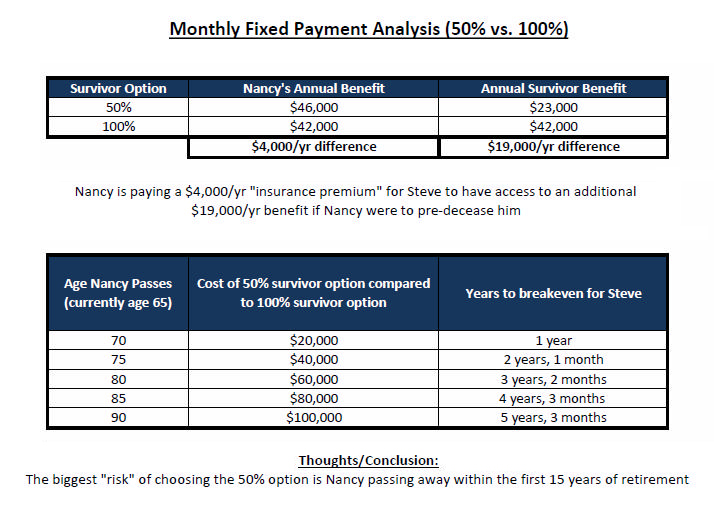
Because Nancy is a number cruncher, we created a spreadsheet to analyze the value of maintaining a larger survivor benefit, assuming she pre-dececeases Steve at various ages:

20180405a.jpg

While it’s all well and good that Steve would receive a higher continuation of benefits if Nancy passes before him under the 100% survivor option, we have to remember that there is a “cost” to this pension option ($4,000/yr lower payout compared to the 50% survivor option). However, as the table above shows, it does not take long at all for Steve to “break even” on the cost of the $4,000/yr “insurance premium”. 

After reviewing the numbers in detail, Steve and Nancy decided to elect the 100% survivor option.  They arrived at this decision primarily because of Nancy’s reduced life expectancy. In addition, if she does die before Steve within the first 15 years of retirement (a very likely possibility), it only takes several years for the larger survivor benefit to make up for the lower pension payment Nancy would have received during her life, especially taking into consideration Steve’s good health.  

As you can see from our example, many factors come into play when selecting a pension benefit and survivor option. While it might be human nature to ask which option is best, unless we have the proverbial crystal ball to look into the future and see what life has in store for us over the next 30+ years, it’s impossible to provide a concrete answer.

When evaluating pension options, my number one goal as a fiduciary advisor is to provide a sound recommendation that aligns with your own personal situation and retirement goals. If our team can be a resource for you in evaluating your pension decision, please feel free to reach out to us.  

See Part 2 of the series, What You Need to Know About Pension Benefit Guaranty Corporation or PBGC. Part 3 Explaining the What is "Restore" Option for Pensions I invite you to listen to a replay of my webinar from April 24th at 1:00 pm on Retirement Income Planning: How Will You Get Paid in Retirement?  

The case study and accompanying chart have been provided for illustrative purposes only. Individual cases will vary


Nick Defenthaler, CFP® is a CERTIFIED FINANCIAL PLANNER™ at Center for Financial Planning, Inc.® Nick works closely with Center clients and is also the Director of The Center’s Financial Planning Department. He is also a frequent contributor to the firm’s blogs and educational webinars.


Choosing a Down Payment Option on a House: Beyond the Numbers

Contributed by: Robert Ingram Robert Ingram

20180403.jpg

Whether you’re buying your first home, looking to downsize or are considering that ultimate dream house, you’re probably facing a couple of common questions. How much should I put down on the purchase?  How much should I finance through a mortgage?  A 20% down payment is typically recommended as a good starting point because amounts less than 20% will likely subject you to private mortgage insurance (PMI) in most conventional loan programs, which increases your mortgage payment.  However, as financial planners we’re often asked if it makes more sense to put down larger amounts and carry smaller mortgages, or to keep those extra funds and invest them.

Making a larger down payment

There are several benefits to increasing the amount you put down on your home purchase.  Having a smaller mortgage balance that you repay over time lowers your monthly payment.  This can provide more flexibility in and control over your monthly budget with smaller portions being committed to servicing debt. 

The smaller mortgage also means you will pay less interest on your loan.  For example, if you put an additional $25,000 down on your home purchase, you are borrowing $25,000 less and you save interest that you would be paying had you borrowed it.  This interest cost savings is like a return on the $25,000 that you are not borrowing.

There are, however, some important considerations when taking more of your assets and putting them towards the home purchase.

  • Those resources are no longer as accessible for your other needs or financial goals. Is your cash reserve still intact in case of unexpected emergencies? Would you still be on track to retire or to fund that college plan?

  • Changes to your financial circumstances or in the economic environment could make it difficult to access the equity in your home through future borrowing. Unfortunately, we saw this all too often during the financial crisis in 2008-2009 when many banks and lending institutions cut home equity lines of credit and drastically tightened their lending standards.

  • Having to fall back on other assets such as your qualified retirement plans or IRA accounts could result in additional taxes and/or early withdrawal penalties depending on your age and other circumstances. Not only could this negate some of the cost savings from making the larger down payment, but it may also derail your retirement.

Smaller down payment and investing the difference

Choosing to make a smaller down payment and investing the additional dollars rather than adding them to the down payment can make sense financially if a key assumption holds true. This assumption is that your investment’s returns outperform the interest cost of your mortgage.  Consider a bank that pays depositors an interest rate (its borrowing cost) and then lends those funds to borrowers for a charged interest rate (its investment return).  If the bank pays 2% interest to depositors and earns 5% interest on the money it lends, its potential earnings exceed its costs, a profitable financial move.

A risk to this strategy of investing the additional funds in lieu of a larger down payment, however, is that earning the required investment return is not guaranteed.

When thinking about making the investment decision, there are some important points to consider.

  • What kind of investor are you?
    Investors should have the appropriate risk tolerance and willingness to invest in a portfolio of different asset categories that may provide the opportunity to earn their required rate of return long-term. For very conservative investors it may be more difficult for their portfolios to outperform the mortgage interest costs. (It may be especially difficult if the mortgage interest rates are higher than historical averages)

  • Following your investment strategy also takes discipline over the long-term.
    It can be challenging to avoid some of the emotional buying and selling decisions that in hindsight can lead to under-performance, and to keep your investments invested.

  • How do you handle debt?
    If the mortgage without the larger down payment is not a burden to your cash flow and you have been successful in limiting other forms of consumer debt, this strategy may fit. If you are prone to getting overextended or have a large part of your budget allocated to paying off debt, reducing your potential mortgage debt may be the appropriate option.

As you can see, many factors can play into the down payment decision depending on your own unique circumstances and values.  As always, consult your planner when considering these financial moves.  We are here to look at the big picture to help you make confident decisions.

Robert Ingram is a Financial Planner at Center for Financial Planning, Inc.®


Any opinions are those of Bob Ingram and not necessarily those of Raymond James or RJFS. Information contained herein was received from sources believed to be reliable, but accuracy is not guaranteed. Information provided is general in nature, and is not a complete statement of all information necessary for making an investment decision, and is not a recommendation or a solicitation to buy or sell any security. Asset allocation and diversification do not ensure a profit or protect against a loss. Past performance is not indicative of future results. Investing always involves risk and you may incur a profit or loss. No investment strategy can guarantee success. Raymond James Financial Services does not provide advice on tax, legal or mortgage issues. These matters should be discussed with an appropriate professional.