Investment Process

Diversification: Timeless and Yet Misunderstood

Shopping cart full of different investment products to represent diversification

Tim Wyman Contributed by: Timothy Wyman, CFP®, JD

Print Friendly and PDF

As I was thinking about this topic, I revisited some excellent Morningstar research on portfolio diversification and investor behavior, which helped inspire a few of the ideas discussed below.

Have you ever noticed that the investments getting the most attention are almost always the ones investors wish they owned more of?

One year it's technology stocks. Another year it's artificial intelligence. Sometimes it's real estate, gold, international markets, or whatever happens to be leading the headlines. The temptation is understandable. When one area of the market is soaring, it can feel like the obvious place to invest.

The problem is that today's winners are rarely obvious in advance.

That's one of the reasons diversification remains one of the most important, and often most misunderstood, principles in investing. It won't always produce the highest return in any given year. In fact, there will be times when diversification feels frustrating because part of your portfolio is inevitably lagging behind. But over the long run, a thoughtfully diversified portfolio can help investors stay disciplined, manage risk, and improve the odds of achieving the goals that matter most.

One of the interesting things about investing is that some of the best decisions rarely feel like the most exciting ones.

Diversification is a perfect example.

Most people have heard the phrase, "Don't put all your eggs in one basket." While that's a good starting point, true diversification is about much more than simply owning a bunch of different investments.

In fact, it's possible to own several mutual funds or ETFs and still not be very diversified if they all behave similarly or own many of the same companies. Diversification isn't about the number of investments you own. It's about owning investments that respond differently to changing economic and market conditions.          

Said another way, effective diversification is really about correlation. Assets don't need to rise and fall in opposite directions all the time, but they shouldn't all react exactly the same way to every market event. The greatest diversification benefits often come from owning investments with lower or even negative correlations, meaning some parts of the portfolio may hold their value or even appreciate when other areas are under pressure. Over time, that interaction can help smooth returns and reduce the impact of major market declines.

The challenge is that diversification can feel frustrating at times.

A properly diversified portfolio will almost always have something in it that isn't performing particularly well. When large technology stocks are surging, bonds may seem unnecessary. When U.S. stocks are leading the way, international investments may appear to be lagging behind. It's natural to wonder why we own certain positions when something else is grabbing all the headlines.

Ironically, that's often a sign that diversification is doing exactly what it's supposed to do.

One of the conversations we frequently have with clients is the difference between chasing the highest possible return and building a portfolio designed to help achieve their most important goals. Most families aren't investing to win a performance contest. They're investing to retire comfortably, support children and grandchildren, fund charitable causes, preserve their purchasing power, and create long-term financial security.

In nearly 30 years of working with families, I've rarely seen a financial plan fail because a client didn't own enough of the year's best-performing investment. More often, problems occur when investors take concentrated risks that don't work out as expected.

A portfolio that experiences fewer extreme outcomes may be more likely to help achieve those goals than one concentrated in a single asset class, sector, or investment theme. For example, a 50% loss requires a 100% return just to get back to your starting point. A 15% decline, on the other hand, requires only about a 17.6% gain to recover. This is one of the reasons we spend so much time managing downside risk. While investors naturally focus on returns, avoiding large losses can have an even greater impact on long-term wealth accumulation. Our objective isn't to eliminate volatility, which is impossible, but rather to help clients avoid the type of losses that can permanently derail a financial plan.

Recent years have provided plenty of reminders of why diversification matters. Different asset classes have taken turns leading the market. There have been periods when U.S. stocks dominated, periods when international markets outperformed, and periods when bonds, real estate, commodities, or gold provided meaningful benefits. The problem is that very few people consistently predict which asset class will be next in line.

Diversification acknowledges that reality. Instead of trying to guess the next winner, it recognizes that nobody knows with certainty what the next few years will bring.

Of course, diversification doesn't eliminate risk, and it certainly doesn't guarantee positive returns. Markets will always experience periods of volatility. However, diversification remains one of the most effective tools investors have for balancing growth opportunities with prudent risk management.

In the end, successful investing is rarely about finding the one investment that outperforms everything else. More often, it's about building a collection of investments that can work together through a variety of market environments.

The best portfolios are not always the ones that generate the highest return in any single year. More often, they're the ones that help investors stay disciplined, remain invested during difficult periods, and ultimately achieve the goals that matter most.

And that's really what diversification is all about.

Timothy Wyman, CFP®, JD, is the Managing Partner and CERTIFIED FINANCIAL PLANNER™ professional at Center for Financial Planning Inc.® Tim earned a place on Forbes’ Best-In-State Wealth Advisors List in Michigan¹ in 2026 for the ninth consecutive year.

Any opinions are those of the author and not necessarily those of Raymond James. There is no guarantee that these statements, opinions, or forecasts provided herein will prove to be correct. This material is being provided for information purposes only and is not a complete summary of all available data necessary for making an investment decision and is not a recommendation. Investing involves risk, and investors may incur a profit or a loss regardless of strategy selected. No investment strategy can guarantee your objectives will be met. Past performance may not be indicative of future results. Prior to making an investment decision, please consult with your financial advisor about your individual situation.

Finding the Perfect Mix: How to Build the Right Asset Allocation for You

The Center Contributed by: Center Investment Department

Print Friendly and PDF

Most delicious meals start with a great recipe. A recipe tells you which ingredients to use — and how much of each — to create something satisfying. In the same way, successful investing begins with understanding the right mix of assets that can help you reach your goals and stay comfortable along the way. Just as tastes and ingredients change or are tweaked over time, markets are ever evolving, so what has worked in the past may need periodic adjustments and thoughtful updates.

Determining the Right Mix

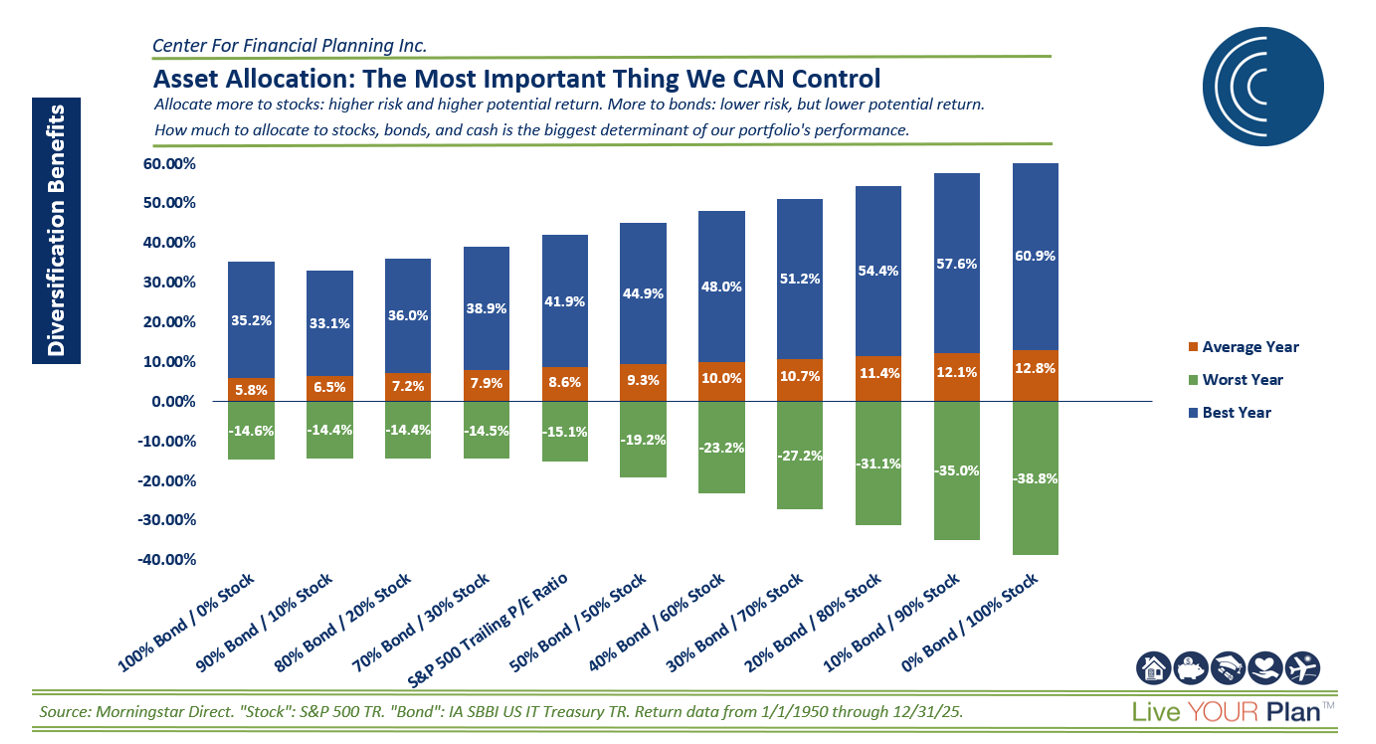
Asset allocation remains one of the most important drivers of long‑term investment outcomes and one of the few things investors can influence. It’s the foundational blend of stocks, bonds, and cash that shapes how your portfolio behaves, so choosing the right mix matters. This concept is perfectly depicted in the chart below, created by my colleague, Nick Boguth, CFA®, CFP®. This chart illustrates different asset allocation mixes and how they have historically produced varying ranges of outcomes. Portfolios with higher stock allocations have experienced higher best‑year returns but also greater drawdowns in worst‑year periods, while more conservative allocations (those with higher bond allocations) have shown narrower return ranges. This really highlights the trade‑off between risk and return that investors should consider when constructing a portfolio.

Visual chart illustrating how different asset allocation mixes of stocks and bonds impact best‑year, average‑year, and worst‑year investment returns, highlighting the tradeoff between risk and potential reward

Now, choosing that mix may look different today than it did several years ago—it’s not static. And it might look different again in the future. To determine what will work best for you, start by answering three core questions:

  1. What are my financial goals?

  2. When do I need to achieve them?

  3. How much will I be investing now — and over time — to support those goals?

Seasoning to Taste: Understanding Your Risk Tolerance

Even the perfect recipe can fall flat if it doesn’t match your palate. The same is true with investing. Imagine the equity market falls 20%. Would you feel tempted to sell stocks and flee to bonds or cash? Whether we like it or not, volatility has become a constant feature of today’s market environment, driven by changes in inflation, Federal Reserve policy shifts, and global uncertainty. We need to take these factors along with others, into consideration, and this is where risk tolerance comes into play. Understanding your comfort level with volatility and loss helps you select an allocation you can stick with, especially during challenging periods. When evaluating your tolerance, consider the risks and rewards associated with different investment types, how you react to market stress, how much loss you could tolerate for long term gains, and whether your emotions align with your strategy. Your feelings and behaviors matter just as much as the math.

Following the Recipe: Staying Disciplined

Just like sticking closely to a recipe produces more consistent results, staying committed to your asset allocation greatly increases your chances of long‑term success. But don’t get me wrong—it isn’t always easy!

Temptations to chase performance, react to alarming headlines, or invest in the “next big thing” are always present. Emotional responses to market swings, fear of missing out, and short‑term noise can all pull investors away from a thoughtfully designed plan, and often at exactly the wrong time. Over time, these small deviations can meaningfully change the risk and return profile of a portfolio. Several basic practices can help reinforce discipline and keep your plan on track:

  • Diversification: Spreading investments across asset classes and regions can help manage risk‑adjusted returns and potentially reduce reliance on any single outcome.

  • Regular Rebalancing: Periodically resetting your portfolio helps manage risk, maintain alignment with your goals, trim positions that have grown too large, and add to areas with future potential.

  • Dollar‑Cost Averaging: Investing consistently over time can help reduce the impact of market volatility and remove the pressure of timing decisions.

Bringing It All Together

We believe finding the right asset allocation is one of the most important steps in building a sound investment plan. By clarifying your goals, timeline, resources, and risk tolerance, you can create a mix that works for you.

Markets will continue to change, but the fundamentals don’t. Define your recipe, understand your palate, and follow the process with discipline. A consistent approach may help support long term investment objectives.

Securities offered through Raymond James Financial Services, Inc., member FINRA/SIPC. Investment advisory services are offered through Raymond James Financial Services Advisors, Inc.

Center for Financial Planning, Inc. is not a registered broker/dealer and is independent of Raymond James Financial Services.

This information is not a complete summary or statement of all available data necessary for making an investment decision and does not constitute a recommendation. Any opinions are those of the author and are not necessarily those of RJFS or Raymond James. Every investor’s situation is unique and you should consider your investment goals, risk tolerance and time horizon before making any investment or investment decision. Investing involves risk, investors may incur a profit or loss regardless of strategy or strategies employed. Asset allocation does not ensure a profit or guarantee against a loss.

Dollar-cost averaging cannot guarantee a profit or protect against a loss, and you should consider your financial ability to continue purchases through periods of low price levels.

"Staying the Course" Isn’t a Snooze Button

Mallory Hunt Contributed by: Mallory Hunt

Print Friendly and PDF

"The key to making money in stocks is not to get scared out of them." – Peter Lynch

When it comes to investing, the phrase "stay the course" is practically gospel. It's repeated in market downturns, shared in financial blogs (this may currently resonate…), and printed on motivational coffee mugs. And rightly so—emotional decisions are one of the biggest threats to long-term investment success. While staying the course is a powerful mindset for long-term investors, it can often be seen as a call for inaction, and you very well may be sick of hearing the phrase, but it's not inaccurate. Just like a plane on autopilot still needs a pilot in the cockpit, your portfolio still needs your eyes—just not your panic.

Staying the Course ≠ Doing Nothing Forever

Yes, staying invested during market volatility is usually the right move, but does that mean your investments should go untouched for decades? Of course not. Your financial life isn't static, nor is the world around you. Life changes. Goals shift. The markets evolve. And your investment strategy needs to reflect that. Think of your portfolio as a garden. Staying the course means letting your plants grow, not digging them up every time a storm rolls in. BUT it doesn't mean ignoring weeds, forgetting water, or never pruning. Good gardeners check in regularly—so should good investors.

This chart below, created by my colleague, Nick Boguth, effectively illustrates the undeniable relationship between risk and return. While drawdowns can be unsettling, we are here to provide guidance and support during these uncertain periods. However, it is important to notice that significant periods of volatility are often followed by substantial growth. The blue line below signifies how markets have continued to grow despite volatility and drawdowns (orange line). While those drawdowns can be deep and painful to live through in the moment, you can see that they tend to be only temporary

What Staying the Course Really Means

It means sticking to a well-thought-out plan, not ignoring it altogether. It means:

  • Rebalancing regularly – Markets move, and over time, your portfolio drifts from its original allocation. Rebalancing brings it back in line with your risk tolerance and goals. Luckily, we are already doing this for you! We review accounts frequently throughout the year and rebalance when they deviate from your set goals.

  • Reviewing goals and timelines – Are you still saving for that early retirement? Has your timeline changed? Are you nearing a big purchase? Your investments should reflect those life updates. Guess what? We do this for you, too! These items are usually discussed during your Annual Review Meetings with your planner.

  • Avoiding emotional reactions – This one remains true. Don't let headlines or temporary downturns dictate your moves. We know this can be difficult, but again, staying calm isn't the same as being passive. We are always available to answer any questions that you may have.

The Bottom Line

Staying the course is about consistency, not complacency. The most successful investors stay engaged, review their plans periodically, and always keep the big picture in mind. So no, you don't need to micromanage your portfolio every week, but it shouldn't be stashed away or forgotten. Check in, stay informed, and above all else, trust the process.

Mallory Hunt is a Portfolio Administrator at Center for Financial Planning, Inc.® She holds her Series 7, 63 and 65 Securities Licenses along with her Life, Accident & Health and Variable Annuities licenses.

The information contained in this blog does not purport to be a complete description of the securities, markets, or developments referred to in this material. The information has been obtained from sources considered to be reliable, but we do not guarantee that the foregoing material is accurate or complete. Any opinions are those of Mallory Hunt and not necessarily those of Raymond James. There is no guarantee that these statements, opinions or forecasts provided herein will prove to be correct. Investing involves risk and you may incur a profit or loss regardless of strategy selected. Every investor's situation is unique and you should consider your investment goals, risk tolerance and time horizon before making any investment. Prior to making an investment decision, please consult with your financial advisor about your individual situation.
The Asset Allocation That Is Right For YOU

Print Friendly and PDF

The Center’s investment committee meets every month, and one of the most regularly discussed topics is the “Strategic Allocation” of our portfolios. The Strategic Allocation is what proportion of our portfolios should, at the highest level, be invested in stocks versus bonds. Then, beyond that, what proportion of the equities should be in large capitalization stocks, small cap, internationally developed, emerging market, and alternative equity asset classes. The same thing on the bond side of the equation when thinking about the proportion of bonds that should be in “core” bond asset classes like treasuries, high-grade corporates, and asset-backed bonds compared to riskier bonds such as high yield, emerging market, long duration, or alternative bond asset classes.

Those discussions may not sound entertaining to you, but we get very energized and spend a lot of time on them because asset allocation is probably the most important decision anyone can make as an investor. This is also why we write about it extensively (sometimes spicing it up with fun analogies…).

I recently listened to a podcast on nutrition and healthy eating habits and couldn’t help but notice the similarities between that topic and asset allocation. The guest on the podcast explained that there is no perfect one-size-fits-all diet for everyone. The ideal diet is the one that gets you to maintain your healthy target weight goal and the one that you will stick with for your ENTIRE life. A quick-fix diet can help with short-term goals, but if you go back to your original diet, there is a good chance that progress will fade. The same goes for investing. 

As financial advisors and portfolio managers, we are committed to helping you create the portfolio that successfully gets you to your target financial goal, AND to find the strategy that you will stick with for your entire investing life. Your asset allocation is useless if you are not committed to it, make changes every time there is a market headline or upcoming election, if it causes more stress than relief, or feel like you can’t take it anymore and would instead hold all cash. Quick fixes, reactive decisions, investing in the hottest asset class of the year, or moving to cash may (or may not) lead to short-term gains, but there is a good chance that progress will fade. Creating a strategy and asset allocation with the intention that you know you will stick with AND will get you to your desired goal is key. 

Many factors will help determine what asset allocation is right for you, and we are here to help you figure out what those are – then implement them all the way through your successful financial plan. How much growth do you need from your portfolio? How much income do you need your portfolio to produce? How much volatility are you comfortable with in your portfolio? Do you have things that you want to invest in that we have to work together to fit into your asset allocation? These are just a few questions we want to work with you to answer. Please don’t hesitate to reach out if you’d like us to help you find your ideal asset allocation or implement it.  

Nicholas Boguth, CFA®, CFP® is a Senior Portfolio Manager and Associate Financial Planner at Center for Financial Planning, Inc.® He performs investment research and assists with the management of client portfolios.

Securities offered through Raymond James Financial Services, Inc., member FINRA/SIPC. Investment advisory services are offered through Raymond James Financial Services Advisors, Inc.

Center for Financial Planning, Inc. is not a registered broker/dealer and is independent of Raymond James Financial Services.

This information is not a complete summary or statement of all available data necessary for making an investment decision and does not constitute a recommendation. Any opinions are those of the author and are not necessarily those of RJFS or Raymond James. Every investor’s situation is unique and you should consider your investment goals, risk tolerance and time horizon before making any investment or investment decision. Investing involves risk, investors may incur a profit or loss regardless of strategy or strategies employed. Asset allocation does not ensure a profit or guarantee against a loss.

Investor Basics: Intro to Fundamental Analysis

Contributed by: Nicholas Boguth Nicholas Boguth

There are two major types of analysis when it comes to investing: Technical Analysis, which you can read more about in Angela Palacios', CFP®, Investor PhD blog, and Fundamental Analysis, which I will break down for you right now.

Ultimately, fundamental analysis is an evaluation of the financial position and performance of a company or strategy.

When doing fundamental analysis on a stock, the process involves breaking down all of the quantitative information found on the company’s financial statements. Digging into a company’s balance sheet tells you about their current position as it pertains to assets, liabilities, and shareholders’ equity. The information on income statements and statements of cash flow reveals how the company has performed, or how much expense, revenue, or profit it generated. Fundamental analysis also involves looking at qualitative factors such as management, the business model, accounting practices, and competitors. All of this data is then analyzed, compared to peers, and used to make an investment decision.

The graphic above lays out The Center’s investment selection process. You will see that there is both quantitative and qualitative fundamental analysis done when choosing the strategies in our model. The process is slightly different when comparing all strategies as opposed to only stocks, but the same considerations have to be taken into account before making an investment decision. We look at quantitative factors such as manager tenure, ownership, costs, risk metrics, and return metrics, just to name a few. We also look at a vast amount of qualitative information about the fund companies, managers, and investment team. Fundamental analysis is step one to selecting each individual strategy for our portfolios. If you have questions on how we build portfolios or fundamental analysis, please reach out to our investment team!

Nicholas Boguth is an Investment Research Associate at Center for Financial Planning, Inc.® and an Investment Representative with Raymond James Financial Services.


The information contained in this blog does not purport to be a complete description of the securities, markets, or developments referred to in this material. The information has been obtained from sources considered to be reliable, but we do not guarantee that the foregoing material is accurate or complete. Any opinions are those of Nick Boguth and not necessarily those of Raymond James. Expressions of opinion are as of this date and are subject to change without notice. There is no guarantee that these statements, opinions or forecasts provided herein will prove to be correct. Investing involves risk and you may incur a profit or loss regardless of strategy selected. Every investor's situation is unique and you should consider your investment goals, risk tolerance and time horizon before making any investment. Prior to making an investment decision, please consult with your financial advisor about your individual situation.

Benefits of Process - 1st Quarter 2012

invcom_process.jpg

Investors are prone to periods of underperformance regardless of strategy. The response to underperformance is an important consideration for the investor's future success. Nobel Prize winning behavioral psychologist points to process:

"Organizations are better than individuals when it comes to avoiding errors, because they naturally think more slowly and have the power to impose orderly procedures." ~ Thinking, Fast and Slow, Daniel Kahneman, 2011.

At Center for Financial Planning, we have an investment committee dedicated to upholding the very processes that hedge us as investors from common pitfalls while maintaining customized financial planning solutions for each client's unique situation. There are checks and balances so that changes for investments don't occur willy-nilly. Parameters anticipating discussion of process change are documented within our written procedure. Please click here to read the full post at Money Centered.

The information contained in this report does not purport to be a complete description of the securities, markets, or developments referred to in this material.  Any information is not a complete summary or statement of all available data necessary for making an investment decision and does not constitute a recommendation.  Any opinions are those of Center for Financial Planning, Inc., and not necessarily those of RJFS or Raymond James.