Charitable Giving: Why Do We Give?

 Tax-deductible charitable donations are a great way to get even more deductions on your tax return. By itemizing those donations to qualified charities on your 1040 Schedule A, you may be able to reduce your taxable income. In her ‘Tis the Season to Give blog written late last year, Julie Hall, CFP® outlined the different ways to give on a tax-efficient basis.  But aside from the attractive benefit of potentially lower taxes, why do we give to charities?

Individuals give to charities for many different reasons:

  • Support a Personal Connection– We may know someone who works for a charity or benefits from the organization in some way (i.e. a relative is a breast cancer survivor, so a donation to the Susan G. Komen Foundation feels like the right way to give back).
  • Support Society as a Whole – We may feel like, because we are fortunate to be financially comfortable, we should do our part and give back to those who are less fortunate (i.e. a local food bank).
  • Support a Cause We Truly Believe In – We have a passion for a cause (i.e. animal lovers may choose to support the Humane Society).
  • Support an alma mater – We give back to our local high school or college as a “thank you” for the educational experience.
  • Support a Religious Affiliation – We tithe to our church on a local, national, or international level.

If you’ve made the conscious decision to give to charities, it is important to (1) research the charities you’re interested in to make sure that they are legitimate and that your donations will be used responsibly for the intended cause and (2) track your giving and communicate your giving plan to your family.

In my next post, I will take a closer look at the best ways to research your charities.

Elections and the Market

 It's election season…again!  While the mudslinging between candidates and special interest groups ramps up, how will the stock markets react? 

History suggests that investors can benefit from paying attention to the presidential election cycle.  Yale Hirsch, a stock market historian and the creator of the Stock Trader’s Almanac, has developed the presidential election cycle theory.  This study, among others, supports evidence that there is a significant relationship between the presidential cycle and the stock market.  

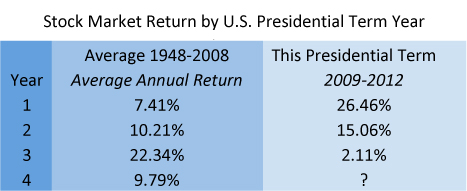
Here is what returns look like on the average election cycle verses our current election cycle:

Source: S&P500 Total Return Index

Year 1: The Post-Election Year
Of the four years in a presidential cycle, the first-year performance of the stock market, on average, is the worst; however, so far with the current administration, it has been the best. We recovered sharply immediately following the financial crisis of 2008.

Year 2: The Midterm Election Year
The second year, although historically better than the first, this time has trailed the strong performance of the first year.

Year 3: The Pre-Presidential Election Year
The third year (the year proceeding the election year) is the strongest on average of the four years, but with the European concerns, ended up being the worst of the cycle so far.

Year 4: The Election Year
In the fourth year of the presidential term and the election year, the stock market's performance tends to be above the overall average.

While the current cycle seems to be turned on its head, it is still worth exploring different election scenarios and how they affect the markets.

  • What if a Democrat wins? What if a Republican wins?
  • What if the race is close? What if it is a landslide?
  • Can the stock market predict an election winner?

While the candidates are busy posturing for the election, we will explore some scenarios and how to posture your portfolio accordingly in the coming weeks.


The S&P 500 is an unmanaged index of 500 widely held stocks that’s generally considered representative of the U.S. stock market.  Keep in mind that individuals cannot invest directly in any index, and individual investor’s results will vary.  Past performance does not guarantee future results.  The information contained in this report does not purport to be a complete description of the securities, markets, or developments referred to in this material.  The information contained in this report does not purport to be a complete description of the securities, markets, or developments referred to in this material.  The information has been obtained from sources considered to be reliable, but we do not guarantee that the foregoing material is accurate or complete.  Any information is not a complete summary or statement of all available data necessary for making an investment decision and does not constitute a recommendation.  Any opinions are those of Center for Financial Planning, Inc., and not necessarily those of RJFS or Raymond James.

You’ve Signed Your Trust Document. Now What?

 Congratulations!  You have finally gotten your estate planning in order.  After years of procrastination, you went to see an attorney (one who specializes in estate planning) and had your important documents drafted, including a Revocable Living Trust.   Your attorney no doubt shared that one of the main reasons that a Revocable Living Trust is a good planning tool is so you (or, really, your heirs) can avoid the time and money to go through the probate process.  So, you signed or executed your new Revocable Living Trust and you are done – or are you? 

In order to truly avoid probate there is another critical step that many people (and even some attorneys) unfortunately skip.  Once your Revocable Living trust is in place, there is a process known as “funding your trust” that is just as important as signing.  Funding a trust is a process where you, preferably with the help of your attorney, make sure that your taxable assets are owned by the trust.  If your assets are not owned by the trust at death – probate will most likely be required.   

Funding a trust may include: 

  • Re-titling property such as a house to your trust via a Quit Claim or Warranty Deed
  • Re-titling your taxable investment accounts such as a brokerage account to your trust
  • Updating beneficiaries of IRA’s, 401k’s and life insurance (assets such as an IRA or 401k cannot technically be “owned” by your trust)

If you don’t follow through and “fund” your trust, chances are you might have purchased really expensive paper from your attorney.  

One last note:   As you acquire new property or open new investment accounts, be sure to consider whether the trust should own or be a beneficiary of the asset.

Please discuss legal matters with the appropriate professional.

Live From Orlando: Top Advisors Tell All on Junior Partners

Registered Rep: by Diana Britton on May 22nd, 2012

Advisor panel speaks about adding junior partners at conference.The worst thing you can do when bringing on a junior partner is to immediately anoint them as heir apparent, said Daniel Boyce, FA and founding partner of the Center for Financial Planning in Southfield, Mich. “That is backwards in my estimation,” Boyce told attendees of Raymond James Financial Services’ National Conference for Professional Development in Orlando, Fla.

Any potential partner needs to earn their right to sit at the table with the partners, Boyce said. Give them the opportunity, but wait for them to step into that opportunity before you give them that reward.

Boyce, head of a $700 million AUM firm, joined other top advisors on a panel session discussing the dos and don’ts of recruiting junior partners. Boyce just brought on a new partner recently, Melissa Joy, who joined the panel to share her insights.

Boyce’s motivation in bringing on Joy was not to transfer clients over to her, as his firm already had an ensemble practice in place for that. The age differential was the motivator; he wants successors of different generations. Joy is in her 30s, he said.

Todd Sanford, branch manager of Sanford Financial Services in Portage, Mich., said his return on investment in bringing Scott Williams into his practice was so high that it would probably rival buying Apple a decade ago.

For Sanford, bringing on a younger partner was a tool for expanding the firm’s generation reach, as Williams could work with people with similar life experiences and serve younger people referred to the firm.

But you can’t just hire a junior partner the moment you need them, Sanford said. You’ve got to hire that person years before you need them.

Boyce said his role at the firm has changed over the years, to become a mentor for planners and staff. He says that role is probably the most satisfying for him, and it’s also the most important. Boyce says you can’t view your staff as an expense, but an investment.

“It’s the human capital that is your biggest asset and resource.”

Do you agree?

Kacy Wyman Fun Run Recap & Thanks!

The weather was fantastic May 6th, 2012 for the 6th Annual Cystinosis Fun Run. With the sun shining, people and pooches gathered to support Kacy Wyman, who continues her journey with Cystinosis, for a 5K Fun Run, Walk and Bike event. More than 300 people participated raising over $20,000! 

"Our gratitude is immeasurable for the amount of support we have received and continue to receive," says Tim Wyman. "The Fun Run is just one example of that support."

The Detroit Free Press ran an article May 13th, 2012 about the event and Kacy's journey. Click here to read.

Research Trip to Wall Street

In April, Dan Boyce and Melissa Joy joined a small group of financial planners for three days visiting Wall Street Firms. With an exclusive group of 30 participants from around the country, discussions were highly interactive. The main focus of the meetings was on Asset Allocation and Portfolio Construction in today’s market environment. Main sessions were held at Blackrock, JP Morgan Asset Management, and Goldman Sachs Asset Management.

The low interest rate environment and future return scenarios for bonds was an enduring theme across firms. It was interesting to see different strategies and perspectives based upon individual firms. Perhaps not surprisingly, the European debt crisis was also a dominant topic. We also always find value of being able to “look under the hood” of financial firms on their turf.

In addition to the larger group meeting, Melissa visited portfolio managers at IVA and American Century. Intellectual curiosity is a cornerstone of our research process and an important component to our investment committee decisions is hands-on due diligence. One of the highlights of the trip was sharing ideas with other financial planners and wealth management firms. We value insights from our peers and are always open to new ideas.

Staying Connected – A Key Factor in Retirement Success

 If you ask most pre-retirees to describe their vision of a successful retirement, you would likely hear words such as family, friends, hobbies, and travel.  You would likely NOT hear someone express a desire to be alone and inactive.

Research shows that individuals who experience isolation and inactivity are much more likely to be diagnosed with depression, memory and other health-related problems.  One such study conducted by Lisa F. Berkman, an epidemiologist at Yale University, found that people who were not connected to others were three times as likely to die over the course of 9 years as those who had strong social ties.  Even more interestingly, the same study found that those with strong social ties and poor health behaviors lived longer than those with poor social ties and positive health behaviors. 

An expanded version of retirement planning is needed to look beyond income distribution planning and investment policy statements.  Planning to maintain vital social connections, whether they are family members, friends, church members, dance partners, etc., seems to be just as important to success in retirement as the stability of your investment portfolio.   So as you or your loved ones plan for retirement, think about exploring activities and hobbies, groups and clubs, and consider living arrangements for all of retirement, including early and later retirement.

Contact your financial planner to develop a retirement plan that includes all aspects of your financial life, especially the all-important social connections.


Source:www.hsph.harvard.edu

Transfer On Death

 Estate planning is all about getting WHAT is valuable to you distributed to WHO you want, WHEN you want after you are gone.  Getting assets distributed in an efficient and cost effective manner is also important.  Avoiding costs of money and time can be accomplished by avoiding the court system for the distribution of an estate.

Probate avoidance is a common estate planning goal for many people. And, rightfully so.  While the probate process has been simplified over the years, the fact remains that the probate process continues to be time intensive and potentially costly. In many cases, a revocable living trust is used as a financial tool to avoid probate.  Another less known vehicle is the Transfer on Death (“TOD”) designation that can be added to accounts such as bank accounts and taxable brokerage accounts.

A TOD account acts much like a beneficiary designation on an IRA, 401k or even life insurance policy.  At the owner’s death, the account bypasses probate and is paid directly to the person named on the TOD form.  Some firms may charge $50-$100 to establish a TOD, but many also provide such an account for free, making this a cost effective alternative to having a Living Trust drafted.


Any opinions are those of Center for Financial Planning, Inc., and not necessarily those of RJFS or Raymond James.