Center Office Closed in Observance of Presidents' Day

 Please note: Our offices, along with the financial markets, will be closed Monday, February 18, for the Presidents’ Day holiday. Of course, you can access your account(s) using Raymond James Investor Access at any time, year-round.

We set aside the third Monday in February so that we may reflect on the exploits of not just our first president, but all our nation’s great past leaders. But there are some things that many don’t know about these great men, some things that might cast a new light on their place in history.

So, for this Presidents’ Day holiday, reflect on these interesting facts:

George Washington’s teeth were not wooden. In fact, they were made of much sterner stuff: gold, ivory, a touch of lead and some actual animal teeth.

John Quincy Adams was quite the swimmer, as evidenced by his regular early morning skinny-dips in the Potomac.

Martin Van Buren popularized the phrase “OK” – he was from Kinderhook, N.Y., and got the nickname “Old Kinderhook,” or “O.K.,” which came to mean that everything was alright.

Millard Fillmore married his teacher – she was only two years older than him, but still.

U.S. Grant once got a speeding ticket – for riding his horse too fast through the nation’s capital.

Grover Cleveland married the same girl he had been legal guardian of since she was 11. They married in the White House when she turned 21, but still.

Woodrow Wilson is the only U.S. President with a doctorate degree. He received his Ph.D. in political science and history, naturally, from Johns Hopkins.

Warren G. Harding once lost the entire White House china collection playing poker; whereas Richard Nixon funded his first congressional campaign from his winnings at the poker table.

Jimmy Carter was the first U.S. President to be born in a hospital.


Helping Clients with Asset Allocation

 In most books that discuss asset allocation, the author will mention at some point the relevance of strategic asset allocation and it being a prominent component to the investor’s outcome, which is typically measured in volatility and return.   At the Center for Financial Planning one of our core investment beliefs works with strategic asset allocation.  We believe there is an appropriate mix of assets that can help investors pursue their personal set of goals during volatile market conditions.  

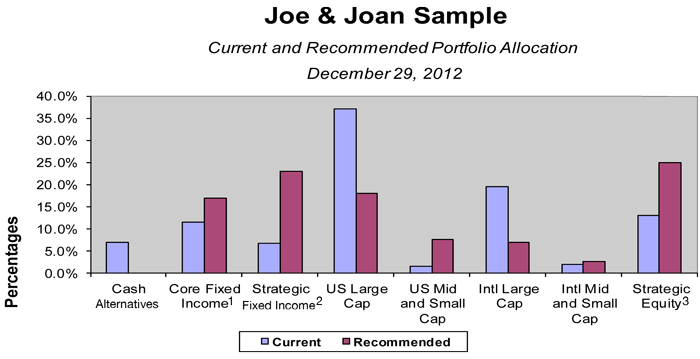
Below is a chart of a new client that recently came in for a financial plan overhaul.  You can see they had quite a difference in their current allocation to that of our recommended strategic allocation.  The current allocation in blue is overweight US Large Cap stocks and International Large Cap stocks while underweight in some of the more non-correlated assets like Strategic Income and Strategic Equity.  We were able to look over their outside investments in 401k’s, and 403b’s to help obtain what we determined to be a suitable mix, designed to keep them within their volatility comfort range as well as on track to reach their return expectations over the long haul.


These asset allocations are presented only as examples and are not intended as investment advice. Actual investor results will vary. Prior to making an investment decision, please consult with your financial advisor about your individual situation. Although derived from information which we believe to be reliable, we cannot guarantee the completeness or accuracy of the information above. Any information is not a complete summary or statement of all available data necessary for making an investment decision and does not constitute a recommendation. Investments mentioned may not be suitable for all investors. Any opinions are those of Matthew Cope and not necessarily those of RJFS or Raymond James. Investing involved risk and asset allocation does not ensure a profit or protect against a loss.
1. Core Fixed Income includes: U.S. Government bonds and high quality corporates
2. Strategic Fixed income includes: Non U.S. bonds, TIPS, less than high quality corporates and other bonds not in core fixed.
3. Strategic Equity includes: Hybrid managers, REITS, hedgeing strategies, commodities, etc.

Center Supports the IOG’s Programs to Engage and Educate Seniors

 The Center is proud of our partnership with the Wayne State University Institute of Gerontology (IOG).  The IOG is committed to engaging and educating seniors in our communities. One of their premier events is the Art of Aging Successfully Annual Senior Conference, which brings hundreds of seniors together to experience well-respected keynote speakers and break-out workshops promoting creative expression, social connection and information on ways to positively embrace all facets of aging.  In addition, time is provided to take a stroll through the Gallery Walk, which is a display of art created by local area seniors.  Sandy Adams has attended this event for the last three years and says, “Art of Aging is a wonderful event.  The energy and creativity of those that attend is inspiring.” This year’s conference will be held on Thursday, March 21, 2013, at the Greater Grace Conference Center in Detroit and is sure to be another sell-out event.  Sandy sits on the Board of Visitor’s for the Institute of Gerontology and will be representing the Center at the Art of Aging event.  To view the conference schedule or to register, go to http://www.iog.wayne.edu/seniors/art-of-aging.php.

The Magic Age of 70 ½ and Your Required Minimum Distributions

 You could call it a rite of passage … one about which you have little choice. Taking a Required Minimum Distribution from your traditional IRA can’t be sidestepped or avoided without federal tax penalty.  The IRS keeps a watchful eye on distributions and navigating through the ins and outs is a must for all retirees who reach the magic age of 70 ½.  To complicate matters, SEP IRAs and SIMPLE IRAs are also subject to the same RMD rules.  On the flip side, Roth IRAs are an exception as no distributions are required during your lifetime. 

What is a Required Minimum Distribution(RMD)? 

  • A specific minimum dollar amount that must be withdrawn every year after age 70 ½.  This number will change every year as account values change and life expectancy factors change.  RMDs are calculated by dividing your traditional IRA or retirement plan account balance (as of December 31 of the year prior to the calendar year during which the distribution must be made) by a life expectancy factor specified in IRS tables.  
  • You can always withdraw MORE, but if you withdraw LESS you will be subject to federal penalty.
  • RMD rules are designed to spread out IRA account distributions over your lifetime. 

Here’s the question I get asked most about RMD’s: “When must it be taken?” 

The short answer is the year you reach age 70 ½.  However, questions usually pop up because the RMD can be taken during the year you reach 70 ½ OR you can delay it until April 1st of the following year.  

For example

  • Your 70th birthday is December 2, 2012, so you will reach 70 ½ in June of 2013.
  • You can take your first RMD during 2013, or you can delay it until April 1, 2014. 
  • If you choose to delay until 2014, you will have to take two distributions during 2014 – one for 2013 and one for 2014.   

From a financial planning perspective, you might delay taking your first distribution if you expect to be in a lower income tax bracket in the following year, perhaps because you’re no longer working or will have less income from other sources.  On the other hand, receiving your first and second RMDs in the same year will increase income and could possibly push you into a higher federal income tax bracket for that year.  So the decision about whether to delay your first required distribution can be important, and should be based on your personal tax situation.


This post contains general information meant to raise awareness of the importance of taking Required Minimum Distributions even if you don’t need or want the income.  Since RMD rules are very specific and IRS penalties punitive, my advice is to talk with your financial advisor or tax preparer to ensure you are meeting the annual distribution requirement.

Looking Ahead: 2013 Financial Planning Opportunities

Check out our recently published presentation that addresses some of today's most relevant financial topics.  The content focuses on retirement planning, income and estate tax changes and general advice provided by your Center team. Please feel free to contact a Center planner with questions or inquiries. In addition, you should discuss any tax or legal matters with the appropriate professional.

Giving Charitably and Doubling Your Tax Benefit

 Many of you are inclined to make large charitable contributions by writing a check.  If the cash is not already sitting in cash, you many need to go to your taxable investment account to determine what to liquidate to create the cash for the donation.  Sure, this can provide you with an itemized deduction to potentially decrease your taxable income*, but might there be a way to make an even bigger impact on your current and future tax liability?

If you hold appreciated stocks or mutual funds in a taxable investment accounts, why not try to avoid paying capital gains tax when you sell to create the cash for your charitable donation?  Did you know that most charitable organizations, including churches and synagogues, can accept a donation of shares of a stock or mutual fund as a gift?  And did you know that in donating this way, you  can avoid paying capital gains tax on a security, and so can the qualified non-profit receiving organizations? 

So, by using an appreciated security, not only can you avoid capital gains tax that could be significantly higher than the 15% top rate we’ve had in recent years, but you may retain the right to use the value of the security donated as an itemized deduction. Double bonus!  (Triple bonus if this also allows you to tax-efficiently reduce an over-weighted position in your portfolio).

Before you write that big check to your favorite charity, consult your financial planner and tax advisor to see if opportunities exist to double your tax benefit by using appreciated securities instead.

This is how the capital gains rates look under the American Taxpayer Relief Act:

0% Capital Gains: 

Those in the 15% marginal tax bracket ($36,250 single filers/$72,500 married filing jointly)

15% Capital Gains:

Those in the 25%, 28%, 33%, or 35% marginal brackets

Those over $200,000/$250,000 but below $400,000/$450,000 are subject to the Medicare surtax, which means that effectively capital gains (and qualified dividends) are taxed at 18.8%

20% Capital Gains:

Those in the 39.6% marginal bracket ($400,000/$450,000).  Because of the Medicare surtax, this means that effectively, capital gains (and qualified dividends) are taxed at 23.8% (and up to 26% during the personal exemption and itemized deduction phase outs).

Sandra Adams, CFP® is a Financial Planner at Center for Financial Planning, Inc. Sandy specializes in Elder Care Financial Planning and is a frequent speaker on related topics. In 2012 and 2013, Sandy was named to the Five Star Wealth Managers list in Detroit Hour magazine. In addition to her frequent contributions to Money Centered, she is regularly quoted in national media publications such as The Wall Street Journal, Research Magazine and Journal of Financial Planning.


Five Star Award is based on advisor being credentialed as an investment advisory representative (IAR), a FINRA registered representative, a CPA or a licensed attorney, including education and professional designations, actively employed in the industry for five years, favorable regulatory and complaint history review, fulfillment of firm review based on internal firm standards, accepting new clients, one- and five-year client retention rates, non-institutional discretionary and/or non-discretionary client assets administered, number of client households served.

*Note that the American Taxpayer Relief Act of 2012 implemented a phase out of itemized deductions for taxpayers with taxable income of over $250,000 for single filers/$300,000 married filing jointly.

The information has been obtained from sources considered to be reliable, but we do not guarantee that the foregoing material is accurate or complete.  Any information is not a complete summary or statement of all available data necessary for making an investment decision and does not constitute a recommendation.  Any opinions are those of Center for Financial Planning, Inc., and not necessarily those of Raymond James.  You should discuss any tax or legal matters with the appropriate professional.

Tying the Knot: Have a Financially Harmonious Union

 Before all the wedding planning and guest lists and honeymoon booking there is one major decision … whether or not to tie the knot. Getting married is one of the “big” decisions in life.  Two people coming together with a host of unique characteristics and different life experiences as well as separate bank accounts and financial positions is expected. What isn’t always expected are money issues that can surface after the big day.  In a perfect world, both halves of a couple share the same values and goals when it comes to finances and money.  In real life, it doesn’t always work that way. 

To help smooth the way to a financially harmonious union, it is both practical and prudent to begin by pulling the individual areas of your finances together as one with transparency and disclosure.  This doesn’t necessarily mean a merger; however laying it all on the table prior to the wedding day provides the foundation to move forward with future financial decisions. 

Here are 5 Tips to help avoid post wedding day financial jitters:

  1. Emphasize partnership and avoid the power struggle
  2. Compare and contrast financial preferences focusing on understanding
  3. Create a budget strategy together that prioritizes financial objectives
  4. Dedicate resources to implement highest priority financial obligations, goals and dreams
  5. Acknowledge the need to be flexible by balancing your deliberate strategy with emergent opportunities and challenges

While combining finances with a partner can be a touchy process, the tips provided are foundational for open communication. And they provide direction for those pursuing a transition from individual financial decision making to joint management of finances.


Any opinions are those of Center for Financial Planning, Inc., and not necessarily those of RJFS or Raymond James.

The Center Curtain Call

 The Center's Team enjoys sharing their knowledge with the press to help stories come to life, share facts and bring important topics to the forefront.  We are also honored when we are recognized by media and publications for our work and service to our profession. Here's what's new:

Medical Economics

Timothy Wyman, CFP®, JD was listed in Medical Economics November 10, 2012: Best Financial Advisors for Doctors

Candidates were selected to the list based upon client and peer references, strong recommendations from physicians, and an extensive background check.  Applicants were also required to complete an extensive questionnaire listing credentials, educational background, noteworthy professional achievements, specific areas of expertise and percentage of physician clients.

Healthiest Employers

Center Recognized as one of Michigan’s Healthiest Employers

Center for Financial Planning, Inc. was recognized as a finalist in the inaugural Michigan’s Healthiest Employers event sponsored by Detroit Business, MiBiZ and Priority Health in Fall 2012. The Center achieved this award in the Metro Detroit Region competing with companies whose workforce size is between 5 and 99 employees.