The Early Bird gets the Dough

This post is provided by Zach Gould our former summer intern and current college campus envoy. From his perspective at the University of South Carolina, Zach offers his take on funding the ever-rising cost of a college education.

The time before, during, and after college can be truly hectic. The packing, the dorm room decorating, it can all be mayhem and the financials can easily be forgotten. I should know! I didn’t do a great job of managing the financials when I was applying to college. Sure I spent hundreds of hours finding which school was the best for business, or which schools had the nicest dorms and on-campus restaurant options, but I put the financial aspect on the back-burner. The reality is that there are a ton of resources out there to help pay for college and to help budget money. The biggest thing is taking a look at these resources before the opportunities to utilize them pass you by.

FAFSA: Don’t Miss the Deadline

The first resource is FAFSA, which stands for Free Application for Federal Student Aid. This is a form that I highly recommend filling out before sending in that first tuition check or even choosing a school. FAFSA becomes available every year on Jan 1st. Check with your individual state, as different states have different deadlines for submission. For this past school year, the deadline in the state of Michigan was March 1, 2013. Federal student aid can come in a variety of forms, from work-study programs (where you work part-time and the money goes directly to paying for your tuition), to low or no interest loans, and even to aid that doesn’t require repayment. And don’t think that you don’t qualify because you or your family is well-off. There are a variety of factors that are looked at and it can’t hurt to apply!

Scholarship Scoop

While I failed at getting a FAFSA in on-time/at all, I did take advantage of one amazing resource that is offered by almost every college out there: SCHOLARSHIPS. Scholarships are probably the most important and valuable resource in helping to pay for school. I can say with all certainty that without scholarship money, I would not be attending the University of South Carolina. As a resident of North Carolina, I noticed that the out-of-state tuition for almost everywhere was triple if not quadruple the in-state tuition rates at many universities. In fact, the University of Michigan has one of the highest out-of-state tuition rates, coming in at over $40,000 per year before any fees or room and board. The University of South Carolina has a particularly attractive scholarship program. The university offers scholarships to qualified out-of-state students that not only reduce the tuition to the in-state rate, but also take-off additional money. I am currently attending an out-of-state school, while paying less than the rate I would pay for an in-state school. See if any of your potential schools have a similar scholarship. The best place to look ships is on the school’s website. Make sure you take extra note of deadlines, as many scholarships have early deadlines.

Study Abroad Secrets

In addition to tuition scholarships, there are scholarships or grants to do things while in school. A friend of mine started early in looking at scholarships for her semester of studying abroad in Italy and received a few thousand dollars to help pay for her semester abroad. This gave her more options once abroad to travel and experience the local culture with the money she saved. At the University of South Carolina there are scholarships available through each language department and there are also general study abroad scholarships or grants that could be applied for within or separate from the school. I truly wish I had taken advantage of these scholarships, as I found out very quickly last semester how expensive it is to live for 4 months in Paris. Like the other financial resources, getting scholarship applications submitted early is imperative and many require written recommendations from professors or other references which can often be a lengthy process.

The opinions are those of Zachary Gould and The Center for Financial Planning, Inc., and not necessarily those of RJFS or Raymond James.

Survey Finds 1 in 4 Investors Lack Plan

 According to survey results reported by Investment News, a quarter of potential investors have no financial plan and, of that group, close to 40% don’t anticipate building one. The Center’s Director of Investments Melissa Joy told Investment News that she wasn’t surprised by those numbers.

If anything, I would think the number might have been higher,” she said of people who don’t have a financial strategy.  “Financial planning isn’t a new concept like it was 20 years ago.  I’m happy to hear that so many people do have a financial plan in place."

On one hand, there are the duck-and-cover investors, on the other are investors who become too complacent when the markets are rosy. That’s how Melissa described those who pay too much attention to events like the government shutdown and those that miss opportunities when the markets are strong. But ultimately, it isn’t usually a market surge or fall that triggers people to put together a financial plan, Melissa said. The most common triggers are life events. It could be preparing for retirement or helping to support an aging parent that drives investors to formalize a strategy for their assets.

If you need help with your plan, contact us here at the Center. To read more about the investor survey check out the article in Investment News:

http://www.investmentnews.com/article/20131008/FREE/131009906


Links are being provided for information purposes only.  Raymond James is not affiliated with and does not endorse, authorize or sponsor any of the listed websites or their respective sponsors.  Raymond James is not responsible for the content of any website or the collection or use of information regarding any website's users and/or members.

Deducting Investment Management Fees & Medicare Surtax: Note for Higher Income Earners

 High earners beware! Thanks to the new Medicare Surtax deducting investment management fees becomes even more complicated.

This potentially applies if you are:

  • Single earning more than $200,000
  • Married filing jointly earning more than $250,000

In a blog last year I explained the grey area of deductibility of investment management fees. In general, investment management fees paid in taxable accounts (such as single, joint or living trust accounts) are a tax deductible expense and reported as a Miscellaneous Itemized deduction on Schedule A of Form 1040. However, this only benefits taxpayers whose Miscellaneous Itemized deductions exceed 2% of their Adjusted Gross Income.

But the new Medicare Surtax further fogs up this grey area. The basic rule is that investment management fees are deductible against the 3.8% Medicare surtax on net investment income.  However, the 2% “rule” still applies, and to further complicate the issue, the deduction amount must be prorated if you have other miscellaneous deductions. 

The good news is that for those working with a professional tax preparer you may not even notice the fog. You will want to continue to provide your tax preparer your yearend tax report from your brokerage firm (such as Raymond James) which contains the necessary information on investment management fees. For those preparing their own tax return, the IRS has stated that they will be providing special IRS forms to assist in the calculation early next year.

As always, if you need help getting through the maze, give us a call. 

Timothy Wyman, CFP®, JD is the Managing Partner and Financial Planner at Center for Financial Planning, Inc. and is a frequent contributor to national media including appearances on Good Morning America Weekend Edition and WDIV Channel 4 News and published articles including Forbes and The Wall Street Journal. A leader in his profession, Tim served on the National Board of Directors for the 28,000 member Financial Planning Association™ (FPA®), trained and mentored hundreds of CFP® practitioners and is a frequent speaker to organizations and businesses on various financial planning topics.


The information has been obtained from sources considered to be reliable, but we do not guarantee that the foregoing material is accurate or complete.  Any opinions are those of Center for Financial Planning, Inc., and not necessarily those of RJFS or Raymond James.  Please note, changes in tax laws may occur at any time and could have substantial impact upon each person’s situation.  While we are familiar with the tax provisions of the issues presented herein, as Financial Advisors of RJFS, we are not qualified to render advice on tax or legal matters.  You should discuss tax or legal matters with the appropriate professional.

Center Hosts Medicare Workshops


In preparation for Medicare Open Enrollment – October 15 through December 7, 2013 – we’ve been busy at The Center for Financial Planning. Over the last month, The Center assisted over 50 clients through Medicare-focused workshops.

Annually reviewing your Medicare plans is extremely important, as providers are changing their plan formularies and account structures each year. “Many individuals can save hundreds of dollars annually by making sure they are in the right Medicare plans,” explained Sandy Adams, CFP®, lead financial planner at The Center. “Making the right Medicare choices can have a significant impact on the success of your overall financial plan in retirement.”

Who is affected by Open Enrollment?

  • Seniors approaching age 65
  • Seniors currently on Medicare
  • Seniors in company retirement health plans
  • Caregivers and children of seniors on Medicare

Open Medicare open enrollment allows for changes to:

  • Medicare Part D Prescription Drug plans
  • Medicare Advantage
  • Medigap Plans

The workshops highlighted changes in the Medicare plan offerings, changes to Medicare due to the Affordable Care Act, and the tools available for individuals to review and analyze their own plans to make the best choices for their individual circumstances.

Contact your financial planner at The Center for additional guidance and information regarding your Medicare planning.   

Is This What A Secular Bull Market Feels Like?

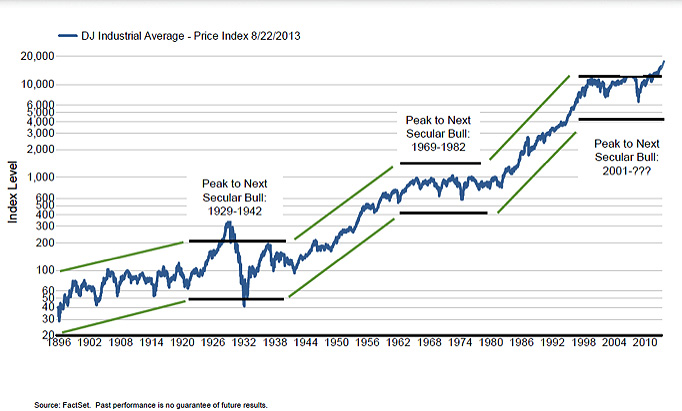
 Fall is a wonderful time in Michigan.  The leaves are turning, the Tigers gave us some playoff excitement and football season is in full swing.  Economists and money managers must agree as many have been visiting the state giving us the opportunity to sit down with various experts over the past couple of weeks here at the Center.  One theme kept coming up while I was listening to a couple of these individuals and it was a welcome distraction from the typical debt ceiling/government shutdown conversations…the secular bull market.

The chart below shows the long-term secular trends for the Dow Jones over the past 100 or so years.  You can see that the markets go through long periods of stagnation, in essence going nowhere fast; followed by periods of steady increases.  These periods of stedily rising markets (indicated below in green) are referred to as secular bull markets.  You can see that this year the Dow has finally broken out of the sideways trading range of the past 12 years. 

The U.S. equity markets have been in a positive trend for four years now, yet one expert stated this is the least trusted, least believed bull market he has ever witnessed.  Most investors erroneously believe that the environment has to feel good before it is the right time to invest.   Unfortunately, once it feels good to invest it is usually the wrong time, think buying technology stocks in 1999.

Whether or not we are in a secular bull market remains to be seen, but once we can say for certain that we are it is usually too late.  Having a financial plan and staying disciplined with your investments, I think, is the most important key to successfully meeting your goals.  

Angela Palacios, CFP®is the Portfolio Manager at Center for Financial Planning, Inc. Angela specializes in Investment and Macro economic research. She is a frequent contributor to Money Centered as well asinvestment updates at The Center.


The information contained in this report does not purport to be a complete dexcription of the securities, markets, or developments referred to in this material.  Any opinions are those of Center for Financial Planning, Inc., and not necessarily those of RJFS or Raymond James.  Expressions of opinion are as of this date and are subject to change without notice.  Past performance may not be indicative of future results.  Holding stocks for the long-term does not insure a profitable outcome.  Investing in stocks always involves risk, including the possibility of losing one’s entire investment.

Planners' Perspective: Four words that forever changed my life

 Part 7 of a series that will shed some light on who we are and why we love financial planning. For Laurie Renchik, it was one defining conversation, one extended invitation that led her into the field of financial planning.

We all have defining moments along the course of our lives.  For me, one of the biggest, from a career perspective came in 1992.  I distinctly remember “the talk” I had with my CPA.  I had been her tax client for a number of years and we often mixed the business of completing my tax return with conversations about family and our respective careers.  This year started out the same, but ended up very differently.   She handed me my tax return and said, “I am selling my tax practice and buying an investment advisory firm from an advisor who is retiring.  Then she added, “Think about joining me.”  Those four words were the beginning of my journey into the financial planning profession. 

I accepted the offer.   It was a huge step for me to strike out in this new venture, but I had the support of a trusted mentor and the desire to learn as much as I could about the financial planning process and how it related to investments and financial goals.  My research led me to the conclusion that the industry standard for financial planners was the Certified Financial Planner™ certification.  I was inspired to get enrolled in the Certified Financial Planning program immediately, and earned the CFP® in 1995.  Simultaneously, I made the decision to make a move to Raymond James Financial Services to better align myself with a firm whose culture was more deeply rooted in the financial planning process.  

In hindsight, my decision to make the move to Raymond James was the right course adjustment for me as I refined my professional career path and set new goals.  An added bonus that I did not anticipate was a chance meeting with Marilyn Gunther, CFP® a founding partner of The Center.  We met at a Women’s Financial Symposium and the reality is that this chance meeting was literally life changing.  Marilyn has the unique ability to hear what is not spoken and to see what is not obvious.  She shared her insights and experiences freely.  Ultimately, she opened the door for me to join the Center team in 2006; an organization that has given me the opportunity to be part of something really special.

As a mentor, Marilyn encouraged me to let my passion for financial planning shine, to listen first and keep my mind open to an array of possibilities that could unfold.  I encourage you to do the same.  Keep listening for your invitation to chart your own course.  It may come in four words.  It may come in forty.  But they can be your catalyst, just as they were mine.     

Step Up in Basis Part 2

In Part 1, we covered a “step up in cost basis” principles with regards to real estate. In this post we will address step up in basis rules pertaining to marketable securities such as stocks, bonds, and mutual funds.

Your cost basis in a security is what you initially purchased it for plus any reinvested dividends.  So if mom bought 1,000 shares of Ford Motor Company back in 1980 when it was trading at $1.00 a share her cost basis is exactly $1,000 (trading costs such as commissions can also be included).   As of 10/25/2013 Ford was trading at $17.60 a share so if mom sold it today she would receive $17,600 from the sale of the Ford stock.  She would be able to subtract her basis for tax purposes ($1,000) and she would have a long term realized capital gain of $16,600.  At today’s long-term capital gains rates mom would owe Uncle Sam as much as 20% of that gain or $3,320.  However, let’s say mom never sold her Ford stock and left it to you after her death.  If mom died on October 25th 2013 your new inherited basis would be the closing market price of Ford on the date of death ($17.60).  Assuming you sold Ford stock at $17.60 you would owe nothing in capital gains thanks to the step up in basis rule.  Please remember that this analysis is only relevant if you are inheriting assets in a taxable account. If you are inheriting Ford stock inside of an IRA (or other similar tax deferred account) then the cost basis is irrelevant – at least for income tax purposes. 

What if mom is feeling generous and decides she wants to gift you the shares of Ford Stock while she is alive?  In this instance you would also receive mom’s cost basis of $1.00 rather than the higher step up in basis at death. 

As always, income tax consequences alone should not dictate financial decisions.  However, care should be taken to maximize both gifts and inheritances. Please speak with a financial advisor about cost basis and other tax-related issues.

Matthew Trujillo is a Registered Support Associate at Center for Financial Planning, Inc. Matt currently assists Center planners and clients, and is a contributor to Money Centered.

The information has been obtained from sources considered to be reliable, but we do not guarantee that the foregoing material is accurate or complete.  Any opinions are those of Center for Financial Planning, Inc., and not necessarily those of RJFS or Raymond James.  Please note, changes in tax laws may occur at any time and could have a substantial impact upon each person’s situation.  While we are familiar with the tax provisions of the issues presented herein, as Financial Advisors of RJFS, we are not qualified to render advice on tax or legal matters.  You should discuss tax or legal matters with the appropriate professional.  The illustration is hypothetical.  Individual results will vary.  This information is not intended as a solicitation or an offer to buy or sell any security referred to herein.  Individual results will vary.   This information is not intended as a solicitation or an offer to buy or sell any security referred to herein.  Center for Financial Planning, Inc., Raymond James Financial Services, Inc., its affiliates, officers, directors or branch offices may in the course of business have a position in any securities mentioned in this report.

Carrots for a Cause: Our day at the Gleaners Food Bank

 You don’t think about the behind-the-scenes work that goes into a food bank until you roll up your sleeves and help. That’s what the Center team and our loved ones did on Saturday September 21 at the Gleaners Community Food Bank of Southeastern Michigan. When we showed up at the Warren Distribution Center, many of us had no idea that we would work up a sweat and leave feeling so satisfied.

We separated into 2 groups, one packing 4-pound bags of carrots (the bags had to be exactly 4 pounds or Jen Hackmann’s astute 10-year-old daughter Jadyn would send you back to the bin to make your corrections). The other group helped in the packaged food assembly line putting together large bags of non-perishable goods to be handed out to families in need. 

The Center’s Jen Hackmann said pitching in gave her a sense of balance. “It’s personally rewarding to do these types of activities with my work and home families together.  I also really enjoy spending time with co-workers outside of the everyday work environment and getting to know the important people in their lives.”

Anyone interested in sending personal donations or finding out how to volunteer their time for Gleaners Community Food Bank can find out more at www.gcfb.org.

Step Up in Basis Part 1: A Key to Understanding Your Inheritance

If you stand to inherit assets, it is crucial that you get the gist of the often-misunderstood concept of step up in basis. This is an area that is more pertinent then ever before as the aging U.S. population looks to transfer a large amount of wealth to the next generation.  The rules are a little different depending on what type of asset you are dealing with, but this blog is going to focus on “real assets” such as property.

In order to fully understand this topic, you need to know what cost basis means.  Your cost basis is simply how much you paid for something.  If you bought some land for $10,000 then your cost basis in the property is $10,000.  If that property appreciates in value and you sell it for $100,000 then you have realized a $90,000 capital gain.  The IRS allows you to subtract the original $10,000 (your cost basis) from the $100,000 sale price because you already paid tax on the $10,000.

Next you need to understand what step up in basis means.  A step up in basis typically occurs when somebody dies and leaves assets to their heirs.  Using our land example again, let’s say that Mom bought a property back in 1960 for $10,000 and left it to you in her will when she died.  The fair market value upon Mom’s death is $100,000.  If Mom sells the property the day before she died she would have a $90,000 capital gain.  However, if Mom leaves the property to you in her will, and you decided to sell it the day after the funeral, you would pay no capital gains tax on the sale proceeds.  The reason for this is that the IRS gives you a full step up in basis at the date of death.  So the $10,000 cost basis that represents the property’s original purchase price is now stepped up to the current market value of $100,000.

In our next blog, we will focus on step up in basis when you are dealing with securities such as stocks, bonds, mutual funds, etc.

Matthew Trujillo is a Registered Support Associate at Center for Financial Planning, Inc. Matt currently assists Center planners and clients, and is a contributor to Money Centered.

The information has been obtained from sources considered to be reliable, but we do not guarantee that the foregoing material is accurate or complete.  Any information is not a complete summary or statement of all available data necessary for making an investment decision and does not constitute a recommendation.  Please note, changes in tax laws may occur at any time and could have a substantial impact upon each person’s situation.  While we are familiar with the tax provisions of the issues presented herein, as Financial Advisors, of RJFS, we are not qualified to render advice on tax or legal matters.  You should discuss tax or legal matters with the appropriate professional.