General Financial Planning

Webinar in Review: Cash Balance Plans

Contributed by: Clare Lilek Clare Lilek

20160621_700x350.jpg

Here at The Center for Financial Planning, Inc., we host webinars not only for our clients but also for other professionals who we may work with as part of the team to best serve our clients. During these webinars, our CERTIFIED FINANCIAL PLANNERS™ dive into specific topics in greater detail than you might find in a typical blog. In our latest webinar of this kind, Nick Defenthaler, CFP®, with the help of Abram Claude, Head of Value Add Programs Learning Center at Columbia Threadneedle Investments, hosted a 45 minute webinar detailing Cash Balance plans as a way to help business owners potentially accelerate retirement savings and lower taxes.

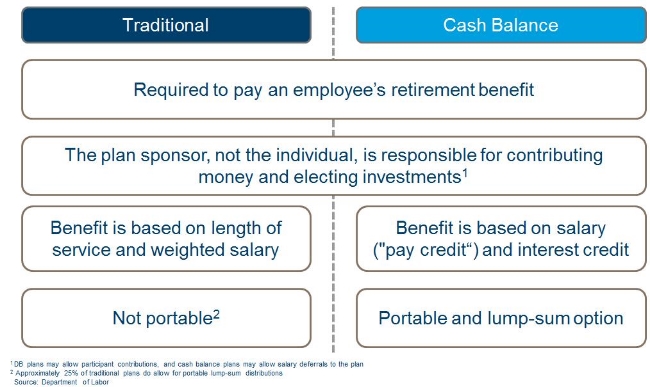
First, Abram clarified a cash balance plan as one type of defined benefit plan. He detailed the differences between a traditional defined benefit plan versus what the majority of the webinar discussed, a Cash Balance plan. Below you can reference a chart that distinguishes the two:

CashBalance.jpg

Typically, Cash Balance plans have been seen as an option only for larger companies, but many smaller businesses have been utilizing this retirement saving strategy because they’re usually easier to manage, they’re not as dependent on interest rate changes, and they offer the same benefit cost for the employer independent of the employee’s age or time with the company, compared to Traditional defined benefit plans.

Here are some questions to ask to determine whether or not a business might be a good fit for a Cash Balance plan:

  • Does the business have a consistent, profitable history?

  • Will the business have significant and consistent cash flow moving forward?

  • Does the business have a budget that can support plan contributions?

  • Does the business already maximize its contributions to a defined contribution plan (401k, 403b, etc.)?

  • Are there multiple owners or partners?

  • Do the business owners or partners want to accelerate their ability to save for retirement and save taxes?

  • Is there a low ratio of non-highly compensated employees to highly compensated employees?

  • Are the highly compensated employees older than the non-highly compensated employees?

  • Is the company relatively small in size (e.g. fewer than 20 eligible employees)

The more “yes,” responses, the greater possibility that a Cash Balance plan might be a good fit for your business or your clients!

For more information, watch the webinar below as Nick and Abram go into the details surrounding the mechanics of these plans, along with helpful examples to illustrate the potential benefits of a Cash Balance plan. If you have any questions after watching the webinar, please feel free to call the office or reach out Nick Defenthaler, CFP®, and we’d be happy to help!

The information contained in this blog does not purport to be a complete description of the securities, markets, or developments referred to in this material. The information has been obtained from sources considered to be reliable, but we do not guarantee that the foregoing material is accurate or complete. Any opinions are those of Clare Lilek and and not necessarily those of Raymond James. Expressions of opinion are as of this date and are subject to change without notice. There is no guarantee that these statements, opinions or forecasts provided herein will prove to be correct. Prior to making an investment decision, please consult with your financial advisor about your individual situation. Raymond James is not affiliated with and does not endorse the opinions or services of Abraham Claude.

Clare Lilek is a Challenge Detroit Fellow / Client Service Associate at Center for Financial Planning, Inc.


Raymond James is not affiliated with and does not endorse the opinions or services of Abram Claude and/or Columbia Threadneedle Investments.

Inherited IRA – Learn About Your Choices as a Non-Spouse Beneficiary

Contributed by: Laurie Renchik, CFP®, MBA Laurie Renchik

During a recent meeting with a client (let’s call her Anne), we discussed the options available to her as the beneficiary of her brother Jim’s IRA. This is an important discussion because there are certain tax benefits that come with inheriting an IRA, but the rules differ depending on whether you are a surviving spouse or what is called a non-spouse beneficiary. In this case Anne is considered a non-spouse beneficiary because she is the sister of the original account owner, Jim.

Here are the options available to Anne:

  1. She can rollover the assets directly into an Inherited IRA for her benefit. With this option Anne will take distributions over her lifetime and enjoy the benefits of tax deferred growth.     

  2. Anne can take a lump-sum distribution. With this option, there is an immediate tax impact. The value of the distribution is taxed as ordinary income in the year it is withdrawn. Because the IRA is inherited Anne can take the lump sum prior to age 59 ½ and not be subject to the 10% penalty that is usually applied for distributions before age 59 ½. 

  3. The third option is that Anne does not have to take the inheritance. She can disclaim all or part of the inherited assets. If this option is chosen the assets pass to the next eligible beneficiaries.  If Anne considers this option she wants to be sure all of the legal requirements are met.

When handled correctly, Anne as a non-spouse beneficiary can enjoy the continued potential for tax-advantaged growth of these assets while avoiding the immediate income taxes.

Our discussion also highlighted some common mistakes to avoid:

  1. A non-spouse beneficiary cannot move the inherited IRA into his or her own IRA. An inherited IRA must be kept totally separate from other IRA’s Anne may have and no new contributions can be deposited into the account.

  2. Beneficiaries named on an IRA account supersede instructions provided in a will or trust. Since the IRA account information takes precedence it is important to make sure the designated beneficiaries named on the inherited IRA are up to date. 

  3. No 60-day rollover. With this rule, you can take a distribution from your own IRA as long as you put the money back in the same account within 60 days, you won’t have to pay income taxes or a penalty. Unfortunately, you can’t do this with inherited IRAs. There is no 60 day rollover rule for inherited IRAs. If you withdraw the money, it’s taxed.

  4. If you inherit an IRA, whether it’s traditional or Roth, the IRS requires you take at least some of the account balance each year. It’s called a required minimum distribution and must be taken annually, regardless of your age, beginning the year following the year-of-death of the original account owner. If you don’t take the distribution, the penalty ends up being 50% of the amount you were required to take.

If you are faced with decisions regarding an inherited IRA and have questions feel free to give me a call or send me an email.  I’ll be happy to review your options with you and make sure the choice works in harmony with the rest of your financial plan goals and objectives. 

Laurie Renchik, CFP®, MBA is a Partner and Senior Financial Planner at Center for Financial Planning, Inc.® In addition to working with women who are in the midst of a transition (career change, receiving an inheritance, losing a life partner, divorce or remarriage), Laurie works with clients who are planning for retirement. Laurie is a member of the Leadership Oakland Alumni Association and is a frequent contributor to Money Centered.


The information contained in this blog does not purport to be a complete description of the securities, markets, or developments referred to in this material. The information has been obtained from sources considered to be reliable, but we do not guarantee that the foregoing material is accurate or complete. Any information is not a complete summary or statement of all available data necessary for making an investment decision and does not constitute a recommendation. Any opinions are those of Laurie Renchik and not necessarily those of Raymond James. There is no guarantee that these statements, opinions or forecasts provided herein will prove to be correct. Every investor's situation is unique and you should consider your investment goals, risk tolerance and time horizon before making any investment. Prior to making an investment decision, please consult with your financial advisor about your individual situation. Raymond James and its advisors do not offer tax or legal advice. You should discuss any tax or legal matters with the appropriate professional.

5 Tips for Budgeting Post-Graduation

Contributed by: Clare Lilek Clare Lilek

Graduation season can be a whirlwind of exams, parties, job interviews, parties, endless nights fueled by caffeine, and more parties. Once the adrenaline and celebration subsides, however, and when reality comes hurtling towards you at full speed, it’s helpful to have your finances in order. Life after graduation can be exhilarating, partly due to the uncertainty, but don’t let uncertain finances take the fun out of adult life.

Here are 5 simple tips to keep in mind when creating your post-college budget, as you prepare for a *hopeful* increase in monthly income:

  1. Whether you’re working at a fast food chain or a Fortune 500 company put 10% of your salary away into what I like to call a “No Touch Savings.” This is a savings fund for emergencies only—in case you lose your job, or your car needs major repairs, or just for when life happens unexpectedly.

  2. Divide your bank accounts into sub folders: Emergency, Travel, Bills, Fun Money, etc. Put money away each month into the various buckets and don’t dip into other buckets. Pro Tip: Make sure you’re allocating the appropriate percentage of funds to each bucket—your fun money bucket probably shouldn’t have a higher deposit rate than your bills bucket (well not yet at least).

  3. Cut out unnecessary spending. When you’re first starting out on your own and creating a budget, it behooves you to be as frugal as possible. If you’re buying coffee and breakfast every day, cut that out of your spending and try to do your early morning routine at home. See how far your salary actually takes you each month first and then add in luxuries, as long as your savings do not suffer.

  4.  Write it out. When drafting up a budget, with your subfolders, savings, and planned spending, write it out on paper. It helps to physically write out your spending and saving goals. For the first few months under your budget, make sure to write out your actual spending and saving as well. See how closely your goals align with your spending reality and make adjustments as necessary. It helps to physically see how much you’re spending to know where you can eventually save.

  5. Set spending priorities. Watch out for superfluous spending on items or experiences that aren’t really important to you, but don’t be afraid to splurge on the things that truly matter. Save as much as you can, but remember to find joy in what you choose to spend your money on, or better put, spend money on items and experiences that truly give you joy.

When creating and following your budget, use the method that best suits you and your style of living. Some people prefer paper and pen (including myself), others excel spreadsheets, and more recently, a growing number of people are using applications and websites. If you need a larger system to help you create and stick to a budget, I suggest Mint. It’s a website and an application that helps you track spending by linking to your bank account. Find what works best for you and stick to it! Consistency is key.

Joining the adult world can be an amazing experience but comes with a rather large learning curve. As you, your children, or your grandchildren begin professional careers post-graduation and start to receive an increase in monthly earnings, remember to take it slow and follow some simple guidelines. You never want to end up over your head, fresh out of college.

Clare Lilek is a Challenge Detroit Fellow / Client Service Associate at Center for Financial Planning, Inc.


The information has been obtained from sources considered to be reliable, but we do not guarantee that the foregoing material is accurate or complete. Any opinions are those of Clare Lilek and not necessarily those of Raymond James.

Millennials Matter: Paying Down Debt While Saving for the Future

Contributed by: Melissa Parkins, CFP® Melissa Parkins

If you missed it, last month I began a monthly blog series geared towards millennials, like me, with topics that are important and relevant to us. Chances are you are going to have debt at some point in your life—student loans, credit cards, new cars, or perhaps a mortgage—and let’s be honest, most of us millennials are drowning in student loan debt these days! Let’s say you finally have a steady income stream and want to start building your net worth… but have enormous student loan debt and maybe some credit cards to think about too. If you are like me, a big question on your mind is probably, “with extra money in my budget over my necessary expenses, do I pay down more debt, or invest more for the future?” The decision can be overwhelming and definitely not easy answer-- how do you decide the right mix of paying down debt and saving for the future?

Things to Consider:

  • First, make sure you are able to at least make the minimum payments on your debts and cover all your other necessary monthly expenses. Then, determine how much extra cash you have each month to work with for additional loan payments and to invest for the future.

  • Have an adequate emergency reserve fund established (the typical emergency fund should be 3-6 months of living expenses). If you don’t have a comfortable emergency fund, start building one with your extra monthly cash flow now.

  • Take advantage of your employer’s 401(k) match, if they offer one.*  If there is a 401(k) match, contribute enough to get the matching dollars. You are not only saving for the future, but it’s extra money invested for retirement too!

  • Make deductible IRA contributions – who doesn’t like saving for the future while saving on taxes? If you have earned income and are not covered by a retirement plan like a 401(k) through work, you are eligible to make deductible IRA contributions up to the annual limit. If you are covered by a retirement plan at work, the deduction on IRA contributions may be limited if your income exceeds certain levels.

  • Make high interest rate debt a priority. Take inventory of your debts and their corresponding interest rates and terms. It is a good idea to pay more than the minimum due on high interest rate debt so you are reducing your interest paid over the life of the loan. You can do this by increasing your monthly debit amount or by making more than one payment a month. Also, check with your lenders for discounts for enrolling in auto payments – many offer a small rate reduction when payments are set to be automatically debited each month.

  • Remember that interest you pay on some debt is tax deductible, like student loan interest (if your income is below certain levels) and mortgage interest (if you are itemizing your deductions). So at least some of the interest payments you are making on your loans go towards saving on your taxes.

  • Lastly, don’t forget to consider what short-term goals you have to pay for in the next 1-2 years. Are you looking to buy a home and need a down payment? Wedding to pay for? New car? Or maybe you have just been working hard and want to treat yourself to a vacation! Lay out these larger short-term goals with amounts and time frame, and see how much of your monthly extra cash should be going to fund them.

Ideas and Tools to Help

  • Technology – Consider the use of budgeting apps like Mint or Level Money to keep your spending in check and your goals on track

  • Social Media – Look to your Twitter feed for inspiration and helpful tips (personally, I like to follow @Money for motivation).

  • Do you receive commissions, bonuses or side income above your normal pay? Instead of counting on that as typical cash flow, each time it comes in put it towards paying off high interest rate debt (I do this and I promise, the feeling is rewarding!). You can also do this with your tax refund each year.

  • When you receive a pay increase at work, instead of increasing your spending level, use it to increase your savings (have you read Nick’s blog on his “One Per Year” strategy?)

  • Call us! We are here not only as financial planners, but also as behavioral coaches to help you effectively achieve your goals!

Ultimately, how do you feel about debt? Your balance between paying down debt and saving for the future will depend on your personal feelings about having liabilities. It is a good idea to start saving as early as possible because of the power of compounding over the long term. But that doesn’t mean you can’t be aggressively tackling your debt as well. Create a plan that you are comfortable with, review it often to make sure you are staying on track, and make adjustments as your cash flow changes over time.

Continuing on with the topic of debt… read next month about student loans and what you can  be doing to be more efficient with them. Don’t forget to look for more info on our upcoming webinar in July as we’ll be going into more details about student loans!

Melissa Parkins, CFP® is an Associate Financial Planner at Center for Financial Planning, Inc.


*Matching contributions from your employer may be subject to a vesting schedule. Please consult with your financial advisor or your retirement

The foregoing information has been obtained from sources considered to be reliable, but we do not guarantee that it is accurate or complete, it is not a statement of all available data necessary for making an investment decision, and it does not constitute a recommendation. Any opinions are those of Melissa Parkins and are not necessarily those of Raymond James. Expressions of opinion are as of this date and are subject to change without notice. While we are familiar with the tax provisions of the issues presented herein, as Financial Advisors of RJFS, we are not qualified to render advice on tax matters. You should discuss tax matters with the appropriate professional.

Are Your Aging Parents a Roadblock in Your Retirement Planning?

Contributed by: Sandra Adams, CFP® Sandy Adams

As the meat in the so-called “sandwich generation,” the baby boomers are approaching retirement at a record pace. As we work with clients and client couples to get their financial and non-financial “ducks in a row,” it is becoming more and more common to discuss issues surrounding the assistance of one or both sets of parents and aging/long term care issues. If this sounds familiar, here are the possible roadblocks that this can cause for your retirement planning and some suggestions about what you can do to prevent them.

What are the Roadblocks?

  • Providing assistance/caregiving often limits the time you can work; you may be forced to take family leave time to provide care, go to part time work, or even take early retirement.

  • Working less reduces earnings, providing less Social Security earnings, and less in retirement savings for future retirement.

  • Stopping work prior to age 65 may mean a need to bridge a health insurance gap when that was not the original plan.

  • Caregiving can be stressful, especially if you are trying to continue to work and also have responsibilities with adult children and/or grandchildren, so your own health can become a concern.

  • With so much going on, just being able to keep your “eye on the ball” and concentrate on your own retirement goals can be a challenge.

What Can You Do to Make Sure To Stay On Track?

If you find yourself in the position of assisting aging parents, now or in the future, do not assume that all is lost. There are things that you can do to make sure that your own retirement will stay on track:

  • Have conversations with your parents and plan ahead as much as possible to make sure that their long term care is funded; have a conversation to discuss if they are willing and able to have non-family members provide care if and when the time comes (at least until you retire); have a professional moderate the planning conversation if it’s not a talk your family is comfortable having on their own.

  • If you do end up leaving work to care for an aging parent, discuss having a paid caregiver contract drafted or determine if your parent’s Long Term Care insurance policy has the ability to pay you for your services as a caregiver.

  • Make sure others take their turn and spread the responsibilities amongst others (see my recent blog on Family Care Agreements); take breaks and take care of yourself (caregiver stress is a real thing!).

  • Continue to meet with your financial planner on an annual basis to keep yourself focused on your own goals along the way—continue to save for retirement as you are able and make progress.

We all have roadblocks that slow our progress towards our goals; aging parents might be one of yours.  The love and care we have for our family—especially our parents—is not something we would ever deny, however frustrating it might be when it delays that ultimate freedom we call retirement. But if we plan ahead, and coordinate with our families and professional partners, we can hope to make the roadblock more of a speedbump.  Contact me if you have questions about how your financial planner can be of assistance.

Sandra Adams, CFP® is a Partner and Financial Planner at Center for Financial Planning, Inc. Sandy specializes in Elder Care Financial Planning and is a frequent speaker on related topics. In addition to her frequent contributions to Money Centered, she is regularly quoted in national media publications such as The Wall Street Journal, Research Magazine and Journal of Financial Planning.


The information contained in this blog does not purport to be a complete description of the securities, markets, or developments referred to in this material. The information has been obtained from sources considered to be reliable, but we do not guarantee that the foregoing material is accurate or complete. Any opinions are those of Sandy Adams and not necessarily those of Raymond James. Prior to making an investment decision, please consult with your financial advisor about your individual situation.

Continuing to Work after Filing for Social Security

Contributed by: James Smiertka James Smiertka

If there’s a chance you will earn income while you are collecting Social Security, you will want to know about an extremely important rule put in place by the Social Security Administration called the “Earnings Test.” There are a variety of reasons why someone may earn income while receiving Social Security.  Whether it’s simply pursuing a passion after retirement or the financial need to pick up a part-time job, it’s important to fully understand the implications of earning income and collecting Social Security benefits prior to reaching your full retirement age (FRA). (Click here to see what your FRA is.) Once you reach full retirement age, however, you are not subject to any reduction of benefits from the “earnings test” on your earned income. Let’s take a look at two different examples in detail:

If you are under full retirement age (FRA) for the entire year:

  • Earnings limit: $15,720

  • Reduction of benefits: $1 for every $2 you earn above the earnings limit

  • Example: John is currently 63 and his FRA is 66. John retires, immediately turns on Social Security benefits ($20,000/yr) but decides he wants to pursue his passion as a tutor and plans on earning $35,720 for the year. Since his earnings would be $20,000 over the Earnings Test limit ($35,720 – $15,720), one half ($1 of every $2 earned), or $10,000, would be withheld from his annual Social Security benefit, therefore, reducing John’s Social Security benefit to $10,000 for the year. 

In the year you reach full retirement age (FRA):

  • Earnings limit: $41,880

  • Reduction of benefits: $1 for every $3 you earn above the earnings limit

  • Example: Sue is currently 65 but is reaching her FRA of 66 in a matter of months. She recently started collecting Social Security, which provides her $30,000/yr. Sue is still working, earning $161,880 annually and was not aware of the Social Security Earnings Test. Her earnings would be $120,000 over the earnings test limit ($161,880 – $41,880), one third ($1 of every $3 earned), or $40,000 would be withheld from her annual Social Security benefit. Since this amount is greater than her Social Security benefit, her entire benefit for this year would be withheld.

It’s important to note that if you have had Social Security benefits withheld because of your earnings, they are not lost forever. Once you reach full retirement age, your benefit will increase to compensate for the benefits that were withheld. It does, however, on average, take nearly 2 decades to essentially recover the benefits that were withheld. The bottom line is that there are very few instances where it would make sense to start collecting benefits if there is a strong likelihood that you will continue working. Instead of collecting Social Security early and more than likely having the majority (if not all) of your benefits withheld, you could simply delay benefits which permanently increases your Social Security benefit up to age 70 (More information on that here).

As you can see, there are many moving parts with Social Security, especially for clients who still plan to work prior to reaching full retirement age. Before turning your benefits on, we always recommend that you reach out to your financial planner to discuss your situation in detail to ensure the strategy you’re selecting is in line with your own personal goals and objectives. If you’d like to chat about your benefits and discuss different filing strategies, give us a call, we are happy to help! 

James Smiertka is a Client Service Associate at Center for Financial Planning, Inc.


This material is being provided for information purposes only and is not a complete description, nor is it a recommendation. Any opinions are those of Jim Smiertka and not necessarily those of Raymond James. The information has been obtained from sources considered to be reliable, but Raymond James does not guarantee that the foregoing material is accurate or complete. Examples provided in this material are hypothetical and for illustrative purposes only.

Identity Protection: Freezing your Credit Report

Contributed by: Melissa Parkins, CFP® Melissa Parkins

Some 9 million Americans are victims to identity theft every year. Anyone who has ever had their identity compromised knows how frustrating it can be to fix – trust me, I know from the experience. Last year, I wrote about how to check your credit report and what to do if you see something unusual. As you may know, you are entitled to pull your full credit report from each of the 3 credit bureaus once per year at no charge; but what about the remaining 364 days a year (or 365, in 2016’s case)? Chances are you won’t realize that your identity has been compromised until you check your credit report once a year OR you go to apply for a new line of credit and are denied because your score has plummeted. What’s worse is that when you do not catch it right away, it becomes more and more difficult to fix.

So what else can you do to protect yourself?

You can actually block access to your credit report information with a “credit security freeze.” To do this, you contact the three major credit bureaus and instruct them to prohibit new creditors from viewing your credit report and score. Companies with whom you currently have existing accounts with will still be able to access your credit information. You can set up a freeze on your credit information even if you haven’t experienced any fraudulent activity before. A credit security freeze can increase the likelihood of catching identity thieves before they can open new accounts in your name.

How do you do this, and what are the fees?

To freeze your credit reports, you must contact each of the three credit bureaus individually. This can be done online here: Equifax, Experian and TransUnion. Fees and filing requirements vary according to state law.

  • In Michigan, The fee to freeze your credit report is $10 for each credit agency you decide to do this with – so $30 total if you freeze your credit with each bureau.

  • Once you have frozen your credit report, it can be lifted at any time. In Michigan, it is another fee of $10 to permanently remove the credit freeze.

  • You can also have the freeze temporarily lifted for a specific period of time or for a specific party (specific party lift is not available in Michigan, but it is in some states). For instance, if you were to start a new job or open up a new line of credit and that company needed access to your credit report, you would need to temporarily lift your freeze. Again, in Michigan it would be a $10 fee for a specific date range lift.

  • If you are a past victim of identity theft, the fees are waived (must provide a copy of a valid complaint filed with law enforcement or a police report), so you can freeze your credit and utilize the temporary lifting at any time for no cost.

Who should freeze their credit reports?

As you can see, all of the fees can really add up. So if you are planning any action that requires a credit check, you may want to delay setting up a freeze. Some actions that would require a credit check are things like:

  • Starting a new job

  • Buying or refinancing a home

  • Taking out a loan

  • Opening a credit card

  • Opening an account with anew utility company or cellphone provider

Placing a security freeze on your credit report does not affect your credit score, nor does it keep you from obtaining your credit report from each of the agencies at any time. Although a freeze can help block identity thieves from opening new accounts with your information, it does not prevent them from making charges on existing accounts. So you should still continue to monitor statements for existing accounts for fraudulent transactions. As you can see, freezing your credit report can be a useful tool for protecting your identity, but it may not be right for everyone. Before setting up a freeze on your credit report, you will want to make sure the timing is right for your unique situation. Let us know if we can be of help.

Melissa Parkins, CFP® is an Associate Financial Planner at Center for Financial Planning, Inc.


This material is being provided for information purposes only and is not a complete description, nor is it a recommendation. Any opinions are those of Melissa Parkins and not necessarily those of Raymond James. The information has been obtained from sources considered to be reliable, but Raymond James does not guarantee that the foregoing material is accurate or complete.

Raymond James is not affiliated with Equifax, Experian, or TransUnion.

Links are being provided for information purposes only. Raymond James is not affiliated with and does not endorse, authorize or sponsor any of the listed websites or their respective sponsors. Raymond James is not responsible for the content of any website or the collection or use of information regarding any website's users and/or members.

Retirement Behavior Zone

Contributed by: Timothy Wyman, CFP®, JD Tim Wyman

Let’s face it; market volatility isn’t a whole lot of fun for any investor—unless that volatility is on the upside, of course. When investments experience downward volatility it can be hard on the psyche. In my experience, however, there is one group that is hit especially emotionally hard: those clients that are on either side of two years from their retirement date. While those with long term horizons feel some pain, it is generally muted because the funds are needed in the distant future and it doesn’t seem to bother them as much. Similarly, those that have been in retirement for a while seem to have the “been there – done that” mentality. They have been through volatility before, hopefully have weathered past storms, and understand volatility is part of the process to potentially get fair returns over time.

But how about those within two years, either side, of retirement? Often times, these clients are the most concerned, and rightfully so. The time that folks switch from being a net saver for so many years to a net spender is emotionally challenging in many cases. As former partner Dan Boyce used to say, it feels like you are eating your seed corn. (Full disclosure – this city boy never really understood it but many a client nodded as if to confirm the saying!).

According to research underwritten by Prudential Securities, “economic researchers have found that emotions play a significant role in how people make financial decisions.” At first, my response was a yawn and a hope that Prudential didn’t pay too much for such a conclusion. Fortunately there was more to the study, something with a little more meat on the bone. The study suggests that the five years before and after retirement is critical. That understanding this behavioral risk becomes even more important. Two specific risks cited in the study include sequence risk and behavioral risk.

At the risk of downplaying behavior risk, it is one that we have some control of, after all. Poor investor behavior during this two year of period within retirement can be hazardous to your financial health, for a long time if not forever. What’s the prescription? Yes this is self-serving, but working with a third party professional can help improve investor behavior. Vanguard suggests that behavioral coaching may bring about as much as 150 basis points (or 1.5%) of value add by advisors.

The second risk, sequence risk, is very real and much less controllable. Large negative returns early in retirement can indeed impact one’s retirement years. Fortunately, for many, one large loss year usually isn’t enough to derail years of proper planning. Again, what’s the prescription? In general, utilizing multiple asset classes, multiple investment styles, and multiple managers (aka asset allocation & diversification) provides enough risk parameters to lessen the potential sequence risk. 

If recent volatility has hit you especially hard (emotionally or in dollars) give us a call. If you are a current client we welcome the opportunity to review your portfolio and your plan, and if you are not a current client we welcome the opportunity to provide another opinion.

Timothy Wyman, CFP®, JD is the Managing Partner and Financial Planner at Center for Financial Planning, Inc. and is a contributor to national media and publications such as Forbes and The Wall Street Journal and has appeared on Good Morning America Weekend Edition and WDIV Channel 4. A leader in his profession, Tim served on the National Board of Directors for the 28,000 member Financial Planning Association™ (FPA®), mentored many CFP® practitioners and is a frequent speaker to organizations and businesses on various financial planning topics.


This material is being provided for information purposes only and is not a complete description, nor is it a recommendation. Any opinions are those of Timothy Wyman and not necessarily those of Raymond James. The information has been obtained from sources considered to be reliable, but Raymond James does not guarantee that the foregoing material is accurate or complete. Past performance is not a guarantee of future results. Investing involves risk and investors may incur a profit or a loss regardless of strategy selected. Raymond James is not affiliated with and does not endorse the opinions or services of Vanguard or Prudential Securities. Diversification and asset allocation do not ensure a profit or protect against a loss. There is no guarantee that using an advisor will produce favorable investment results.

Three Ways to Establish and Improve your Credit Score

Contributed by: Matt Trujillo, CFP® Matt Trujillo

In a previous blog I discussed how your credit report is composed and what goes into a credit report; I would encourage you to check out to find out how your score is calculated. Now, I want to discuss methods for improving your credit score, if you are unhappy with your current number, and/or establishing credit if you are just getting started.

First, let’s start by establishing how you get credit. If you want to establish credit, you need a regular source of income. The income can be derived from a job, trust fund dividends, government benefits, alimony, investment dividends, or any number of sources. What’s important is that you have some kind of continuing and predictable cash flow. Without regular income, you cannot demonstrate an ability to make regular payments. Establishing a regular source of income is your first step.

Once you have a steady source of income it is time to start applying for credit. If you are just starting out or are looking to repair credit, I recommend starting small. Here is a short list of ideas that you can consider for getting easy access to credit and slowly starting to improve or establish your score.

An overdraft line of credit on your checking account at your bank

  • Here is how it works. You have a checking account. You apply for and are granted an overdraft line of credit in the amount of $500. Your checking account balance is $40. You write a check for $75. When the check is presented to the bank for collection, the bank does not return it for insufficient funds. Instead, it credits your checking account in the amount of $100. Now you have a balance of $140 in your account. The bank can honor the $75 check, leaving you with $65 in the account. The bank bills you monthly for the $100. You can repay the $100 all at once, or make minimum monthly payments. You will be charged interest and perhaps a service fee. Although it may not look like a loan, it is. Activity on these accounts is regularly reported by many banks.

Getting a secured credit card

  • Many credit issuers offer secured credit cards. A secured credit card provides you with an open line of credit secured by a cash deposit. These types of cards typically come with a high interest rate. Here is how a secured credit card works. You give the credit card issuer a cash deposit. The credit issuer gives you a credit card with a credit limit equal to the cash deposit. You can charge up to the credit limit using the card, and then make monthly payments on the balance. If you fail to make the payments, the credit card issuer uses your cash deposit to cover the unpaid balance. If you make your payments as agreed, you will eventually establish credit (or improve your current score) and qualify for an unsecured credit card. The secured credit card issuer will return your deposit, less any unpaid balance due, when you cancel the account.

Using collateral when applying for new lines of credit

  • When you secure credit, you give the lender collateral to back your loan. The risk is reduced for the lender. If you do not pay, the lender can use the value of the collateral to satisfy the debt. Collateral can be anything of value, but usually takes the form of cars or real estate. If you have something of value, but no credit rating, you may be able to acquire credit by offering to post your valuables as collateral.

These are just a few simple and easy ways to either establish credit or improve your credit score in order to build a credit report you are comfortable with.  

Matthew Trujillo, CFP®, is a Certified Financial Planner™ at Center for Financial Planning, Inc. Matt currently assists Center planners and clients, and is a contributor to Money Centered.


The information contained in this report does not purport to be a complete description of the securities, markets, or developments referred to in this material. The information has been obtained from sources considered to be reliable, but we do not guarantee that the foregoing material is accurate or complete. This material is being provided for information purposes only and is not a complete description, nor is it a recommendation. Any opinions are those of Matt Trujillo and not necessarily those of Raymond James.

A Change to Your American Funds CollegeAmerica 529 Plan

Contributed by: Melissa Parkins, CFP® Melissa Parkins

If you have 529 Plan(s) with American Funds CollegeAmerica, a change is coming this year that you should be aware of.

What is happening?

On June 24, 2016 your CollegeAmerica 529 account will be transferred out of the custody of American Funds, and into the custody of Raymond James.

What does this mean?

  • Better communication, efficiency, and service for you! Raymond James will now hold your CollegeAmerica 529 account assets instead of American Funds.
  • Communications about your account will now be more consistent and clear. Statements and tax documents will all come from Raymond James, instead of multiple communications from multiple sources.
  • If your 529 account is currently enrolled in systematic purchase plans at American Funds, they will continue without any disruptions or delay. The information will be transferred to Raymond James to continue any automatic transactions that are currently set up.
  • Your Raymond James account number for your 529 account will not change. The CollegeAmerica Program will continue to govern your account, but Raymond James will now hold the account.
  • The change will not affect the value of your investments, and there will not be any fees for this transfer.

What other information will you be receiving?

  • You will receive a letter from Raymond James at the beginning of April with the details of this change. If you have more than one CollegeAmerica 529. You will receive multiple mailings, one for each account.
    • This letter will state that your financial advisor (us) will now be your single point of contact for managing your American Funds CollegeAmerica 529 account. We have always been your main point of contact for these accounts. So you will continue to call or email us with any requests related to your accounts.
  • You will receive a statement from American Funds after June 24 reflecting a zero balance, because your investments in the 529 account will no longer be held by American Funds. The statement will show a transfer out of the 529 plan.
  • Two year-end statements will be sent for your 529 plan in early 2017: one from American Funds and one from Raymond James. Your year-end statement from American Funds will indicate that the funds transferred out.
  • If you had any reportable transactions before June 24, you will receive a 1099-Q tax document from American Funds. If you had any reportable transactions after June 24, you will receive a 1099-Q tax document from Raymond James. These would also both come in early 2017.

In a nutshell, not much is changing from your end. This change will allow us to more timely and efficiently service your 529 accounts, since we will no longer need to go through American Funds for any processing. This means better service to you! Please call us if you have any questions.

Melissa Parkins, CFP® is an Associate Financial Planner at Center for Financial Planning, Inc.