Investment Happenings

Q2 2023 Investment Commentary

Print Friendly and PDF

While Federal Reserve (the Fed) policy, macroeconomic headlines such as inflation, and geopolitical uncertainty are themes investors continue to hear about, U.S. large cap stocks finished the first half of 2023 up 15.5%. It is important to look under the hood of these returns as they have been entirely driven by the market's largest stocks, with the top 10 companies in the S&P 500 accounting for over 95% of gains. Beyond the largest companies, performance fell off quickly. Developed markets equity (International) has had notable returns year to date ending over 11% in positive territory for the year so far. While their returns struggled to eclipse the top 10 companies in the S&P 500, international investments handily outpaced the balance of the companies in the S&P 500. Commodities struggled the most as economies and production started to slow, and inflation is coming down (even though it is still elevated higher than we would like to see).
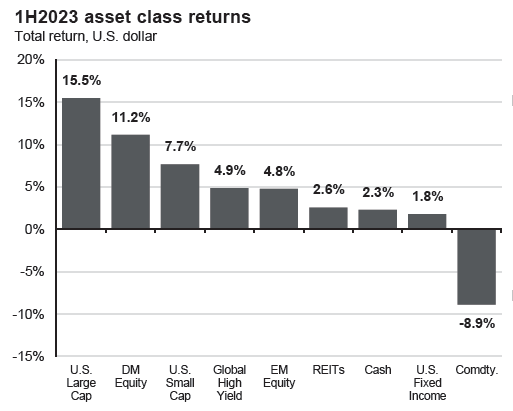


Much of the quarter was dominated by the banking sector headlines that cropped up at the end of the first quarter and debt ceiling negotiations in Washington. Two larger regional bank failures put the markets on edge, waiting for contagion to kick off this quarter. However, the backstop provided by the government and FDIC quickly seemed to curb potential contagion. Then all attention turned toward Washington dragging its feet over raising the debt ceiling, which led to intra-quarter volatility. As the U.S. government approached the date it was expected to run out of money to pay its bills, a deal was reached on June 1st to suspend the debt ceiling through January 2025 while cutting federal spending. As we mentioned in our previous commentary, this is the outcome that would likely occur as history has served as a guide for this. This agreement averted a U.S. government default ahead of the deadline.

The strong equity returns in the year's first half may have taken many by surprise. The question is, where do we go from here? Summer tends to be a time of weakness for markets, and a strong first half of the year could cause buyers to pause. It's not uncommon to see the market stop and gather itself and digest strong gains after they occur.

Higher interest rates

We have witnessed a large amount of excitement surrounding higher interest rates in CDs, money markets, and short-term treasuries. While this is great for money, we need to keep liquid for a shorter-term need or a place to park cash while implementing a dollar-cost averaging strategy; it is important to not give up on investing in a diversified portfolio. When rates were attractive in the early 2000s, it may have been tempting to divert some of your equity investments into cash equivalents rather than invest in the S&P 500 during a recession and continue with this throughout the years. But the opportunity cost is high. The chart below shows how investing $12,000 per year into equities, whether perfectly timed or the most poorly timed, outweighs diverting excess additions beyond need into cash equivalents. Even the worst timing over the years ended up well ahead of cash equivalents.

So, what has happened in the shorter term after times when CD rates peaked and seemed their most attractive? The chart below shows 12-month forward returns for different asset classes after rates peaked. While they may offer the added protection of FDIC insurance, notice that the 6-month CDs never returned more than the peak rate. This makes sense, as you are locking in a rate. The dark blue is the U.S. bond index, the light blue is high-yield bonds, and the green is the S&P 500. As you can see, the other asset classes returned far more than the CD rates 12 months after rates peaked in most of the periods shown below.


Again this reiterates the point not to allocate more than is appropriate for you into short-term fixed strategies.

Check out the video for an economic update!

This summer, all eyes will be on the next Fed decision when the FOMC meets at the end of July. In June, the Fed decided to pause and let the economy digest the drastic rate increases of 2022 and earlier this year. They did signal that we could likely see up to two more rate hikes this summer/fall. The U.S. economy still looks strong, so the FED feels they have room to continue to increase interest rates, even though at a much slower pace to get inflation under control. GDP growth worldwide continues to hold up, signaling we aren't in a recession yet (see the chart below). The Fed will continue to remain very data-dependent when determining their next steps, but the risk is rising that they will overtighten and push the economy into recession.

While the taxable bond yield curve remains strongly inverted, the Municipal bond yield curve is less inverted. This means that investors are better compensated for moving out longer in duration. For those in a higher tax bracket, municipal bonds can provide attractive taxable equivalent yields.

Continue to expect some volatility through the summer as markets digest hefty first-half returns, and we learn more regarding future interest rate action. A sound financial plan and regular rebalancing, when needed, help bring a portfolio through uncertain times. We are here to answer any questions you might have! Do not hesitate to reach out! Thank you for the trust you place in us each and every day!

Angela Palacios, CFP®, AIF®, is a partner and Director of Investments at Center for Financial Planning, Inc.® She chairs The Center Investment Committee and pens a quarterly Investment Commentary.

Any opinions are those of the Angela Palacios, CFP®, AIF® and not necessarily those of Raymond James. The information contained in this report does not purport to be a complete description of the securities, markets, or developments referred to in this material. There is no assurance any of the trends mentioned will continue or forecasts will occur. The information has been obtained from sources considered to be reliable, but Raymond James does not guarantee that the foregoing material is accurate or complete. Any information is not a complete summary or statement of all available data necessary for making an investment decision and does not constitute a recommendation. Investing involves risk and you may incur a profit or loss regardless of strategy selected. The S&P 500 is an unmanaged index of 500 widely held stocks that is generally considered representative of the U.S. stock market. The MSCI EAFE (Europe, Australasia, and Far East) is a free float-adjusted market capitalization index that is designed to measure developed market equity performance, excluding the United States & Canada. The EAFE consists of the country indices of 22 developed nations. The Bloomberg Barclays US Aggregate Bond Index is a broad-based flagship benchmark that measures the investment grade, US dollar-denominated, fixed-rate taxable bond market. Keep in mind that individuals cannot invest directly in any index, and index performance does not include transaction costs or other fees, which will affect actual investment performance. Individual investor's results will vary. Past performance does not guarantee future results. Diversification and asset allocation do not ensure a profit or protect against a loss. Investing involves risk and you may incur a profit or loss regardless of strategy selected. Past performance is not a guarantee or a predictor of future results. Raymond James and its advisors do not offer tax or legal advice. You should discuss any tax or legal matters with the appropriate professional.

Morningstar’s “Star Rating”

Print Friendly and PDF

You may have seen Morningstar’s popular “star rating” at some point in your investment lifetime. Sometimes it shows up on account statements, lists of investment options, or marketing materials – but what exactly is it telling you?

A common mistake we hear is that a fund is presumed to be a “good investment” because it is a “5-star fund” at Morningstar. While the fund may be a good investment, that is not what the star rating tells us.

The star rating is simply telling us how the fund performed compared to peers in the PAST, and we know from one of the most common financial disclosures in the industry that “past performance does not guarantee future results.”

In Morningstar's own words, "It is not meant to be predictive." They do have a qualitative rating that IS meant to be predictive, but that is only available to subscribers of their service (like The Center!) Morningstar is one of our team's many resources in its investment process.

We hope this provides some clarity for when you see these ratings out in the wild. Don't fall victim to what hedge fund billionaire Ray Dalio calls "the biggest mistake in investing" by thinking that just because an investment has done well in the past, it will do well in the future.

Nicholas Boguth, CFA®, CFP® is a Portfolio Manager at Center for Financial Planning, Inc.® He performs investment research and assists with the management of client portfolios.

The information contained in this letter does not purport to be a complete description of the securities, markets, or developments referred to in this material. The information has been obtained from sources considered to be reliable, but we do not guarantee that the foregoing material is accurate or complete. Any opinions are those of Nick Boguth, CFA®, CFP®, and not necessarily those of Raymond James. Expression of opinion are as of this date and are subject to change without notice. With the Morningstar rating system, funds are ranked within their categories according to their risk-adjusted return (after accounting for all sales charges and expenses), and stars are assigned such that the distribution reflects a classic bell-shaped curve with the largest section in the center. The 10% of funds in each category with the highest risk-adjusted return receive five stars, the next 22.5% receive four stars, the middle 35% receive three stars, the next 22.5% receive two stars, and the bottom 10% receive one star. Funds are rated for up to three periods--the trailing three, five, and 10 years and ratings are recalculated each month. Funds with less than three years of performance history are not rated. For funds with only three years of performance history, their three-year star ratings will be the same as their overall star ratings. For funds with five-year records, their overall rating will be calculated based on a 60% weighting for the five-year rating and 40% for the three-year rating. For funds with more than a decade of performance, the overall rating will be weighted as 50% for the 10-year rating, 30% for the five-year rating, and 20% for the three-year rating. The star ratings are recalculated monthly. For multiple-share-class funds, each share class is rated separately and counted as a fraction of a fund within this scale, which may cause slight variations in the distribution percentages. This accounting prevents a single portfolio in a smaller category from dominating any portion of the rating scale. If a fund changes Morningstar Categories, its historical performance for the longer time periods is given less weight, based on the magnitude of the change. (For example, a change from a small-cap category to large-cap category is considered more significant than a change from mid-cap to large-cap.) Doing so ensures the fairest comparisons and minimizes any incentive for fund companies to change a fund's style in an attempt to receive a better rating by shifting to another Morningstar Category. For more information regarding the Morningstar rating system, please go to https://www.morningstar.com/content/dam/marketing/shared/research/methodology/771945_Morningstar_Rating_for_Funds_Methodology.pdf Any information is not a complete summary or statement of all available data necessary for making an investment decision and does not constitute a recommendation. Securities offered through Raymond James Financial Services, Inc., member FINRA/SIPC. Investment advisory services are offered through Raymond James Financial Services Advisors, Inc.

Q1 2023 Investment Commentary

Print Friendly and PDF

The year has started much stronger than it may have felt so far. Growth-style investments trounced value-style investments as tech names came back into favor. International development beat U.S. while EM equity lagged, which was contributed by a weaker U.S. dollar. Small company stocks lagged large company stocks mainly due to a heavier technology exposure for large company indexes like the S&P 500. In contrast, the smaller company indexes had a heavier weighting in financials. The Morningstar asset allocation category of funds had 50-70% stock and 30-50% bonds, so on average, a 60% stock/40% bond allocation was up about 3.9% in the first quarter of the year.

Speaking of financials, Silicon Valley Bank (SVB), a lender to some technology companies and startups, became the largest bank to fail since 2008. Signature Bank became the 3rd largest bank to fail within hours of the SVB failure.  

How did they get to the point of failure? SVB was a commercial bank that specialized in servicing the venture capital community. Over the last few years, there has been much activity in venture capital fundraising, and many deposits flowed into the bank in late 2020 and 2021. SVB's balance sheet at this time went from $70 Billion to $200 Billion, while lending was only a fraction of what they did. So they had excess levels of liquidity and took most of that money to purchase treasuries. Their intention was to hold to maturity, so while they didn't have credit risk exposure, they had a lot of interest rate risk. During 2022 they experienced deposit outflows as venture capital companies were experiencing a lot of spending outflows and not as many inflows. At the same time, interest rates increased, causing unrealized losses in these bonds. As money continued to flow out of the bank, this caused a liquidity issue which forced the bank to sell treasuries at a loss to meet withdrawal demands. So ultimately, high amounts of interest rate risk and sector concentration were the main reasons for failure.

What about contagion? It's important to remember that banks do fail almost every year. Usually, they are caused by Fraud or mismanagement. But there are times when something bigger is going on that can cause multiple banks to fail. In the chart below you can see the largest amount of failures happened in the 1980s due to the farm crisis, oil prices, and the S&L crisis. The great recession was another big wave of bank failures.

In the case of the most recent failures, the government acted quickly over the weekend to create policies to back-stop banks that may need to sell treasuries to meet customer withdrawals. These policies allow banks to take cheap loans backed by those treasuries for a short term to meet depositor withdrawal demand if needed without booking losses.

Are my deposits with you covered by FDIC? We diligently review FDIC coverages for our clients. If you're unfamiliar with the Raymond James Bank Deposit program, here is a primer. One account at Raymond James through the Raymond James Bank Deposit Program (RJBDP) can provide up to $3,000,000 ($6,000,000 for joint accounts) of total FDIC coverage. Raymond James does the work behind the scenes as available cash is deposited into interest-bearing deposit accounts. RJ uses a waterfall process to ensure higher cash levels for clients than the traditional limits. With the Raymond James Bank Deposit Program, uninvested cash is deposited into interest-bearing deposit accounts at up to 20 banks, providing this increased FDIC eligibility.

Raymond James will deposit up to $245,000 ($490,000 for joint accounts of two or more) in each bank on a predetermined list. Another way to qualify for more coverage is by holding deposits in different ownership categories (account types such as an individual account, a trust account, and an IRA all qualify for their own FDIC coverage).

Is my money safe in Raymond James Bank? Questions about how Raymond James is positioned in this stressed environment? Watch this video.

Cash management is a much more active process than in the past. Short-term treasuries, Certificate of Deposits, and money market mutual funds offer attractive rates for the right investor. While these options don't carry FDIC coverage, they shouldn't be ignored. Talk to your advisor to explore what might be right for you if you're carrying large cash balances at your bank with no immediate need of utilizing the cash.

The U.S. government is close to its limit (Debt ceiling), where it can no longer borrow additional funds. Several months ago, Congress had to begin using "extraordinary measures" to fulfill some obligations, and the clock is ticking for them to be able to come to an agreement and raise the debt ceiling so that spending can continue without pause. Estimates show these measures run out as early as June. The issue is typical (see other times when the debt limit was raised in the graphic below), but a divided Congress can make the issue more contentious. The main holdup is that Republican opponents want to see spending cuts before the ceiling is raised, and spending cuts are not easy for anyone to agree upon. 

Expect volatility as deadlines to meet obligations approach and the market's price is in more uncertainty. The direct impact and potentially biggest worry for investors is the risk of the U.S. government defaulting on its Treasury debt. Additional pain in the form of spending cuts would have a direct economic impact, with uncertain outcomes and hard decisions being made on where to cut the spending. There is no way to predict the future, but history as a guide would suggest a deal is reached and the ceiling is once again raised as it has been every other time the issue has come up in our lifetimes. We lean on diversification, conservative portfolio positioning, and a sound financial plan during times of uncertainty, and we're always here to answer any questions you might have on the topic.

Is ESG Investing Political? Check out our upcoming webinar on April 19th!

Angela Palacios, CFP®, AIF®, is a partner and Director of Investments at Center for Financial Planning, Inc.® She chairs The Center Investment Committee and pens a quarterly Investment Commentary.

Any opinions are those of the Angela Palacios, CFP®, AIF® and not necessarily those of Raymond James. The information contained in this report does not purport to be a complete description of the securities, markets, or developments referred to in this material. There is no assurance any of the trends mentioned will continue or forecasts will occur. The information has been obtained from sources considered to be reliable, but Raymond James does not guarantee that the foregoing material is accurate or complete. Any information is not a complete summary or statement of all available data necessary for making an investment decision and does not constitute a recommendation. Investing involves risk and you may incur a profit or loss regardless of strategy selected. The S&P 500 is an unmanaged index of 500 widely held stocks that is generally considered representative of the U.S. stock market. Keep in mind that individuals cannot invest directly in any index, and index performance does not include transaction costs or other fees, which will affect actual investment performance. Individual investor's results will vary. Past performance does not guarantee future results. Diversification and asset allocation do not ensure a profit or protect against a loss. Investing involves risk and you may incur a profit or loss regardless of strategy selected. Past performance is not a guarantee or a predictor of future results.

Battle of the Brackets…Portfolio Management Edition: A Center Spin-Off Competition

Nicholas Boguth Contributed by: Nicholas Boguth, CFA®

Print Friendly and PDF

I believe certain things make our team outstanding here at The Center, and a few of them were in the spotlight this past month amid the March College Basketball Tournament:

In the spirit of education, teamwork, and some friendly competition, we ran a bracket competition with an investment focus (we did a normal bracket game too, but mine was busted the first day, so there is no need to talk about that). Every team member chose an asset class to represent their “team” in the tourney. The winner of each round is the asset class that outperformed over the week, and we are repeating for five weeks until we have our champion.

Some team members chose more stable asset classes like short-term U.S Treasuries or investment-grade bonds, while some chose more volatile options like Emerging Market stocks or commodities. Overall, it is fun for the entire team to collaborate and for all of us (not just those in investment roles) to watch how different asset classes move with economic news*.

*We all know there is no shortage of economic news lately from the U.S. and overseas. Markets have been volatile, and times like these stress the importance of having a plan in place. As always, we are here to help answer any questions you may have about your plan. One small but powerful tool in investment management that we have taken advantage of is tax-loss harvesting during volatile markets. Read more about that here.

The cherry on top of this competition is that we are playing for some of our favorite local charities. The Center’s Charitable Committee donated $1,000 to the winning four team members’ charities of choice. Check out the results from last year, as we ran the same competition using individual stocks instead of asset classes. We will continue to find new ways to collaborate, learn, and partner with charities here at The Center. We hope you follow our blog as we update along the way!

Nicholas Boguth, CFA® is a Portfolio Manager at Center for Financial Planning, Inc.® He performs investment research and assists with the management of client portfolios.

Any opinions are those of Nicholas Boguth, CFA® and not necessarily those of Raymond James. Every Investor’s situation is unique and you should consider your investment goals, risk tolerance and time horizon before making any investment, Prior to making an investment decision, please consult with your financial advisor about your individual situation.

When Stock Markets Fall 20%

Nicholas Boguth Contributed by: Nicholas Boguth

Print Friendly and PDF
When Stock Markets Fall 20% Center for Financial Planning, Inc.®

We are supposed to know that stocks are risky, but that doesn’t make holding onto them any easier during turbulent times like these. Hopefully this post provides some optimism for anyone invested in stocks, both domestic and international.  

What happened if you invested $1 in a stock market after it crashed 20% or more?

I took 15 stock indexes representing the largest economies in the world and found the date when they fell 20% from an “all-time high” like the U.S. markets did this past March. I counted 68 of these drawdowns in Morningstar’s database. Below is the performance of $1 over the 10 years following each drawdown.

This is a hypothetical example for illustration purposes only. Investors cannot invest directly in an index.

This is a hypothetical example for illustration purposes only. Investors cannot invest directly in an index.

In this example, blue lines ended positive. Red lines ended negative. $1 invested after a 20% drawdown turned positive 64 out of the 68 times. There were only 4 negative time periods (Hong Kong & Italy in ’73, Brazil & Italy in ’08). In the worst 10 year period, the index was down 28% and ended at $0.72. The best instances returned over 600%, and even all the way up to 1,100%!

The economy is tanking, should I get out of the market?

Every investor has thought about this question at least once, probably multiple times, during his or her lifetime. I’m not going to answer it for you here, because there is no universal answer. Investing is not one-size-fits-all. Time horizon, spending goals, cash flows, risk tolerance, and your entire financial plan will affect the decision. We work with our clients to ensure that they have a plan in place before it is too late. If you are unsure of your plan, or need to create one, feel free to reach out to us by phone, email, or on our social media.   

Source: Morningstar Direct. Indexes and dates shown below. Total return, monthly data.

Source: Morningstar Direct. Indexes and dates shown below. Total return, monthly data.

Keep in mind that individuals cannot invest directly in any index, and index performance does not include transaction costs or other fees, which will affect actual investment performance. Individual investor's results will vary. Past performance doesn't guarantee future results. Investing involves risk regardless of the strategy selected, including diversification and asset allocation. Holding investments for the long term does not insure a profitable outcome.

International investing involves special risks, including currency fluctuations, differing financial accounting standards, and possible political and economic volatility.

Nicholas Boguth is a Portfolio Administrator at Center for Financial Planning, Inc.® He performs investment research and assists with the management of client portfolios.


A free float-adjusted market capitalization weighted index that is designed to measure the equity market performance of developed markets. The MSCI World Index consists of the following 24 developed market country indices: Australia, Austria, Belgium, Canada, Denmark, Finland, France, Germany, Greece, Hong Kong, Ireland, Israel, Italy, Japan, Netherlands, New Zealand, Norway, Portugal, Singapore, Spain, Sweden, Switzerland, the United Kingdom, and the United States. With Net Dividends (Total Return Index): Net total return indices reinvest dividends after the deduction of withholding taxes, using (for international indices) a tax rate applicable to non-resident institutional investors who do not benefit from double taxation treaties. The S&P 500 is an unmanaged index of 500 widely held stocks that is generally considered representative of the U.S. stock free float-adjusted market capitalization index that is designed to measure the equity market performance of developed markets, excluding the United States & Canada. As of June 2007 the MSCI EAFE Index consisted of the following 21 developed market countries: Australia, Austria, Belgium, Denmark, Finland, France, Germany, Greece, Hong Kong, Ireland, Italy, Japan, Netherlands, New Zealand, Norway, Portugal, Singapore, Spain, Sweden, Switzerland, and the United Kingdom. (Total Return Index) - With Net Dividends: Approximates the minimum possible dividend reinvestment. The dividend is reinvested after deduction of withholding tax, applying the rate to non-resident individuals who do not benefit from double taxation treaties. MSCI Barra uses withholding tax rates applicable to Luxembourg holding companies, as Luxembourg applies the highest rates. The MSCI EAFE Index (Europe, Australasia, Far East) is a free float-adjusted market capitalization index that is designed to measure the equity market performance of developed markets, excluding the US & Canada. The MSCI EAFE Index consists of the following 21 developed market country indexes: Australia, Austria, Belgium, Denmark, Finland, France, Germany, Hong Kong, Ireland, Israel, Italy, Japan, the Netherlands, New Zealand, Norway, Portugal, Singapore, Spain, Sweden, Switzerland, and the United Kingdom. The MSCI Hong Kong Index is designed to measure the performance of the large and mid-cap segments of the Hong Kong market. With 43 constituents, the index covers approximately 85% of the free float-adjusted market capitalization of the Hong Kong equity universe. The MSCI Japan Index is designed to measure the performance of the large and mid-cap segments of the Japanese market. With 323 constituents, the index covers approximately 85% of the free float-adjusted market capitalization in Japan. The MSCI Germany Index is designed to measure the performance of the large and mid-cap segments of the German market. With 59 constituents, the index covers about 85% of the equity universe in Germany. The MSCI United Kingdom Index is designed to measure the performance of the large and mid-cap segments of the UK market. With 96 constituents, the index covers approximately 85% of the free float-adjusted market capitalization in the UK. The MSCI France Index is designed to measure the performance of the large and mid-cap segments of the French market. With 77 constituents, the index covers about 85% of the equity universe in France. The MSCI Italy Index is designed to measure the performance of the large and mid-cap segments of the Italian market. With 24 constituents, the index covers about 85% of the equity universe in Italy. The MSCI Canada Index is designed to measure the performance of the large and mid-cap segments of the Canada market. With 89 constituents, the index covers approximately 85% of the free float-adjusted market capitalization in Canada. The Russell 2000 Index measures the performance of the 2,000 smallest companies in the Russell 3000 Index, which represent approximately 8% of the total market capitalization of the Russell 3000 Index.

Market Performance and Viral Outbreaks

Print Friendly and PDF
Market+Performance+and+Viral+Outbreaks

Recent market volatility caused by the spread of the coronavirus and a fear of a global economic slowdown has left many wondering if this has happened before and if so, is it different this time?  There have been numerous outbreaks in recent history that we can look at.  Below is a list of different outbreaks (many of which were far deadlier than the coronavirus) that occurred. Check out the return of the S&P 500 6 and 12 months after the epidemic.

But how about a short term global impact?  The chart below shows 1 month, 3 month, and 6 month returns of the MSCI World index.  Again, not the extreme reaction that we are feeling right now in markets. 

While there may have been short term volatility, in most cases it was short lived.

But you may still be thinking that it is different this time.   The world is far more dependent on global trade than it was during SARS in 2003 for example.  There will be some supply chain disruptions and we may not be able to source these goods from other locations quickly enough.  For example, Coca-Cola recently announced that there may be some supply disruptions in the artificial sweetener used in Diet Coke and Zero Sugar Coke…this could be devastating!  I may have to switch to drinking regular coke! Actually, I don’t drink very much pop but now that I know there could be a shortage I’m craving it!  Jokes aside, many industries may face this challenge until China is back up and running around the globe.  The trade war has actually done more to prepare us for this situation than, I think, anything could have.  Companies were already searching for supply sources outside of China or bringing production back into the U.S. after the implementation of tariffs last year.

The severity of the virus will dictate the eventual outcome. Right now investors are taking a “sell first and ask questions later” mentality. We have a lot to learn from the individuals in the U.S. under care of physicians here in the U.S. as to exactly how deadly this flu is under our system of healthcare which is one of the best in the world. Markets are selling off on a guess, right now, of where this could head. If history is any indicator, by this time next year, this should be a distant memory.

Angela Palacios, CFP®, AIF®, is a partner and Director of Investments at Center for Financial Planning, Inc.® She chairs The Center Investment Committee and pens a quarterly Investment Commentary.


There is no guarantee that these statements, opinions or forecasts provided herein will prove to be correct. Past Performance does not guarantee future results. One cannot invest directly in an index. The S&P 500 is an unmanaged index of 500 widely held stocks that is generally considered representative of the U.S. stock market. The MSCI World is a free float-adjusted market capitalization index that is designed to measure large and mid cap performance across 23 developed markets countries. The information has been obtained from sources considered to be reliable, but we do not guarantee that the foregoing material is accurate or complete.

Market Sector Impact of Donald Trump's Presidential Win

Contributed by: Jaclyn Jackson Jaclyn Jackson

By appealing to white, blue collar voters, Donald Trump unexpectedly captured rustbelt states and secured the 2016 presidential election. Additionally, Republicans made a clean sweep taking both the House and Senate majority. Uncertainty remains as many await cabinet selections and the unveiling of comprehensive policy. Market industry professionals anticipate rising performance from equity sectors that benefit from tax reform, infrastructure stimulus, and deregulation. The “Post-Election Day Winners and Losers” chart gives us insight as to how market sectors have performed post-election. Below, I’ve explored how each sector could continue to win or lose under the Trump administration.

The Winners

Industrials/Materials: Throughout the campaign trail, Trump showed great enthusiasm for infrastructure spending. Accordingly, industrials picked up after the election. Civil infrastructure companies and military contractors will likely have more opportunity for government work under his administration. As a result, the material and industrial sectors should have legs to run. 

Energy: Companies linked to fossil fuel energy may see a lift under a Republican White House because of less regulation and slower adaptation to renewable energy. Trump’s support of coal energy positions the energy sector for rebound.

Healthcare: Assuredly, the Affordable Care Act is on the agenda for repeal under the Trump administration. Companies that have benefited from Obamacare may decline. In contrast, pharmaceutical and biotech stocks have rallied due to the President-elect’s relatively lenient stance on drug pricing. Yet, there are no sure signs this sector will remain a winner since Trump also favored prescription drugs importation (unconventional for GOP policy) during his campaign run. According to Morgan Stanley analysis, prescription drug importation could negatively impact pharmaceutical companies.

Financials: Banks have rallied as Trump’s victory points towards deregulating financials. Conversely, well-known investment management corporation, BlackRock, challenged that repealing the Dodd-Frank law may result in “simpler and blunter, but equally onerous rules.”

The Losers

Treasuries: As votes tallied in favor of Trump’s victory on election night, investors fled from equities to Treasuries. The risk-off approach, however, dissipated overnight; perhaps because Trump’s victory speech was more conciliatory than expected revealing hope for moderate governance. Ultimately, U.S. Treasury concerns hinge on whether Trump’s policies widen the deficit.

Emerging Markets: Mexico’s reliance on exports to the US leave it vulnerable to tariffs/trade wars, therefore, Mexico and countries alike (Brazil, Argentina, Columbia) could sell off. We’ve already witnessed the peso falling in response to Trump’s protectionist views. On the other hand, JPMorgan’s chief global strategist, Dr. David Kelly, encouraged investors to evaluate emerging markets by their own “strengths.” China and some countries in Latin America, for example, are adjusting well to growth and lack populous sentiment. Overall, emerging markets have forward momentum with improving economies, easing monetary policies, and a global focus on spending.

Developed Markets/Euro: Companies with money overseas in the technology, healthcare, industrials, and consumer discretionary sectors, could gain from Trump’s desire to incentivize business repatriation of offshore cash. Subsequently, the Euro has fallen provided high concentrations of US based multinationals’ earnings are in Europe.

Consumer Stocks: Consumer stocks could be hurt because tougher immigration restrictions may deter labor supply and consumer demand. Additionally, policies that force tariffs on countries like China and Mexico may unintentionally pass on the costs of tariffs to US consumers.

If you have questions about your portfolio or how these “winners and losers” might affect you and your future, please reach out to your planner. We’re always here to help and answer your questions!

Jaclyn Jackson is an Investment Research Associate at Center for Financial Planning, Inc.® and an Investment Representative with Raymond James Financial Services.


The information contained in this blog does not purport to be a complete description of the securities, markets, or developments referred to in this material. The information has been obtained from sources considered to be reliable, but we do not guarantee that the foregoing material is accurate or complete. Any opinions are those of Jaclyn Jackson and not necessarily those of Raymond James. Expressions of opinion are as of this date and are subject to change without notice. There is no guarantee that these statements, opinions or forecasts provided herein will prove to be correct. Investing involves risk and you may incur a profit or loss regardless of strategy selected. This material is being provided for information purposes only and is not a complete description, nor is it a recommendation. This information is not intended as a solicitation or an offer to buy or sell any security referred to herein. Investments mentioned may not be suitable for all investors. Sector investments are companies engaged in business related to a specific sector. They are subject to fierce competition and their products and services may be subject to rapid obsolescence. There are additional risks associated with investing in an individual sector, including limited diversification. Investing in emerging markets can be riskier than investing in well-established foreign markets. Investing involves risk and investors may incur a profit or a loss. Past performance may not be indicative of future results.

Webinar in Review: Summer Investment Update

Contributed by: Angela Palacios, CFP® Angela Palacios

As summer heats up so have the headlines! From Brexit to the Election there has been much for investors to digest so far this year. On Thursday, July 28th, Melissa Joy, CFP®, Partner and Director of Wealth Management, and Angela Palacios, CFP®, Director of Investments, hosted a webinar to update investors on the economy, stocks, bond, and all the exciting headlines.

We started the year with all eyes on the Federal Reserve Board as investors wondered when the next interest rate hike would occur.

They have been watching several data points on the economy to assist them in making this decision, including:

  • Unemployment and Wage Inflation

  • Inflation (Core Consumer Price Index)

  • Gross Domestic Product Growth

On all points there hasn’t been enough strength shown yet by the economy for the Fed to justify raising rates further since the last rate hike in December.

The election cycle is now in full swing. Melissa discussed how Brexit, the United Kingdom vote to leave the European Union, and the election here are very telling of a constituency that is tired of the status quo. We expect headlines for Brexit to make waves in the market over the next couple of years, similar to what we remember from the Greek debt crisis a few years ago, as deadlines approach and negotiations of the separation ramp up. 

While politics here in the U.S. will cause some very interesting negative headlines in the next few months, election years overall are usually some of the better performing years (past performance is not a guarantee of future results) despite this. 

Focusing on interest rates we shared our thoughts on record low rates both here in the U.S. and around the world. Low to negative rates are becoming the trend around the world making high quality U.S. government debt extremely attractive to investors outside the U.S. This anomaly is keeping our rates very low despite a Federal Reserve Board that is slowly trying to increase rates.

While interest rates are low, many investors are turning more and more to equities to seek out yield and returns; however, it is important to remember that bonds have the potential to provide needed preservation even at these low rates during stock market corrections. When markets are comfortably up as we have seen this year investors often become complacent and don’t pay attention to their portfolios. Market highs present investors with some great opportunities to tune up their portfolios.

Melissa offered her checklist of what to do when markets are up:

  • Make sure you have future cash needs set aside.

  • Rebalance your portfolio.

  • Consider charitable gifting.

  • Reflect on your investment perspective.

  • Make sure your plan is on track.

If you want to learn more on any of these topics check out the webinar recording below. If you still have questions, don’t hesitate to reach out to Melissa or Angela for further discussion.

Angela Palacios, CFP® is the Director of Investments at Center for Financial Planning, Inc.® Angela specializes in Investment and Macro economic research. She is a frequent contributor The Center blog.


The information contained in this report does not purport to be a complete description of the securities, markets, or developments referred to in this material. The information has been obtained from sources considered to be reliable, but we do not guarantee that the foregoing material is accurate or complete. Any opinions are those of Melissa Joy and Angela Palacios and not necessarily those of Raymond James. Expressions of opinion are as of this date and are subject to change without notice. There is no guarantee that these statements, opinions or forecasts provided herein will prove to be correct. Investing involves risk and you may incur a profit or loss regardless of strategy selected.

BREXIT—What the Separation Means for You

Contributed by: Nicholas Boguth Nicholas Boguth

In case you missed it, Great Britain voted to leave the European Union yesterday. Here’s a recap of why this vote took place, what the arguments were on each side, and what the vote means for you, the U.S. investor.

It costs Great Britain nearly $10 billion to be a member of the European Union. What does a country like Great Britain gain from the $10B membership fee? The EU spends its budget on economic stabilization, job creation, and security for European citizens. Its members also get the benefit of being a part of the largest trade bloc in the world.

This vote took place now because David Cameron, Prime Minister of Great Britain, campaigned on the promise that he would negotiate better terms of Great Britain’s membership to the European Union. Great Britain has been at a divide for the past few years when it came to key issues related to the European Union. Proponents of leaving the EU cited issues such as the price tag of membership, weak borders as a result of the EU’s immigration and free movement of people policies, and the limit of business growth because of strict general lawmaking. The argument of those who wanted to remain in the EU was centered on the economic benefit of the trade bloc that allowed for free trade between Great Britain and the other members.

Now that Great Britain has voted to leave the EU, they will begin a two year negotiation to determine the details of the separation - the largest of issues being the details of trade between the now independent Great Britain and the remaining EU member countries.

This vote contributed to investor uncertainty in the previous months, and the decisions that are made over the next couple years will undoubtedly contribute to investor uncertainty as media outlets continue to make noise as they do all too well. The key for investors is to be able to filter through the noise to make well informed decisions. Events such as Brexit are great examples of systematic risk that contributes to volatility and risk in portfolios, something that we continually monitor in our portfolios here at The Center. 

Nicholas Boguth is an Investment Research Associate at Center for Financial Planning, Inc. and an Investment Representative with Raymond James Financial Services.


The information contained in this blog does not purport to be a complete description of the securities, markets, or developments referred to in this material. The information has been obtained from sources considered to be reliable, but we do not guarantee that the foregoing material is accurate or complete. Any opinions are those of Nick Boguth and not necessarily those of Raymond James. There is no guarantee that these statements, opinions or forecasts provided herein will prove to be correct. Investing involves risk and you may incur a profit or loss regardless of strategy selected.

Sell in May and Go Away, Revisited

Contributed by: Angela Palacios, CFP® Angela Palacios

Questions arising during this election year have prompted me to revisit an old topic. This election year seems anything but average (or at the very least entertaining), but what happens when you layer in the old debate of whether it is a good idea to, “Sell in May and go away.” Will this election year be different? 

Markets tend to have their stronger performance between October and May, which, despite a major bump in the road during January and February this year, has certainly held true in the past year. 

This chart is for illustration purposes only.

This chart is for illustration purposes only.

There are many theories as to why this could be true:

  • Investors tend to fund their IRA accounts either early or later in the year.
  • There could be lower summer productivity for business.
  • And the most obvious, people prefer to be outside rather than inside investing their money (especially in Michigan).

However, this year could be different. If you look at monthly returns in Election years the above picture is contradicted.

This chart is for illustration purposes only

This chart is for illustration purposes only

Strategies involving the short-term timing of the markets usually end up hurting investors rather than preserving or boosting returns, so take caution.

I am often asked if investing should be held off until after the election during years like this. However, I believe experience teaches us that we are better off if we keep our voting and investing decisions separate.

Angela Palacios, CFP® is the Portfolio Manager at Center for Financial Planning, Inc. Angela specializes in Investment and Macro economic research. She is a frequent contributor to The Center blog.


Source: The Big Picturehttp://www.ritholtz.com/blog/

Any opinions are those of Angela Palacios and not necessarily those of Raymond James. The information has been obtained from sources considered to be reliable, but we do not guarantee that the foregoing material is accurate or complete. Investing involves risk and investors may incur a profit or a loss.

The S&P 500 is an unmanaged index of 500 widely held stocks that is generally considered representative of the U.S. stock market. Keep in mind that individuals cannot invest directly in any index, and index performance does not include transaction costs or other fees, which will affect actual investment performance. Individual investor's results will vary. Past performance does not guarantee future results.