Investment Updates

Q1 2026 Investment Commentary

Print Friendly and PDF

Executive Summary

  • Markets faced early volatility driven by geopolitical tensions, higher oil prices, tariff uncertainty, and evolving Fed policy.

  • Stocks declined modestly (S&P 500 down ~4%), while bonds were essentially flat, cushioned by higher yields.

  • Oil and gold were volatile, reminding investors that even “safe haven” assets can move unexpectedly.

  • The Federal Reserve held rates steady, despite market swings in rate-cut and rate-hike expectations.

  • Diversification mattered—spreading risk across asset classes and sectors helped limit portfolio drawdowns.

  • Long-term investors are best served by staying disciplined, maintaining liquidity needs, and avoiding emotional decisions during short-term market noise.

Volatility is a normal part of investing. A thoughtful financial plan and a diversified portfolio remain the most reliable tools for navigating uncertain markets.


2026 is off to an eventful start, reminding us once again that volatility is a normal part of the investing journey. A wide variety of headlines, mostly geopolitical, have dominated the year so far, creating early volatility across equities, commodities, and even bonds. First, the U.S. military arrested the Venezuelan  President Nicolás Maduro and his wife, forcing a change in leadership for the country. Gold and silver surged, while defensive sectors like U.S. energy and utility stocks rallied. Shortly after, the U.S. made statements about the possibility of controlling Greenland, which strained relations with Denmark and NATO partners. Lastly, the U.S. re-entered conflict in the Middle East as war broke out in the region with Iran.  With traffic through the Strait of Hormuz restricted, global oil markets felt the impact as the price for a barrel of oil quickly spiked to well over $100 and hovered there for the remainder of the quarter.

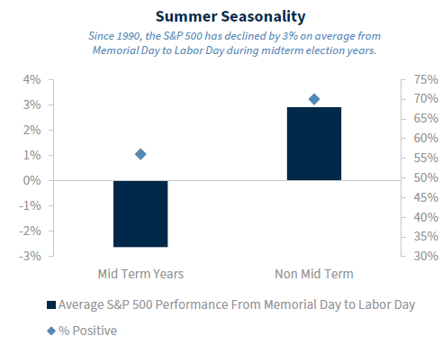
Bonds, as measured by the Bloomberg US Aggregate Bond index, ended the quarter essentially flat at -0.05% while U.S. stocks (S&P 500) were down -4.33%. International markets and U.S. small-cap markets started the year with surprising strength, but they have given back much of those gains through March as the war escalated. Gold experienced the most volatility, rallying another 20% this year before giving nearly all of that back, and ended the quarter up only 5.7%. In our recent investment event, we discussed many of these headlines and noted that this is a midterm election year, which is usually marked by greater-than-average volatility but often ends positively.

Volatility Caused by Geopolitical Events

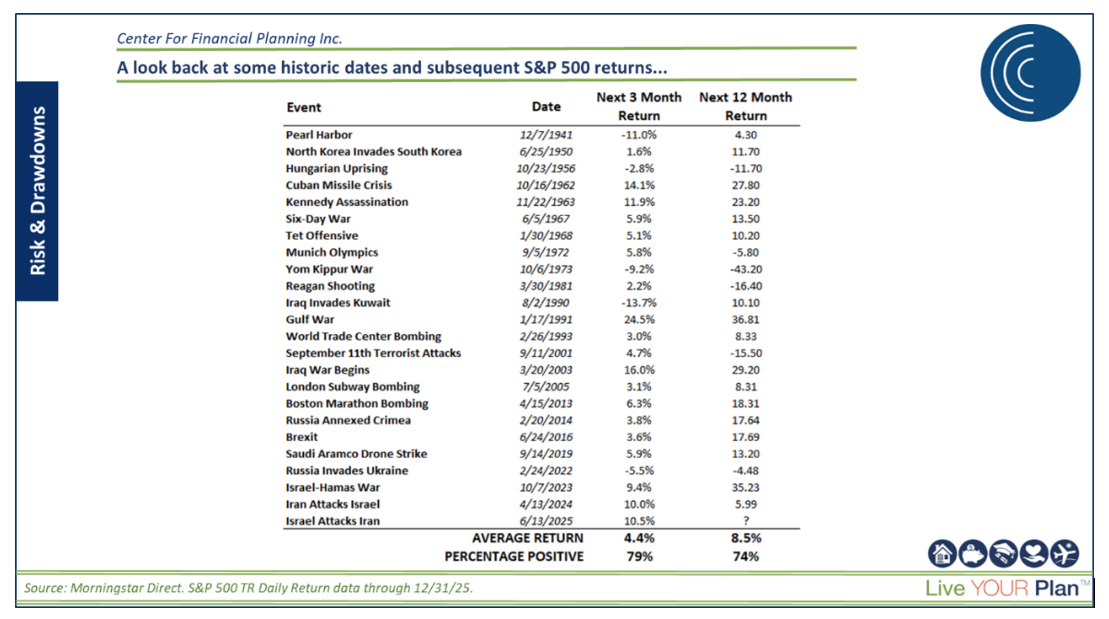
The above headlines can make investors want to act – maybe even sell their investments and stock up on cash under the mattress or gold bars in the safe. In times of stress, it is important to lean on history and data to guide the next best course of action. See below for stock returns 3 and 12 months after key conflicts over the past 100 years. Does the data surprise you?

Table showing S&P 500 returns after major historical events, including wars, terrorist attacks, and political crises, comparing 3‑month and 12‑month market performance.

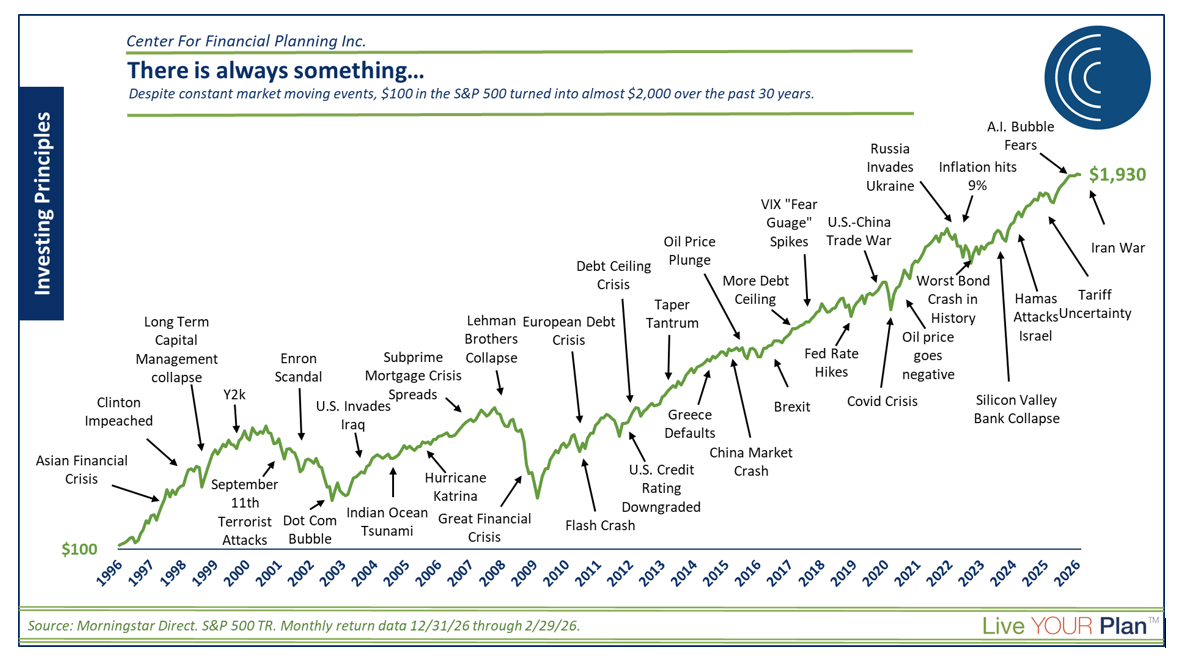
Diversification and remaining invested are very important in times like these. While diversification doesn’t completely insulate you from drawdowns during the hard times, it does make them much more bearable and hopefully sets your portfolio up for a quicker recovery. Volatility is a normal part of investing. Remember, if we had no risk, there would also be no reward. It is the price we pay for long-term positive returns. Each year, volatility crops up for one reason or another, and temporary pullbacks are very normal.

Line chart showing long‑term growth of $100 invested in the S&P 500 rising to nearly $2,000 over 30 years, despite major market shocks such as wars, recessions, inflation, and financial crises.

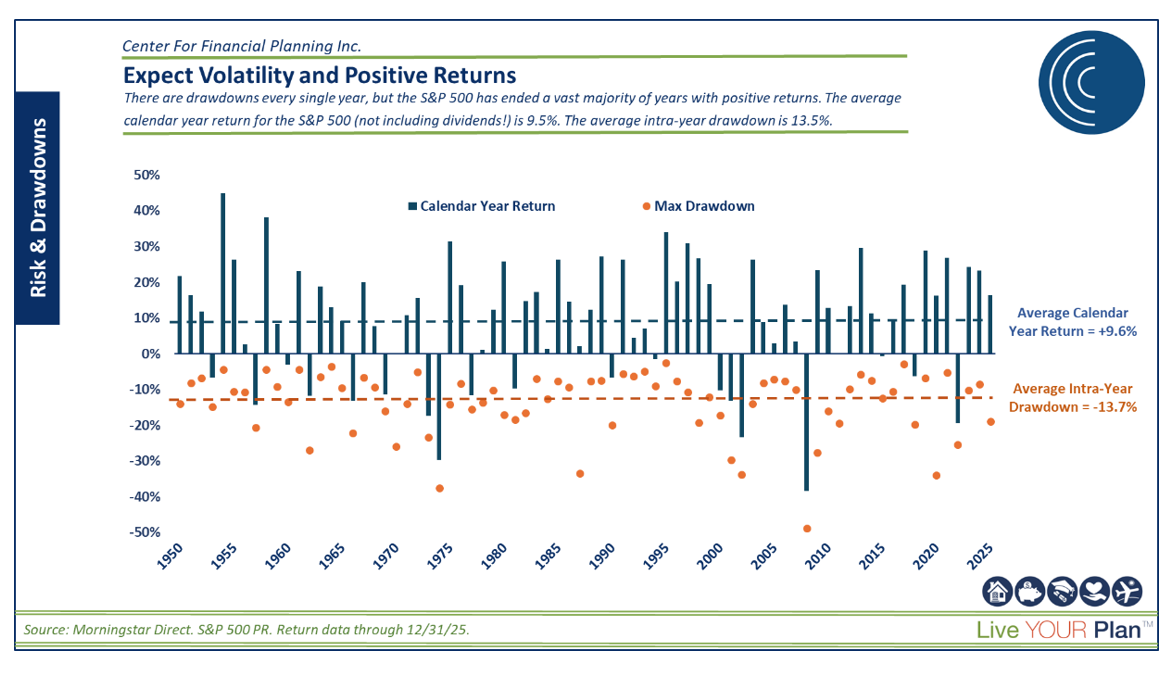
2025 and 2026 have been no exception. Liberation Day (political branding of tariff policies) caused a strong market pullback around the same time last year, followed by the Iran War this year. The chart below shows the regularity of pullbacks. The blue bars (overwhelmingly positive) are calendar year returns. The orange dots show how much the market fell WITHIN each calendar year. Some years only see 3% to 10% dips. Some years see dips of 10% to 50%. The “average” intra-year drawdown since 1950 is 13.5%. Despite those dips, the S&P 500 was positive ¾ of the time and averaged 9.5% per year.

Chart showing annual S&P 500 calendar returns and maximum intra‑year drawdowns over time, illustrating that market volatility occurs every year while long‑term returns are usually positive.

For investors with long time horizons, these moments may serve as great entry points, especially if you have additional dollars to save. For those who depend on their assets, we have an action plan in place that was developed long before this volatility began. The thoughtful planning work we do with you helps ensure you have what you need for the next 6 months, a year, or even two years, already in cash or money market, which means you don’t have to sell into market volatility.

Federal Reserve and Interest Rates

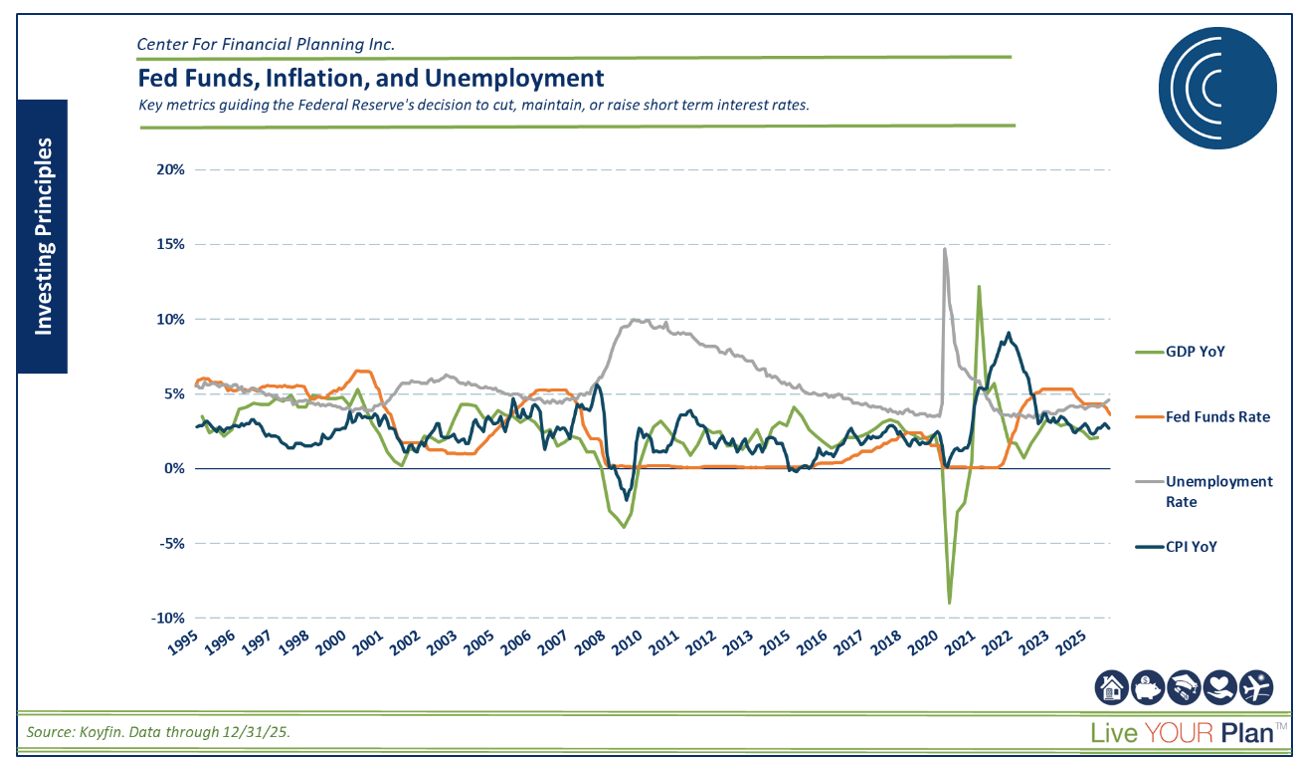
The Federal Reserve (The Fed) has faced political pressure to cut interest rates while it navigates stubborn inflation, a weakening labor market, and the economic consequences of the war in Iran. The Fed opted to hold interest rates steady at 3.5%–3.75% through its January and March meetings, even as oil‑price spikes linked to Middle East conflict complicated its inflation outlook. It is important to remember that the Fed focuses on core PCE, which strips out inflation pressures from energy and food because they are typically so volatile. Inflation fears and concerns that the Fed could raise short-term interest rates have picked up again amid the spike in oil prices. I think we all immediately remember the 1970s era of inflation when we hear that oil is getting expensive and start to worry. As of now, this spike has been short-lived, and if the Straits of Hormuz reopen soon and oil starts moving again, we should see oil prices start to come back down. Short-term spikes usually don’t flow through to core PCE inflation in a meaningful way. However, if oil remains scarce and prices remain high, you will start to see the higher energy costs leak through to other areas of the economy, which would then be reflected in higher core PCE.

The bond market immediately jumped to the conclusion in March that the latter would happen, and the Fed would be staring at rising inflation numbers, and then further assume the Fed would start raising interest rates again to combat this inflation. We think it is far too early to assume this will happen. We entered the year with bond and equity markets pricing in 1 or 2 rate cuts by the end of this year, and now the market is pricing in a rate increase before year's end. This change in expectations is why bonds have had a negative month of returns. However, it is important to note that this isn’t the start of a 2022 bond market again. Now we are starting from a place of much higher yields, and we still have a robust interest rate being paid to us every month to compensate for some volatility.

Despite market assumptions, Fed officials continue to project one rate cut later in 2026, but internal disagreement continues, and if Kevin Warsh is confirmed by the Senate to take over in May, opinions could shift. It is important to remember that no single person sets this policy. There are 12 voting members of the Federal Open Market Committee (FOMC) who determine the fate of interest rates. The Chairman is simply the public representative of this board, and the chairperson only has 1 vote like everyone else and has no veto power.

At the same time, political pressure from President Trump on the Fed continues, as he publicly called for an immediate rate cut amid market volatility driven by war. Chair Jerome Powell, nearing the end of his term, emphasized that the Fed is still assessing the impact of the Iran war, elevated oil prices, and mixed economic data, and warned that the path ahead remains deeply uncertain. With leadership transitions approaching and geopolitical risks rising, the Fed’s next move remains far from clear—fueling market anxiety and adding to the perception that 2026 has become one of the most unpredictable years for Fed policy in over a decade.

Long Term Versus Short Term Interest Rates and Mortgage Rates

While the Fed does set interest rate policy, it is important to remember that it only sets short-term rates. Intermediate and long-term interest rates are driven more by supply and demand. Many have hoped that lower short-term rates would equate to lower mortgage rates. While rates have come down over the past 9 months, they have recently (in March) drifted back upward, causing new home buyers to pause. Earlier this quarter, 30-year mortgages had fallen below 6%, but they have drifted back to the mid-6 % range, nearly halting mortgage applications.

Private Credit Fears

Over the past few years, we have gotten many questions on private credit. We are constantly kicking the tires on different investment opportunities and trying to understand if they deserve a spot in your portfolio. The allure of 10%+ interest rates and little volatility sounded very tempting, but it was the first red flag in our review. Limited liquidity also had alarm bells swirling in our heads. Usually, if something sounds too good to be true, it often is. Private credit is no exception. Many dove in, thinking there would be little volatility and a great income stream. The problem with a limited liquidity product is just that, you usually can’t access your money when you most want it. As there were notable headlines about private credit borrowers, these private credit funds faced many redemption requests that they could not fulfill. Imagine wanting to sell an investment and being told no. That fear then starts to snowball, and more investors request redemptions, snowballing the issue and the headlines. We recognized this product for what it is: for high-net-worth investors with very long time horizons who can wait out redemption limitations without needing the cash. Even then, they aren’t guaranteed to pay you a premium investment return. The headlines are likely to continue escalating around these products as barriers to selling persist and securities in the portfolios are marked down to their actual values.

Artificial Intelligence

A.I. news continues to drive headlines and move markets. Companies that are driving the technology forward continue to share new developments and innovations that can be both exciting AND nerve-wracking. There is no shortage of opinion pieces predicting what the future holds for the technology, ranging from “minor” to “world-changing”. This uncertainty has shown up in financial markets, as there is some dispersion in stock prices lately. Not everything is moving in unison…which is healthy! We would not want to see dot-com bubble-era behavior, where any stock that mentioned A.I. was immediately rewarded. Certain companies’ stock prices have fallen following announcements of large A.I. spending plans, while others have reacted positively. Demand for “chips” is driving strong earnings expectations in the semiconductor industry, but there is concern about circular spending, where companies are just paying each other back and forth, and that may not be sustainable. There has also been some major volatility among individual stock names as competitive moats come under attack from A.I. Utilities and commodities are affected as “datacenter” plans with mind-blowing power needs continue to develop.

This is a major theme that affects many parts of the market. With any innovation, uncertainty follows, and all investors can do is invest accordingly. As far as our portfolios go, we continue to monitor valuations and expectations for the stocks and bonds that are directly affected. This quarter's volatility has actually made valuations more attractive. We get the question, “Is this a bubble?” a lot…and we just don’t see it across the whole market. Sure, there might be individual companies trading at extreme valuations, but it certainly isn’t across the entire market. It might surprise you to hear that, for example, Microsoft ended the quarter in a 31% drawdown from its prior high! It is one of the largest holdings in the S&P 500, but due to performance in other sectors, the index was still only down ~4% in Q1. To us, that is yet another example of diversification (in this case, sector diversification within the S&P 500) leading to better outcomes for investors.

Tariff Update

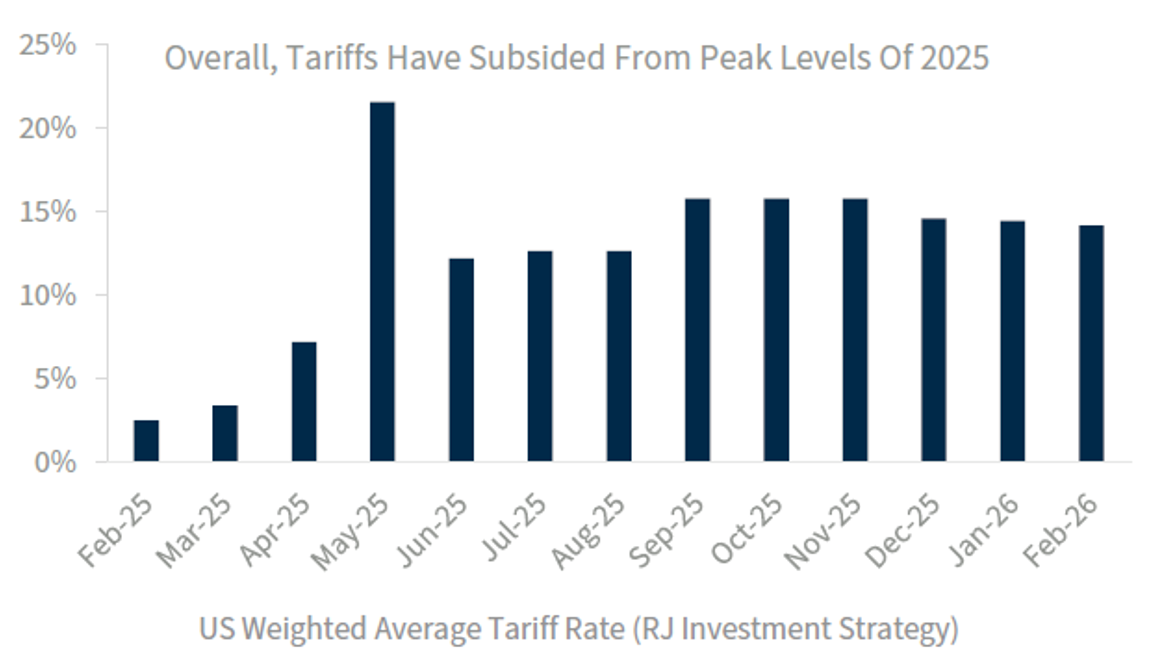
Trump’s tariffs were another source of volatility in the first quarter. The Supreme Court ruled that a portion of Trump's tariffs, the ones imposed on specific countries, were unlawful. Trump’s initial justification for imposing those tariffs as a national “emergency” did not hold up in the Supreme Court, so those tariffs were removed. He immediately responded to this ruling by imposing new temporary tariffs of 10%, then later 15%. Ultimately, this is a fluid situation that is adding to the uncertainty in the stock and bond markets. Companies have to navigate pricing and supply chain issues arising from tariff uncertainty, and there is still the lingering question of whether tariff refunds will be paid out.

Bar chart showing the U.S. weighted average tariff rate declining from a peak in mid‑2025 and stabilizing through early 2026, according to RJ Investment Strategy.

Overall, it seems we can expect tariffs to remain in place for now, which will ultimately provide another revenue stream for the U.S. government but lead to higher prices for U.S. consumers. Time will tell how these tariffs will change going forward, whether they will remain in place long-term or be used more as a bargaining chip to make deals with other countries.

Gold Crash?

Another surprising market move in Q1 came from Gold. Gold started the year continuing its growth, hitting a new all-time high of almost $5,600 near the end of January! Then it fell 20% from its high over the next month and a half, bottoming out near $4,200 on March 23rd. It rallied slightly and ended the quarter near $4,600/oz.

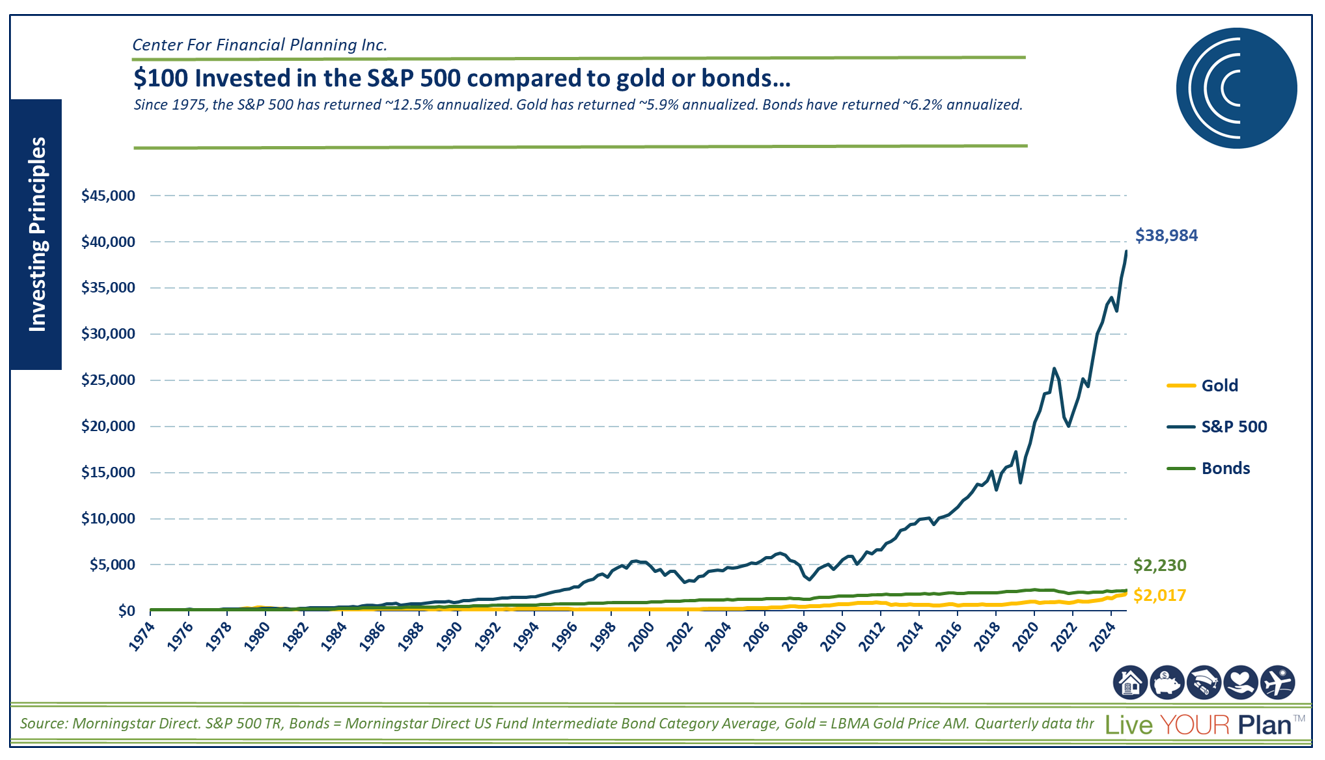
The market can surprise us more often than we think. Gold is often considered a “safe haven” asset, which you would expect would RALLY in the event of something like, I don’t know, the unknowns of a war in the Middle East. But that is not how gold reacted this past quarter; in fact, headlines at the very end of the quarter hinted at an off-ramp from the conflict with Iran, and gold actually rallied on the news, similarly to stocks! Not exactly the movement you would expect from a “safe haven” asset.

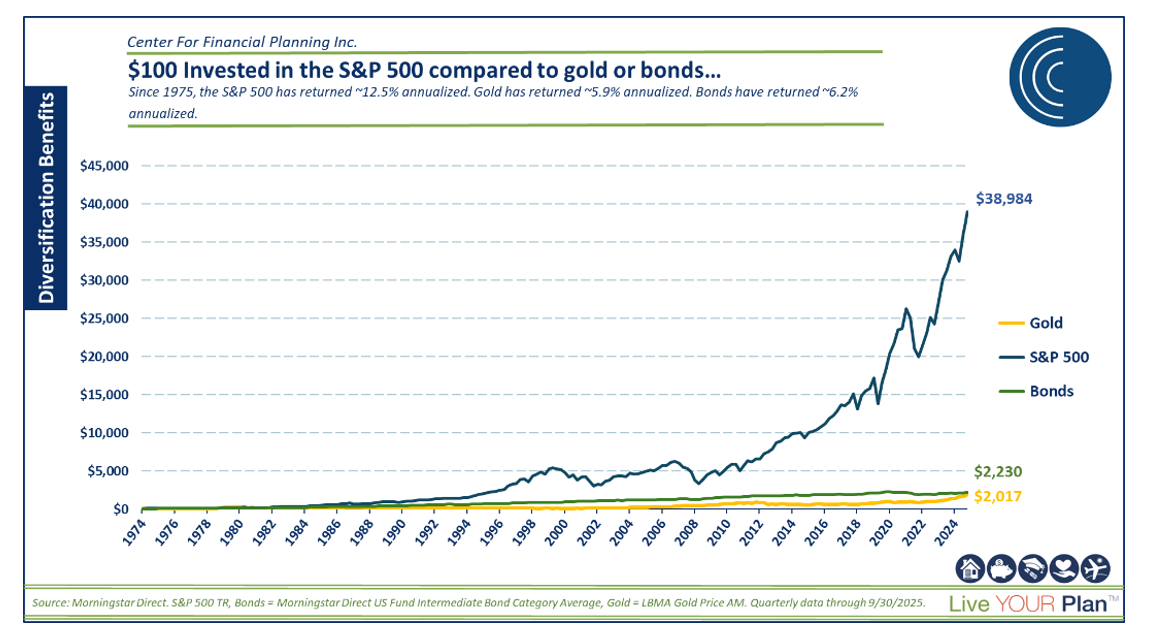
Line chart comparing $100 invested in the S&P 500, gold, and bonds since 1975, showing significantly higher long‑term growth for the S&P 500 than gold or bonds.

Gold is an uncorrelated asset for better or worse. It has been on an amazing run over the past few years and just began experiencing some volatility this past quarter. Like any asset, consider the risks before investing, and understand your unique situation and financial plan to determine if, where, and how gold might fit into your portfolio.

Thank you for taking the time to read this quarter’s investment commentary. There is a lot of noise in the markets, and we believe that a thoughtful financial plan, paired with a disciplined investment process, is more important than ever. Please don’t hesitate to reach out to your financial advisor or anyone on our team here at The Center with any questions. We’re here to help and would be delighted to have a conversation.

Angela Palacios, CFP®, AIF®, is a partner and Director of Investments at Center for Financial Planning, Inc.® She chairs The Center Investment Committee and pens a quarterly Investment Commentary.

Nicholas Boguth, CFA®, CFP® is a Senior Portfolio Manager and Associate Financial Planner at Center for Financial Planning, Inc.® He performs investment research and assists with the management of client portfolios.

Any opinions are those of Angela Palacios, CFP®, AIF® and Nick Boguth, CFA®, CFP® and not necessarily those of Raymond James. The information contained in this report does not purport to be a complete description of the securities, markets, or developments referred to in this material. There is no assurance any of the trends mentioned will continue or forecasts will occur. The information has been obtained from sources considered to be reliable, but Raymond James does not guarantee that the foregoing material is accurate or complete. Any information is not a complete summary or statement of all available data necessary for making an investment decision and does not constitute a recommendation. Investing involves risk and you may incur a profit or loss regardless of strategy selected.

The S&P 500 is an unmanaged index of 500 widely held stocks that is generally considered representative of the U.S. stock market. The Russell 2000 Index measures the performance of the 2,000 smallest companies in the Russell 3000 Index, which represent approximately 8% of the total market capitalization of the Russell 3000 Index. The MSCI EAFE (Europe, Australasia, and Far East) is a free float-adjusted market capitalization index that is designed to measure developed market equity performance, excluding the United States & Canada. The EAFE consists of the country indices of 22 developed nations. The Bloomberg Barclays US Aggregate Bond Index is a broad-based flagship benchmark that measures the investment grade, US dollar-denominated, fixed-rate taxable bond market. Keep in mind that individuals cannot invest directly in any index, and index performance does not include transaction costs or other fees, which will affect actual investment performance. Individual investors’ results will vary. Investing in oil involves special risks, including the potential adverse effects of state and federal regulation and may not be suitable for all investors. Past performance does not guarantee future results. Diversification and asset allocation do not ensure a profit or protect against a loss. Investing involves risk and you may incur a profit or loss regardless of strategy selected. Past performance is not a guarantee or a predictor of future results. Raymond James and its advisors do not offer tax or legal advice. You should discuss any tax or legal matters with the appropriate professional.

Gold is subject to the special risks associated with investing in precious metals, including but not limited to: price may be subject to wide fluctuation; the market is relatively limited; the sources are concentrated in countries that have the potential for instability; and the market is unregulated.

Q4 2025 Investment Commentary

Print Friendly and PDF

As we close out 2025, global markets have successfully navigated a year of disruption. Tariffs, AI, and a weaker US dollar have influenced investment outcomes. Inflation continued to trend closer to the Federal Reserve target, while bonds quietly rallied as interest rates were cut. Equity markets reflected this pivot, with leadership broadening beyond mega-cap technology as cyclical sectors regained footing amid improving global demand.

Investor sentiment seemed to fluctuate between optimism and caution over structural headwinds—from persistent fiscal deficits to geopolitical uncertainties. Geopolitics have been in the forefront of headlines to start out the new year with the capture of Nicolas Maduro and his wife. Check out this whitepaper for more information on what that could mean for oil markets. While cryptocurrencies fell out of favor, precious metals have regained the spotlight as governments view these as critical resources. As we look ahead, we are cautiously optimistic for a market environment that could prize discipline and adaptability. The S&P 500 ended the year up almost 18% even after it was down almost 20% back in April, while international markets represented by the MSCI ACWI Ex-US rallied even more up over 32%, and lastly bonds were up over 7%. For an idea of where that left diversified portfolios, Morningstar’s “Moderate Allocation” category had an average return of 12.5%.

Interest Rates, Inflation, and Unemployment

The Federal Reserve’s (the Fed) policy stance in 2025 marked a shift back to a more accommodative approach. After holding rates steady through the summer to ensure inflation was firmly trending toward its 2% target as tariffs were introduced, the Fed initiated a series of measured cuts late in the year as economic data allowed. These reductions, totaling 75 basis points, were framed by Fed chair, Jerome Powell, as a normalization rather than an emergency response, aiming to support moderating growth without reigniting inflation pressures. The Fed emphasized its data-dependent posture, leaving room for flexibility should labor markets or inflation dynamics deviate from expectations.

So what “data” is the Fed watching? Inflation and unemployment are the two main factors they focus on.  Core Consumer Price Index (CPI) is the Fed’s preferred gauge of inflation. As of late December, inflation was sitting around 2.6%. The Fed would like to see it continue to trend down toward 2%, but they seem content with numbers coming in below 3%. On the other hand, unemployment is currently sitting at 4.6% in December, and this number has trended up from near 4% earlier this year. When the Fed cuts interest rates, it risks spurring inflation, but it also helps keep unemployment low or lower. While they don’t seem too concerned about unemployment levels, the two levels trending in the direction they have this year seem to be giving the Fed reason to cut.

Despite rate cuts, some outstanding opportunities have flown under the radar of many. Municipal bonds! For high-tax bracket investors, municipal bonds that pay high-quality income allowed them to lock in very attractive taxable-equivalent yields throughout 2025. Even though short term interest rates were pushed lower by cuts from the Federal Reserve, longer-dated municipal bonds actually saw interest rates increase due to higher than normal issuance, tax uncertainty under a new President, and investor outflows! This area could be poised for a nice rebound.

Importance of Small Businesses

Small businesses are the backbone of our economy here in the U.S. The unemployment situation is largely influenced by whether small businesses (which make up 44% of our Gross Domestic Product (GDP) here in the U.S.) are hiring or pulling back. Small business bankruptcies are one way to monitor their health. In 2025, we saw small business bankruptcies up over 8% from the prior year and rising faster than those of larger businesses.  Small-company stocks, as represented by the Russell 2000, are worth watching, as they tend to be the “canary in the coal mine” if a recession is around the corner. While small businesses that aren’t publicly traded might be experiencing difficulty, the Russell 2000 has rallied strongly this year.

A.I. and Tech Outperformance

We can’t have a commentary without including one of the hottest topics of the year – Artificial Intelligence! Companies are making eye-popping investments into developing technology, building infrastructure, and figuring out how to implement this fast-growing technology into their businesses. Only time will tell if those investments turn out to be profitable or not, but the market is clearly excited about the prospects as it has rewarded most of those A.I. related companies with higher stock prices. The tech sector slightly lagged in Q4, but it led the way as the top-performing sector in 2025.

International Outperformance and Tariffs

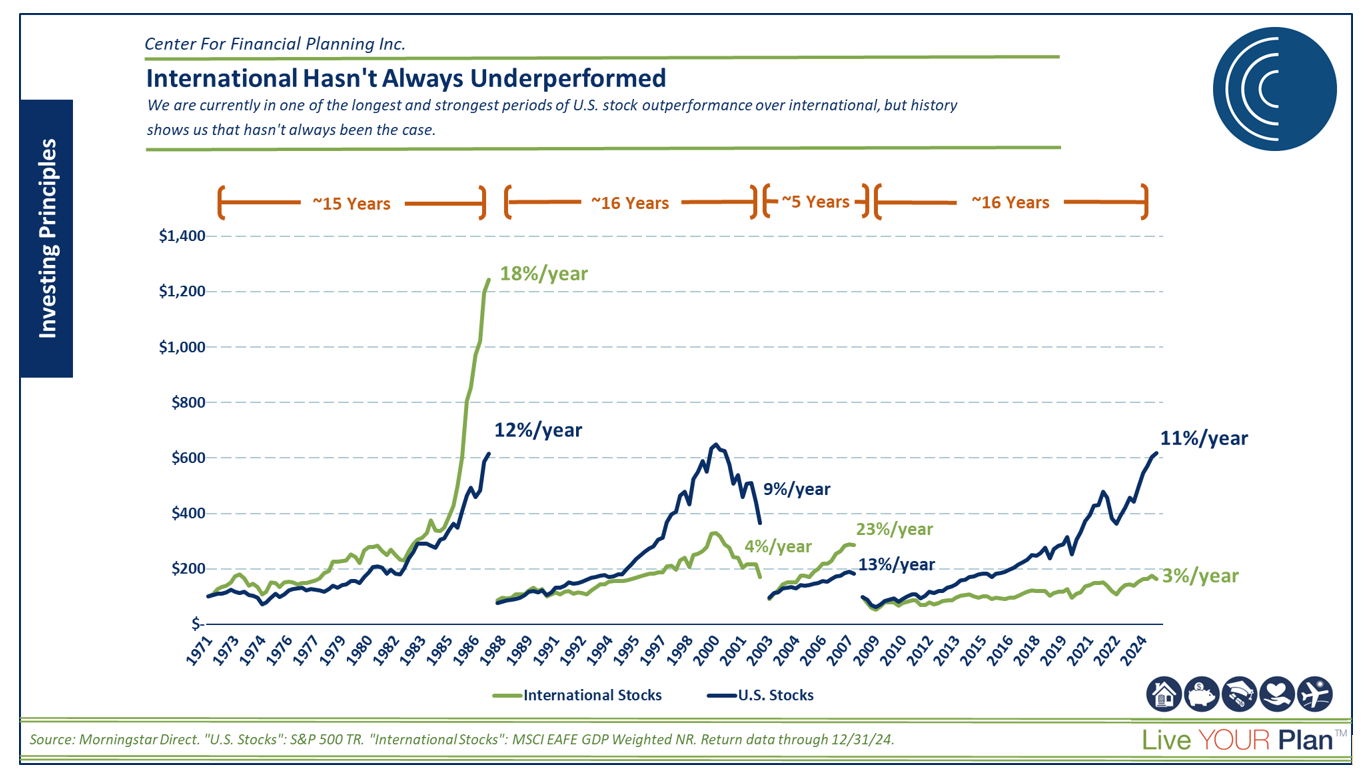
Speaking of outperformance – were you invested in international equities this year? It has been a rough past decade for international stocks compared to their U.S. large counterparts, but the script flipped in 2025. International stocks (MSCI ACWI Ex-US) beat U.S. stocks (S&P 500) by ~15% this year, finishing with an impressive return of +32% for 2025. Could this be a turning point in market leadership going forward? No one knows for sure, but history has shown these two asset classes taking turns outperforming each other, and international stocks do have a major tailwind given their discounted starting valuations compared to the extremely elevated valuations of the U.S.

International performance might be the most surprising outcome of the year, given the political backdrop to start the year. Trump started his presidency with a focus on American leadership, which might suggest stock outperformance, and then introduced tariffs to improve America’s trading position and penalize unfair foreign trade practices… which, at face value, also seems to suggest U.S. stock outperformance! But here we are at year-end with international outperformance that nobody saw coming. To us, this just further reinforces our belief in diversification and a disciplined process for our portfolios. Chasing headlines or short-term gains may have led investors to miss the strong run in international stocks this year.

Bitcoin Down and Metals Way Up

After peaking in October, Bitcoin fell over 30% in just over one month and ended the year slightly negative. Gold, on the other hand, had a historic year, rising by over 60%. That is gold’s strongest return since the early 70’s! These alternative asset classes are prone to volatility. What goes up quickly can also come down quickly. Be wary of narratives that try to make sense of these moves or extrapolate them going forward. Is gold’s run an indication of the end of U.S. dollar dominance? Is Bitcoin’s dip an indication of its demise? Or is this normal volatility from historically volatile asset classes that can move violently in both directions? Every investor has to decide for themselves whether alternative asset classes with this kind of volatility belong in their portfolios.

What Major Analysts Think for 2026…and Does It Matter?

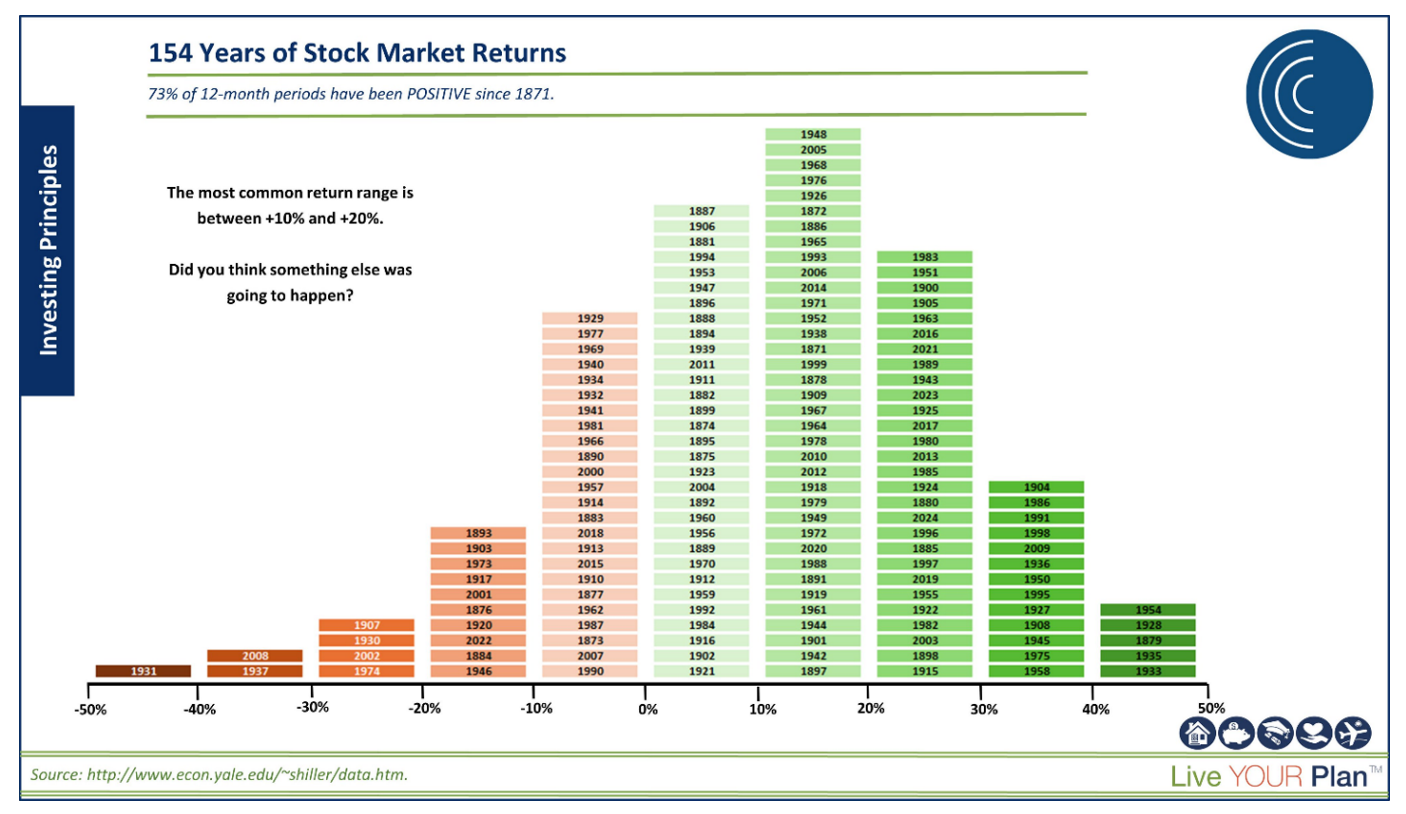
There is an annual practice from big banks and analyst firms to publish their S&P 500 year-end price targets. They are historically not very accurate. We included this in our Q4 commentary last year as well! With that being said, analysts last year were generally bullish, and the stock market was up about 17%…well done to the analysts who nailed it! Or perhaps a betting man would perform best by looking back 150 years and predicting the most common return for the stock market…

2026 analyst predictions are looking mostly bullish again. We’ll review them again next year and see how they did! They may not be the most useful for predicting the future of the stock market, but they are useful for better understanding expectations and what is being priced into the market. Currently, it seems the market is pricing in serious optimism, with bullish analysts and near-record-high valuations.

We will continue to stick to our process, diversify, maintain appropriate cash levels, and, most of all, lean on sound financial planning to ensure we are prepared for whatever the market throws at us next. As always, we are here to help answer any questions you may have regarding your individual financial situation. We hope you had a great year – now onto what we hope is a great 2026!

Angela Palacios, CFP®, AIF®, is a partner and Director of Investments at Center for Financial Planning, Inc.® She chairs The Center Investment Committee and pens a quarterly Investment Commentary.

Nicholas Boguth, CFA®, CFP® is a Senior Portfolio Manager and Associate Financial Planner at Center for Financial Planning, Inc.® He performs investment research and assists with the management of client portfolios.

Any opinions are those of Angela Palacios, CFP®, AIF® and Nick Boguth, CFA®, CFP® and not necessarily those of Raymond James. The information contained in this report does not purport to be a complete description of the securities, markets, or developments referred to in this material. There is no assurance any of the trends mentioned will continue or forecasts will occur. The information has been obtained from sources considered to be reliable, but Raymond James does not guarantee that the foregoing material is accurate or complete. Any information is not a complete summary or statement of all available data necessary for making an investment decision and does not constitute a recommendation. Investing involves risk and you may incur a profit or loss regardless of strategy selected. The S&P 500 is an unmanaged index of 500 widely held stocks that is generally considered representative of the U.S. stock market. The Russell 2000 Index measures the performance of the 2,000 smallest companies in the Russell 3000 Index, which represent approximately 8% of the total market capitalization of the Russell 3000 Index. The MSCI EAFE (Europe, Australasia, and Far East) is a free float-adjusted market capitalization index that is designed to measure developed market equity performance, excluding the United States & Canada. The EAFE consists of the country indices of 22 developed nations. The Bloomberg Barclays US Aggregate Bond Index is a broad-based flagship benchmark that measures the investment grade, US dollar-denominated, fixed-rate taxable bond market. Keep in mind that individuals cannot invest directly in any index, and index performance does not include transaction costs or other fees, which will affect actual investment performance. Individual investors’ results will vary. Investing in oil involves special risks, including the potential adverse effects of state and federal regulation and may not be suitable for all investors. Past performance does not guarantee future results. Diversification and asset allocation do not ensure a profit or protect against a loss. Investing involves risk and you may incur a profit or loss regardless of strategy selected. Past performance is not a guarantee or a predictor of future results. Raymond James and its advisors do not offer tax or legal advice. You should discuss any tax or legal matters with the appropriate professional.

Bitcoin issuers are not registered with the SEC, and the bitcoin marketplace is currently unregulated. Bitcoin and other cryptocurrencies are a very speculative investment and involves a high degree of risk.

Q3 2025: A Quarter of Records & Resilience in the Markets

Mallory Hunt Contributed by: Mallory Hunt

Print Friendly and PDF

The third quarter of 2025 will be remembered as a historic chapter in the ongoing bull market, delivering a standout performance and offering a welcome boost to investor confidence and portfolio growth. Despite ongoing economic headwinds and global uncertainty, investors witnessed a powerful rally. Markets surged to record highs, driven by strong corporate earnings, a strategic rate cut from the Federal Reserve, and the continued dominance of AI-powered growth stocks. This wasn’t just a strong quarter; it was pivotal, signaling a potential turning point in the post-pandemic economic cycle and offering fresh momentum heading into the final stretch of the year. Let’s take a look at some of those record-breaking numbers:

  • The S&P 500 closed above $6600 for the first time, logging 23 record highs, matching the most in any quarter since Q1 1998. Final numbers had the index up 7.79% for the quarter and over 13.72% year-to-date.

  • Nasdaq Composite soared 11.24%, driven by continued momentum in AI-related stocks.

  • Dow Jones Industrial Average rose 5.22%, marking its 8th record high of the year.

  • Russell 2000 small-cap index jumped 12.02%, outperforming large caps and reaching its first record high since 2021.

This remarkable market performance wasn’t just pure luck; several key drivers came together to propel markets to new heights and can be credited as the fuel to this rally:

  • AI Momentum: The “Magnificent 7” tech stocks (Alphabet, Amazon, Apple, Meta, Microsoft, Nvidia & Tesla) continued to dominate, with artificial intelligence innovation driving investor enthusiasm and capital inflows

  • Federal Reserve Rate Cut: The Fed delivered the first rate cut of the year in September, lowering the federal funds rate by 25 basis points and signaling a shift toward a more accommodative policy. This helped ease market concerns and boost investor sentiment.

  • Strong Corporate Earnings: Over 80% of S&P 500 companies exceeded earnings expectations in the second quarter of 2025, which drove investor sentiment in the third quarter and reinforced the strength of U.S. corporations.

  • Global Market Participation: International markets also rallied, with emerging markets outperforming developed ones. Easing trade tensions and supportive policy measures contributed to the global upswing.

As far as sector standouts, leading the quarter’s rally was technology, powered by AI-driven momentum, strong earnings, and expanding valuations. Healthcare demonstrated resilience amid evolving policy landscapes and ongoing innovation. Small-cap stocks outperformed their large-cap counterparts, signaling broader market strength. Growth stocks continued to outpace value stocks, particularly within consumer discretionary and communication services. Meanwhile, safe-haven assets like gold and silver also surged, with gold climbing over 15% and silver approaching its 1980 highs, as investors sought protection against inflation.

While the quarter was overwhelmingly positive, several cautionary factors remain on the radar. Inflation remains above target. Equity valuations have reached elevated levels, prompting concerns that limited earnings growth could cap future gains. Geopolitical and trade tensions persist, including ongoing tariff disputes and global instability, which pose risks to supply chains and investor confidence. Additionally, the current government shutdown will likely delay critical economic data releases, potentially complicating the Federal Reserve’s policy decisions and adding uncertainty to the market outlook.

As we transition into the fourth quarter—a period that historically favors market strength—investors have reason to remain optimistic, while staying mindful of elevated valuation levels and macroeconomic signals. While past performance is never indicative of future results, the momentum from Q3 sets a compelling stage for what could be a potentially dynamic finish to the year. Staying invested and diversified remains key, as disciplined strategies continue to benefit from long-term market trends.

Mallory Hunt is a Portfolio Administrator at Center for Financial Planning, Inc.® She holds her Series 7, 63 and 65 Securities Licenses along with her Life, Accident & Health and Variable Annuities licenses.

The information contained in this blog does not purport to be a complete description of the securities, markets, or developments referred to in this material. The information has been obtained from sources considered to be reliable, but we do not guarantee that the foregoing material is accurate or complete. Any opinions are those of Mallory Hunt and not necessarily those of Raymond James. There is no guarantee that these statements, opinions or forecasts provided herein will prove to be correct. Investing involves risk and you may incur a profit or loss regardless of strategy selected. Every investor's situation is unique, and you should consider your investment goals, risk tolerance and time horizon before making any investment. Prior to making an investment decision, please consult with your financial advisor about your individual situation.

Q3 2025 Investment Commentary

The Center Contributed by: Center Investment Department

Print Friendly and PDF

The third quarter of 2025 was one for the record books. The S&P 500 hit new all-time highs 23 times during the quarter. That is the most new highs in a single quarter since 1998! Bonds and small company stocks did not want to be left behind. The Russell 2000 set its own first record high since 2021, and the Bloomberg Aggregate Bond index moved higher for the 3rd straight quarter. Developed international and emerging markets also continued their strong start to the year. For more details, check out our blog. This means that this year has been great for diversified portfolios, which have taken less risk than the S&P 500 but logged nearly as high returns for a 60% Stock/40% Bond portfolio (40% Bloomberg Aggregate Bond index, 40% S&P 500, and 20% MSCI EAFE International index).

Muted Inflation and Interest Rate Cut

While inflation is tempered for now (even though it lingers above the 2% Fed target), we will likely see it rise in the coming months. Tariffs will cause upward pressure, but low energy prices, declines in shelter inflation, and global economic sluggishness should mitigate the rise.

The Federal Reserve (The Fed) began cutting interest rates again, citing a sluggish labor market.  The first cut of .25% occurred in September and is likely to be followed by 1 or 2 more .25% cuts this year. The Fed will continue to let data drive its decision-making here. The only issue with this is that some data points may be very delayed due to the government shutdown. Lower rates will mean lower money market interest rates, but should also lead to a welcome reduction in mortgage interest rates. 

Tariffs

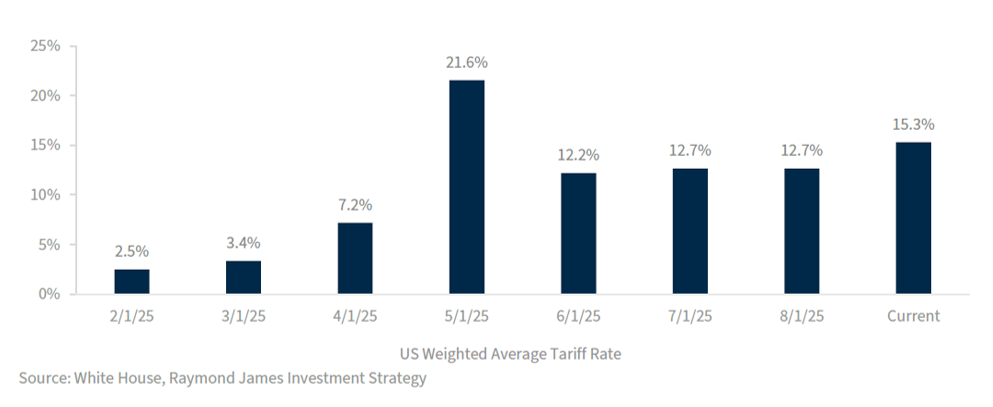
Tariff revenue is starting to ramp up. Both August and September reports indicate that monthly revenue was over $31 billion each month. Our weighted average tariff revenue in the U.S. is sitting just over 15% compared to just 2.5% in February of this year. As an example, if a 20% average tariff rate were in place for the next 12 months, the U.S. Treasury could collect over $600 billion, which exceeds taxes received from corporations! It remains to be seen how companies will manage this, whether they absorb the hit to their bottom line or pass it along to consumers. Given enough time, companies will also find strategies to mitigate, such as onshoring production or shifting production to countries with lower tariff rates, to stay competitive.

While tariffs were ruled unlawful by lower courts, this case is now in the Supreme Court’s hands, and it could take several months before a final ruling. So they are here to stay for the time being.

Government Shutdown

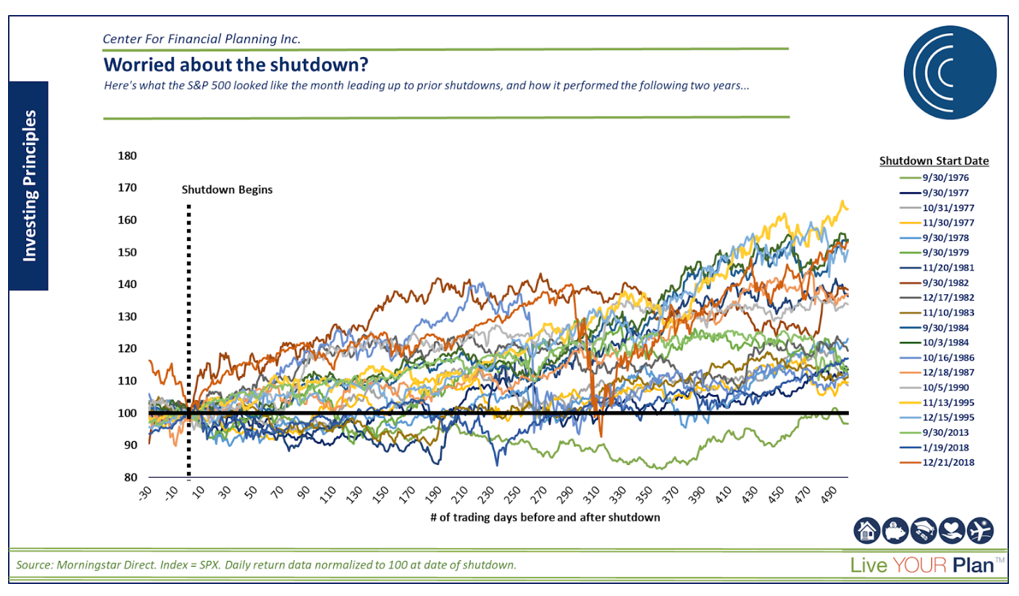
As of October 1st, the U.S. government has officially entered a shutdown—its first in nearly seven years since the record-breaking 35-day standoff in 2018. The impasse stems from Congress’s failure to pass a budget, driven by partisan disagreements over healthcare funding and proposed federal spending cuts. This has led to disruptions across key agencies, such as the Bureau of Labor Statistics, which has delayed vital economic data and raised concerns about the Federal Reserve’s ability to make informed monetary policy decisions. While this shutdown carries unique weight due to the administration’s push for permanent layoffs and structural changes, investors are reminded that volatility often presents opportunity. Shutdowns are typically brief, averaging just nine days and usually create openings for disciplined investors to reassess and rebalance.

As illustrated in the chart below, the S&P 500 has consistently trended upward in the months following past shutdowns. Despite initial turbulence, markets have shown remarkable resilience, frequently rebounding once political uncertainty fades. 12-month gains following the 20 shutdowns over the past 50 years have averaged 13%, with positive performance 85% of the time! Shutdowns may feel unsettling in the moment, but history offers a reassuring perspective: portfolios anchored in strong fundamentals tend to weather political disruptions better than reactive strategies. Staying diversified and focused on long-term goals remains the most effective approach. The chart serves as a powerful visual reminder that staying the course has historically paid off, even when headlines suggest otherwise.

Investing at All-Time Highs

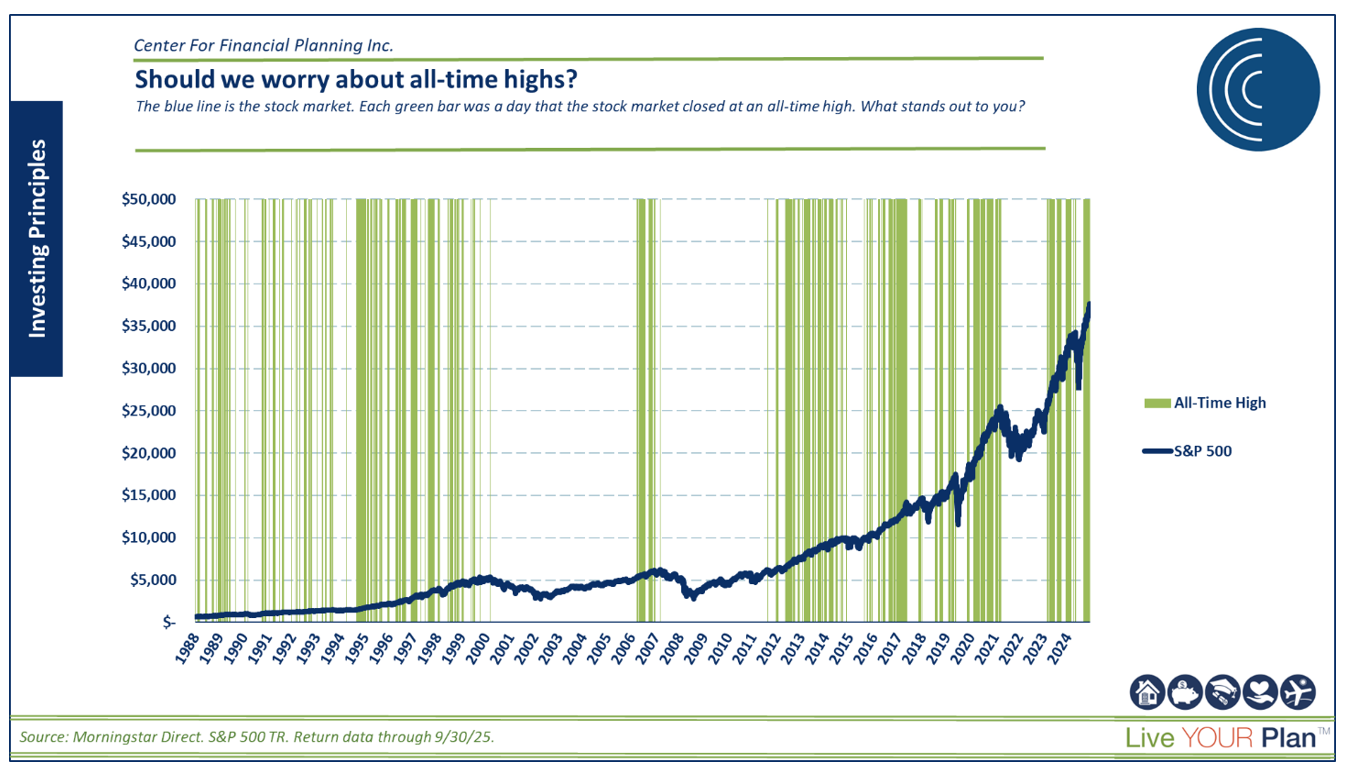
We are navigating this current stock market with two competing narratives. One screams, “sell!” as valuations continue to rise to historic levels despite a weakening labor market, increased tariffs, and uncertain global trade. The other screams, “buy!” as consumers remain strong, the Fed begins cutting rates, companies continue to grow earnings, and the excitement around productivity gains from A.I. continues to accelerate. Whatever your opinion on the stock market, the fact is that the S&P 500 continued to make new all-time highs this quarter – which is NOT an indicator that stocks need to fall. On the contrary, all-time highs tend to be followed by…more all-time highs. With that being said, it is understandable to be concerned or have a cautious outlook on equity markets going forward. When times feel extra uncertain, we lean on our process, historical precedent, diversification, emergency cash reserves, and strong financial planning to provide comfort and give us the conviction we need to stick to the plan.

Gold’s Strong Performance

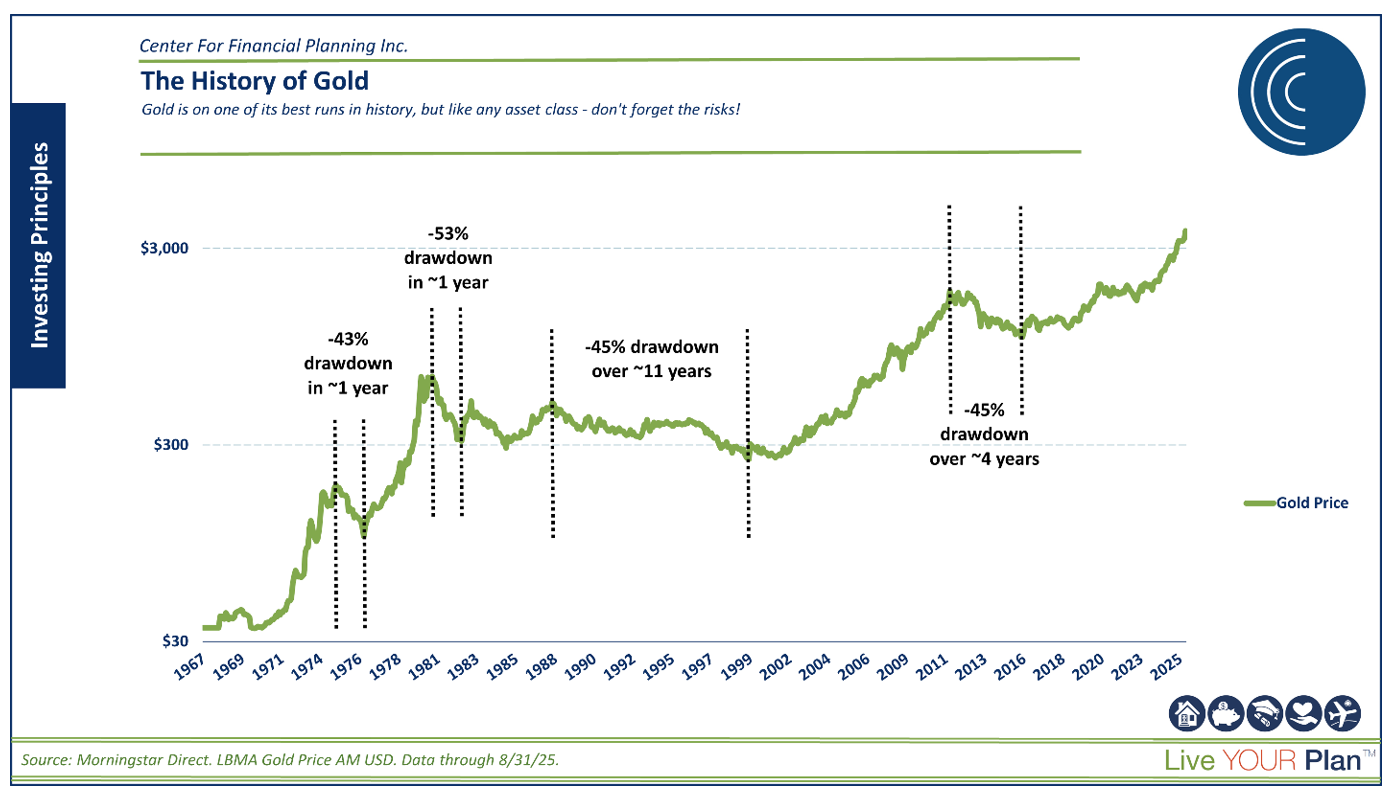
The remarkable run-up in gold prices this year also speaks to the themes of uncertainty and opportunity in today’s investment landscape. By the end of this quarter, gold had risen above $3,800 per ounce, marking a staggering 47% gain year-to-date and setting repeated record highs amid rate cuts, rising deficits, geopolitical tensions, and government shutdowns. Will it reach a historic new level and surpass $4,000 this year? Maybe…that is only another ~5% away. Gold is a volatile investment that typically moves in bursts, and we are currently witnessing one impressive surge. Like any investment, it comes with serious risk, though. Check out the chart below to see some of gold’s historic crashes.

It has had multiple periods where it was cut in half over YEARS. It can have beneficial attributes in an investment portfolio due to its uncorrelated nature, but no investment is perfect, so consider the risks before allocating or chasing performance. Also, keep in mind the long-term performance of gold vs. stocks and bonds.

As we enter the final stretch of 2025, your financial plan is prepared for what the markets may throw our way. Six months ago, on April 2nd, Liberation Day, the tariff plan was rolled out. This caused a sharp correction in markets, but almost as sharp a recovery. If you blinked, you probably missed it. It is an important reminder not to make knee-jerk reactions with your portfolio during these times of volatility, as you could quickly be left on the sidelines waiting for your re-entry point, especially when markets soar to new highs, as they have this year. If you have any questions, we are always here for you. Please don’t hesitate to reach out to us!

Any opinions are those of Angela Palacios, CFP®, AIF®, Nick Boguth, CFA®, CFP®, and Mallory Hunt and not necessarily those of Raymond James. The information contained in this report does not purport to be a complete description of the securities, markets, or developments referred to in this material. There is no assurance any of the trends mentioned will continue or forecasts will occur. The information has been obtained from sources considered to be reliable, but Raymond James does not guarantee that the foregoing material is accurate or complete. Any information is not a complete summary or statement of all available data necessary for making an investment decision and does not constitute a recommendation. Investing involves risk and you may incur a profit or loss regardless of strategy selected. The S&P 500 is an unmanaged index of 500 widely held stocks that is generally considered representative of the U.S. stock market. The Russell 2000 Index measures the performance of the 2,000 smallest companies in the Russell 3000 Index, which represent approximately 8% of the total market capitalization of the Russell 3000 Index. The MSCI EAFE (Europe, Australasia, and Far East) is a free float-adjusted market capitalization index that is designed to measure developed market equity performance, excluding the United States & Canada. The EAFE consists of the country indices of 22 developed nations. The Bloomberg Barclays US Aggregate Bond Index is a broad-based flagship benchmark that measures the investment grade, US dollar-denominated, fixed-rate taxable bond market. Keep in mind that individuals cannot invest directly in any index, and index performance does not include transaction costs or other fees, which will affect actual investment performance. Individual investor's results will vary. Investing in oil involves special risks, including the potential adverse effects of state and federal regulation and may not be suitable for all investors. Past performance does not guarantee future results. Diversification and asset allocation do not ensure a profit or protect against a loss. Investing involves risk and you may incur a profit or loss regardless of strategy selected. Past performance is not a guarantee or a predictor of future results. Raymond James and its advisors do not offer tax or legal advice. You should discuss any tax or legal matters with the appropriate professional.
Investing in gold carries special risks, including wide price fluctuations, a limited market, concentrated sources in potentially unstable countries, and an unregulated market.

Q2 Investment Commentary - Diversification Delivers Results

Print Friendly and PDF

Key Highlights This Quarter:

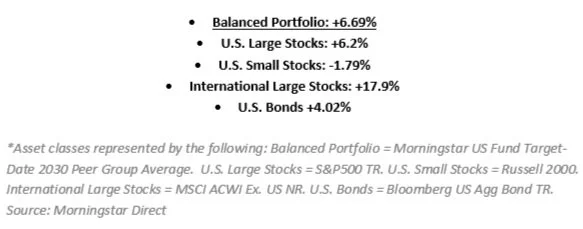
  • Diversification Outperforms
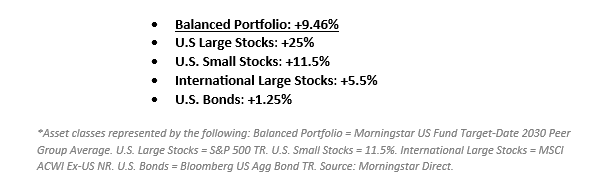
    A balanced portfolio returned +6.69%, outpacing the S&P 500’s +6.2%, while also reducing risk amid market swings.

  • Market Volatility Persists
    The S&P 500 hit new highs, dropped into correction, and rebounded—all within the quarter—highlighting the value of a balanced approach.

  • Tariff Tensions Resurface
    Trade negotiations remain uncertain as the U.S. approaches key deadlines. Tariff revenue is rising, largely funded by U.S. consumers and businesses.

  • “Sell America” Fears Overblown
    Despite April’s rare simultaneous drop in stocks, bonds, and the dollar, foreign demand for U.S. assets remains strong. Bond yields fell, and U.S. equities hit new highs by quarter-end.

  • Credit Rating Downgrade
    Moody’s downgraded the U.S. from AAA to AA1—still strong, but a signal worth monitoring.

  • Consumer Resilience Holds
    TSA screenings, hotel occupancy, and restaurant reservations remain robust, signaling continued consumer strength (Source: Raymond James Up and Adam).

  • Geopolitical Risks Rise
    Escalation in the Middle East caused short-term volatility and a modest rise in gold and oil prices. Historically, such events have limited long-term market impact.

  • GDP Impacted by Imports
    A surge in imports ahead of tariffs dragged Q1 GDP, but underlying consumer demand and inventory growth remain solid.

The first six months of 2025 have been anything but calm—changing government leadership, trade negotiations, global conflicts, and volatile markets have kept headlines spinning. Even the Federal Reserve, after pausing rate hikes, cited 'uncertainty' caused by tariffs. We have watched the S&P 500 hit new all-time highs, fall into correction territory, and then back to new all-time highs in a very short period. A diversified portfolio has provided some welcome risk reduction this year while also outpacing the returns of the S&P 500.

Tariffs

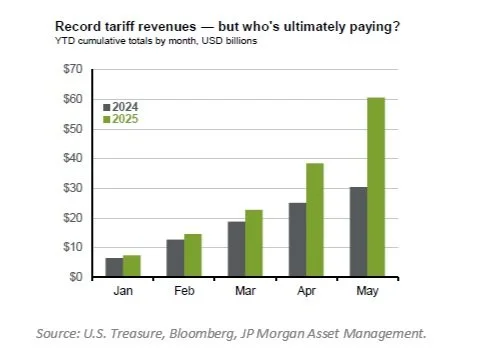
It is likely that we will continue to see volatility as the trade war escalates again, given the approaching expiration of the 90-day negotiation deadlines with various countries. There were numerous headlines surrounding the on-again, off-again tariff situation throughout the quarter. In the second half of the quarter, the legality of certain tariffs has been called into question, but there has been little traction on this issue, and it is a lengthy process to progress through the court system. The Big, Beautiful Bill is counting on about $2.5 Trillion in tariff revenue to offset costs. It is too soon to say if this will materialize, but for now, the worst-case Tariff scenarios seem to be off the table, and with that, consumer sentiment has improved. The very early data below show that in April and May, the government is earning more in tariff revenue than it did the year before. Where is that coming from? Mostly American consumers and businesses.

Best offers from trading partners were due on June 4th. As information becomes available regarding the parameters of certain deals, it is essential to remember that it will be unrealistic to negotiate a deal with every trading partner by July 8th (the 90-day deadline). However, don't get caught up in noise from small trading partners. We should focus most closely on our top 10 trading partners, as they account for 80% of our trade volume. The EU, Mexico, China, and Canada are our top trading partners, collectively accounting for 60% of our trade.

3 possible outcomes after July 9th (most likely a mixture of all 3 as the month continues): 

  1. It could be a nonevent for certain countries with additional deadline extensions ;

  2. It might be a time of celebration of long-promised trade deals;

  3. Or it could be a day for other countries when the hammer comes down, and tariffs are simply dictated again.

Sell America!?

Among the April drawdown post-liberation day, we saw this "sell America" theme emerge. The worry was that investors had collectively lost faith in all things America, which caused a rare occurrence where stocks, bonds, and the U.S. dollar all fell at the same time. While rare, this does not necessarily need to be a red flag. April was a bit of an anomaly compared to a "normal" market environment because President Trump shook up all global trade.

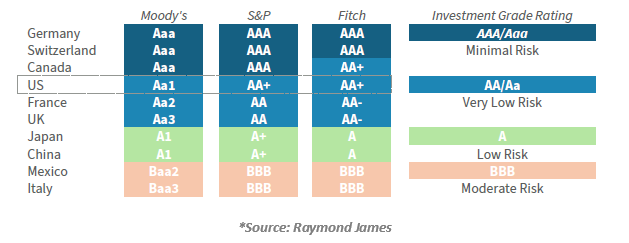
To add to the headlines, Moody's decided in May to move the U.S.A. down one notch on their credit rating system – from AAA to AA1. Still great, but not perfect. Also, it's a worrisome headline.

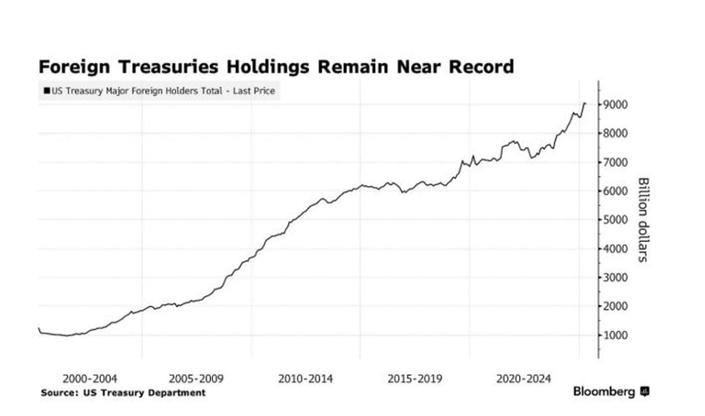
We are not going to ignore the headlines; they COULD be the start of larger themes, but maybe more importantly, we will track the data to see where money is ACTUALLY going. Despite the headlines, Bloomberg reported that foreign banks were still holding more U.S. treasuries than ever. Despite the "sell America" headline, it seems that everyone is still "buying America." Another confirmation of this fact is that bond yields are lower than they were when we started the year. If investors were selling U.S. bonds in mass, you would likely see higher yields. And this is without even mentioning U.S. stocks (while underperforming internationally) were hitting all-time highs at the end of June.

Here is how our new rating stacks up against the rest of the world’s largest economies.

GDP

The decline was driven by a significant surge in imports, which is a subtraction in the calculation of GDP. Imports increased at an annualized rate of 41.3% in the first quarter as companies packed in as many orders as they could ahead of anticipated tariffs from the Trump administration. The surge in imports was good for a -5% contribution to the GDP calculation in the first quarter. Final sales of goods to domestic purchasers, another sign of demand in the economy, grew at a 3% annualized rate in the first quarter, above the 2.9% seen in the fourth quarter of 2024. We saw a huge build in inventories. However, when you examine underlying demand and consumer spending growth, it was still relatively solid.

There are several interesting real-time economic indicators that help determine the health of the consumer, who accounts for 70% of our economy. TSA screenings, Hotel occupancy, and restaurant reservations are all still looking very strong throughout the quarter. People are still going out to travel and eat.

Geopolitical Events

The Middle East conflict between Iran and Israel escalated significantly in June when Israel targeted bombing Iran's nuclear capabilities and the U.S., followed by also striking their nuclear facilities later in June. As a result, we saw some initial volatility, and gold prices climbed modestly again. However, history tells us that events like these, although extremely concerning from a humanitarian perspective, often cause initial stock market volatility but have a minimal impact over the long term. Most of the time, the S&P 500 notches positive returns, with an average annual return of about 8.5% when fast-forwarded 12 months.

Oil prices also spike as Iran is responsible for supplying a portion of the world's oil. However, it is interesting to note that the U.S. has become far less dependent on importing oil. In fact, we are net EXPORTERS of oil. See the chart below:

As you enjoy these final beautiful summer months, don't hesitate to reach out to us with any questions you may have. We appreciate the trust you place with us; thank you!

Angela Palacios, CFP®, AIF®, is a partner and Director of Investments at Center for Financial Planning, Inc.® She chairs The Center Investment Committee and pens a quarterly Investment Commentary.

Any opinions are those of the Angela Palacios, CFP®, AIF® and Nick Boguth, CFA®, CFP® and not necessarily those of Raymond James. The information contained in this report does not purport to be a complete description of the securities, markets, or developments referred to in this material. There is no assurance any of the trends mentioned will continue or forecasts will occur. The information has been obtained from sources considered to be reliable, but Raymond James does not guarantee that the foregoing material is accurate or complete. Any information is not a complete summary or statement of all available data necessary for making an investment decision and does not constitute a recommendation. Investing involves risk and you may incur a profit or loss regardless of strategy selected. The S&P 500 is an unmanaged index of 500 widely held stocks that is generally considered representative of the U.S. stock market. The Russell 2000 Index measures the performance of the 2,000 smallest companies in the Russell 3000 Index, which represent approximately 8% of the total market capitalization of the Russell 3000 Index. The MSCI EAFE (Europe, Australasia, and Far East) is a free float-adjusted market capitalization index that is designed to measure developed market equity performance, excluding the United States & Canada. The EAFE consists of the country indices of 22 developed nations. The Bloomberg Barclays US Aggregate Bond Index is a broad-based flagship benchmark that measures the investment grade, US dollar-denominated, fixed-rate taxable bond market. Keep in mind that individuals cannot invest directly in any index, and index performance does not include transaction costs or other fees, which will affect actual investment performance. Individual investor's results will vary. Investing in oil involves special risks, including the potential adverse effects of state and federal regulation and may not be suitable for all investors. Past performance does not guarantee future results. Diversification and asset allocation do not ensure a profit or protect against a loss. Investing involves risk and you may incur a profit or loss regardless of strategy selected. Past performance is not a guarantee or a predictor of future results. Raymond James and its advisors do not offer tax or legal advice. You should discuss any tax or legal matters with the appropriate professional.
Q4 2024 Investment Commentary

Click the image above to watch the video commentary!

Print Friendly and PDF

Think back to one year ago. It's January 2024. So far, the economy had avoided the recession everyone thought was coming. The S&P 500 just wrapped up a +26% year. Bonds provided some positive performance. Inflation was coming down, unemployment was still at historic lows, and the mood could be described as cautious optimism as investors expected a "growing but slowing" economy.

Most market forecasts (more on these later) expected 2024 to be good but definitely not great. ESPECIALLY in an election year, because you never know what sort of uncertainty that could bring!

Well, we just wrapped up 2024. How was it? From the lens of the financial markets, it was a strong year.

Stocks continued to climb, and bonds were slightly positive despite some bond market volatility. The S&P 500 was the standout among the major asset classes, but even small cap stocks and international stocks contributed positive performance.

Q4 brought some volatility and uncertainty between a major presidential election and multiple Fed rate cuts. U.S. stock indices climbed through the uncertainty, but international stocks and bonds fell slightly.

The big change during Q4 was the increase in bond yields as investors adjusted to what is looking like an even stronger economy than expected. A stronger economy generally comes with higher bond yields, which means less rate cuts from the Fed. This was reiterated in the Fed's Summary of Economic Projections in December that showed they expected the Fed Funds Rate to get to 3.9% by the end of 2025 (3 months prior, that projection showed an estimate of 3.4%).

We'll be watching this dynamic continue to evolve in the markets this year, but as of today investors are looking at a strong economy backed by an easing Federal Reserve, positive expectations for stock earnings, and decent bond yields providing strong fixed income options.

Interest Rates and The Economy

In December, the Federal Reserve (the Fed) held its final meeting of 2024, finalizing a year marked by significant continued disinflation and one of the strongest in recent years of economic activity. However, uncertainty always remains when looking ahead. Tariff and immigration policies proposed by the incoming administration are clouding investor's (and the Fed's) outlook for 2025.

With the Fed still in easing mode, equities should continue to be well supported (remember the old saying, "Don't fight the Fed"). While the Fed's December rate cut was a 'hawkish' cut (a cut with guidance there will be fewer future cuts), we continue to focus not on the number of cuts but more on the overall economic trajectory, which seems to be very resilient right now. With the economy still showing momentum, earnings should maintain their climb in 2025—reinforcing our positive longer-term outlook. However, in the short term, there can always be volatility, and after such a strong year, a little short-term volatility would not be unexpected.

So why doesn't this potential increased volatility scare us very much? A strong consumer!  Since the consumer makes up 70% of the U.S. Economy, we are a key ingredient to keep an eye on. The strength of the consumer in 2024 was evident through several key indicators. Consumer spending has shown consistent growth, while consumer confidence remains unshaken, driven by low unemployment rates, steady job growth, and rising wages. There could be some cracks on the horizon for consumer spending. We are starting to see consumers "trade down" a bit in their purchases, meaning they are still happy to spend but on cheaper options for goods and services. There aren't so many cracks to be concerned about yet, but it is certainly an area we watch closely.

Bonds have had a bizarre year. Coming into 2024, we weren't sure what to expect other than the unexpected. As such, the caution we have exhibited in that portion of our portfolios has helped reduce some volatility in bonds in 2024. Treasury yields have moved contrary to normal historical patterns by rising instead of falling after the Fed started to cut rates in the fall. Better-than-expected economic data and inflation not falling as fast as the market would like to see have challenged investors to reassess the Fed's expected rate path. This means yields are likely to stay a bit more elevated than everyone originally thought. If you look at inflation and employment, the Fed has largely accomplished what it set out to do, even though markets might like to see them do more. The chart below shows where we are versus the Fed's targets.

S&P 500 Price Targets and Return Expectations

Major banks and brokerage firms put out S&P 500 price targets every year, and it may or may not surprise you, but they are rarely accurate. It is impossible to predict something as volatile as the stock market over such a short time. Last year, for example, analysts ranged from bearish to bullish, and the stock market blew straight through every one of their price targets by May.

Stock performance over one year can vary dramatically, but it has been remarkably consistent over the long term.

The other thing on investors' minds right now is…can the performance continue? Of course it can! No one knows for sure if it WILL over the next year (as I said, it is impossible to predict something so volatile as the stock market over such a short time frame), but just because stocks had a tremendous last year does not mean that they must lag the following year. In fact, the statistics show there is essentially no correlation between last year's performance and the next year's performance.

Election Outcome and Markets

As the election dust settles, it is important to remember that the economy is usually the guiding force behind winners and losers in our portfolio.  Overall, rising corporate profits, continued economic expansion, and the potential for lower yields later this year provide a potentially positive backdrop for the markets, in our view.  Some areas, like international investments, may see additional headwinds from political forces like tariffs or a strong U.S. dollar.  At the same time, smaller companies in the U.S. may see some natural tailwinds from continued onshoring and disinflation. While there are many reasons for an optimistic outlook, being prepared for a downturn is evergreen. Our actions in your portfolio will reflect our continued research and developments in these areas as President Trump takes office. There are important things that we need to focus on, as always, such as making sure that you have 6-12 months of expenses set aside in cash so that we can weather any short-term volatility in markets (especially if you are retired), rebalancing to maintain proper diversification and paying close attention to tax loss harvesting and capital gains. 

A new administration may provide new risks, but when aren't there risks in investing? With new risks also come new opportunities, and our investment committee meets monthly to ensure portfolios are allocated to take advantage of constantly changing markets. Most importantly, your financial planner here at The Center is here to help you build a financial plan that gives you confidence no matter the market conditions. With that being said, onto 2025!

Angela Palacios, CFP®, AIF®, is a partner and Director of Investments at Center for Financial Planning, Inc.® She chairs The Center Investment Committee and pens a quarterly Investment Commentary.

Nicholas Boguth, CFA®, CFP® is a Senior Portfolio Manager and Associate Financial Planner at Center for Financial Planning, Inc.® He performs investment research and assists with the management of client portfolios.

Any opinions are those of the Angela Palacios, CFP®, AIF® and Nick Boguth, CFA®, CFP® and not necessarily those of Raymond James. The information contained in this report does not purport to be a complete description of the securities, markets, or developments referred to in this material. There is no assurance any of the trends mentioned will continue or forecasts will occur. The information has been obtained from sources considered to be reliable, but Raymond James does not guarantee that the foregoing material is accurate or complete. Any information is not a complete summary or statement of all available data necessary for making an investment decision and does not constitute a recommendation. Investing involves risk and you may incur a profit or loss regardless of strategy selected. The S&P 500 is an unmanaged index of 500 widely held stocks that is generally considered representative of the U.S. stock market. The Russell 2000 Index measures the performance of the 2,000 smallest companies in the Russell 3000 Index, which represent approximately 8% of the total market capitalization of the Russell 3000 Index. The MSCI EAFE (Europe, Australasia, and Far East) is a free float-adjusted market capitalization index that is designed to measure developed market equity performance, excluding the United States & Canada. The EAFE consists of the country indices of 22 developed nations. The Bloomberg Barclays US Aggregate Bond Index is a broad-based flagship benchmark that measures the investment grade, US dollar-denominated, fixed-rate taxable bond market. Keep in mind that individuals cannot invest directly in any index, and index performance does not include transaction costs or other fees, which will affect actual investment performance. Individual investor's results will vary. Investing in oil involves special risks, including the potential adverse effects of state and federal regulation and may not be suitable for all investors. Past performance does not guarantee future results. Diversification and asset allocation do not ensure a profit or protect against a loss. Investing involves risk and you may incur a profit or loss regardless of strategy selected. Past performance is not a guarantee or a predictor of future results. Raymond James and its advisors do not offer tax or legal advice. You should discuss any tax or legal matters with the appropriate professional.
Q3 2024 Investment Commentary

Print Friendly and PDF

This year has been off to a solid start as the melt-up continues. Even during what is usually the worst performing month on average, September, markets rallied. Mega-cap US tech stocks have remained a standout this year again and have driven much of the returns for the S&P 500 for the first half of the year. But, since then, we have seen participation from other areas of the market, such as international, particularly emerging markets, and small company stocks that have made a strong showing since interest rate cuts were back on the table and inflation continued to abate. Bonds have been positive by about the interest they have paid this year, and the Federal Reserve has started to cut interest rates with a .5% cut in September. Interest rate expectations and inflation news have been the major drivers of market returns so far this year. You may have noticed that I have left the election out of this list because the election hasn’t really driven market volatility so far. If you want to learn more about the relationship between elections and markets, check out a replay of our webinar from last month!

As we approach election day, the headlines could potentially drive some short-term volatility and, certainly, our emotions, but historically, long-term markets are driven far more by factors like economic growth, Federal Reserve direction, and fundamentals like growth and valuation. It is very likely that the outcome of the election won’t be settled by the time we wake up the next day, so this could possibly cause some short-term volatility, but we wouldn’t expect this to be sustained. A last note on politics: it is worth mentioning that Congress averted a government shutdown through the passage of a stopgap bill to fund the government through December 20. At that time, we could possibly see some political posturing surrounding this topic again, so we expect to see more headlines surrounding this late in the year. Markets tend to shrug off these headlines as we have “been there, done that” many times before.

GDP

Since the economy is a bigger driver of long-term returns, we should check in on this. As you can see from the chart below, the Federal Reserve seems to be engineering this soft landing they were hoping for.  Inflation and wages continue to come down, unemployment has grown slowly this year, retail sales have slowed a bit, and GDP shows a slowing in this chart but has since had somewhat stronger readings as the year has gone on.

Sources: Bloomberg, Bureau of Economic Analysis, Bureau of Labor Statistics.  Data as of 29 March 2024 for GDP and 31 May 2024 for other statistics.  Retail sails = adjusted retail and food services sales.  Wages = average hourly earnings.

Interestingly, Economic data is almost always revised after the fact. Data points such as how many people in an entire country are looking for jobs, how much money every citizen in a country has earned/spent/saved, or how much the prices of everything in a country have changed – these are pretty hard to track. This quarter, the Bureau of Economic Analysis revised GDP upwards by .3% in 2021, .6% in 2022, and .1% in 2023. Turns out we (consumers) spent more money than previously calculated in the past few years. Remember when we had two negative quarters of GDP growth in early 2022 (which is the technical definition of a recession), but a recession was never declared? Now, with revisions, there weren't actually two negative quarters of GDP growth. The 2nd quarter of 2022 was revised into positive growth rather than negative growth.

Headlines and Inflation

Inflation is still under the microscope despite the Fed shifting gears from the past couple of years' rate-hike environment into the rate-cut environment it has established going forward. The market will likely be watching economic data as it rolls in and reacting accordingly, as it weighs the odds of increasing inflation (and the potential reaction of the Fed moving slower with its rate cuts) OR continued disinflation/deflation (and the potential reaction of the Fed moving faster with its rate cuts). Recently, there have been some headlines of OPEC increasing oil production, which could possibly put downward pressure on oil prices. At the same time, strikes are beginning at ports on the East Coast, which could potentially slow down supply chains and put upward pressure on prices.

Yield Curve UN-Inversion

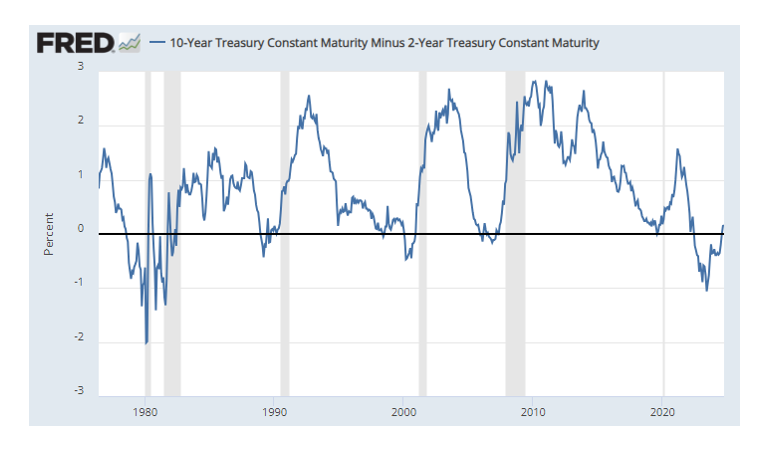
About two and a half years ago, the yield curve inverted. You can see this in the chart below, with the blue line dropping below 0 (meaning short-term rates are yielding greater than long-term rates).  We wrote about it then and shared that despite the warning sign – stocks still were positive a majority of the time 1 and 2 years later. 2022 was a rough year for both the stock and bond markets, but here we are 2.5 years later, and the S&P 500 is back, making new all-time highs.

Source: https://fred.stlouisfed.org/series/T10Y2Y

Last month, the yield curve UN-inverted (see that blue line above moving back above 0). You may have seen news articles directing attention to THAT event as the event that typically precedes recessions. It is hard to focus on the signal over the noise when the noise is so loud in our daily lives, from 24/7 media coverage to daily newspapers and endless social media feeds, but looking back on the last ten times, the yield curve UN-inverted:

  • 8 out of 10 times, the S&P 500 was higher the next year.

  • 10 out of 10 times, the S&P 500 was higher ten years later.

Source: Morningstar Direct. S&P 500 TR (USD)

So, what does this mean for your portfolio?

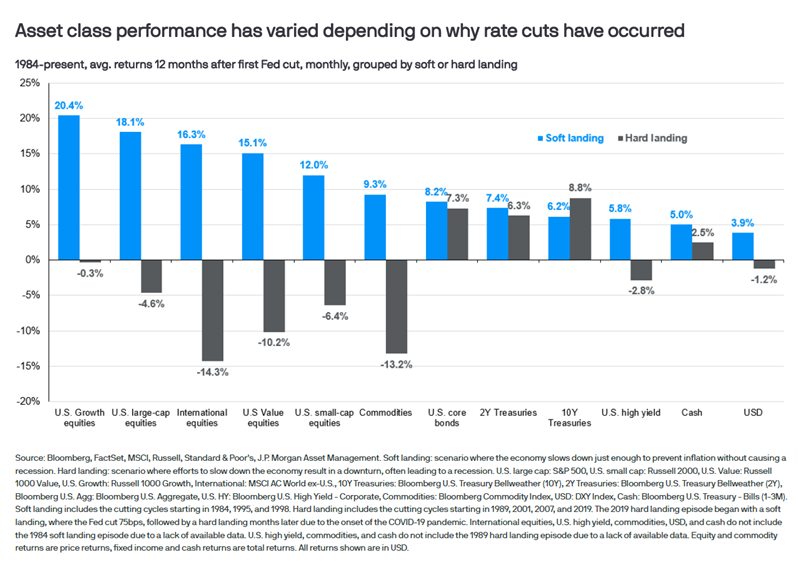
After this first rate cut by the FED, the yield curve UN-inverted AND it is looking like the FED has successfully engineered a soft landing. History can generally be a useful guide to understand how different assets (beyond just US Large cap) performed in this time period. Typically, you see risk assets doing well for equities, while in fixed income, quality tends to shine. Certain asset classes may have a little more tailwind behind them because of starting valuations and a scenario layered in where we have had high but falling inflation, so while the outcome may rhyme, it probably won't be identical to below.

Emerging Markets

Emerging markets made some noteworthy moves recently. Outside China, India, and Taiwan are experiencing excellent performance driven by monetary policy easing and their technology sectors. However, China has had some significant developments, causing them to play a bit of catchup recently. Chinese leaders announced several monetary policy initiatives that drove their recent equity return spike. First was a 50 basis point (bps) cut to the reserve requirements (the amount of cash that banks must hold in reserve against deposits). Second, they cut existing mortgage loan interest rates by 50bps. Other initiatives were also put into place to kickstart their economy. While the path forward could be bumpy, several factors remain a potential tailwind, such as reasonable valuations and company fundamentals and easing monetary policy.

Small Cap Stock Performance

Small cap stocks have been lagging their large cap counterparts for most of the last decade, but this quarter we saw one of the biggest moves in recent history from the asset class. Early in the quarter, there was a huge divergence, and small cap stocks provided a boost to portfolios. The Russell 2000 index ended the quarter +9.3%, beating out the S&P 500 index that was only up +5.9%. Many attributed the outperformance to the market reacting to a potential lower interest rate environment as it looked more certain that the Fed would be cutting rates, the cheaper starting valuations of the small cap asset class, and the overall higher volatility expected from the smaller and less liquid stocks. Whatever the catalyst was, many investors who have been waiting a long time for small cap outperformance were rewarded this past quarter.

While most of us invest with an eye years or decades into the future, short-term market swings can still trigger strong emotional reactions and sometimes push normally calm investors to become short-term traders rather than long-term investors. A properly allocated portfolio and enough cash to fund short-term needs can help to allay an emotional response that might derail your long-term plan. Is your portfolio appropriately positioned for your situation? As always, we are here to help!

Angela Palacios, CFP®, AIF®, is a partner and Director of Investments at Center for Financial Planning, Inc.® She chairs The Center Investment Committee and pens a quarterly Investment Commentary.

Nicholas Boguth, CFA®, CFP® is a Senior Portfolio Manager and Associate Financial Planner at Center for Financial Planning, Inc.® He performs investment research and assists with the management of client portfolios.

Any opinions are those of the Angela Palacios, CFP®, AIF® and Nick Boguth, CFA®, CFP® and not necessarily those of Raymond James. The information contained in this report does not purport to be a complete description of the securities, markets, or developments referred to in this material. There is no assurance any of the trends mentioned will continue or forecasts will occur. The information has been obtained from sources considered to be reliable, but Raymond James does not guarantee that the foregoing material is accurate or complete. Any information is not a complete summary or statement of all available data necessary for making an investment decision and does not constitute a recommendation. Investing involves risk and you may incur a profit or loss regardless of strategy selected. The S&P 500 is an unmanaged index of 500 widely held stocks that is generally considered representative of the U.S. stock market. The Russell 2000 Index measures the performance of the 2,000 smallest companies in the Russell 3000 Index, which represent approximately 8% of the total market capitalization of the Russell 3000 Index. The MSCI EAFE (Europe, Australasia, and Far East) is a free float-adjusted market capitalization index that is designed to measure developed market equity performance, excluding the United States & Canada. The EAFE consists of the country indices of 22 developed nations. The Bloomberg Barclays US Aggregate Bond Index is a broad-based flagship benchmark that measures the investment grade, US dollar-denominated, fixed-rate taxable bond market. Keep in mind that individuals cannot invest directly in any index, and index performance does not include transaction costs or other fees, which will affect actual investment performance. Individual investor's results will vary. Investing in oil involves special risks, including the potential adverse effects of state and federal regulation and may not be suitable for all investors. Past performance does not guarantee future results. Diversification and asset allocation do not ensure a profit or protect against a loss. Investing involves risk and you may incur a profit or loss regardless of strategy selected. Past performance is not a guarantee or a predictor of future results. Raymond James and its advisors do not offer tax or legal advice. You should discuss any tax or legal matters with the appropriate professional.
Q2 2024 Investment Commentary

Print Friendly and PDF

When the circumstances change, our perspective evolves. This anthem of the past year highlights the importance of adaptability and openness to new information. But as much as things have changed this year, much has stayed the same. Megacap tech stocks are still driving the S&P 500 gradually upward for the year. The S&P 500 has had the best start to a presidential reelection year by logging 31 record highs this year and low volatility. Interest rates are still high. Stocks are performing better than bonds, while the U.S. continues to trounce international and large company stocks, which continue to beat small company stocks. 

Elections

The remainder of the summer and fall will surely be dominated by election headlines. Because elections can be divisive and unnerving, it's important to remember that markets are often resilient even in the face of the most unsettling election scenarios. Watch for an invitation to our upcoming election event to hear more details on this topic, but here are some quick observations:

  • U.S. stocks trend upward on average in election years regardless of which candidate wins the White House

  • Balanced portfolios historically help investors meet their financial planning objectives while managing risk over presidential terms

  • It's time in the market and not timing that matters the most for an investor; sitting on the sidelines with long-term assets sitting in cash can be costly to a long-term investment strategy

If you look at average and median returns through a presidential cycle, you can see that election years tend to be strongly positive. Historically, median returns are over 10% in an election year, with average returns over 7% in an election year. 

Returns also tend to come more strongly in the second half of the election year, as shown in the chart below. This year has broken the mold with strong returns through the first half of the year. Usually, when this happens, there tends to continue to be strong returns also through the second half of the year.

What Has Led to These Strongly Positive Returns?

While higher interest rates and high inflation seem like a staple part of the economy now, it is easy to forget that we enjoyed decades of low interest rates, low inflation and globalization that drove those trends.

Inflation has resumed its slow march downward despite a small pause this year and some numbers that had looked like they might be turning back upward. It seems unlikely that inflation will accelerate and should continue to resume the disinflation trend. Now, most of the inflation comes from shelter costs, and we have seen rent prices level off and slow slightly. Rent prices starting to come down should help this source of inflation. You also may have noticed your insurance rates increasing. Car insurance has contributed notably to recent inflation numbers. 

Many consumers still feel the sting of higher prices because slowing inflation only means prices aren't going up at the pace they were. The price increases we experienced over the past several years are here to stay and will need to be permanently factored into budgets going forward. Many households have found substitutes by shopping around at bargain retailers, and some have been lucky enough to experience wage inflation (although not enough to offset economic inflation.

Interest Rates and The Fed

It is hard to talk about inflation without discussing The Federal Reserve and the current interest rate environment. As of the end of the quarter, the 1-year treasury rate was ~5.1%, and the 10-year treasury rate was ~4.4%. You are still getting paid MORE in short-term bonds than you are in longer-term bonds – that is strange! In a normal interest rate environment, you would get a higher coupon from longer bonds because, in return, you are taking on more risk and uncertainty from the longer time until maturity.

This environment has made it much more attractive to hold money market funds, CDs, and other short-term instruments, BUT those are not without risks of their own. If the 10-year rate falls, for example, then the risk of being in the short-term bond is that you will miss out on the price gains of the 10-year bond, and if short-term rates fall as well, then you will have to reinvest your money at a lower interest rate once your bond matures. Without knowing the path of interest rates going forward, there is no way to know with certainty which type of bond will outperform. However, we are here to help make sure your portfolio is positioned well for YOUR financial plan.

Speaking of the path of interest rates, despite inflation heading in the direction that the Fed wants, they kept the Fed Funds rate steady at the same rate as it has been for almost the past year: 5.25-5.5%. There are advocates on each side of the argument saying that they should have cut rates already OR that they should even keep further hikes on the table. Jerome Powell continues to stress data dependence and their commitment to the 2% inflation target, and this sentiment is shown in bond rates as rate cut expectations have continually been priced out of the market year-to-date. No one has control over inflation numbers, the Fed, interest rates, or the stock market – you have to  invest given the hand you are dealt.

AI and Meme Stocks

Several investment crazes have filtered into this stock market rally; some have long-term validity, and some don't. The evolving landscape surrounding artificial intelligence has strongly impacted any company investing heavily in it. Nvidia corporation has been the poster child of a rally surrounding artificial intelligence, which has been up very strongly this year, even though it has recently pulled back some. Nvidia is viewed as a pioneer in the space as its business shifted from gaming consoles to data centers where its chips now power large language models like ChatGPT.  Meanwhile, Gamestop found itself in the middle of the meme stock craze again. While returns attributed to meme stock hype are usually short-lived, the idea of social media heavily influencing trading performance is something the markets are still trying to make sense of. While investing in a long-term productivity enhancement like artificial intelligence can drive long-term fundamental returns, meme stocks are more about hype and short-term volatility.

Hopefully, you take a few moments to check out the Olympics this month. I am often in awe of the amazing talent seen from around the world. That kind of talent comes from a lifetime of diligence and hard work, much like successful investing. Natural ability or luck can only take you so far and can't be counted on. Athletes must train in various muscle groups and mental stamina to be successful. Much like athletes rely on diversified training in investing, we rely on asset diversification, good investor behavior, and consistent saving over time to reach our finish line. We are here to help ensure your investments are helping you reach the finish line no matter what the market environment looks like. Don't ever hesitate to reach out with any questions you may have.

Angela Palacios, CFP®, AIF®, is a partner and Director of Investments at Center for Financial Planning, Inc.® She chairs The Center Investment Committee and pens a quarterly Investment Commentary.

Nicholas Boguth, CFA®, CFP® is a Senior Portfolio Manager and Associate Financial Planner at Center for Financial Planning, Inc.® He performs investment research and assists with the management of client portfolios.

Any opinions are those of the Angela Palacios, CFP®, AIF® and Nick Boguth, CFA®, CFP® and not necessarily those of Raymond James. The information contained in this report does not purport to be a complete description of the securities, markets, or developments referred to in this material. There is no assurance any of the trends mentioned will continue or forecasts will occur. The information has been obtained from sources considered to be reliable, but Raymond James does not guarantee that the foregoing material is accurate or complete. Any information is not a complete summary or statement of all available data necessary for making an investment decision and does not constitute a recommendation. Investing involves risk and you may incur a profit or loss regardless of strategy selected. The S&P 500 is an unmanaged index of 500 widely held stocks that is generally considered representative of the U.S. stock market. The MSCI EAFE (Europe, Australasia, and Far East) is a free float-adjusted market capitalization index that is designed to measure developed market equity performance, excluding the United States & Canada. The EAFE consists of the country indices of 22 developed nations. The Bloomberg Barclays US Aggregate Bond Index is a broad-based flagship benchmark that measures the investment grade, US dollar-denominated, fixed-rate taxable bond market. Keep in mind that individuals cannot invest directly in any index, and index performance does not include transaction costs or other fees, which will affect actual investment performance. Individual investor's results will vary. Past performance does not guarantee future results. Diversification and asset allocation do not ensure a profit or protect against a loss. Investing involves risk and you may incur a profit or loss regardless of strategy selected. Past performance is not a guarantee or a predictor of future results. Raymond James and its advisors do not offer tax or legal advice. You should discuss any tax or legal matters with the appropriate professional.
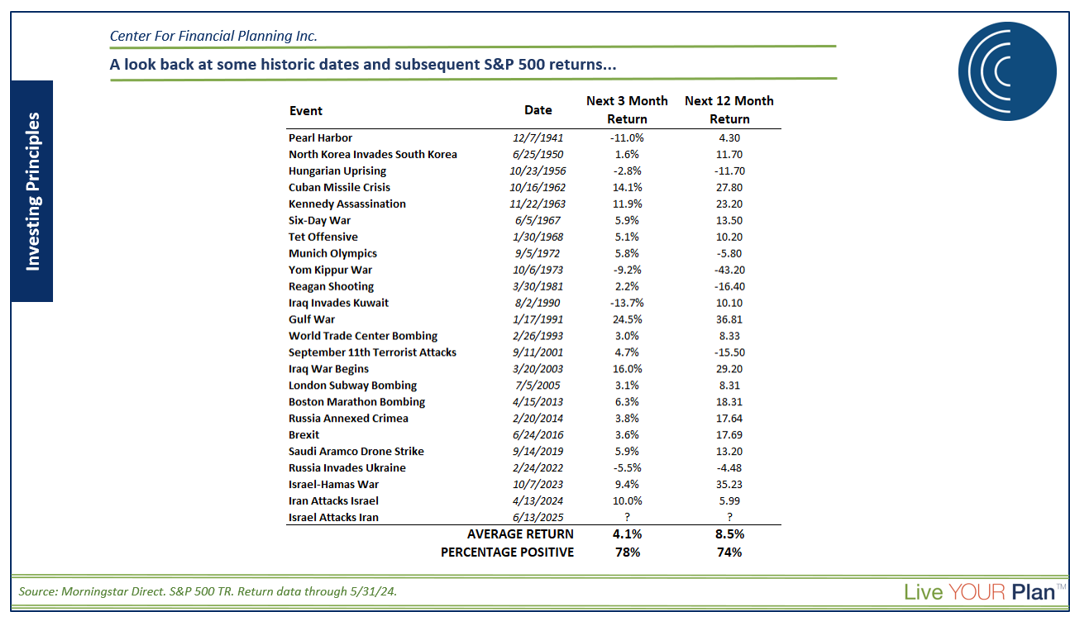
Q1 2024 Investment Commentary

Print Friendly and PDF

As the 4-year anniversary of the Covid stock market correction came and went last month, markets have given historians and economists much to reflect on. Since the consumer is the major driver of the U.S. economy, the aftereffects of the COVID-19 pandemic stay-at-home policies and the economic reopening policies meant it has taken several years for a recession to roll through the economy. This uncorrelation of the sector effects has made this business cycle feel quite different. For example, when staying at home, we shifted our spending to either saving money or spending on goods rather than services, causing a major recession and unemployment in the services industry (remember when we couldn’t travel and instead spent our money on things like a Peloton!). Once herd immunity was achieved, we shifted our spending patterns from goods to services and travel, causing recessionary characteristics to roll through the manufacturing industry. This lack of synchronization has caused the NBER (National Bureau of Economic Research) to not call a recession here in the U.S. even though we met the official definition of one back in 2022 of two negative quarters of GDP growth (Gross Domestic Product).

Recently, the manufacturing numbers, as measured by the ISM index (a leading economic indicator), finally climbed out of recessionary territory (below 50 readings) after a 16-month continuous streak of contractions. This is the longest contractionary steak since 2002! If you couple this with a recovery in new home building permits (another leading indicator), it looks more and more likely that the Federal Reserve has been successful in engineering a soft landing. The Conference Board Leading Economic Index also rose in March for the first time in two years!

The stock market agrees as the year has started out very strongly, with U.S. stocks up over 10.5% as measured by the S&P 500, U.S. small company stocks up 5.2% as measured by the Russell 2000, and International stocks up 5.78% as measured by the MSCI EAFE. Bonds were off to a slower start, down .78%, as the market reset expectations of the number of interest rate hikes that are likely to occur this year.

As the S&P 500 hits new highs, it is natural that you might be wondering if the market is too expensive. Investing at all-time highs seems like the wrong time to add to your investments. Check out my recent blog for some interesting statistics on forward returns when investing on days the market is making a new high. The moral of the story, though, is that while valuations are expensive, they do NOT necessarily mean the market will crash tomorrow, next quarter, or even next year. Current valuations are usually a poor indicator of how markets will perform in the short run. It is important to set reasonable expectations of future market returns. This is not the same market we have seen over the past couple of years driven by a few concentrated names. Returns have broadened across the benchmark, and political headlines may start to creep into market performance in the short term.

Investing by Political Party: A Long-Term Perspective

What if you ONLY invest in the stock market when your president is in office? Over the past 80 years, the political party-agnostic investor beats the democrat and republican by ~3,000% and ~17,500%!

OK, this may fall under the “lying with statistics” category, but I think it still illustrates two very important points. Stocks don’t grow because of political parties, and time in the market is the single most important factor in growing your investment. 

Let’s consider three hypothetical investment strategies starting with $10,000 in 1945:

  1. Republican Only Investor: puts 100% of their money into the S&P 500 when the president is a Republican, otherwise hides their money under their mattress.

  2. Democrat Only Investor: puts 100% of their money into the S&P 500 when the president is a Democrat, otherwise hides their money under their mattress. 

  3. Agnostic Investor: puts 100% of their money into the S&P 500 the entire time.

The results may shock you. The “Republican Only” investor ends up with ~$309k, the “Democrat Only” investor ends up with ~$1.75M, and the “Party-Agnostic” investor ends up with a whopping ~$54.5M.

Obviously, this hypothetical is a bit outlandish for a few reasons. It has an 80-year time horizon, which is much longer than most people are seriously investing. It is an all-or-nothing strategy that puts all its eggs in one basket or the other. One of those baskets earns 0% (which isn’t realistic if you compare it to money markets or short-term treasuries over time). And lastly, it might lead one to confuse correlation and causation when looking at the Democratic/Republican gap.

It would be easy to point to this as confirmation that the Democratic party is better for stocks, but digging a little deeper makes it less clear. The lead changes throughout history – if we wrote this in the 1990s, someone could point to it as confirmation for the Republican party and stock performance. Aside from that, the gap comes from two very distinct decades: the 2000s that gave investors one of the worst decades of stock returns in history, and the 2010s that gave investors one of the best. Lively debates are still happening today over what caused the Tech Bubble, the Great Financial Crisis, and subsequent recovery – but there were certainly more factors than one. In the long run, stocks grow because earnings grow, and earnings have much more to do with innovation and economic growth than those sitting in the Oval Office.

The second and even more important point is that the best way to partake in those growing stock earnings is, unsurprisingly, to invest in stocks! The chart below uses the same data as the previous chart but only shows the time each investor invested in stocks. Each party held office for almost exactly half of the time, so missing out on the other half was a HUGE detriment to results for both investors.

The Fed, Interest Rates, and Bond Returns

The Fed ended the fastest rate hike cycle in history last summer when they made the final hike to 5.25-5.5%. Since then, the bond market has been trying to pinpoint exactly when the first interest rate CUT would come. March? June? Later? Expectations have been shifting later than initially predicted. You can see that in the rising interest rates the past few months – the 1-year treasury rate was around 4.7% in January but back to 5% by the end of the quarter. What does all this ACTUALLY mean for bond investors, though?

Well, the Fed doesn’t control the entire yield curve – they only have a direct impact on the shortest durations of bonds at the front end of the curve. If you are invested in those short duration bonds, you will probably see the yields fall as the Fed cuts, but the prices of short duration bonds do not move nearly as much as longer duration bonds. Money market funds, for example, have become very popular over the past two years as rates have increased. Roughly speaking, if the Fed cuts rates from 5.5% to 4.5% over the next year, a money market investor would likely see their yield fall a similar 1% but wouldn’t see any price appreciation (they also wouldn’t likely see any price DEPRECIATION if yields were to rise).

Intermediate and long-term bond investors have more factors to consider because those durations are much more volatile and move with longer term economic growth expectations as well as inflation expectations. Just because the Fed cuts rates does not necessarily mean that the 10-year rate would also decrease. BUT if it did, that investor would see significant price appreciation. The flip side to that, as we all saw in 2022, is that those investors saw significant price depreciation as rates rose.

So, What May Be Coming This Quarter?

  • Presidential Primary races will continue throughout this quarter, concluding in early June, but with all opponents dropping out of the race, it looks like we will repeat the 2020 election of Donald Trump and Joe Biden. Market driving election headlines are likely to be minimal for now but may start to play into market performance in the short term. Holding the cash you may need in the next year, lengthening the duration of our bonds – to potentially offset equity market volatility, and rebalancing are all tools we are deploying to take advantage of or insulate against short-term market volatility.

  • Next month, the SEC will shorten the standard trade settlement cycle from two business days to one business day after the trade date. This reduces the time between when a sale of a security occurs and when the proceeds are cleared for withdrawal.  

  • Portfolio spring cleaning? Much like moving through the rooms in your house with a critical eye, the investment committee is focused on reviewing asset classes within the portfolio. We are focused on extending the duration of our bond portfolio with a partial change having already occurred. We will also be doing a deep dive into our international investments. 

We are grateful for the opportunity to guide you throughout your investment journey. If you ever have any questions, don’t hesitate to contact us!

Angela Palacios, CFP®, AIF®, is a partner and Director of Investments at Center for Financial Planning, Inc.® She chairs The Center Investment Committee and pens a quarterly Investment Commentary.

Nicholas Boguth, CFA®, CFP® is a Senior Portfolio Manager and Associate Financial Planner at Center for Financial Planning, Inc.® He performs investment research and assists with the management of client portfolios.

The Composite Index of Leading Indicators, otherwise known as the Leading Economic Index (LEI), is an index published monthly by The Conference Board. It is used to predict the direction of global economic movements in future months. The index is composed of 10 economic components whose changes tend to precede changes in the overall economy.

Any opinions are those of the Angela Palacios, CFP®, AIF® and Nicholas Boguth, CFA®, CFP® and not necessarily those of Raymond James. The information contained in this report does not purport to be a complete description of the securities, markets, or developments referred to in this material. There is no assurance any of the trends mentioned will continue or forecasts will occur. The information has been obtained from sources considered to be reliable, but Raymond James does not guarantee that the foregoing material is accurate or complete. Any information is not a complete summary or statement of all available data necessary for making an investment decision and does not constitute a recommendation. Investing involves risk and you may incur a profit or loss regardless of strategy selected. The S&P 500 is an unmanaged index of 500 widely held stocks that is generally considered representative of the U.S. stock market. The MSCI EAFE (Europe, Australasia, and Far East) is a free float-adjusted market capitalization index that is designed to measure developed market equity performance, excluding the United States & Canada. The EAFE consists of the country indices of 22 developed nations. The Bloomberg Barclays US Aggregate Bond Index is a broad-based flagship benchmark that measures the investment grade, US dollar-denominated, fixed-rate taxable bond market. Keep in mind that individuals cannot invest directly in any index, and index performance does not include transaction costs or other fees, which will affect actual investment performance. Individual investor's results will vary. Past performance does not guarantee future results. Diversification and asset allocation do not ensure a profit or protect against a loss. Investing involves risk and you may incur a profit or loss regardless of strategy selected. Past performance is not a guarantee or a predictor of future results. Raymond James and its advisors do not offer tax or legal advice. You should discuss any tax or legal matters with the appropriate professional.
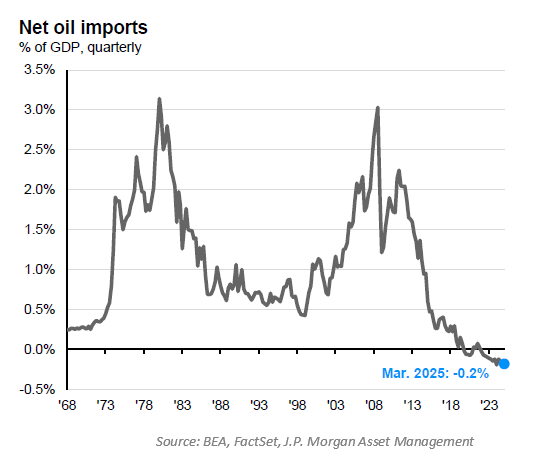
Q4 2023 Investment Commentary

 
Print Friendly and PDF

There were many reasons the fourth quarter of 2023 could have been weak. After two years of revenge spending of pent-up household COVID savings, the consumer seemed like they could have run out of steam, but the Christmas spending season was strong, and consumer confidence grew. The strength in the labor market has slowed down, and jobs are being added at a slower pace, but unemployment is creeping down and not up. While much of the population is still enjoying their low mortgage or auto loan rates that have been locked in, those forced to move into a new home or buy new automobiles are feeling the crunch of higher interest rates. Student loan debt became payable again just ahead of the holiday season while all insurance premiums are on the rise.

Despite all these reasons, we saw one of the strongest fourth quarters on record regarding returns. While returns were narrow early in the year, driven by AI-related hype, the second half of the year has been about inflation coming under control and, thus, a halt in interest rate increases for the last quarter. A typical 60% Stock/40% Bond diversified portfolio ended the year up around 15%, led by the strong growth of U.S. large stocks with some of the best returns of any major asset class at +26% for the year (Example 60/40 portfolio represented by 40% Bloomberg US Aggregate Bond TR, 30% S&P 500 TR, 15% MSCI EAFE NR, 10% Russell 2000 TR, and 5% MSCI EM NR). International stocks underperformed the U.S. but also had a strong year, up around 18%, and U.S. aggregate bonds finished the year positively at 5.5%, thanks to falling yields and tighter spreads.

Recession?

A year ago, the media was full of recession buzz. The S&P 500 experienced a peak-to-trough drawdown during 2022 of 24%, which usually signals a mild recession (stock market reaction usually happens ahead of an economic recession). But just because we didn’t experience a traditional recession, defined as two-quarters of negative Gross Domestic Product Growth in a row, doesn’t mean various sectors didn’t have periods of contraction. Capital Group shared an interesting perspective recently that the economy experienced recessions within multiple industries; they just didn’t align simultaneously. No doubt another hangover anomaly from the COVID shutdown and subsequent highs from the government infusion of cash. The common thread over the past couple of years was the resiliency of the jobs market. As long as people are as employed as they want, money continues to flow into their pockets for spending. Consumer spending is the largest component of our economy, and a strong job market means the economy should continue to grow and avoid recession.

U.S. Dollar

The U.S. Dollar weakened somewhat versus a basket of other currencies from the beginning of the year. This has served as a tailwind for international investing. Some of the weakening came late in the fourth quarter after the Federal Reserve indicated their desire to start cutting rates in the U.S. before other developed market economies would start. The differential between interest rates in the U.S. versus other economies worldwide is a driver of the strength or weakness of the dollar. If the rate differential narrows, meaning rates in the U.S. start to come down while rates stay higher in other areas of the world, making the yields similar, whether here or abroad, would weaken the U.S. dollar. This coupled with slowing inflation will likely continue to impact the dollar strength.

Source: JP Morgan Guide to the markets 11/30/23

Inflation and Interest Rates

Speaking of inflation…It appears that inflation is back down to long-term averages and continuing to drift downward. The chart below shows headline inflation (blue) and core CPI, the Federal Reserve’s preferred measure, as it strips out volatile items like food and energy in the short term. Shelter and services are the two areas of the economy that are still driving inflation. If inflation remains under control, this gives the Federal Reserve more leeway in cutting interest rates next year. 

Government Fiscal Situation

While we, as consumers, have applauded higher yields for over a year, interest outlay on the national debt is rising. Doubling from just a few years ago, interest payments now total approximately 14-15% of tax revenues. The 1990s is the last time we saw levels like this. Likely, this has yet to peak as debt continues to mature and be re-issued at higher interest rates. The level of debt continues to increase at what seems to be an unsustainable pace, too. The amount of debt per capita is nearly $100,000 for the first time. That means the government is $100,000 in debt per person in the United States. There are several ways to reduce or slow the growth: strong GDP growth, increasing immigration, spending cuts, and increased taxes (fiscal policy).

At the December Federal Reserve meeting, the FED confirmed that they are intending on rate cuts in 2024 rather than any more rate increases. The data is supporting this move. Rate reductions should help to slow the stress on interest payments for the government. This has certainly impacted consumer mortgage rates as they are falling from their peak.

You might have heard that there is an election in 2024. Some major topics of debate will make headlines in the coming months, including international policy, the impact of inflation, the growing national debt, and many key social issues.  

While it is nearly a year away, you may be anxious about how it will impact investments. A volatile campaign season and close vote can create uncertainty for markets. But, historically, election years have favored patient investors even though they may be volatile. For long-term investors, the political party holding the White House has had little impact on returns. Check out the chart below. You can see that returns for the S&P 500 have, on average, been similar regardless of who holds this office.

No doubt 2024 will be interesting. Not only are we facing a major election, but 40 national elections are happening worldwide (Russia, India, the U.K., South Africa, and Taiwan, to name a few)! That is more than 40% of the world’s population. Since a year can be a lifetime in politics, in addition to our February investment update, we will be doing a special election update in the fall to shed light on the progression of this process and how it may be impacting investments in the short run.

Portfolio Construction: Thinking Differently for the Coming Year

We are coming off two years that were full of surprises. Nobody saw the fastest rate hike cycle in history coming in 2022, leading to one of the worst stock and bond years. To follow that up, nobody predicted that the U.S. stock market would be positive over 25% in 2023. While your core investment philosophy should not change from year to year, the market is constantly changing and may provide short-term opportunities to keep on your radar. Lately, it feels as though those market changes are happening faster than ever. A few things that we are keeping on our radar that might drive opportunities for tweaks in portfolios are:

Inflation: Is high inflation behind us? How will the Fed react?

  • Think about shifting in or out of real assets, commodities, and TIPS.

Interest Rates: Are we leaving a rising rate environment and entering a falling rate environment?

  • Think about targeting certain maturities in bond portfolios.

Elections: Are there key policy shifts that may drive market trends for years? 

  • Think about an overweight or underweight to certain sectors in both stocks and bonds and use election volatility as a rebalancing opportunity throughout the year.

Valuations: Have international, small-cap stocks, or the value style become cheap enough to expect outperformance?

  • Think about shifting from the more expensive asset class to the discounted one. 

Dollar Strength: The dollar was in a bull market for almost 15 years, but are we in the early innings of a turnaround?

  • Don’t give up on international investing. Think about underweighting U.S. dollar assets and adding to international.  

While these themes, and surely many others, will play out through the next year and potentially provide opportunities to take advantage of – our underlying philosophy will not change. We will focus on fundamentals and stick to our process. Headlines might cause investors to overreact one way or the other, but rather than get swept up in the news cycles, we will use those opportunities to rebalance and stick to our long-term investment goals.

Lastly, there is one additional change coming in May of 2024. The SEC is shortening the standard trade settlement cycle from two business days after the trade date to one business day after the trade date. This reduces the time between when a sale of a security occurs and when the proceeds are cleared for withdrawal. Remember years ago when settlement took three days? Will there ever be a zero-day settlement? Only time will tell. As technology improves and processes can be completed more efficiently, we see benefits like this!

Stay tuned for the invitation to our annual economic and investment update coming soon! There will be both an in-person event and a webinar!

Angela Palacios, CFP®, AIF®, is a partner and Director of Investments at Center for Financial Planning, Inc.® She chairs The Center Investment Committee and pens a quarterly Investment Commentary.

Example 60/40 portfolio represented by 40% Bloomberg US Aggregate Bond TR, 30% S&P 500 TR, 15% MSCI EAFE NR, 10% Russell 2000 TR, and 5% MSCI EM NR.

Any opinions are those of the Angela Palacios, CFP®, AIF® and not necessarily those of Raymond James. The information contained in this report does not purport to be a complete description of the securities, markets, or developments referred to in this material. There is no assurance any of the trends mentioned will continue or forecasts will occur. The information has been obtained from sources considered to be reliable, but Raymond James does not guarantee that the foregoing material is accurate or complete. Any information is not a complete summary or statement of all available data necessary for making an investment decision and does not constitute a recommendation. Investing involves risk and you may incur a profit or loss regardless of strategy selected. The S&P 500 is an unmanaged index of 500 widely held stocks that is generally considered representative of the U.S. stock market. The MSCI EAFE (Europe, Australasia, and Far East) is a free float-adjusted market capitalization index that is designed to measure developed market equity performance, excluding the United States & Canada. The EAFE consists of the country indices of 22 developed nations. The Bloomberg Barclays US Aggregate Bond Index is a broad-based flagship benchmark that measures the investment grade, US dollar-denominated, fixed-rate taxable bond market. Keep in mind that individuals cannot invest directly in any index, and index performance does not include transaction costs or other fees, which will affect actual investment performance. Individual investor's results will vary. Past performance does not guarantee future results. Diversification and asset allocation do not ensure a profit or protect against a loss. Investing involves risk and you may incur a profit or loss regardless of strategy selected. Past performance is not a guarantee or a predictor of future results. Raymond James and its advisors do not offer tax or legal advice. You should discuss any tax or legal matters with the appropriate professional.