Tax Planning

Efficient Tax Planning is Year-Round Work

Josh Bitel Contributed by: Josh Bitel

efficient tax planning

While many of us focus this time of year on getting our tax returns done, year-round tax planning excites us number geeks! We really can’t control taxes, right? Well, not exactly. 

Of course, we can’t change the tax rates set by our government, but we can work collaboratively on financial decisions throughout the year that help ensure the greatest possible level of tax efficiency. Let’s look at a few examples:

EXAMPLE #1: FORD STOCK

Say you have a stock position in Ford purchased at $3 a share when “the sky was falling”. Because its worth has greatly increased, your unrealized gain amounts to $20,000. The stock has done so well, you might not want to part with it. You also don’t want to pay tax on that nice $20,000 gain. 

So consider this: If your taxable income falls within the 12% marginal tax bracket, chances are you would pay very little or possibly ZERO tax on the $20,000 gain. You could lock in that nice profit and potentially improve the overall allocation of your portfolio. 

This is a hypothetical example for illustration purpose only and does not represent an actual investment.

EXAMPLE #2: ROTH CONVERSION

Let’s take a look at another real-life example we often see. What if your income this year takes a significant drop, through a job loss, retirement, job change, or other move? Be sure to keep us in the loop, so that we can help you make pro-active tax planning decisions.

In this situation, a Roth IRA conversion could make a lot of sense if your income will fall into a lower tax bracket that you most likely will not see again. You would pay tax at a much lower rate, and moving Traditional IRA dollars into a Roth IRA for potential future, tax-free growth could create a monumental planning opportunity.   

SHARING YOUR TAX RETURNS

These are just two examples of the many factors we examine in your financial plan to make sure your dollars are efficiently taxed. You can help us do this work. Sharing your tax return early gives us a much better chance throughout the year to uncover strategies that may make sense for you and your family. 

Many of our clients have now signed a disclosure form allowing us to directly contact their CPA or tax professional to obtain copies of returns and to discuss tax-planning ideas. This saves you, as the client, the hassle of making copies or e-mailing your return – and we are all about making your life easier! 

Josh Bitel is a Client Service Associate at Center for Financial Planning, Inc.® He conducts financial planning analysis for clients and has a special interest in retirement income analysis.


While we are familiar with the tax provisions of the issues presented herein, as Financial Advisors of RJFS, we are not qualified to render advice on tax or legal matters. You should discuss tax or legal matters with the appropriate professional. Opinions expressed in the attached article are those of the author and are not necessarily those of Raymond James. All opinions are as of this date and are subject to change without notice. Every investor's situation is unique and you should consider your investment goals, risk tolerance and time horizon before making any investment. Prior to making an investment decision, please consult with your financial advisor about your individual situation.

Restricted Stock Units vs. Employee Stock Options

Kali Hassinger Contributed by: Kali Hassinger, CFP®

Some of you may be familiar with the blanket term "stock options." In the past, this term most likely referred to Employee Stock Options (ESOs), which were frequently offered as an employee benefit and form of compensation. But over time, employers have adapted stock options to better benefit both their employees and themselves.

20190219.jpg

ESOs provided the employee the right to buy a certain number of company shares at a predetermined price, for a specific period of time. These options, however, would lose their value if the stock price dropped below the predetermined price, making them essentially worthless to the employee.

Shares promised

As an alternative, many employers now use another type of stock option, known as Restricted Stock Units (RSUs). Referred to as a "full value stock grant,” RSUs are worth the "full value" of the stock shares when the grant vests. So unlike ESOs, the RSU will always have value to the employee upon vesting (assuming the stock price doesn't reach $0). In this sense, the RSU is a greater advantage to the employee than the ESO.

As opposed to some other types of stock options, the employer does not transfer stock ownership or allocate any outstanding stock to the employee until the predetermined RSU vesting date. The shares granted with RSUs essentially become a promise between the employer and employee, but the employee receives no shares until vesting.

RSU tax implications

Since there is no "constructive receipt" (IRS term!) of the shares, the benefit is not taxed until vesting.

For example, if an employer grants 5,000 shares of company stock to an employee as an RSU, the employee won't be sure of how much the grant is worth until vesting. If this stock value is $25 upon vesting, the employee would have $125,000 of income (reported on their W-2) that year.

As you can imagine, vesting dates may cause a large jump in taxable income, so the employee may have to select how to withhold taxes. Usual options include paying cash, selling or holding back shares within the grant to cover taxes, or selling all shares and withholding cash from the proceeds.

In some RSU plan structures, the employee may defer receipt of the shares after vesting, in order to avoid income taxes during high earning years. In most cases, however, the employee will still have to pay Social Security and Medicare taxes in the year the grant vests.

Although there are a few differences between the old-school stock options and more recent Restricted Stock Unit benefit, both can provide the same incentive for employees. If you have any questions about your own stock options, we’re always here to help!

Repurposed from this 2016 blog: Restricted Stock Units vs Employee Stock Options

Kali Hassinger, CFP® is an Associate Financial Planner at Center for Financial Planning, Inc.®


The information contained in this report does not purport to be a complete description of the securities, markets, or developments referred to in this material. The information has been obtained from sources considered to be reliable, but we do not guarantee that the foregoing material is accurate or complete. Any opinions are those of Kali Hassinger, CFP® and not necessarily those of Raymond James. Expressions of opinion are as of this date and are subject to change without notice. There is no guarantee that these statements, opinions or forecasts provided herein will prove to be correct. Investing involves risk and you may incur a profit or loss regardless of strategy selected. This information is not intended as a solicitation or an offer to buy or sell any security referred to herein. Investments mentioned may not be suitable for all investors. This is a hypothetical example for illustration purpose only and does not represent an actual investment.

Important Information for Tax Season 2018

As we prepare for tax season, we want to keep you apprised of when you can expect to receive your tax documentation from Raymond James.

Important Tax Dates for 2018 Tax Season

Form 1099 mailing schedule 

  • January 31 – Mailing of Form 1099-Q and Retirement Tax Packages

  • February 15 – Mailing of original Form 1099s

  • February 28 – Begin mailing delayed and amended Form 1099s

  • March 15 – Final mailing of any remaining delayed original Form 1099s

Additional important information

Delayed Form 1099s

In an effort to capture delayed data on original Form 1099s, the IRS allows us to extend the mailing date until March 15, 2019, for clients who hold particular investments or who have had specific taxable events occur. Examples of delayed information include:

  • Income reallocation related to mutual funds, real estate investment, unit investment, grantor and royalty trusts; as well as holding company depositary receipts

  • Processing of Original Issue Discount and Mortgage Backed bonds

  • Expected cost basis adjustments including, but not limited to, accounts holding certain types of fixed income securities and options.

Amended Form 1099s

Even after delaying your Form 1099, please be aware that adjustments to your Form 1099 are still possible. Raymond James is required by the IRS to produce an amended Form 1099 if notice of such an adjustment is received after the original Form 1099 has been produced. There is no cutoff or deadline for amended Form 1099 statements. The following are some examples of reasons for amended Form 1099s: 

  • Income reallocation

  • Adjustments to cost basis (due to the Economic Stabilization Act of 2008)

  • Changes made by mutual fund companies related to foreign withholding

  • Tax-exempt payments subject to alternative minimum tax

  • Any portion of distributions derived from U.S. Treasury obligations

What can you do?

You should consider talking to your tax professional about whether it makes sense to file an extension with the IRS to give you additional time to file your tax return, particularly if you held any of the aforementioned securities during 2018.

If you receive an amended Form 1099 after you have already filed your tax return, you should consult with your tax professional about the requirements to re-file based on your individual tax circumstances.

You can find additional information at https://raymondjames.com/wealth-management/why-a-raymond-james-advisor/client-resources/tax-reporting.

As you complete your taxes for this year, a copy of your tax return is one of the most powerful financial planning information tools we have. Whenever possible, we request that you send a copy of your return to your financial planner, associate financial planner, or client service manager upon filing. Thank you for your assistance in providing this information, which enhances our services to you.

We hope you find this additional information helpful. Please call us if you have any questions or concerns about the upcoming tax season.

Please note, changes in tax laws or regulations may occur at any time and could substantially impact your situation. Raymond James financial advisors do not render advice on tax or legal matters. You should discuss any tax or legal matters with the appropriate professional.

Webinar in Review: Charitable Giving Strategies

The New Year is a great time to get your charitable giving plan in place for the New Year. With the fairly recent tax law changes, you may be finding that it is more challenging than ever to give to the way you want while still reaping the tax benefits for doing so. Feel free to watch the recorded webinar with Sandy Adams, CFP® and Jana McNair from the Wayne State University Development Department as they discuss strategies for charitable giving that can help you get a more pro-active and tax-efficient plan in place to start the year off right.

Check out the time stamps below to listen to the topics you’re most interested in:

(02:00): Intro & Agenda

(09:30): Taxes & Charitable Giving 101

(13:30): Make Charitable Contributions and Still Get a Tax Benefit

(16:45): Tip #1: Donating Appreciated Securities

(21:00): Tip #2: Donor Advised Fund

(26:30): Tip #3: Qualified Charitable Distribution (QCD)

(34:00): Planned Giving Ideas for Impactful Giving

(41:00): Takeaways for Charitable Giving

High-deductible medical insurance plan? Try an HSA!

Josh Bitel Contributed by: Josh Bitel

With the first year of the new Tax Cuts and Job Act behind us, tax-efficient saving seems to be top of mind for many Americans. In a world of uncertainty, why not utilize a savings vehicle you can control to help with medical costs?

20190108.jpg

USING AN HSA

A Health Savings Account, or HSA, is available to anyone enrolled in a high-deductible health care plan. Many confuse an HSA with a Flex Spending Account or FSA – don’t make that mistake! A Health Savings Account is typically much more flexible and allows you to roll any unused funds over year to year, while a Flex Spending Account is a “use it or lose it” plan. 

WHAT AN HSA CAN COVER

Many employers who offer high-deductible plans will often contribute a certain amount to the employee’s HSA each year as an added benefit, somewhat like a 401k match. Dollars contributed to the account are pre-tax, and tax-deferred earnings accumulate. Funds withdrawn, if used for qualified medical expenses (including earnings), are tax-free.

The list of qualified medical expenses can be found at irs.gov; however, just to give you an idea, they include expenses to cover your deductible (not premiums), co-payments, prescription drugs, and various dental and vision care expenses.

As always, consult with your financial advisor, tax advisor, and health savings account institution to verify what expenses qualify. If you make a“non-qualified” withdrawal, you will pay taxes and a 20% penalty on the withdrawal amount. 

HERE ARE THE DETAILS FOR 2019:

Individuals

  • Must have a plan with a minimum deductible of $1,350

  • $3,500 contribution limit ($1,000 catch-up contribution for those 55 or older)

  • Maximum out-of-pocket expenses cannot exceed $6,750

Family

  • Must have a plan with a minimum deductible of $2,700

  • $7,000 contribution limit ($1,000 catch-up contribution for those 55 or older)

  • Maximum out-of-pocket expenses cannot exceed $13,500

WITHDRAWING FROM AN HSA

Once you reach age 65 and enroll in Medicare, you can no longer contribute to an HSA. However, funds can be withdrawn for any purpose, medical or not, and you will no longer be subject to the 20% penalty. The withdrawal will be included in taxable income, as with an IRA or 401k distribution. This can present a great planning opportunity for clients who may want to defer additional money, but have already maximized their 401k plans or IRAs for the year.

Although you have to wait longer to avoid the penalty than with a traditional retirement plan (age 59 ½), this investment vehicle could reduce taxable income in the year contributions were made, while earnings have the opportunity to grow tax-deferred and tax-free.  

As you can see, a Health Savings Account can be a great addition to an overall financial plan and should be considered if you are covered under a high-deductible health plan. No one likes medical expenses, but this vehicle can potentially soften their impact.

Josh Bitel is a Client Service Associate at Center for Financial Planning, Inc.®


Links are being provided for information purposes only. Raymond James is not affiliated with and does not endorse, authorize or sponsor any of the listed websites or their respective sponsors. Raymond James is not responsible for the content of any website or the collection or use of information regarding any website's users and/or members.

Bond woes: “Why do we own bonds if we think they aren’t going to do well in a rising rate environment?”

The Center Contributed by: Center Investment Department

Hoping for capital gains is not a good reason why you should own bonds. Actually, owning or  buying bonds in this low and rising interest rate environment with the hope that you'll be able to sell them later at a higher price may not work out. BUT…just because you can’t sell this investment at a profit later does not make the investment a bad idea.

20181113.jpg

A great real life comparison is a car. We own a car to get our family and us from one place to another, hopefully safely. Many components go into the makeup of a safe driving automobile. The engine is key in making the car go. Stocks act much like the engine of a car.  They make our portfolios go/grow. But, would you ever drive a car that wasn’t equipped with brakes or an airbag? Brakes and airbags are similar to the bonds in our portfolio. Bonds help you control some of the risk of owning stock. For most people, the reason to own bonds is to slow down our bottom-line losses experienced in our portfolio during major market declines. Without this moderation (and sometimes even with it), investors tend to panic when stock prices fall.

So in a nutshell, “Why own bonds?”

They make the scary times less so. When the stock market experiences an extended decline, investors look around for where to turn. Cash and Bonds are usually the place they turn to.A volatile stock market can happen suddenly and unexpectedly. Waiting to add bonds until something happens means you are going to suffer much of the downside before you actually add them to the portfolio. You have to have already had them in the portfolio for them to help. Talk with your financial planner to make sure you have the proper amount of your portfolio invested in bonds so you can hang on to your investments through those difficult times. A portfolio makeup that allows you to stay the course over the long term is much more likely to get you to your destination!


https://www.marketwatch.com/story/why-bonds-are-the-most-important-asset-class-2015-06-10 Links are being provided for information purposes only. Raymond James is not affiliated with and does not endorse, authorize or sponsor any of the listed websites or their respective sponsors. Raymond James is not responsible for the content of any website or the collection or use of information regarding any website's users and/or members.

IRS Announces Increases to Retirement Plan Contributions for 2019

Josh Bitel Contributed by: Josh Bitel

Several weeks ago, the IRS released updated figures for 2019 retirement account contribution and income limits. 

IRS Increases Retirement Plan Contributions for 2019

Employer Retirement Plans (401k, 403b, 457, and Thrift Savings Plans)

  • $19,000 annual contribution limit, up from $18,500 in 2018.

  • $6,000 “catch-up” contribution for those over age 50 remains the same for 2019.

  • An increase in the total amount that can be contributed to a defined contribution plan, including all contribution types (employee deferrals, employer matching and profit sharing), from $55,000 to $56,000, or $62,000 for those over age 50 with the $6,000 “catch-up” contribution.

In addition to increased contribution limits for employer-sponsored retirement plans, the IRS adjustments provide some other increases that can help savers in 2019. A couple of highlights include:

Traditional IRA and ROTH IRA Limits

  • $6,000 annual contribution limit, up from $5,500 in 2018 – the first raise since 2013!

  • $1,000 “catch-up” contribution for those over age 50 remains the same for 2019.

Social Security Increase Announced

As we enter 2019, keep these updated figures on the forefront when updating your financial game plan. As always, if you have any questions surrounding these changes, don’t hesitate to reach out to our team!

Josh Bitel is a Client Service Associate at Center for Financial Planning, Inc.®

Webinar in Review: Year-End Tax and Planning Strategies

Josh Bitel Contributed by: Josh Bitel

In November of 2017, the Tax Cuts and Job Act of 2018 passed with numerous changes to our tax code. This year we provided a refresher on some of those changes as well as some planning opportunities to think about as 2018 wraps up.

If you weren’t able to attend the webinar live, we encourage you to check out the recording below. 

With the year winding down and the holidays quickly approaching, it's very easy for our personal finances to take a back seat. However, based on the significant changes to our tax code this year, there are several timely and relevant year-end tax and financial planning item strategies you should have on your radar.

Check out the time stamps below to listen to the topics you’re most interested in:

  • (04:20): New 2018 Marginal Tax Brackets

  • (06:30): Highlights of the 2018 Tax Cuts and Jobs Act (TCJA) – comparing 2017 with 2018

  • (14:24): Planning charitable gifts under the new tax law

  • (19:15): Healthcare coverage overview – Health Savings Accounts (HSAs) and Medicare

  • (25:30): Roth IRA conversions as an attractive planning opportunity

  • (33:20): How to utilize your employer retirement plan most effectively

  • (36:30): How we help mitigate taxes & tax efficient investing

  • (41:30): Updates to gifting and intra-family gifting for 2018

When It Might Make Sense to Distribute an IRA Account

Sandy Adams Contributed by: Sandra Adams, CFP®

20180828.jpg

As you might imagine, most financial planners (and most clients) have a preference for stretching the distribution of their IRA (or other qualified retirement) accounts over long periods of time so as to lessen the income tax burden on those accounts over many years.  And, if possible, most clients would prefer the ability to leave dollars in those accounts to their children and grandchildren as a form of legacy/inheritance. However, as life circumstances change, it sometimes makes sense to keep an open mind about how we view the distribution of those accounts. 

In our experience, we have found that it sometimes makes sense to consider accelerating the distribution of IRAs/qualified retirement accounts when the following circumstances are present:

  • Owner of the IRA is an older adult (in this context, meaning beyond RMD status)

  • IRA/Qualified Retirement Accounts are smaller accounts within the clients overall investment portfolio (i.e. have a $30k IRA and have other investment accounts/bank accounts to draw from)

  • Are likely in a lower tax bracket than the heirs they might be leaving the assets to

  • May have medical/health care costs to write off to offset the income from the potential income from IRA/qualified account distributions

While these circumstances certainly will not apply to MOST clients, they might apply to a select few. When they do, this strategy can not only save significant tax dollars but can simplify the distribution of an estate long term by avoiding the division of a small IRA amongst multiple beneficiaries.

If you or your family have questions about whether this strategy might apply to you or someone you know, please reach out to our Center Team.  We are always happy to help!

Sandra Adams, CFP® is a Partner and Financial Planner at Center for Financial Planning, Inc.® Sandy specializes in Elder Care Financial Planning and is a frequent speaker on related topics. In addition to her frequent contributions to Money Centered, she is regularly quoted in national media publications such as The Wall Street Journal, Research Magazine and Journal of Financial Planning.


Any opinions are those of Center for Financial Planning, Inc. and not necessarily those of Raymond James. The information has been obtained from sources considered to be reliable, but Raymond James does not guarantee that the foregoing material is accurate or complete. Any information is not a complete summary of all available data necessary for making a financial decision and does not constitute a recommendation. Please note, changes in tax laws may occur at any time and could have a substantial impact upon each person's situation. Raymond James does not provide tax advice. You should consult a tax professional for any tax matters related to your individual situation.

Seven Summer Financial Planning Strategies

20180814.jpg

It is summer time! So, if you get a few minutes in between all of the outdoor activities here are 7 quick financial planning strategies to review.  As always, if we can help tailor any of these to your personal circumstances feel free to reach out.

By now you have heard there is a new tax law.  Because we will not experience the actual affects until next April, many of us are not sure how it applies to our specific circumstances.

  1. Do a quick tax projection with your tax preparer and check your tax withholding. Many of us will have an overall tax decrease – but withholdings from our paychecks also went down. Do not get caught off-guard. More importantly, some folks will see higher taxes due to the new limitations on certain itemized deductions. Combine this with lower withholding and you have a double whammy (read: you will be writing a bigger check to the IRS).

  2. Lump and clump itemized deductions. The standard deduction has increased to $24k for married couples filing jointly. In addition, miscellaneous itemized deductions have been removed completely. $10k cap. For some. Lumping charitable deductions in one year to take advantage of itemizing deductions and then taking the standard deduction for several years might be best.

  3. Utilize QCD’s. If you are over age 70.5 and making charitable contributions, you should consider utilizing QCD. Don’t know what QCD stands for? Call us now.

  4. Consider partial ROTH conversions to even out your tax liability. If you are retired, but not yet age 70.5 (when RMD’s start). Don’t know what an RMD is? Talk with us today! If you are in this group, multiyear tax planning may be beneficial.

  5. Most estates are no longer subject to the estate tax given the current exemption equivalent of $11.2M (times 2 for married couples). However, income taxes remain an issue to plan around. One of my favorites: Transfer low basis securities to aging parents and then receive it back with a step up in basis. If you think you might be able to take advantage of this let us know.

  6. Review your distribution scheme in your Will or Trust. Are you using the old A-B or marital/credit shelter trust format? Do you understand how the increased exemption affects this strategy?

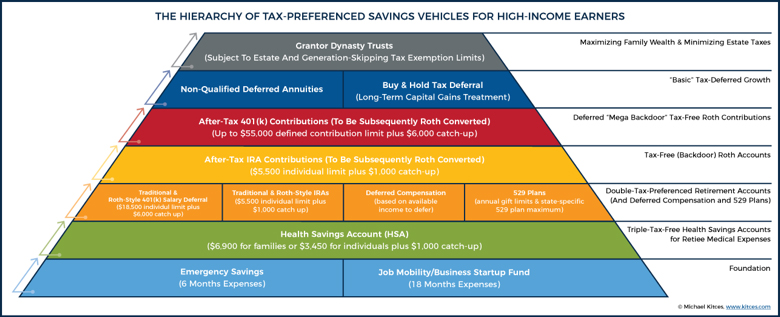
  7. How should high-income folks prioritize their savings?
    Are you in the new 37% marginal bracket? If so, consider contributing to a Health Savings Account IF eligible. Next, consider making Pretax or traditional IRA/401k contributions. However, if you reasonably believe that you will be in the highest marginal tax bracket now AND in retirement – then the ROTH may be suggested. Know that for the great majority of us this will not be the case. Meaning, we will be in a lower bracket during our retirement years than our current bracket. Next, use Backdoor ROTH IRA contributions. If your employer offers an after tax option to your 401k plan, take advantage of it. You can then roll these funds directly into a ROTH. Next, consider a non-qualified annuity that provides tax deferral of earnings growth followed by taxable brokerage account.

20180814a.jpg
20180814b.jpg

If you have not received a copy of our 2018 Key Financial Data and would like a copy let us know

Timothy Wyman, CFP®, JD is the Managing Partner and Financial Planner at Center for Financial Planning, Inc.® and is a contributor to national media and publications such as Forbes and The Wall Street Journal and has appeared on Good Morning America Weekend Edition and WDIV Channel 4. A leader in his profession, Tim served on the National Board of Directors for the 28,000 member Financial Planning Association™ (FPA®), mentored many CFP® practitioners and is a frequent speaker to organizations and businesses on various financial planning topics.


The foregoing information has been obtained from sources considered to be reliable, but we do not guarantee that it is accurate or complete, it is not a statement of all available data necessary for making an investment decision, and it does not constitute a recommendation. Any opinions are those of Tim Wyman and not necessarily those of Raymond James. Investments mentioned may not be suitable for all investors. Unless certain criteria are met, Roth IRA owners must be 591⁄2 or older and have held the IRA for five years before tax-free withdrawals are permitted. Additionally, each converted amount may be subject to its own five-year holding period. Converting a traditional IRA into a Roth IRA has tax implications. Investors should consult a tax advisor before deciding to do a conversion. Raymond James and its advisors do not offer tax or legal advice. You should discuss any tax or legal matters with the appropriate professional. A fixed annuity is a long-term, tax-deferred insurance contract designed for retirement. It allows you to create a fixed stream of income through a process called annuitization and also provides a fixed rate of return based on the terms of the contract. Fixed annuities have limitations. If you decide to take your money out early, you may face fees called surrender charges. Plus, if you're not yet 591⁄2, you may also have to pay an additional 10% tax penalty on top of ordinary income taxes. You should also know that a fixed annuity contains guarantees and protections that are subject to the issuing insurance company's ability to pay for them. Every investor's situation is unique and you should consider your investment goals, risk tolerance and time horizon before making any investment. Prior to making an investment decision, please consult with your financial advisor about your individual situation.