Laurie Renchik Embarks on Leadership Oakland Cornerstone Program

Since 1990, the Leadership Oakland Cornerstone Program has brought together over 900 leaders from corporate, civic and non-profit organizations.

As one of class of 50 leaders for 2011-12, Laurie’s membership in this program provides exposure to an exclusive organization with a mission to develop leadership skills, expose individuals to key issues impacting the region, and enable participants to reach their full potential personally, professionally, and through public service to their communities.

Laurie recently attended the Kick-Off Retreat, a three-day, two-night retreat, where participants were provided an overview of the region and its challenges, insights into their own leadership style, and an opportunity to get to know their fellow Leadership Oakland classmates.  They will also set goals for their year in the Leadership Oakland Cornerstone program.

Laurie commented, "Over time community leaders armed with knowledge, collective creativity and innovation can change the course of our region to a stronger more vibrant future.”

By building a shared understanding and partnership, Cornerstone graduates develop purpose and commitment to the community for the organizations they represent and the communities they live and work in.

Taking IRA Distributions Before You Need Them?

My wife truly enjoys talking to our two dogs – not that she expects them to talk back (I don’t think so at least) – but who doesn’t enjoy seeing their heads turn as if that will really help them understand what she has to say.  I had a client give me a similar look a few years back when I suggested taking money from his IRA even though he didn’t need it for current spending.  (The client was past age 59.5 but younger than age 70.5 so he didn’t have to take a distribution quite yet.) 

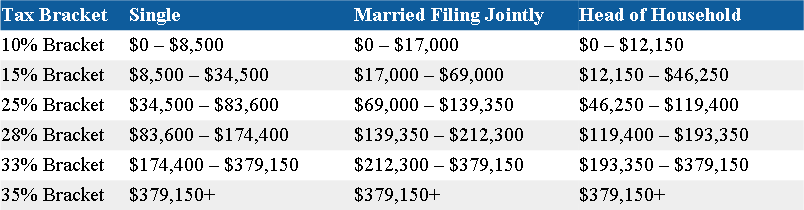
While, like my dogs, he didn’t say anything his look suggested that he was thinking “why would I take a distribution that I don’t need and accelerate income taxes?”  His head started to turn straight again when I illustrated that he might want to maximize the lower tax brackets.  A married couple filing jointly can have taxable income up to $69,000 in 2011 and still remain in the 15% marginal income tax bracket (remember taxable income is adjusted gross income minus exemptions and deductions). For this client, they could take out roughly $25,000 from their IRA and still be within the 15% marginal bracket.  While no one knows what income tax rates will be for sure in the future –locking in a 15% rate seemed attractive. 

2011 IRS Tax Brackets

To find out if accelerating IRA distributions is the right move for you, work with your financial planner and tax preparer to run “what if” scenarios.

Any information is not a complete summary or statement of all available data necessary for making an investment decision and does not constitute a recommendation. Any opinions are those of Timothy W. Wyman, CFP®, JD, and Center for Financial Planning, Inc., and not necessarily those of RJFS or Raymond James. Please note, changes in tax laws or regulations may occur at any time and could substantially impact your situation. While we are familiar with the tax provisions of the issues presented herein, as Financial Advisors of RJFS we are not qualified to render advice on tax or legal matters.


Building Your Foundation

Contributed by: Angela Palacios, CFP® Angela Palacios

Asset allocation is like the foundation of your house. It is the most important structural part of your investment process. Without it, your home or your financial plans could become extremely unstable. 

Many investors either become paralyzed and unable to make decisions, or make decisions by constantly chasing the recent past and, thus, earning dismal returns.  To avoid those mistakes, one of the first and most important steps in investing is determining your Asset Allocation. 

An Asset Allocation Model is usually the outcome of the financial plan you complete with your investment professional. Its goals are normally to identify the mix of assets that best balances an investor’s desire for return with the desire not to take undue risk.  Studies have shown that asset allocation decisions account for a significant amount of the variation of total returns, while security selection accounts for a relatively small portion of the variability of total returns.  The most notable study was done in 1986 by Brinson, Hood and Beebower.  The researchers found that the asset allocation policy explained 93.6% of the average funds’ variation over time. 

In its simplest form, Asset Allocation is the percent of stocks, bonds, and cash you would own in a world of normal valuations.  Generally, allocations with more stocks than bonds would be in the “High Risk/High Return” area of the line on the “Efficient Frontier” chart below.

Efficient Frontier_1_Asset Allocation Post.jpg

Disclosure:  The “Efficient Frontier” is a concept derived from Modern Portfolio Theory.  According to the theory, it is possible to construct an “efficient frontier” of optimal portfolios offering the maximum possible expected return for a given level of risk.

This chart can change greatly depending on the time period you use to draw it.  The following is how the above chart varies in actuality decade to decade.

© Dorsey Wright & Associates

© Dorsey Wright & Associates

In the 1960s, 1980s and 1990s stocks significantly outperformed bonds. While the 1970s and the 2000s show a much different story. Not only were stocks an underperforming asset, but the risks involved were very high using standard deviation as our risk scale. (The Weiss Report, Vol. 13)

While careful Asset Allocation can help make your investment portfolio structurally strong, unlike the foundation of your house, shifting investments can be a good thing. In practicality your Asset Allocation, rather than being static, can be changed tactically to reflect current market conditions as shown above.  Watch future posts to find out more about using asset allocation and other investment strategies. 

Angela Palacios, CFP® is the Director of Investments at Center for Financial Planning, Inc.® Angela specializes in Investment and Macro economic research. She is a frequent contributor The Center blog.


Any information is not a complete summary or statement of all available data necessary for making an investment decision and does not constitute a recommendation. Any opinions are those of Center for Financial Planning, Inc., and not necessarily those of RJFS or Raymond James. Every investor’s situation is unique and you should consider your investment goals, risk tolerance and time horizon before making any investment. Investing involves risk and you may incur a profit or loss regardless of strategy selected. Asset allocation does not ensure a profit or protect against a loss.

Financial Fitness is a Family Affair

Improving our health – physical or financial – may mean changing the habits we  learned as children.  What was your family’s attitude about money?  Is yours still the same?  Financial health is so much more than how much money you make or save: it’s about who you are and what you want from life.  The bottom line is that it’s “All About You.” 

As soon as kids begin to handle money, it’s time to start teaching them how to handle it wisely.  Concepts like saving for something valuable, financial goal setting, and basic money management are all important lessons that generations of children have learned from parents and extended family members.   

Here are five fundamental exercises that will develop financial muscles for kids as they move through the various stages of money maturity. 

  1. Allowance.  Giving children an allowance is a good way to begin teaching how to save money and budget for things they want.  Allowances can be coupled with opportunities to earn extra money by doing chores that fall outside normal household responsibilities.
  2. Saving.  Piggy banks are a great way to introduce the concept of a savings account.  By elementary school the next step is to open a savings account at a bank or credit union. This teachable moment can highlight the value of earning interest on your savings.
  3. Critical Thinking.  As kids get older, television commercials and peer pressure are constant temptations to spend money.  Teach them how to compare items by price and quality and encourage care thinking about purchases they make.
  4. Part-time Job.  Teens that have part-time jobs begin to experience greater financial independence.  This is an opportunity to show how withholding for FICA and federal and state taxes take a bit out of their paychecks.
  5. College bound.  When young adults head off to college a prepaid spending card can offer an opportunity to learn about using credit responsibly without accumulating bad debt. 

In many ways, financial health is like physical health.  Both of them require:  knowledgeable advice, a long-term view and proactive participation.

The Center's Elder Care Planning Resource for Seniors and Professionals

Sandy AdamsSandy Adams' specialized expertise in Elder Planning has generated plenty of speaking opportunities for senior audiences throughout the years.  Recently, professional groups have also turned to Sandy for education in this growing and complex senior market.   

On October 12th, Sandy presented to over 100 local seniors as part of the Elder Law and Financial Planning Panel at the Older Persons’ Commission (OPC) in Rochester. The panel presentation was part of a Caregiving Basics fall workshop series sponsored by the OPC and open to the public

In addition, Sandy Adams presented to the MACPA (Michigan Association of CPAs) on the topic of Financial Gerontology at the group’s Elder Care Planning Forum & Webinar on October 20th. 

The presentation, titled “Financial Gerontology – Everything Changes with Age,” addressed financial issues and strategies for aging clients, as well as practice implications for professionals with clients in this demographic. 

Please contact Sandy, The Center's point person for Elder Care-related issues, with questions or matters for yourself or a family member.


Changes to Mutual Fund Cost Basis Reporting

As of January 1, 2011, a new law - part of the Economic Stabilization Act of 2008 - requires Raymond James (along with all broker/dealers, banks, custodians and transfer agents) to capture and report to the IRS detailed information on covered securities sales. 

  • This change only affects taxable accounts.
  • To select the average cost method, a signed Cost Basis Election form will be submitted to Raymond James on behalf of Center clients.
  • Center clients will receive a letter outlining important details and the Cost Basis Election form by email or regular mail in the month of November.

 Please feel free to contact your planner at 248-948-7900 with questions. 

It's Just Math...

Let’s say Samantha invests $100,000 in the stock market and in a gigantic downturn, she loses half. Not great for Samantha, since she was planning on sending her son to college soon and now she has $50,000. Perhaps it’s time to pick a new school, but first let’s do the math. 

Quick question:  How much does she need to gain to get back to even? 

Did you guess 50%? 

Wrong! When you lose 50% and you then gain 50%, you end up at 75%. If Samantha gained 50% after her bad run of luck, she’d be up to $75,000 … not the 100-grand she invested from the get-go. 

To get back to where she started and get her son packed off to college, Samantha’s going to need a whopping 100% return! So remember, the greater the losses … the greater the needed rebound just to get back to even. 

                   If you lose …        You’ll break even with …

                   10%                      11%

                   20%                      25%  

                   50%                      100%

                   80%                      400%

The Best Gift You Can Give Your Family

What is the best gift you can give to your family?  Is it college education for a grandchild?  Is it a paid family vacation for your children and their families?

Gifting to family members may be an important piece of your financial legacy plan.   You may desire to gift to family members during your lifetime – when the financial support is needed or when you can observe the enjoyment of the gift. 

The BEST gift, as it turns out, is for you to plan ahead for yourself.  Your ability to ensure that you can fund your own financial independence and any future long-term care needs can provide more of an economic (an emotional) benefit to your family than a gift now.

  • According to a recent MetLife study, Americans who take time off work to care for their aging parents are losing an estimated $3 trillion dollars in wages, pensions and Social Security benefits.
  • A 2010 study by Fidelity Investment Research found that a 65 year-old couple that plans to live into their 90’s spends $250,000 to cover health care expenses, including Medicare premiums, co-pays, coinsurance and some home care costs.  Note:  This does NOT include chronic conditions or long term care costs.  


Before significant gifting is done, it is important to do a realistic assessment of your ability to fund your own retirement and long-term care needs.   Make sure that the proper documents and financial tools are in place to fund your needs now and later. Take the first step now and schedule a time to meet with your financial planner to discuss long term care planning.

South Oakland Lunch Program – Another Rewarding Experience!

In support of the South Oakland Community Lunch Program, now in its 17th year, The Center volunteered to prepare and serve a warm meal for 60 to 80 eager patrons.  The Center team has served this Saturday free lunch program in downtown Royal Oak at least annually for over 10 years.

The following day Tim Wyman sent all concerned an informal but hearfelt message that helped sum up the experience:


“Nice job with the South Oakland Community Lunch Program once again! The cookers prepared a great meal….and the servers….well they were spectacular. Amanda is to be congratulated on her goulash serving skills – well done! Thanks to Jen for coordinating the effort – everything was in order and really helped for a successful event. I trust that everyone involved felt a great sense of satisfaction (not the word I am looking for – but hopefully you know what I mean). For many of Saturday’s guests it was truly a treat – and a good reminder as to how lucky we all are. For me personally, having my boys with me was so much more meaningful than just telling them how fortunate we are and that they should give back. Thanks to The Center for providing the opportunity.”

Please visit the Saturday Community Lunch Program Facebook Page to learn more about the program and volunteer opportunities.