June 2012 Investment Performance - 2nd Quarter 2012

invcom_201207_1.jpg

Source: Morningstar

Bonds represented by Barclay's Aggregate Bond Index a market-weighted index of US bonds. US Large Companies per S&P 500 Index a market-cap weighted index of large company stocks. Barclay’s Global Bond index is a market-cap weighted index of global bonds. US Small Companies per Russell 2000 Index a market-cap weighted index of smaller company stocks. International stocks measured by MSCI EAFE is a stock market index designed to measure the equity market performance of developed markets outside of the US and Canada. Commodities per Morgan Stanley Commodity Index a broadly diversified index designed to track commodity futures contracts on physical commodities. 

Inclusion of these indexes is for illustrative purposes only. Keep in mind that individuals cannot invest directly in any index, and index performance does not include transaction costs or other fees, which will affect actual investment performance. Individual investor’s results will vary. Past performance does not guarantee future results.

A Debt Surprise - 3rd Quarter 2012

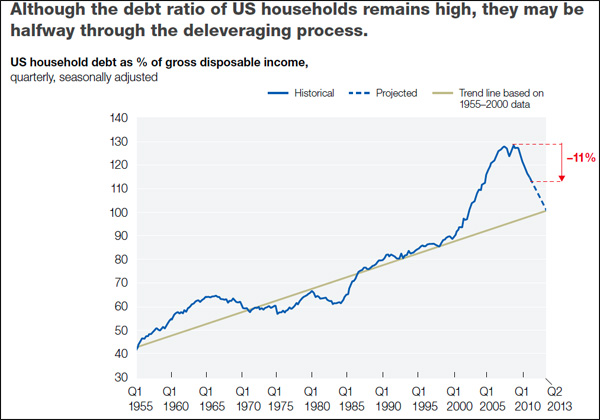
It seems as though we American’s should be giving ourselves a pat on the back.  Ever since the financial crisis we have shown a noticeable improvement in our debt levels as a percent of gross disposable income.  About half of the excess debt (amount above the trend line or average growth in ratio of debt to disposable income) built up since the year 2000 has been eliminated.  The growth in debt over the past ten years sprang from the availability of home equity loans and most of this availability has dried up since the decrease in property values. 

invcom_201207_3.jpg

Unfortunately our government can’t say the same yet.  While government debt is leveling off and slowly drifting downward looking at forward estimates, our politicians have a lot of work to do over the next decade or so tightening their belts.

invcom_201207_2.png

It is quite common for households and corporations to lead the way in debt reduction during an economic recovery.  After all, it is far easier for us to reduce our spending (even though it may not feel like it!) since we don’t have to worry about winning the next election.  Also, governments delay their debt reduction in order to attempt to stimulate the economy by spending more so individuals and households can have healthier balance sheets.  Later the government can work to reduce their own debt. 

When looking under the hood we may not have as much to be proud of as we thought.  Sadly, much of the consumer debt reduction has come in the form of foreclosure and defaults.  Coming out the other side of this, consumers will have either less or more expensive credit available to them (partially due to lower credit scores and also due to no home equity to borrow upon) and thus won’t be able to fuel the economy quite so much as the government has come to expect in the last decade. 

Reduced consumer spending could make the government’s job much more difficult reducing their own debt.  The U.S. government is highly unlikely to default on their debt like consumers did so they would need to depend on GDP growth (among other factors like Inflation) to shrink overall debt levels.  And with consumers not spending as much it is unclear where this rebound in GDP will come from.

It seems logical to say “Enough is enough!” and make the hard cuts necessary to win this battle over debt in the coming years.  However, nothing is ever that simple when it comes to deciding what programs to actually cut and how that may affect other aspects of the meager economic recovery.

The information contained in this report does not purport to be a complete description of the securities, markets, or developments referred to in this material. The information has been obtained from sources considered to be reliable, but we do not guarantee that the foregoing material is accurate or complete. Any opinions are those of Angela Palacios, CFP® and not necessarily those of RJFS or Raymond James.

Sandy Adams Attends Health Policy Forum Roundtable

 Sandy Adams recently attended the June taping of the Altarum Institute’s Health Policy Forum Roundtable entitled “Speak Up! Influential Women Give Voice to the Challenges of Elder Care” at Detroit Public Television studios.  The day began with a roundtable discussion by experts in the field discussing how the current health care systems are unprepared for our aging society, and proposing changes in attitudes, policies and technologies to help make needed changes.  Sandy then participated in a breakout session where participants brainstormed ideas for making needed change going forward.  The dynamic group of leaders in serving our aging communities will plan to continue this conversation later this year.  To view a replay of the roundtable webcast, visit:  http://www.altarum.org/roundtablejune5.

The Altarum Institute integrates independent research and client-centered consulting to create comprehensive, system-based solutions that improve health and health care.

The opinions and services of the speakers and their representative entities are independent of Raymond James.  Links are being provided for information purposes only.  Raymond James is not affiliated with and does not endorse, authorize or sponsor any of the listed websites or their respective sponsors.  Raymond James is not responsible for the content of any website or the collection or use of information regarding any website’s users and/or members. 

Barclay's, LIBOR, and What it Means for You - 3rd Quarter 2012

Just what the world needs today: another financial scandal involving banks and your money! An investigation initiated in 2007 has culminated in a nearly half billion dollar fine from Barclay’s and the possibility of an ever-expanding scandal.

The London Interbank Offered Rate (also known as LIBOR) is a common benchmark for financial instruments based upon the cost of borrowing between large banks around the world. If you read financial headlines, the last time you may have been thinking about LIBOR rate was in 2008 when the cost for borrowing between banks went through the roof. But, whether or not you’re following LIBOR, it’s not obscure. In fact, LIBOR is linked to more than $700 trillion in financial instruments around the world including adjustable mortgages, student loans, and car loans.

It turns out that Barclay’s (and quite probably other banks) were padding their own wallets leading up to the financial crisis by boosting LIBOR rates. This meant that derivatives on their books were paying off for the banks. They could also collect more on the loans they issued linked to LIBOR. It made their operations more profitable, possibly at the expense of your loan costs if you had adjustable rate loans. Another big victim may have been your local government as many municipalities have contracts tied to LIBOR.

That’s not all! Just as it helped to boost the LIBOR in 2007, it was very useful to report lower LIBOR rates amidst the global meltdown. Why? Well, lower borrowing meant you might be a stronger financial institution. This is a good thing if you’re trying to stay in business and prevent a bank run. Again, this goes back to the bank’s profitability with little regard for the victims of such a scam. And fudge those numbers they did!

How, you may ask, could they get away with this? LIBOR is managed based upon a glorified honor system. Banks are expected to look in the mirror each day and report their inter-bank borrowing costs. This self-reporting system seems to have lots of cracks, and many are saying that Barclay’s getting caught is just the tip of the iceberg.

Want to learn more? Here are some resources that further explore this unfolding topic:


The information contained in this report does not purport to be a complete description of the securities, markets, or developments referred to in this material. The information has been obtained from sources considered to be reliable, but we do not guarantee that the foregoing material is accurate or complete. Any opinions are those of Melissa Joy, CFP® and not necessarily those of RJFS or Raymond James. Links are being provided for information purposes only. Raymond James is not affiliated with and does not endorse, authorize or sponsor any of the listed websites or their respective sponsors. Raymond James is not responsible for the content of any website or the collection or use of information regarding any website's users.

Downsizing: Tough decisions and new beginnings

 What do we keep? What do we give away? Who do we give it to?  These are all questions that come when it's time to downsize. Selling a home to move into a smaller living space is a decision many retirees are faced with today.  Downsizing is not a simple task because it not only involves finding a different home, it also means problem-solving the practical logistics of a move, and the emotional work of sorting through the personal belongings we accumulate over a lifetime.  Securing smaller quarters and reducing personal possessions is a process that can include multiple family members coming together to make decisions about the disposition of treasured belongings and mementos.

According to Catherine Lysack, PhD, an occupational therapist and the Deputy Director of the Institute of Gerontology at Wayne State, these questions about keeping and getting rid of things resonate with older adults and their families.  The answers are often based in emotion because they involve personal evaluations of value and worth. Downsizing is therefore a very personal process that reflects who we are and what we envision for the future.  Dr. Lysack cautions, “While some items are easily given to charity and sold in yard sales the most cherished items require special placement—most often with family and friends.”

While the reasons for downsizing are many and varied for seniors here are 5 common triggering events:

  • Health reasons
  • Death of a spouse
  • Desire to live closer to family
  • Financial limitations
  • Desire for a new beginning

Downsizing is so much more than packing boxes and moving.  Demographic trends today highlight the fact that baby boomers are on the march to middle and older age.  The downsizing conversation is an important discussion to have with your financial planner and family members. To learn more about an upcoming educational event where Dr. Lysack will be the featured speaker contact me at laurie.renchik@centerfinplan.com.

Household Downsizing


WHAT:
A program designed to help retirees and their loved ones
navigate the very emotional and personal process
of household downsizing.

FOR:
Retirees and those involved
in the logistics of downsizing

WHEN:
Wednesday, August 8, 2012
5:30 pm - 7:00 pm

WHERE:
Bloomfield Twp Public Library
1099 Lone Pine Road, Bloomfield Hills, MI 48302
www.btpl.org

SPEAKER:
Cathy Lysack, Ph.D
Deputy Director of the Institute of Gerontology (IOG)
Dr. Lysack's areas of expertise include aging,
rehabilitation and mobility disabilities.
"Downsizing Possessions for Residential Moves Later in Life"
is among her most recent studies.

RSVP:
Gerri Harmer at (248) 948-7900 or
Gerri.Harmer@CenterFinPlan.com

Elections and the Markets: Landslide victories and divided governments

 While I was only in grade school at the time, many of you may remember the landslide victory of Ronald Reagan in 1984.  He not only won 59% of the popular vote, he also had the highest number of electoral votes (525) over Walter Mondale.  If you were lucky enough to be an investor at this time, you will remember this was the start of a strong bull market run for domestic stocks.  But are landslide victories always this good for investors? 

The short answer is “no,” but there have not been enough landslide victories to get a good sample set to draw conclusions.  The markets don’t necessarily like them because overwhelming victories by either party means the politician could have more power to invoke change and that could mean potentially higher economic policy risk resulting in higher inflation or interest rates on the horizon.

A divided government can alleviate much of this concern as it brings with it the benefits of legislative check and balances.  During Reagan’s era, Democrats controlled the House while Republicans were the majority in the Senate for 6 of his 8 years as President. All parties had to work together to create the successful policies like the 25% across the board tax reduction, deregulation and corporate tax cuts that stimulated the economy and markets onward and upward.

So how does this play out in the 2012 election?  It may feel like the election is close, but consider that the GOP still hasn’t officially nominated a candidate.  Polls tend to favor Obama against presumptive nominee Mitt Romney, but there are still four important months left of campaigning.  It doesn’t appear, at this point in the race, as though a win will be a Reagan-like landslide.  What it will mean for the markets remains as much of a mystery as which candidate will win on November 6th.

Source: FederatedInvestors.com


The information has been obtained from sources considered to be reliable, but we do not guarantee that the foregoing material is accurate or complete.  Any information is not a complete summary or statement of all available data necessary for making an investment decision and does not constitute a recommendation.  Any opinions are those of RJFS or Raymond James.  Past performance may not be indicative of future results.

Angela Palacios's First Triathlon Experience

 Earlier this year, I decided I wanted to get into a sport that would increase my athletic abilities and give me more incentive to work out on a daily basis throughout the summer, which is usually filled with indulgent summer BBQs.  I decided a triathlon was what I wanted to try.  Prior to training, I had not run more than a mile or two in more than 10 years and had never swam any distance. 

Juggling a career, 5-6 days of training per week, and a family, I learned to plan my workout efficiently and stagger them to avoid injury.

I trained for 5 months and about a week before the race on June 20th I was going nuts with anticipation for the race.  Race day came faster than I could’ve ever imagined. I arrived at the event two hours early to register and get my gear set up. Honestly, I had no idea what to expect. I knew I could do each event by itself with relative ease or even two of the events back-to-back. The big question was how my body would respond to all three bricked together. Especially on a day when it was over 90 degrees at the 6 pm start time.

I did a short swim to shake off the nerves because you start in the water. With less than a half an hour to start, I was suited up and waiting in a huge line to jump into the 80 degree lake for my first triathlon!

The swim started with chaos. I decided to ease off and let everyone get situated. After about three minutes, I found myself in a steady pace.  From that point on, the swim was comfortable besides getting hit in the head once. I finished the swim with plenty of energy and made the dash through the transition area to get set for the bike. When I got all my gear on, I took off.

It was hot, so our trainers instructed us to hydrate well on the bike. I was surprised that the bike racers were pretty spread out; you weren’t competing for space on the road like I thought you would be. I finished the bike with enough energy to make the transition into the run.  Going into the transition area I realized I forgot to leave my running shoes untied so I lost time getting the knots out before I could put them on.  I bet I will never do that again!

I realized shortly after the adrenaline abated from running through the crowd and high fiving my daughter and husband that my legs felt like cement.  I really started struggling with the run around mile two and a teammate noticed. She ended up slowing down to encourage me onward for the rest of the 5k, making me run faster than I ever have to finish the race strong despite having the urge to throw up (thanks Nancy)!  I finished in 1 hour 37 minutes.

Looking back at week one, I couldn't believe how far I'd come. It seems amazing that I had just completed a triathlon when just a few months ago I couldn't even keep a jog for more than 2 miles.  Not only have I accomplished something that once seemed daunting, but I’d learned that I’m often capable of much more than I think I am, I only need to try! Despite the grueling work it takes to get ready for a triathlon, I’m already looking forward to my next one in July!

Want Another Reason to Consider Keeping Your GM/Ford Pension?

 Thousands of GM and Ford retirees across the nation are struggling with one of the most important decisions of their financial lives – whether to keep their current pensions or take a lump sum offer.  We support the case for each of these individuals working with their financial advisors to carefully analyze their particular situation.  But, before a final decision is made, recent statistics may give reason to pause and consider one more important factor in the puzzle. 

According to Dr. Michael Finke, professor at Texas Tech University, beginning between the ages of 55 – 59 (and certainly after age 60) we begin to lose our cognitive ability at the rate of about 2% per year.  Professor David Laibson, professor of economics at Harvard University, references research showing that between the ages of 65 and 69, 1.7% Americans are affected by dementia, and this number doubles every 5 years.  Even though financial capacity decreases, Dr.Finke indicates that confidence in financial decisions does not decrease.   So, our decisions aren’t as good as we think they are?

What does this have to do with the GM and Ford pension decision?  The potential for diminished financial capacity, combined with continued confidence in financial decision-making ability, may leave many Americans susceptible to poor future financial decision making and/or financial fraud.  By adding an annuity (a.k.a. the pension) – a monthly income stream that is locked into place – older adults may be hedging against these future dangers to their financial lives.   

If you or someone you know is still facing the GM or Ford pension decision and would benefit from an individual analysis of their situation, contact us for assistance.  And dig a little deeper into making this important decision by referencing additional blogs on this topic.


The information contained in this report does not purport to be a complete description of the securities, markets or developments referred to in this material.  The information has been obtained from sources considered to be reliable, but we do not guarantee that the foregoing material is accurate or complete.  Any information is not a complete summary or statement of all available data necessary for making an investment decision and does not constitute a recommendation.  Any opinions are those of Center for Financial Planning, Inc., and not necessarily those of RJFS or Raymond James.
Being successful (It’s not the same as being a success)

 One has to do with accomplishment and the other with the ongoing will to improve continuously.  One looks back at what was completed and the other looks forward to what is needed to stay vibrant.

A success is old news!

There is a strong correlation with getting up in the morning and getting up in the world. And nothing that good happens after 10 p.m., anyway.  Or maybe I’m just a morning person.  Much of success is state of mind. In the early ‘90’s, when I entered the business world, I half-jokingly told my parents and family I was one of the best financial advisors in the world. They would look at me and laugh. One of them would say, “Matt you hardly have any clients. You’re just starting out and I know darn well know you are not the best financial advisor in the world.” I would pause and say, “Those are simply my circumstances, but I’m doing everything to be one of the best financial advisors in the world.”

Part of being successful is luck.  Think of Christopher Columbus. Fairly successful, right? Discovered the new world and all, despite the fact that he didn’t know where he was going when he started, when he got there he didn’t know where he was, and when he got back he didn’t know where he had been. Today, he’s a hero.

But luck is also the residue of design. Not to downplay luck, but, successful people develop a plan.  That’s the first step. Here are a few more steps down the path:

  • Develop a 5-year plan for your personal and professional life (and update it annually!).
  • Have a positive attitude.  Ask yourself  “What’s the most powerful force in the world?” My favorite answer is, “Your attitude”.  That stuck with me. 
  • Have a commitment – you will do that which you are committed to.  I think I have always been committed to seeing that clients have a suitable, individual plan in place for reaching their goals.
  • Write down 100 things you want to do in your life before you die.
  • Join a nonprofit group that you believe in.  Get involved in something greater than yourself.
  • Write personal notes to friends, family, and clients whenever possible.
  • Find very intelligent people in your life and spend time with them, especially if you don’t always agree with them.
  • Take up meditation: Seriously. I love the quote, "Only in quiet water do things mirror themselves undistorted. Only in a quiet mind is adequate perception of the world." Hans Margolius

If you want to be successful, you can wait for luck or you can start to design your plan. I say work hard, have an insatiable focus, never stop learning and growing, and learn from the best mentors. 

Any opinions are those of Matthew Chope, CFP(r) and not necessarily those of RJFS or Raymond James.