Investment Performance - 2nd Quarter 2013

invcom_20130715.jpg

Source: Morningstar

Bonds represented by Barclay's Aggregate Bond Index a market-weighted index of US bonds. US Large Companies per S&P 500 Index a market-cap weighted index of large company stocks. Barclay’s Global Bond index is a market-cap weighted index of global bonds. US Small Companies per Russell 2000 Index a market-cap weighted index of smaller company stocks. International stocks measured by MSCI EAFE is a stock market index designed to measure the equity market performance of developed markets outside of the US and Canada. Commodities per Morgan Stanley Commodity Index a broadly diversified index designed to track commodity futures contracts on physical commodities. Barclays Capital US Corporate High Yield Index is an unmanaged index that covers the universe of fixed-rate, noninvestment-grade debt. Barclays Capital US Corporate High Yield Index is an unmanaged indexthat covers the universe of fixed-rate, noninvestment-grade debt.

Inclusion of these indexes is for illustrative purposes only. Keep in mind that individuals cannot invest directly in any index, and index performance does not include transaction costs or other fees, which will affect actual investment performance. Individual investor’s results will vary. Past performance does not guarantee future results.

Why Being an Investor is Like Being a Sports Fan

20130711a.jpg

As an enthusiastic fan of the Detroit Tigers, I entered into this baseball season with high expectations.  According to Las Vegas odds-makers, our local team is the favorite to win this year’s World Series, given the talented roster we have in place.  As the season has gone on, I have found myself riding a rollercoaster of emotions as the team has had impressive streaks of success, as well as discouraging displays of mediocrity.  In a way, this reminds me of the emotions many of us feel as investors as we watch the ebbs and flows of the stock market.

Behavioral Finance

Behavioral finance is a term used to describe the behavioral and psychological reasons why people make irrational financial decisions.  Interestingly, many of these behavioral tendencies are similar to those of sports fans.

  • Following the Crowd (herding) – As investors and as sports fans we may jump on and off the bandwagon. As investors, we may panic and decide to make dramatic shifts in our asset allocation in reaction to a market downturn or upswing. As sports fans, we may bet our entire fortune on our favorite team when they’re winning or move our allegiance to another team altogether when they’re losing.

  • Short-term Focus – With investments, as with sports, we care about what’s happening now, but can lose sight of the long-term goal. It is hard to keep in mind that the 5 game losing streak (or 5% market pull-back) may have little to no impact on the team’s record after 160 games (or achieving the results we need to meet our retirement goals).

  • Finding Someone (or Something) to Blame – When things aren’t going well, there is always a scapegoat. When our favorite sports team is doing poorly, we can always find one player or coach that’s to blame. When our investments aren’t performing the way we’d like, we can find an investment vehicle or manager to blame. Know that if you have good line-up and a solid strategy, there is no need to place blame (especially when the investment you blame now may be your best performer next year!)

The ability to avoid reacting irrationally is the sign of a long-term investor and of a loyal sports fan.  When it comes to investing, your financial planner can be your best coach, helping you to stay in the game, even when the going gets rough!

Sandra Adams, CFP®is a Financial Planner at Center for Financial Planning, Inc. Sandy specializes in Elder Care Financial Planning and is a frequent speaker on related topics. In addition to her frequent contributions to Money Centered, she is regularly quoted in national media publications such as The Wall Street Journal, Research Magazine and Journal of Financial Planning.

Any opinions are those of Center for Financial Planning, Inc., and not necessarily those of RJFS or Raymond James.  Investing involves risk and investors may incur a profit or a loss.

Serving our community and profession


Leadership Oakland announced the list of graduates of the 2012-2013 Cornerstone Program class. Among the 53 individuals representing businesses and non-profit agencies completing the requirements of the year-long leadership development program was our own Tim Wyman, CFP® JD.  When asked about his experience Tim said, “The program exceeded all of my expectations.  The experience provided a tremendous opportunity for both personal and professional growth as I continue to serve clients at The Center and the community.”  A graduation ceremony was held at the Fieldstone Golf Club in Auburn Hills where participants were recognized for their commitment to community and the program as well as a greater understanding of local issues.

Tim traveled to northern Michigan to begin the program with a kick-off leadership retreat held in early September.  The retreat was followed by monthly day-long sessions that delved into issues facing the region.  Tim remarked, “My appreciation of the wonderful resources and people in our region has increased tenfold.  My 52 class cohorts, along with the many people I met serving others in our region, have inspired me to be a better husband, father, business leader, and contributor to our community.”  Tim and his fellow graduates are now linked to one of the most powerful business networks in Michigan. Way to go Tim!

A New Kind of Bucket List

 Retirees love to talk about their Bucket Lists, their current adventures and travel, and all the things they would like to do before it is too late.  You can have great fun constructing this checklist of what is possible, what is probable, and maybe some things that are way out there.

This Bucket List theory can also apply well to retiree financial situations.  We know the volatility of the stock market causes people angst, distress, and can leave them unable to make decisions.  But think of your finances in two separate buckets.  The first is a cash bucket that has up to 18 months or possibly two years worth of cash that will be used for current spending.  This bucket includes pensions, social security, and income from investments that should be there for the designated time.

The second bucket is an investment bucket with a well-diversified portfolio, preferably managed by professionals. Although we never lose sight of the second bucket, we can let it ride through the normal gyrations of the financial markets.  This strategy can help provide investor confidence.

Our cash bucket can be replenished by adding dividends from the fixed income portion of our investment bucket.  Some folks like to add a third bucket, a wish list bucket to have cash available to fulfill the traditional Bucket List of adventures.  This can be filled when we do not spend as much as planned and with potential excess appreciation of portfolios.

So while you’re dreaming up exotic destinations, mountains to climb, or wineries to visit, also make plans to fill your financial buckets. It will make it much easier to check off the things you’ve waited your whole life to do!


Any information is not a complete summary or statement of all available data necessary for making an investment decision and does not constitute a recommendation.  Investing involves risk and you may incur a profit or loss regardless of strategy selected.  Diversification does not ensure a profit or guarantee against a loss.  Dividends are not guaranteed and must be authorized by the company’s board of directors.

Triathletes come in all Shapes and Sizes

 This is my second year of triathlon competitions.  I use the term “competition” loosely as I am not going out there to compete against others, just myself.  For the first time in my life I woke up last year and said, “I’m going to complete a triathlon this summer.” What was really astounding is that I had never swam, didn’t own a bike and rarely ran.  With hard work, I not only met my goal but completed three of them.  Finishing the final event of the season was very bittersweet, a relief that I could take a break but sad because I enjoyed them so thoroughly. 

But the winter flew by and before I knew it, it was time to start training again.  This year I am doing the exact same series of triathlons that I did last year.  It is a familiar course which makes it easy to track my progress in fitness level from one to the next. 

I was surprised this year to notice many of the same people that I saw last year out there.  It got me thinking what a great crowd it is.  On June 19th, about 500 people started the race and 430 completed it.  What really struck me about the crowd is how triathletes can come in all shapes and sizes.  Of course there are the super fit people who look like they eat nothing but birdseed for 3 meals a day and they finish without even breaking a sweat (yes you may read the slight jealousy in my writing).  Those aren’t the people who impress me though.  The people who impress me are the people who believe they can do something and set out to achieve it.  Many are moms that are obviously stretched for time, much like me.  Others are trying to lose weight and yet others are just trying to stay fit as they age.  In fact, the largest age brackets were people in their mid-30’s to 50’s!  This proves it doesn’t matter what stage in life you are in, just that you get out and do something!

What Women can do to Create more Retirement Confidence

 Spending a weekend with girlfriends I have known since high school is a can’t-miss opportunity that rolls around once a year. Not only do I eagerly anticipate this get-together, this year it gave me a chance to not only laugh and commiserate with my girlfriends, but to also share some important knowledge on a topic that women don’t talk about enough … money. Women should have more open, meaningful conversations that focus not just on financial assets, budgets and credit scores, but also include stories about value and worth that are created by our individual experiences, communities, family, friends, career and legacies.

The financial risks that women run are distinct from men because of real cultural, psychological and biological differences. Women live longer, earn less and do not have complete control over either of these factors. Combine that with a general aversion to investment risk, and females (my friends included) can find themselves questioning how they are going to achieve financial confidence in retirement. 

Here are 3 conversation starters you might use next time you're with your girlfriends:

  • How can we pursue human capital potential during all life stages?
  • How can we maximize our workplace salary and benefits?
  • Would we continue to work past retirement age if we are still healthy and able?

Every weekend isn’t a girlfriends get-away, so these topics aren’t for the back-burner. Don’t you want those in your circle of friends to realize full potential in the workplace, negotiate a competitive salary and benefits package, and choose a unique and custom pathway to retirement? If so, maybe its time to get a meaningful girls weekend on the books and get ready for it by talking with your financial advisor about all these approaches and how they can work for you.

Laurie Renchik, CFP®, MBA is a Senior Financial Planner at Center for Financial Planning, Inc. In addition to working with women who are in the midst of a transition (career change, receiving an inheritance, losing a life partner, divorce or remarriage), Laurie works with clients who are planning for retirement. Laurie was named to the 2013 Five Star Wealth Managers list in Detroit Hour magazine, is a member of the Leadership Oakland Alumni Association and in addition to her frequent contributions to Money Centered, she manages and is a frequent contributor to Center Connections at The Center.


Five Star Award is based on advisor being credentialed as an investment advisory representative (IAR), a FINRA registered representative, a CPA or a licensed attorney, including education and professional designations, actively employed in the industry for five years, favorable regulatory and complaint history review, fulfillment of firm review based on internal firm standards, accepting new clients, one- and five-year client retention rates, non-institutional discretionary and/or non-discretionary client assets administered, number of client households served.

The information contained in this report does not purport to be a complete description of the securities, markets or developments referred to in this material.  Any opinions are those of Center for Financial Planning, Inc., and not necessarily those of RJFS or Raymond James.

Tales of Inflation

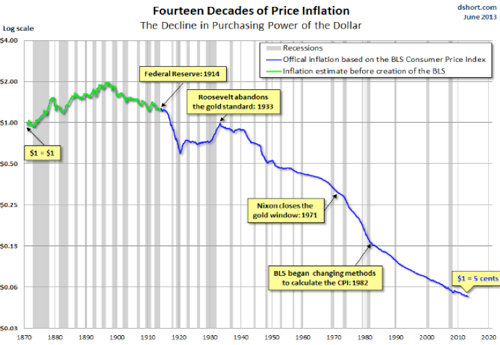
 As a kid I fondly remember sitting around hearing stories from my parents’ childhoods.   While I gave some stories more credence than others, there were many interesting lessons to learn if you could get past the obvious embellishments.  For example, even at a young age, I recognized it was impossible to walk up hill all the way both ways to school if there was only one route to take.  However, other stories show the power inflation can have on our buying power as is exhibited in the chart below.  Perhaps Dad wasn’t embellishing when he said a candy bar only cost a nickel.

The chart shows that $1 today only purchases what a nickel would have purchased in 1871 and again in 1933!  While inflation is quite low right now (1.4% as of the June 18th 2013 report by the Bureau of Labor Statistics) it likely won’t stay this way forever as history has shown.  Inflation can have a devastating effect on retirement planning if your plan and asset allocation aren’t structured to handle it. 

Someday, while my daughter may never believe I lived without an iPad (or whatever the advanced version is at that time), she will surely roll her eyes at the idea that a Starbucks latte cost less than $5 in 2013! So, while I suggest properly planning for inflation, you might also collect a little evidence in the here and now to back up your stories down the road.

Angela Palacios, CFP®is the Portfolio Manager at Center for Financial Planning, Inc. Angela specializes in Investment and Macro economic research. She is a frequent contributor to Money Centered as well asinvestment updates at The Center.


The information contained in this report does not purport to be a complete description of the securities, markets, or developments referred to in this material.

Center Investment Committee Members Attend Premier Conference


Matt Chope, CFP® and Investment Research Associate Jaclyn Jackson recently traveled to Chicago for the 2013 Morningstar Investment Conference.   This conference is one of the investment industry’s most respected events. Jaclyn called it a wonderful way to gain insight from the diverse perspectives of industry experts.

Matt and Jaclyn spent two days attending educational sessions, keynote presentations and dinner meetings all focused on trending financial topics, investment strategies and perspectives on the economy. According to Matt, who has attended many Morningstar conferences in his career, “Many of the attendees seemed to be finally ready to get over the economic turmoil of the last cycle.”

There were ample opportunities to network with financial advisors, financial analysts, mutual fund managers, and industry experts including managers with 30-plus years of experience.  Matt said many of the panelists and speakers indicated that it was one of the hardest times in their careers to allocate capital because all the bargains were gone.  Despite those challenges, Jaclyn found practical advice that could apply to every investor. She said, “Focus on what you can control.  You can’t control market volatility or the Fed, but you can diligently stick with your financial plan.”

4 Steps to Save You Big Headaches on Your Summer Vacation

 Though we have experienced some glorious summer weather, June 21st actually marked the “official” start of summer.  The shift in season brings a host of activities – evening strolls, outside concerts, boating, picnics, and if you are one of the lucky ones…taking a summer vacation! 

Whether you are hoping to relax by tranquil waters or seeking the rush of scaling a mountain, few can disagree there is nothing like a summer vacation.  In my family, planning is half the fun.  The discussion of our destination, where to stay, who to visit, and what to pack gets us ready for the anticipation of our departure. 

But when you are planning time away from your home base, it is very important that you prepare yourself financially.

Here are some behind-the-scenes items to add to your travel to-do list: 

1. Research the “financial” aspects of your destination well in advance.  Get an idea of where to access ATMs and banks in the area. It is also prudent to understand the local currency and exchange rate(s) if traveling abroad. 

2. Be sure to have different types of currency available during your time away (if possible). This can include cash, traveler’s checks, debit and credit cards.  Not all debit or credit cards may be accepted where you are traveling so carrying cash for daily expenses is always helpful. 

3. Notify your credit card companies and banks when and where you will be traveling.  This ensures the utmost safety for your accounts. If you do not give notification, that souvenir you are trying to purchase may be flagged as potential fraud and your account frozen for unauthorized activity! It is also a good idea to find out what your service fees will be for utilizing credit while in a foreign country. 

4. Make a list (or copies) of all your pertinent information like credit card account numbers, insurance cards, passports and driver’s licenses.  Keep this list in a secure spot at home or with your financial planner.  It is always hoped it will not be needed but should a situation arise, you will be thankful you have this information. 

Going on a vacation, whether a quick get-away or trip around the globe, is such an exciting part of the summer.  Taking a small amount of time to engage in some financial housekeeping will help ensure your time away is as relaxing or adventurous as you planned!