

Our Cliff Notes from the FPA Fall Symposium

 In our busy lives, both at home and at work, it can often seem as if there are just not enough hours in the day to accomplish everything we’d like.  Despite our busy schedules, it is our responsibility as trusted advisors to step out of the office occasionally to better ourselves both professionally and personally.  I was fortunate enough to attend the 2013 Financial Planning Association (FPA) Fall Symposium in late September.  The FPA is a well-known and respected organization in the financial planning profession giving advisors the chance to network; discuss better business practices and, most importantly, learn from each other’s experiences.  Over the two-day event, Matt Trujillo, Sandy Adams and I attended close to 10 presentations regarding the market, the economy and various financial planning strategies.  While I won’t bore you with every “take-away” we found extremely helpful and useful, here are some key points discussed at the conference that I felt clients would find valuable and beneficial:

Key Points

  • Stay Smart: Under stress (such as experiencing a market downturn) studies have shown that IQ levels drop an average of 13%.  It is extremely important for us to remind clients of the negative effects of poor investment decisions during stressful periods in the market and to help guide them through these turbulent times. 
  • Make it Personal: Labeling accounts has been shown to increase saving on average by 50%.  For example, labeling a checking or savings account as “Jane’s college fund” greatly increases the savings level by adding a personal touch or goal to the account. 
  • What to Watch: Although domestic equities have done phenomenally this year, valuations still point to potential further appreciation, as price-to-earning (P/E) ratios are approximately 7% below the historical average. 
  • Eye on Europe: Many portfolio managers and market strategists are forecasting a strong outlook for international equities in the coming years as Europe emerges out of their recession. 
  • Bond Buzz: Despite rising interest rate environments, investors should still consider bonds!  Bonds act as a diversifier to the equity portion of the portfolio and can be a very integral piece of the investment puzzle.  We think investors should be focusing on shorter duration bonds to hedge against interest rate risk. 

Several of these points have been on our investment team’s radar for quite some time and we are still implementing them within client portfolios.  It is, however, a nice feeling to know many of the suggestions made by some very bright speakers were things we at the Center do for clients on a daily basis. 

One of my favorite quotes from the symposium was this: “The future is more consistent than the present”.  As much as I wish I had that highly sought-after crystal ball, we cannot possibly predict what the market will do on a day-to-day basis.  What we can do, however, is help guide clients over many years and walk them through each stage of their financial plan to help ensure long-term success, which as the quote states, is far more predictable –something we can all value and appreciate.  

Nick Defenthaler, CFP® is a Support Associate at Center for Financial Planning, Inc. Nick currently assists Center planners and clients, and is a contributor to Money Centered and Center Connections.


The information has been obtained from sources considered to be reliable, but we do not guarantee that the foregoing material is accurate or complete. Any information is not a complete summary or statement of all available data necessary for making an investment decision and does not constitute a recommendation. This information is not intended as a solicitation or an offer to buy or sell any investment referred to herein. Every investor's situation is unique and you should consider your investment goals, risk tolerance and time horizon before making any investment. Prior to making an investment decision, please consult with your financial advisor about your individual situation. Any opinions are those of Nick Defenthaler, CFP and not necessarily those of RJFS or Raymond James. There is an inverse relationship between interest rate movements and bond prices. Generally, when interest rates rise, bond prices fall and when interest rates fall, bond prices generally rise. International investing involves special risks, including currency fluctuations, differing financial accounting standards, and possible political and economic volatility. Investing involves risk and investors may incur a profit or a loss. Keep in mind that individuals cannot invest directly in any index, and index performance does not include transaction costs or other fees, which will affect actual investment performance. Individual investor's results will vary. Past performance does not guarantee future results.


The information has been obtained from sources considered to be reliable, but we do not guarantee that the foregoing material is accurate or complete. Any information is not a complete summary or statement of all available data necessary for making an investment decision and does not constitute a recommendation. This information is not intended as a solicitation or an offer to buy or sell any investment referred to herein. Every investor's situation is unique and you should consider your investment goals, risk tolerance and time horizon before making any investment. Prior to making an investment decision, please consult with your financial advisor about your individual situation. Any opinions are those of [FANAME] and not necessarily those of RJFS or Raymond James. There is an inverse relationship between interest rate movements and bond prices. Generally, when interest rates rise,bond prices fall and when interest rates fall, bond prices generally rise. International investing involves special risks, including currency fluctuations, differing financial accounting standards, and possible political and economic volatility. Investing involves risk and investors may incur a profit or a loss. Keep in mind that individuals cannot invest directly in any index, and index performance does not include transaction costs or other fees, which will affect actual investment performance. Individual investor's results will vary. Past performance does not guarantee future results.
A Bond Market Doomsday – Part 2

 With the bond bear potentially rearing its’ ugly head, it is important to understand what a bond bear market looks like to properly prepare a portfolio for it. 

Only one in five investors know how interest rates affect bond prices

In a 2009 study on financial capability, only 21% of respondents knew that prices on existing bonds generally go down when interest rates go up (National Financial Capability Study, 2009 National Survey, Financial Industry Regulatory Authority).   Prices and rates typically move inversely because older bonds with lower rates are less attractive to buyers than newly issued bonds that offer higher rates.

If bond prices have been at all-time lows this stands to reason that bond prices have a long way to fall and indeed they began this fall earlier this year.

When rates go up, prices go down

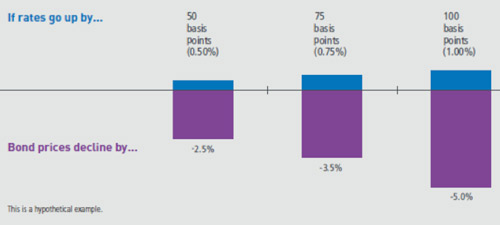
Take a look at the examples below, illustrating the effect of rising rates on a 5‑year US Treasury bond.

Source: MFS

This is a hypothetical example that represents the effect a rise in the interest rate of a new issue bond may have on the price of existing bond issues.  Although bond prices and interest rates typically move inversely, a change in interest rates is only one factor determining the price of a bond security.

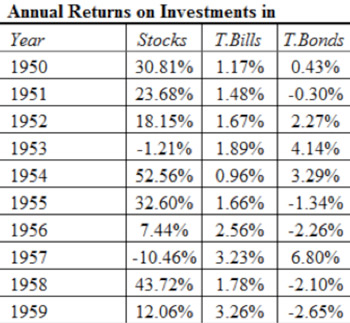
However, what bond bear markets lack in depth, they make up for in length.  In Part 1 I suggested we are in a time similar to the early 1950’s when rates bottomed out at similar levels to where we are today.  Below is a table of returns for the 10 years following rates bottoming taken from the Federal Reserve database in St. Louis. 

*Stock represented by the S&P 500, Treasury bill rate is a 3-month rate and the Treasury bond is the constant maturity 10-year bond, but the Treasury bond return includes coupon and price appreciation

Rising rates historically means rising income and total returns.  If rates rise slowly, interest has a chance to outweigh loss of principal over time as you can see in the chart above.  Devastating returns are not seen on the bond side of the ledger, but rather slow returns that tend not to keep up with long term inflation rates. 

Diversification rather than Doomsday

While we are not at doom’s doorstep, diversification is certainly the key, as it always is.  Most likely, not all areas of the bond market will suffer at all times over the coming years.  Investors must be careful of certain investments with characteristics similar to that of bonds (i.e. “bond proxies”) though.  Investing in something like dividend paying stocks in place of your bonds could add a lot of potential risk to the portfolio.  These types of positions will not support a portfolio in times of a stock market correction like bonds generally do.  It is important now more than ever to work with your financial planner to make sure you have a well-diversified portfolio and are making decisions with your overall financial goals in mind.

Angela Palacios, CFP®is the Portfolio Manager at Center for Financial Planning, Inc. Angela specializes in Investment and Macro economic research. She is a frequent contributor to Money Centered as well asinvestment updates at The Center.


Diversification does not ensure a profit or guarantee against a loss.  The information contained in this report does not purport to be a complete description of the securities, markets or developments referred to in this material.  The information has been obtained from sources considered to be reliable, but we do not guarantee that the foregoing material is accurate or complete.  The information is not a complete summary or statement of all available data necessary for making an investment decision and does not constitute a recommendation.  Any opinions are those of Center for Financial Planning, Inc., and not necessarily of RJFS or Raymond James.  Expressions of opinion are as of this date and are subject to change without notice.  This information is not intended as a solicitation or an offer to buy or sell any investment referred to herein.  Investments mentioned may not be suitable for all investors.  Investing involves risk and investors may incur a profit or a loss.  Dividends are not guaranteed and must be authorized by the company’s board of directors.  Past performance is not a guarantee of future results.

A Bond Market Doomsday – Part 1

 Eye-catching headlines like this are great ratings boosters right now.  Phrases like “Surviving financial annihilation” or “Devastating losses” have been en vogue lately because investors are becoming more aware that bonds may not be the pillar of our portfolios as we have come to rely on them over the past 30 years.  Yields on bonds have been kept artificially low due to the Federal Reserve’s intervention over the past several years with the Quantitative Easing (QE) programs.  However, now that it looks as though the FED will be backing off of their QE programs, since it looks like the economy will be able to stand on its own two legs, we are left with a bond market with yields at nearly all-time lows

Does this mean that the bond bear is finally out of hibernation? 

The chart below gives us a history lesson on the last time we headed into a bond bear market (early 1950’s).  Rates on the 10-Year U.S. Treasury bond were at similar levels to where they are today.

From what we have seen already this year, it does seem that rates have nowhere to go but up.  According to the above chart, it will be important to temper our return expectations coming from this bond portion of a portfolio.  The average return we have come to expect from bonds will likely be drastically reduced going forward.  If expectations are properly tempered, this need not “annihilate” our portfolios going forward.  In my next blog I will go into more detail of what a bond bear market has looked like in the past.

Angela Palacios, CFP®is the Portfolio Manager at Center for Financial Planning, Inc. Angela specializes in Investment and Macro economic research. She is a frequent contributor to Money Centered as well asinvestment updates at The Center.


The information contained in this report does not purport to be a complete description of the securities, markets or developments referred to in this material.  The information has been obtained from sources considered to be reliable, but we do not guarantee that the foregoing material is accurate or complete. The information is not a complete summary or statement of all available data necessary for making an investment decision and does not constitute a recommendation. Any opinions are those of Center for Financial Planning, Inc., and not necessarily of RJFS or Raymond James. Expressions of opinion are as of this date and are subject to change without notice. There is an inverse relationship between interest rate movements and bond prices. Generally, when interest rates rise, bond prices fall and when interest rates fall, bond prices generally rise.

Medicare open enrollment begins October 15th

 Medicare’s open enrollment season is upon us. That means from now until December 7, you are able to make changes to your Medicare Advantage and prescription drug coverage. If you’re happy with your coverage, you don’t have to do anything. But this could be a good opportunity to make adjustments based on changes in your situation and changes to Medicare.

It pays to take the time to compare plans and shop around. While many plans have maintained or decreased their premiums, more than 450 plans are expected to increase premiums for 2014. You can also expect continued discounts on prescription drugs as part of the Affordable Care Act’s plan to gradually close the Part D coverage or “doughnut hole”.

Even if you’re satisfied, open enrollment presents a great opportunity to make sure you’re getting the most out of Medicare.

Here are some tips to help you get started.

  • Ask yourself some important questions. Have your needs changed? Is your current coverage adequate? Will the cost of your current plan be going up? Are there comparable, lower-cost plans available?
  • Review the annual notice of change from your current plan provider. You should have received this in September.
  • Compare plans using medicare.gov’s Medicare Plan Finder.
  • Call the Medicare Rights Center at 800.333.4114 for free counseling.

Medicare decisions can be complicated. If you have any questions about open enrollment, or if you’d like to discuss how healthcare costs factor into your overall financial plan, please contact your Center planner.

Who are the Quality Financial Planners?

 October is Financial Planning Month and Center Partner Tim Wyman takes this opportunity to bring us back to the basics. In this blog 5-part series he clarifies some general questions about financial planning and the financial planning process. 

There are many individuals and companies in the financial services industry to choose from based on your specific needs.  There are large firms in addition to wire house firms.  

Determining who the “best” is challenging and you should be sure to interview a couple to determine a good fit.  Do they work with others like you? Are they experienced in working with similar issues as yours? Are you comfortable with their costs? 

Ultimately a financial planning relationship is a personal relationship.  Regardless of what firm you choose to work with, it is critical that you feel a high degree of confidence in trust with the INDIVIDUALS that you will be working with to accomplish your objectives.

Timothy Wyman, CFP®, JD is the Managing Partner and Financial Planner at Center for Financial Planning, Inc. and is a frequent contributor to national media including appearances on Good Morning America Weekend Edition and WDIV Channel 4 News and published articles including Forbes and The Wall Street Journal. A leader in his profession, Tim served on the National Board of Directors for the 28,000 member Financial Planning Association™ (FPA®), trained and mentored hundreds of CFP® practitioners and is a frequent speaker to organizations and businesses on various financial planning topics.


Any opinions are those of Center for Financial Planning, Inc., and not necessarily those of RJFS or Raymond James.  Every investor’s situation is unique and you should consider your investment goals, risk tolerance and time horizon before making any investment.  Clients should evaluate if an asset-based fee is appropriate in servicing their needs.  A list of additional considerations, as well as the fee schedule, is available in the firm’s Form ADV Part II as well as in the client agreement.

Center supports Gleaners Food Bank as a Presenting Sponsor at Vine & Dine

 As a presenting sponsor, The Center proudly supported our local community and Gleaner’s Community Food Bank of Southeastern Michigan.  The 10th Annual Vine & Dine, hosted by the Birmingham Bloomfield Chamber of Commerce, is best described as a strolling food, wine and fashion event.  “What a wonderful excuse for an out-of-the-ordinary evening,” said attendee and Center Partner Melissa Joy. “It was such a pleasure to support Gleaner’s in such a unique way.”

Over the years, The Center has shared a strong partnership with the chamber through volunteerism or sponsorship.  This year's event was held Wednesday September 25th at Neiman Marcus at The Somerset Collection.   The event featured a fall runway fashion show and more than 400 guests were in attendance.

Gleaners Community Food Bank provides surplus donated and low cost food and related personal care products to people in need in southeastern Michigan. For more information about Gleaner's Community Food Bank of Southeastern Michigan, please visit their website at: www.gcfb.org 

Your Financial Plan: How to Prepare & How Much Does it Cost?

 October is Financial Planning Month and Center Partner Tim Wyman takes this opportunity to bring us back to the basics. In this blog 5-part series he clarifies some general questions about financial planning and the financial planning process. 

A financial plan can be prepared on your own or with the assistance of a professional.  If you choose to work with a professional, a Certified Financial Planner™ practitioner is suggested since they are trained to provide a comprehensive review.  Regardless, if you choose to do it on your own or work with a professional, there are common steps.

6 most common steps in the process: 

  1. Gather Personal and Financial Data
  2. Establish Goals
  3. Process & Analyze Information
  4. Develop Comprehensive Plan
  5. Implement the Plan
  6. Monitor the Plan 

The cost of a financial plan will vary depending upon the experience of the professional you work with and the complexity of your situation.  In many cases, the fee may range from $500 to several thousand dollars – again based on the complexity. 

In the final blog of this 5-part series, we’ll look at who the best financial planners are. 

Timothy Wyman, CFP®, JD is the Managing Partner and Financial Planner at Center for Financial Planning, Inc. and is a frequent contributor to national media including appearances on Good Morning America Weekend Edition and WDIV Channel 4 News and published articles including Forbes and The Wall Street Journal. A leader in his profession, Tim served on the National Board of Directors for the 28,000 member Financial Planning Association™ (FPA®), trained and mentored hundreds of CFP® practitioners and is a frequent speaker to organizations and businesses on various financial planning topics.


Any opinions are those of Center for Financial Planning, Inc., and not necessarily those of RJFS or Raymond James.  Every investor’s situation is unique and you should consider your investment goals, risk tolerance and time horizon before making any investment.  Clients should evaluate if an asset-based fee is appropriate in servicing their needs.  A list of additional considerations, as well as the fee schedule, is available in the firm’s Form ADV Part II as well as in the client agreement.

Investment Performance - 3rd Quarter 2013

invcom_performance_2013q3.jpg

Source: Morningstar

US Bonds represented by Barclay's US Aggregate Bond Index a market-weighted index of US bonds. US stocks per S&P 500 Index a market-cap weighted index of large company stocks. Barclay’s Capital Global Bond index is a market-cap weighted index of global bonds. US Small Companies per Russell 2000 Index a market-cap weighted index of smaller company stocks. International stocks measured by MSCI EAFE is a stock market index designed to measure the equity market performance of developed markets outside of the US and Canada. Commodities per Morgan Stanley Commodity Index a broadly diversified index designed to track commodity futures contracts on physical commodities. Barclays Capital US Corporate High Yield Index is an unmanaged index that covers the universe of fixed-rate, noninvestment-grade debt. Barclays Capital US Corporate High Yield Index is an unmanaged indexthat covers the universe of fixed-rate, noninvestment-grade debt.

Inclusion of these indexes is for illustrative purposes only. Keep in mind that individuals cannot invest directly in any index, and index performance does not include transaction costs or other fees, which will affect actual investment performance. Individual investor’s results will vary. Past performance does not guarantee future results.
Planners' Perspective: Finding home after 8 years

 Part 5 of a series that will shed some light on who we are and why we love financial planning. From an integral visionary teacher to an 8 year journey to the Center, Tim Wyman tells us how he found his calling and his calling finally found a home.

Ever since my junior year at Albion College I knew that I was meant to be in personal finance.  I found my way to Albion to play football – or at least that’s what I thought at age 17. Four years later I came away with a passion for personal finance. A young professor, Jon Hooks, played an important role in my academic interests.  It’s fair to say that he saw something I didn’t at first. We all need a coach/mentor/cheerleader and I owe him a great deal of gratitude.

As much as I’d like to say my path to the Center was a straight line filled with success – it wasn’t.  Early in my career I had stints with an insurance company and a few brokerage firms before striking out on my own; hanging out my shingle for a number of years.  This was also the time that I decided to attend Law School and begin a family.

In 1999 I was introduced to the partners at The Center.  From my first encounter, I knew it was the place I had been looking for the last 8 years.  Dan Boyce, Marilyn Gunther, and Estelle Wade were not only some of the finest financial planners I ever met; they were some of the best human beings I had met.  Our values of family, doing what’s in the best interest of clients at all times, passion for financial planning, and building a long-lasting firm to serve clients and staff was evident from day one.  My calling found a home.

After 14 years here at the Center, my passion burns as strong as ever. Helping clients make sense of all of the options to meet their personal objectives fuels the fire.  Along with current partners Matt Chope and Melissa Joy, I am excited to continue to build on the Center’s strong 28-year foundation for many years to come.