Center Wins Governor’s Healthy Workplace Award

 Financial health isn’t the only health our Center team focuses on every day.  One of our core values is living a balanced life which means keeping all areas of our lives healthy and balanced.  Part of that balance includes dipping into some physical activity and good nutrition.  We find it keeps our energy up, our minds focused and our creativity flowing allowing us to better serve our clients, our family, each other and our community.  That’s why we are so excited to announce winning the Healthy Workplace Award in the small business category presented by the Michigan Fitness Foundation and the Governor’s Council on Physical Fitness, Health and Sports. 

You may see some of our posts from time to time talking about what we’re doing in the health and wellness area.  Don’t be surprised if you see us on the ball (balanced ball that is) at our computer or eating a healthy snack.  We share in the Governor’s passion for promote fitness and health. So next time you stop in to see us at The Center, feel free to share some of the things you’re doing to lead a healthier, more balanced life. We’re always looking for great new ideas!

To see other companies on the list, click here.


A14-006732

The High Cost of Dying

 Death is the inevitable end of life and most of us do not spend much time thinking about it or the cost. According to the National Funeral Directors Association the average funeral can exceed $10,000 when you include cemetery costs. How we memorialize our loved ones is dictated by religious, cultural and societal practices, which may increase the cost dramatically.

Three Options for Funeral Planning

Most funeral practices are regulated at the state level with recent efforts to standardize practices through the national association. There are several ways to prepare for funeral costs.

  • Final Expense Insurance is a low-cost whole life insurance with face values in the amounts of $5—25,000. An advantage of these policies is the ease at which they can be obtained. The disadvantage is the proceeds do not necessarily have to be used for funeral expenses.
  • Pre-need Funeral Contracts are basically insurance policies. The money is placed into a trust, as regulated by most states. Clients should receive information on the policies over the years.
  • Funeral Trusts allow individuals to pre-pay funeral services so the money will be available when needed. Again, most states require the money to be put into a master trust, appropriately invested with clients knowing the name of the institution where it is held and receiving periodic reports.

Funeral Rule Legislation Protects Relatives

One of the most significant pieces of consumer protection legislation is the Funeral Rule, enforced by the Federal Trade Commission. This rule makes it possible for consumers to purchase only those goods and services they want, rather than an entire package of goods and services offered by the funeral home. Funeral homes must provide a general price list that includes all items and services the home offers and the cost of each one. Generally, this rule provides:

  1. A person has the right to choose the funeral goods and services they want
  2. The funeral provider must give a person a general price list that states what is wanted in writing
  3. If state or local law requires individuals to buy any particular good or service, it must be stated with references to the law
  4. The funeral director cannot refuse to handle a casket or urn purchased somewhere else
  5. Funeral directors that provide cremations must make alternative containers available to consumers
  6. Individuals cannot be charged for embalming if not authorized

This legislation was passed to counteract many abusive practices that existed within the industry.

In addition to the cost of funerals, the biggest assistance living individuals can give to their loved ones is to leave their wishes on what services they would like for themselves. These wishes should be stated in writing and placed where they will be found. It is recommended it not be in the will, which may not be discovered until after the funeral. It is a great gift to the family to know they are providing the type of service their loved one desired.


Any information is not a complete summary or statement of all available data necessary for making an investment decision. Any opinions are those of Center for Financial Planning, Inc. and not necessarily those of Raymond James. You should discuss any legal matters with the appropriate professional. C14-007746

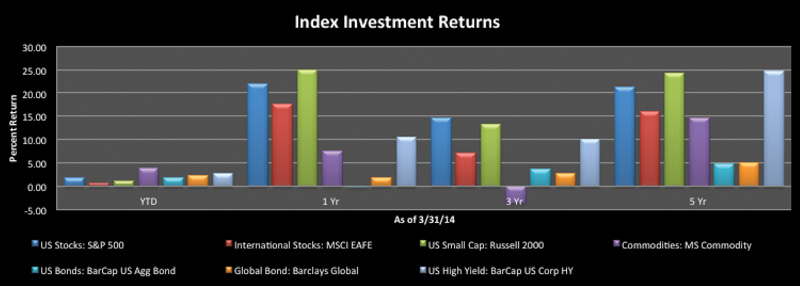
Investment Performance - 1st Quarter 2014

invcom_performance_2014q1.jpg

Source: Morningstar

US Bonds represented by Barclay's US Aggregate Bond Index a market-weighted index of US bonds. US stocks per S&P 500 Index a market-cap weighted index of large company stocks. Barclay’s Capital Global Bond index is a market-cap weighted index of global bonds. US Small Companies per Russell 2000 Index a market-cap weighted index of smaller company stocks. International stocks measured by MSCI EAFE is a stock market index designed to measure the equity market performance of developed markets outside of the US and Canada. Commodities per Morgan Stanley Commodity Index a broadly diversified index designed to track commodity futures contracts on physical commodities. Barclays Capital US Corporate High Yield Index is an unmanaged index that covers the universe of fixed-rate, noninvestment-grade debt. Barclays Capital US Corporate High Yield Index is an unmanaged indexthat covers the universe of fixed-rate, noninvestment-grade debt.

Inclusion of these indexes is for illustrative purposes only. Keep in mind that individuals cannot invest directly in any index, and index performance does not include transaction costs or other fees, which will affect actual investment performance. Individual investor’s results will vary. Past performance does not guarantee future results.

Retirement Strategies: Which Account Should You Tap?

 Receiving a pay check when you are in your working years is pretty straightforward.  You work hard each week, typically have a certain amount of federal and state taxes withheld, and you get paid.  Pretty simple, right?  Fast forward to the golden years of retirement, when you are no longer working for the income you receive, you are generally getting paid from the money from the portfolio you invested in over those hard-working years.  At this stage, the tax treatment of your “pay check” becomes a little more complicated.  With several different types of accounts and income sources, such as pension and Social Security, which account should you consider drawing the income from? Let’s take a look: 

Enjoying Life in the Go-Go Years

Take the example of a 63-year-old couple, just retired, and planning to enjoy a few years of extensive travel, golf and entertainment.  Spending is typically a little higher in these initial years of retirement. At The Center, we refer to them as the “go-go” years.  Both are receiving nice pension benefits ($100,000 total) and have collected Social Security ($40,000 total) at 62. The couple has their home paid off, live a healthy lifestyle and have very little itemized deductions and therefore take the standard deduction ($12,200) when they do their taxes.  They have both accumulated sizable IRAs ($750,000 total) and a joint taxable brokerage account of $250,000.  The clients would like to draw $60,000 from their portfolio for 6 years and begin to cut back once they are in their late sixties.  So what account(s) do we take the $60,000 from?  First off, let’s clarify the tax treatment between the IRA and joint account. 

The IRA: Any funds withdrawn from the IRAs will be treated as ordinary income and included in taxable income at the end of the year.  This is because the clients received a tax-deduction when they initially made contributions. 

The Joint Account: Withdrawals from the joint account on the other hand, will not be treated as ordinary income – the funds contributed to this account never received a tax deduction.  Unlike the IRA, however, the joint account does not grow tax-deferred and the clients will receive a 1099 each year showing capital gains or losses and any dividends or interest paid in the account. 

The Answer: If we take the full $60,000 from the IRA, the additional income will push them from the 25% tax bracket into the 28% bracket and a portion of the distribution would be taxed at 28%.  If the funds were taken from the joint account, the clients would not pay ordinary income tax on the distribution, thus keeping them in the 25% bracket and reducing their overall tax bill.

Everything in Moderation

Now let’s look at a different 63-year-old married couple living a much more modest lifestyle.  They do not have a pension and usually only live off the $40,000 they receive in Social Security benefits.  They also have a total of $750,000 between both of their IRAs and a $250,000 joint taxable brokerage account.  Their Social Security benefits are not taxable in this case because their AGI is under the IRS threshold. They still have a mortgage on their home and give money to several charities throughout the year which allows them to itemize their deductions ($25,000 total).  This year is an exception to their normal frugal lifestyle; they’d like to take $10,000 from their portfolio to go on a 10 day vacation to Hawaii. What account(s) should they take the funds from?  (Hint: Think of the difference between the tax treatment for the IRA and joint account from our previous example) 

The Answer: Assuming modest interest, capital gains and dividends from the joint account, they would feasibly be able to withdraw the $10,000 from the IRA and not pay any federal tax after factoring in their itemized deductions and personal exemptions, even though the IRA distribution was included in their ordinary income. 

As you can see from these examples, there is never a “one-size fits all” answer.  As financial planners, our team does just that, PLAN!  We take a close look at each client’s current and projected tax situation and coordinate with other professionals to make sure we are being as efficient as possible while getting you the funds you need to live the life you choose. 

Nick Defenthaler, CFP® is a Support Associate at Center for Financial Planning, Inc. Nick currently assists Center planners and clients, and is a contributor to Money Centered and Center Connections.


The examples provided are hypothetical. Every investor’s situation is unique and you should consider your investment goals, risk tolerance and time horizon before making any investment or withdraw decision. Please consult with your financial advisor about your individual situation. The information has been obtained from sources considered to be reliable, but we do not guarantee that it is accurate or complete, it is not a statement of all available data necessary for making an investment decision, and it does not constitute a recommendation. Any opinions are those of Center for Financial Planning, Inc. and not necessarily those of Raymond James. You should discuss any tax matters with the appropriate professional. C14-007122

Curtain Call

 The Center's Team enjoys sharing their knowledge with the press to help stories come to life, share facts and bring important topics to the forefront.  We are also honored when we are recognized by media and publications for our work and service to our profession. Here's what's new:

Center Recognized as a finalist for the 2014 Governor’s Fitness Awards

The finalists were selected by a committee of judges for their commitment to personal health, dedication to their communities, and the unique definition of what fitness means to them. The Governor’s Fitness Awards are a platform for recognizing organizations in Michigan that have made outstanding contributions to health and physical fitness during the last year.

http://michiganfitness.org/gfa-finalists-2014-news A14-006160

Reuters

Matthew Chope, CFP®: Matt was quoted on Reuters.com on March 3, 2014, in an article titled, “Will Warren Buffett’s investment advice work for you?” by Lauren Young.

Happy Centerversary to Jen Hackmann


The Center celebrates its 29th year! Founded in 1985, our success and longevity would not be possible without the support from our team members.

It is with warm appreciation that we honor Jen Hackmann, RP who celebrates her 13th Centerversary at the end of March. Congratulations! Jen took a minute to put her thoughts into words, "What a great 13 years it has been! Great co-workers, fantastic clients, what more could one ask for?"


A14-006938

6 Tips for Your Tax Return

This March, in honor of Women’s History Month, I’d like to share a little about Muriel Siebert, a legend on Wall Street and a trailblazer for women.  In 1967, she was the first woman to buy a seat on the New York Stock Exchange. This accomplishment, as well as her other successful business ventures and philanthropic activities, helped to expand opportunities for women in finance. 

As March exits and we transition to April, many of us are busy with tax preparation leading up to the April 15th deadline for filing. Now is the time to follow the trailblazing example of Muriel Siebert and blaze a path to your own financial independence. Are you getting a refund?

Here are some tips to help you make the most of this once in a year windfall:

  • Ask why you have a refund.  Did you pay too much in the first place? Has something changed in your financial picture? Or is it a forced saving strategy?

  • Set some aside. Treat the refund as income and save a minimum of 15% for longer-term goals that are important to you.

  • Pay down debt obligations. Especially credit card debt or student loan debt with high interest charges.

  • Not maxing out your 401k? A strategy for reducing future taxes is to increase your 401k contribution and then set aside the current refund to help with monthly cash flow if needed.

  • Are you saving for college educations? If additional funds are needed, use the refund to put savings goals back on track.

  • Splurge! Set it aside for gifts, vacations and other lifestyle choices.

As Women’s History month comes to an end and April  15th approaches, celebrate your commitment to making the most of your financial opportunities. Take a look back at the success you have experienced along the way and continue to step forward into your financial plan for the future.

Laurie Renchik, CFP®, MBA is a Partner and Senior Financial Planner at Center for Financial Planning, Inc. In addition to working with women who are in the midst of a transition (career change, receiving an inheritance, losing a life partner, divorce or remarriage), Laurie works with clients who are planning for retirement. Laurie was named to the 2013 Five Star Wealth Managers list in Detroit Hour magazine, is a member of the Leadership Oakland Alumni Association and in addition to her frequent contributions to Money Centered, she manages and is a frequent contributor to Center Connections at The Center.

Five Star Award is based on advisor being credentialed as an investment advisory representative (IAR), a FINRA registered representative, a CPA or a licensed attorney, including education and professional designations, actively employed in the industry for five years, favorable regulatory and complaint history review, fulfillment of firm review based on internal firm standards, accepting new clients, one- and five-year client retention rates, non-institutional discretionary and/or non-discretionary client assets administered, number of client households served. C14-006593