Center Makes Crain's List of Top Money Managers

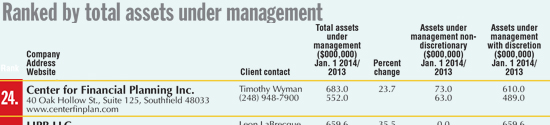
 For the second consecutive year, Center for Financial Planning has been recognized as one of the Detroit area’s largest money managers. The annual Top 25 recognition is a big deal to us because it means we are making our mark in southeast Michigan and beyond.

Center Partner Melissa Joy says the recognition puts CFP in great company.

We have never set a goal to be the largest firm around, but our size and community footprint here in Michigan helps us to deliver world-class financial planning service to an exceptional group of people – our clients. To us, success isn’t measured by dollars and cents, but by the lives we touch.”

Crain’s list is a compilation of money managers in Wayne, Oakland, Macomb, Washtenaw and Livingston counties. To see the complete list click here.


Criteria used to determine the Top 25 Managers is based on assets under management with discretion exclude master trusts, directed trusts, options, custodial accounts and advisory accounts over which no direct investment responsibility exists. Information was provided by the companies or from Form ADV. It is not a complete listing but the most comprehensive available.

Links are being provided for information purposes only. Raymond James is not affiliated with and does not endorse, authorize or sponsor any of the listed websites or their respective sponsors. Raymond James is not responsible for the content of any website or the collection or use of information regarding any website's users and/or members. C14-028649

Retirement Spending: Finding Your Actual Cost of Living

 When you’re approaching retirement, it can be hard to determine how much you would like to spend when you stop working.  It’s a scary thought for most.  You wonder: Have I saved enough?  Is what I want to spend reasonable and safe?  It can seem a bit overwhelming, but hopefully part one of this two-part blog series will help to simplify that discussion. 

How much does my lifestyle really cost?

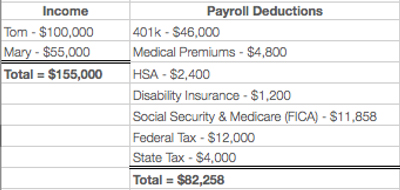
Start the conversation by figuring out your current cost of living. To illustrate, look at an example of how this figure might be much less than you think.  Tom and Mary are both age 58 and plan to retire at age 62.  The discussion of retirement planning is becoming increasingly important to them as they near retirement.  Tom works for Ford and earns $100,000/yr and Mary works as a teacher earning $55,000/yr.  Tom and Mary are great savers and each contribute the maximum to their 401k each year ($23,000 each, $46,000 total for 2014).  They have health insurance through Mary’s work and pay $400/mo for excellent coverage – they also save $200/mo towards a Health Savings Account (HSA) to be efficient with their out-of-pocket medical expenses each year.  They each pay into a group disability policy that costs $100/mo in total.  Of course, we can’t forget about taxes.  In 2013, they paid $12,000 in federal tax and $4,000 in Michigan state tax. Social Security and Medicare (FICA) cost them $11,858 (7.65% on their income).  Below is a breakdown of these payroll deductions on an annual basis:

Assuming no additional dollars are saved beyond the 401k, Tom and Mary are actually living on $72,742/yr ($155,000 – $82,258) – only 47% of what they are earning.  This is a great starting point but this is where we start to explore a bit by asking questions like: 

  • Are they happy with their current lifestyle? 
  • Do they feel constrained right now and want to spend more on things like travel in retirement?
  • Or, do they already travel and do the things they love on their $72,742/yr lifestyle? 
  • What personally meaningful things do they want to accomplish once they are retired? 

These kinds of questions open the discussion surrounding retirement spending and goals.  It is also worth mentioning that there will be several expenses and payroll deductions that will ultimately disappear or significantly reduce upon retirement.  I will go into detail on these items and show how things change in retirement in part two of this blog series – stay tuned!

Nick Defenthaler, CFP® is a Certified Financial Planner™ at Center for Financial Planning, Inc. Nick currently assists Center planners and clients, and is a contributor to Money Centered and Center Connections.


Any opinions are those of Center for Financial Planning, Inc. and not necessarily those of RJFS or Raymond James. Any example is hypothetical in nature and is used for illustrative purposes only. Individual cases will vary. C14-026770

Elder Care Planning: Assisted Living

 In last month's post we talked about how most older adults would prefer to age in their own homes (age in place). This is often possible for a lifetime, but for some, physical and/or cognitive decline makes it necessary to look at housing options that provide care on-site. According to the recent Legg Mason study on Aging Clients, the national average cost to live in an assisted living community is $3,500 to $5,000 a month.

As we meet with our clients, we find that there are several reasons why looking for an assisted living community makes more sense than trying to age in place. These reasons can be reviewed looking at the 4 "C's": Comfort, Convenience, Companionship and Care.

Comfort in Knowing Care is Available

An older couple may find that they can no longer safely assist each other.  One person may require more assistance than the other, but caregiving can be extremely difficult and can often put the healthier spouse at risk for harm.  Or a widowed client, without family able to help, may find that bringing care into the home becomes too cost-prohibitive as the need for more hours of assistance escalates.  Just knowing that a qualified care provider is available within the community at all times can provide comfort in the way of peace of mind.

Convenience of Resources

Assisted Living communities, while they are not "home," can provide conveniences not available to those who choose to age in place.  Meals are provided, so it is no longer necessary to cook.  Care providers are available on-site.  And things like transportation and organized trips are readily available.

Companionship Right Outside the Door

One of the biggest challenges for older adults can be socialization and companionship.  An assisted living community allows individuals the space to be by themselves, when and if they desire. But when having a conversation with someone is desired, it is literally right outside the door. Community rooms, small gathering areas, and organized social activities are readily available, providing a way to stay engaged and connected.

Care is Always There

The ability to make a call and have a care provider available in a moment's notice can be invaluable for older adults, especially those who are alone.  Knowing that help is near can also ease the burden of worry.

If you or someone you know thinks they may need to look at an assisted living community in the future, I recommend (as always) planning ahead.  Begin by researching assisted living communities that will fit your specific needs:

  • Vicinity to your home community and/or to family members
  • Services provided by the community fit your needs
  • Comfort level with the community and the types of residents

Include your family members in the discussion – consider potential challenges, resources and options. And last, but not least, take a look at cost.  Discussing the financial impact of future housing decisions with your financial planner is important and can help ensure financial independence for a lifetime.

Sandra Adams, CFP® is a Partner and Financial Planner at Center for Financial Planning, Inc. Sandy specializes in Elder Care Financial Planning and is a frequent speaker on related topics. In 2012-2014 Sandy has been named to the Five Star Wealth Managers list in Detroit Hour magazine. In addition to her frequent contributions to Money Centered, she is regularly quoted in national media publications such as The Wall Street Journal, Research Magazine and Journal of Financial Planning.


Five Star Award is based on advisor being credentialed as an investment advisory representative (IAR), a FINRA registered representative, a CPA or a licensed attorney, including education and professional designations, actively employed in the industry for five years, favorable regulatory and complaint history review, fulfillment of firm review based on internal firm standards, accepting new clients, one- and five-year client retention rates, non-institutional discretionary and/or non-discretionary client assets administered, number of client households served.

Any opinions are those of Center for Financial Planning, Inc. and not necessarily those of Raymond James. C14-028648

Richard Marston on Investing for a Lifetime

 What does a financial planning geek do for fun? He visits the Wharton School of the University of Pennsylvania for a day of lectures! The first part of the day was spent hearing from Professor Richard C. Marston. Professor Marston is the James R.F. Guy Professor at Wharton, a graduate of Yale, MIT, and Oxford (on the east coast they would call him “wicked smart”). Moreover, he has taught asset allocation for over twenty years and in 2011 wrote the book Portfolio Design: A Modern Approach to Asset Allocation (Wiley, 2011). Needless to say, it was a thought-provoking and worthwhile day.

In two lectures -- the first taken from his new book, Investing for a Lifetime” Managing Wealth for the “New Normal” and the second titled “Investing with a Fifteen Year Perspective: Past and Future” – Marston shared what he believes to be some “best practices” in savings and investing. He talked about choosing an asset allocation focusing on stocks when you are still years from retirement. You then gradually shift towards a 50/50 portfolio while saving 15%-20% of income during the accumulation period. And once you reach retirement, he discussed spending 4% of accumulated wealth. My sense is that these are consistent messages that our clients have heard from us over the years. 

During one of the wicked smart professor’s lectures, he shared that as he gets older, he has a greater appreciation for the role that investor and advisor behavior plays in ultimate investment success.  For example, he believes in using active managers. He also believes that selecting the right investments is important (and he is paid by several family offices to do so), but behavior such as letting fear or greed control actions plays a critical role as well.

Professor Marston’s recent work also focuses on determining a savings goal for retirement. A common rule of thumb is that investors must save 8 times their income before they retire.  So, if you earn $100k, then you need $800k saved at retirement.  Professor Marston was intrigued by the simplicity of the general rule and decided to put it through his own analysis. In the end, his analysis suggested that 8 times income is probably too low for most people.  His own conclusions, obviously depending on the exact assumptions, ranged from 11.5 to 18.4 times income. In his opinion, your savings goals will vary widely depending on two main factors:

  • If you are single: Your savings must be higher because a couple will receive more in social security benefits at the same earnings (consider it a marriage premium).
  • If you earn much more than $100k: Your savings rate needs to be higher because social security plays a lessor role in your retirement income.

As a quick aside, I was pleased to hear Professor Marston include and emphasize the importance of social security in the retirement planning analysis.  Without it, the savings rates above would need to be increased significantly.  I invite you to read our many previous posts on social security and let us know if we can help answer any questions.

On the flight home from the lectures, I read Professor Marston’s newest book Investing for a Lifetime (Wiley, 2014). It’s about making saving and investing understandable to the investor.  Probably the most important statement, that occurs early and often, is SAVING IS MORE DIFFICULT THAN INVESTING. Meeting your life goals, such as retirement, is much more dependent on our savings than getting another 1% from investment portfolios.  As I have written in the past, saving is much more than dollars and cents; it takes discipline and perseverance.

For our long-time clients, the book would provide a good refresher on many of the concepts we have discussed and encouraged over the years.  If you have a family member or friend starting their career or looking to take more control of their finances, Professor Marston has the ability to make the complex simple and I think his books would be a wonderful gift.

The second part of my Wharton School visit was spent hearing from Professor Christopher Geczy, Ph.D., another wicked smart guy.  I will leave that review for another post.  If you like Alpha, Beta, Correlation coefficient, Standard Deviation, R Squared, Systematic risk, and Idiosyncratic risk…well you are in for a treat!

Timothy Wyman, CFP®, JD is the Managing Partner and Financial Planner at Center for Financial Planning, Inc. and is a frequent contributor to national media including appearances on Good Morning America Weekend Edition and WDIV Channel 4 News and published articles including Forbes and The Wall Street Journal. A leader in his profession, Tim served on the National Board of Directors for the 28,000 member Financial Planning Association™ (FPA®), trained and mentored hundreds of CFP® practitioners and is a frequent speaker to organizations and businesses on various financial planning topics.


The information contained in this report does not purport to be a complete description of the securities, markets, or developments referred to in this material. The information has been obtained from sources considered to be reliable, but we do not guarantee that the foregoing material is accurate or complete. Any opinions are those of Center for Financial Planning Inc. and Richard C. Marston and not necessarily those of RJFS or Raymond James. Every investor’s situation is unique and you should consider your investment goals, risk tolerance and time horizon before making any investment. Investing involves risk and you may incur a profit or a loss regardless of strategy selected. Any information is not a complete summary or statement of all available data necessary for making an investment decision and does not constitute a recommendation. Asset allocation does not ensure a profit or guarantee against a loss. C14-026186

Curtain Call

 The Center's Team enjoys sharing their knowledge with the press to help stories come to life, share facts and bring important topics to the forefront.  We are also honored when we are recognized by media and publications for our work and service to our profession. Here's what's new:

Center named as #228 on Financial Advisor Magazine's 2014 RIA Ranking

Center for Financial Planning, Inc. has been recognized among the nation's top-ranked investment advisory firms for the past four consecutive years.

Financial Advisor Magazine ranks the top registered investment advisory firms (RIAs) across the country based on a survey of firms' assets under management and percentage of growth. C14-025822

WISER ADVISOR.COM

Melissa Joy, CFP®: Melissa was quoted on WiserAdvisor.com in an article titled, “Gen X at the Crossroads: Baby Boomers’ Kids Could Face a Retirement Squeeze” by James O’Brien. C14-023684

Factoring the Cost of Living in a Post-Retirement Relocation

Your retirement plan may involve a move. You could be moving some place warm so you don’t have to put up with the wonderful Michigan winters or perhaps moving to be closer to your kids and grandkids.  Whatever the motivation, there is always a financial component in the decision-making process.

Paying for what you want vs. what you need

The cost to live in other areas of the country can be higher or lower, but some people don’t know the specific figures you will probably pay after you make the move.  Is a dollar in Michigan the same as a dollar in California or Utah? A recent conversation with a client evaluating relocating placed focus on this specific issue. His thinking was that it didn’t matter where you lived, you can always find a way to spend money.  While I certainly have to agree with him on that point, I think the bigger point is that there is a difference between spending money on things you want versus spending money on things you need.

Comparing Expenses

Let’s take a look at the cost of different goods and services in the two cities. These figures were taken from www.costofliving.org and they are an average estimate taken from people who live in Salt Lake City and San Francisco. The list of goods and services has more than 75 commonly purchased or used items but we’ll look at just a sampling of expenses.

As you can see, everything in San Fran is more expensive except the T-Bone steak. Unfortunately, after you pay for your basic living expenses, you might not have any money left over for that T-Bone! According to the living expense calculator on www.costofliving.org someone living on $70,000 of net income in Livonia, Michigan would need approximately $120,000 net in San Francisco.  In Salt Lake City, that same person would only need $69,000 to maintain the same standard of living. 

If you think a move might be in your future, talk to your financial advisor to weigh the costs associated with the new location and make sure it fits within your retirement income goal.

Matthew Trujillo, CFP®, is a Certified Financial Planner™ at Center for Financial Planning, Inc. Matt currently assists Center planners and clients, and is a contributor to Money Centered.

Any opinions are those of Center for Financial Planning, Inc. and not necessarily those of Raymond James. The information has been obtained from sources considered to be reliable, but Raymond James does not guarantee that the foregoing material is accurate or complete. C14-022592

Center Summer Picnic Becomes a Tradition

 Tradition is an important part of The Center’s culture. That’s why we couldn’t be happier to see last year’s picnic turning into a tradition. For our 2nd Annual Center Picnic, The Center team gathered at Island Lake State Park in Brighton on July 19th. The day was filled with food, laughs, and competition. The weather wasn’t quite as cooperative as last year, but that didn’t stop anyone from enjoying the day. 

The picnic began with some friendly games of cornhole and balloon animals for the kids. We fueled up on burgers, hot dogs, sausages, chips, cupcakes, and cookies, and then the games began. 

Referred to by some as “The Boyce Show,” Dan was once again the Master of Ceremonies.  Even as the ominous clouds began to roll in, our MC reminded the team that, much like the financial markets, we can’t be deterred by an uncertain future!  Despite the periodic rain showers, Dan maintained order and fun with his trusty megaphone.

The competition was heated in the balloon toss, egg and spoon race, and volleyball matches where The Center team’s passion and determination shined through. We firmly believe the motto:

It’s not whether you win or lose, it’s how you play the game.

Everyone left the picnic feeling like a champion.  However, it should be noted that some team members claim they are already training for next year.


A14-026126

The 50/50 strategy turns your next raise into lifelong savings

 Ever wonder how much you should be saving? We hear it from a lot of clients who want to make sure they’re putting away enough each paycheck towards retirement.  We typically suggest saving at least 10% of your before-tax income and for those approaching retirement within 10 – 15 years, we like to see that number closer to 20%.  Although we never like to make blanket statements in financial planning, those savings rates are typically what most should be striving for while still maintaining a balance to live a full life now.  But is there a better strategy that could be more efficient?

Give Your Savings a Raise

What do most people do when they get a raise?  Many people keep their savings rate the same but increase their standard of living.  Sure, the actual dollar amount is increasing because the savings percentage is now based on a larger salary; however, my argument would be that controlling your standard of living is what is most important, especially when approaching retirement.  So how do you keep your standard of living from getting out of control and far surpassing savings? 

Spend 50% of your raise and save the other 50% 

Let’s see how that strategy could impact our hypothetical client, Jack.  Jack is 30 years old and is earning $100,000/yr as a business consultant.  He is currently saving 10% towards his 401k ($10,000/yr).  Jack had a great year in 2013 and earned an 8% raise for 2014, increasing his base salary to $108,000.  Assuming Jack kept his savings rate of 10% the same, he would now be putting $10,800/yr into his 401k.  However, what if he took the “spend 50, save 50” approach?  After taxes and other payroll deductions, Jack actually realizes a “take home” raise of $5,000.  In the 50/50 strategy, Jack would tack on $2,500 to his annual 401k savings, increasing total annual contributions to $12,500 (from $10,000 prior to his raise).  By simply saving 50% of the money that didn’t exist the year prior, Jack has increased his total retirement savings to about 11.6% ($12,500/$108,000). He’s controlled how quickly his standard of living increases. 

As a young professional, I can certainly attest to the difficulty of looking down the retirement road to a goal that is 35+ years away.  However, committing to your goals and having a clear, simple strategy, such as the 50/50 savings approach, can help you reach the financial goals you set for yourself or family!

Nick Defenthaler, CFP® is a CERTIFIED FINANCIAL PLANNER™ at Center for Financial Planning, Inc. Nick currently assists Center planners and clients, and is a contributor to Money Centered and Center Connections.


Any opinions are those of Center for Financial Planning, Inc. and not necessarily those of RJFS or Raymond James. C14-025359

Following Charles de Vaulx for 25 Years

The Center investment committee meets with and interviews dozens of management teams each year. We have face-to-face sessions, conference calls, and trips to company home offices. We recently had a chance to meet with a portfolio manager that we worked with for most of the last quarter century ... Charles de Vaulx. Warren Buffet once said:

A portfolio is much like a bar of soap, the more you touch it the smaller it gets.”

In order to keep portfolio changes to a minimum we spend a lot of time on the front end finding the right minds with an investment philosophy that matches ours.

Charles has represented part of three different teams over the 25-year period, including IVA Funds, but we have followed him. His approach to investing resides in the contrarian, absolute return, low risk, global, alternative asset class emphasis with experience in global value investing.

“The Perennial Bear”

Charles is usually looking at the world with a glass half empty viewpoint. His team was labeled “The Perennial Bear” during the market run up in the 1990’s as the greatest bubble in stocks was building and just before a 12 year bear market in stocks occurred. This was one of the longest bear markets in history. And just before the worst decade of stock returns in U.S. history (not many people realize that Dec 31st 1999 – Dec 31st 2009 produced a lower return in the S&P 500 than the depression period of the 1930s).

According to Charles, it had everything to do with price. People need to pay more attention to the price that is paid for the potential return that can be achieved going forward. That is where the work is done. The rest is patience and time. 

Matthew E. Chope, CFP ® is a Partner and Financial Planner at Center for Financial Planning, Inc. Matt has been quoted in various investment professional newspapers and magazines. He is active in the community and his profession and helps local corporations and nonprofits in the areas of strategic planning and money and business management decisions. In 2012 and 2013, Matt was named to the Five Star Wealth Managers list in Detroit Hour magazine.


Five Star Award is based on advisor being credentialed as an investment advisory representative (IAR), a FINRA registered representative, a CPA or a licensed attorney, including education and professional designations, actively employed in the industry for five years, favorable regulatory and complaint history review, fulfillment of firm review based on internal firm standards, accepting new clients, one- and five-year client retention rates, non-institutional discretionary and/or non-discretionary client assets administered, number of client households served.

Any opinions are those of Matt Chope and not necessarily those of RJFS or Raymond James.

Financial Lessons for College Students

A college education holds the promise of a great career start for many students.  The excitement of choosing a college, getting accepted, and actually starting classes will eventually die down. Then your student is likely to encounter some financial lessons that won’t be taught in the classroom.  Lessons like:

  • How continuous spending can take a bank balance to zero and then the bank piles on additional service fees 

  • Or how spending on small things like getting a pizza or a school sweatshirt can quickly add up

Here are three time-tested financial tips to help students develop habits that will serve them well during college years and into their adult life.

Keep Track of Spending

If you don’t know what you are spending, you don’t know what is left or what you can afford or not afford. The key is to create a spending plan for necessary purchases like food, gas, and cellphone service before spending on discretionary items. Take the guesswork out of budgeting by using an online tool like Mint.com to automatically categorize transactions.

Don’t Underestimate the Importance of Managing Debt

While credit cards are great for convenience and emergency situations, be wary of running up a balance that you cannot pay off every month.  Use the plastic cautiously.  Establishing good credit during college will make it easier to apply for a car loan, rent an apartment, or even purchase a first home. If student loans are needed to fund college expenses, take the time to read the fine print.  Don’t take more than you need today because piecing together student loans for 4 or more years can add up. Your student may not realize they are easily signing up for substantial payments for twenty years or more after graduation.

Think Twice before Lending Money to a Friend

Everyone has had an experience where a friend comes up short and says, “Can I borrow some money?  I promise I’ll pay you back!” Recognize that lending money is a risk, even if a friend is completely trustworthy.  Just because your friend is asking you don’t have to say yes. Many of life’s lessons your student will have to learn on their own, but if they think carefully before they lend, are cautious of debt, and track spending, they can avoid some common financial mistakes.

Laurie Renchik, CFP®, MBA is a Partner and Senior Financial Planner at Center for Financial Planning, Inc. In addition to working with women who are in the midst of a transition (career change, receiving an inheritance, losing a life partner, divorce or remarriage), Laurie works with clients who are planning for retirement. Laurie was named to the 2013 Five Star Wealth Managers list in Detroit Hour magazine, is a member of the Leadership Oakland Alumni Association and in addition to her frequent contributions to Money Centered, she manages and is a frequent contributor to Center Connections at The Center.

Five Star Award is based on advisor being credentialed as an investment advisory representative (IAR), a FINRA registered representative, a CPA or a licensed attorney, including education and professional designations, actively employed in the industry for five years, favorable regulatory and complaint history review, fulfillment of firm review based on internal firm standards, accepting new clients, one- and five-year client retention rates, non-institutional discretionary and/or non-discretionary client assets administered, number of client households served. A14-025160