First Quarter 2016 Investment Pulse

Contributed by: Angela Palacios, CFP® Angela Palacios

We hit the ground running in the New Year with great insight from outside experts on a wide array of topics ranging from fixed income research to how to conduct a more successful investment committee meeting and nearly everything in between!  Here is a summary of some of the highlights.

Chris Dillon, a global fixed income portfolio specialist with T. Rowe Price

An hour spent listening to Chris was one of the most informative yet exhausting hours of the quarter!  He spent much of his time explaining global complexities within the fixed income markets and how they could affect investors in the coming months.  Of particular interest was a discussion on negative rates and his opinion that we will likely look back on these negative interest rate policies around the world as being completely ineffective.  Also discussed was the coming money market reform here in the U.S. with the formation of Prime Money Markets that will have floating pricing (Net Asset Values).  While these will mostly affect institutional level investors his recommendation was not to purchase these, but they could create a fundamental change in the market place presenting interesting opportunities for short term bond investors.

Bob Collie, Chief Research strategist, Americas Institutional, Russell Investments

Bob discussed the difficulty of working in committees as it isn’t something that comes naturally to most people.  He offered many questions to ask ourselves to understand how our own investment committee measures up to others.  These answers helped identify areas to focus on improving.  Since our investment committee meets at least once a month you can imagine the agendas are usually very packed.  We need to make the most of our time together overseeing portfolios.  Areas we are focusing on improving after listening to Bob have been visioning (what does success of committee work look like), dynamic discussions, and pre-reading of agenda items and background research so we all have time to formulate our points for the discussion ahead of time.  We have already noted improvements during the meeting and outcomes from the meetings.  Hopefully even more improvements are on the horizon!

Jeremy Siegel, Ph.D., Russell E. Palmer Professor of Finance at the Wharton School of the University of Pennsylvania and Senior Investment Strategy Advisor, Wisdom Tree

"Bubble, the most overused word in finance today."

He believes the market has an aggregation bias, if there are a few stocks or a sector that has large losses, like energy does now, the entire market can look skewed.  The energy sector is biasing the P-E index of the market upward making it look more expensive as a whole than it really is.  He thinks fundamentals have driven interest rates to zero rather than artificial means, the FED has simply followed suit reducing interest rates along the way.  Economic growth and risk aversion are the most important determinants of real rates.  Increased risk aversion, aging investors, a desire for liquidity and the de-risking of pension funds has increased demand for bonds forcing their yields lower.  Jeremy has always had a very bullish view on the markets and now seemed no different.  He feels returns over the coming years will fall in line with long term averages.

Angela Palacios, CFP® is the Portfolio Manager at Center for Financial Planning, Inc. Angela specializes in Investment and Macro economic research. She is a frequent contributor to Money Centered as well as investment updates at The Center.


This material is being provided for information purposes only and is not a complete description, nor is it a recommendation. Any opinions are those of Angela Palacios and not necessarily those of Raymond James. The information has been obtained from sources considered to be reliable, but Raymond James does not guarantee that the foregoing material is accurate or complete. Raymond James is not affiliated with and does not endorse the opinions or services of Chris Dillon, Bob Collie, Jeremy Siegel or the companies/organizations they represent. Investing involves risk and investors may incur a profit or a loss regardless of strategy selected. Past performance is not a guarantee of future results. There is no guarantee that these statements, opinions or forecasts provided herein will prove to be correct.

Investor Ph.D. Series: A Game of Negative Interest Rates

Contributed by: Angela Palacios, CFP® Angela Palacios

While many of us, including me, are eager for the new season of Game of Thrones to begin to see what happens next in Westeros, another game is surfacing around our world. Countries around the world are changing the rules of the game by pushing interest rates into negative territory. What happens when this occurs? Winter seems to be inevitable for the citizens in the seven kingdoms but is it inevitable for us?

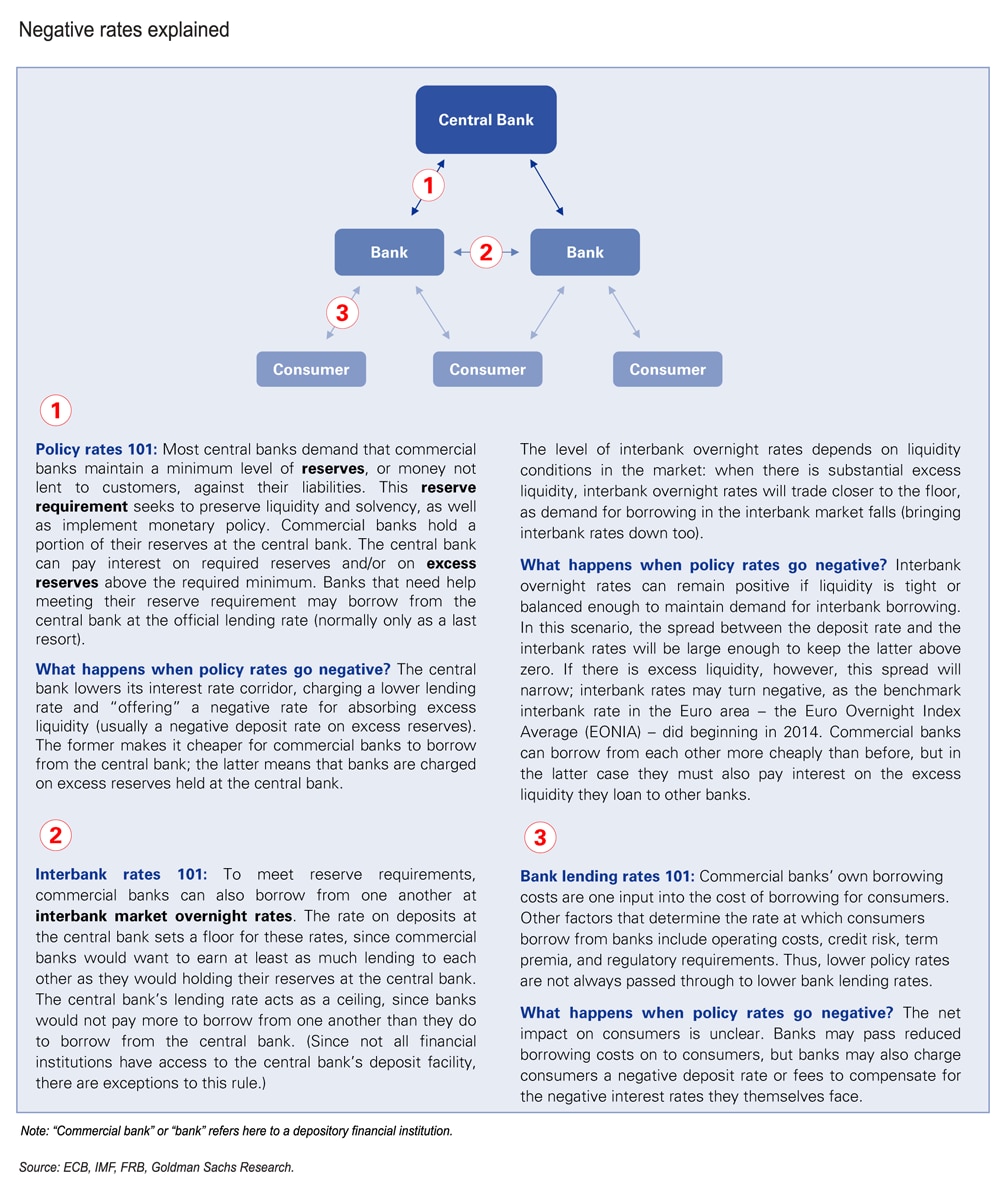
My colleague Nick Boguth recently wrote a blog explaining the different types of interest rates: Policy, Interbank, and Bank lending rates. Each of the rates is affected differently when interest rates are pushed into negative territory but all are ultimately connected. 

When Policy Rates go Negative

This is the money paid to banks when they deposit their excess reserves with the Central Bank or have to borrow from the Central Bank to meet their reserve requirements. When these rates go negative it makes it cheaper for commercial banks to borrow to meet their reserve requirements but can actually cost the bank money when they park their excess reserves with the Central Bank overnight. Like the Iron Bank of Braavos “The Iron (Central) Bank will have its due.” This encourages banks to look around for something else to do with their excess reserves, like looking to each other to borrow from and lend to rather than the Central Bank. 

When Interbank Rates go Negative

Banks lending to each other is affected by negative rates as they must now pay to lend money to another bank. The only way they would do this is if they had to pay less to loan their money to another bank than to pay to park it at the Central Bank. Neither of these situations is desirable. Institutions desire to earn money on these excess reserves rather than pay to loan to anyone. That has spurred them to buy short-term government debt with their excess reserves to try to seek some yield and the result is that they have pushed Government yields in certain countries, like Germany, into negative territory too. This, in turn, also drags down rates on corporate debt as they are correlated to government bond yields. 

When Bank Lending Rates go Negative

The domino effect of all of these negative rates should pass through to the consumer but doesn’t always show up in lending rates. This negative deposit rate pushes down rates on short-term loans of other types of lending the bank does, like home and auto financing. But other factors, such as credit risk (while a Lannister always pays their debts, consumers don’t) and term premia can put a floor on how low rates can go to the consumer. Favorable lending rates also can be made up with charging consumers more to park their money in the bank. In theory, this downward pressure on rates is supposed to provide an economic boost while also weakening the country’s currency.

No one knows how the series Game of Thrones is going to end as the books have yet to be written. Like the show, the book has not yet been written on the full impact of negative interest rates either. It remains to be seen how this game ultimately ends!


http://www.goldmansachs.com/our-thinking/pages/macroeconomic-insights-folder/negative-interest-rates-101/img-01-slide.png


http://www.wsj.com/articles/everything-you-need-to-know-about-negative-rates-1456700481?cb=logged0.8200769642227588

This material is being provided for information purposes only. Any opinions are those of Angela Palacios and not necessarily those of Raymond James. The information has been obtained from sources considered to be reliable, but Raymond James does not guarantee that the foregoing material is accurate or complete.

Links are being provided for information purposes only. Raymond James is not affiliated with and does not endorse, authorize or sponsor any of the listed websites or their respective sponsors. Raymond James is not responsible for the content of any website or the collection or use of information regarding any website's users and/or members.

Investor Basics: Bank Loans, Interest Rates, and Game of Thrones

Contributed by: Nicholas Boguth Nicholas Boguth

In the spirit of preparing for season six of Game of Thrones, this set of Investor Basics and Investor Ph.D blogs is aimed to discuss bank loans and interest rates with respect to the increasingly popular adventure/fantasy television series. Check out our Director of Investment’s blog “A Game of Negative Interest Rates” HERE.

There are three types of bank loans – 1: Central Bank Loans, 2: Interbank Loans, and 3: Consumer Loans. Each loan is between different parties and has a different interest rate.

Central Banks require commercial banks to meet reserve requirements to ensure their liquidity. At the end of every day, after all of a commercial bank’s clients deposit and withdraw money, if that bank has less than the reserve requirement then it has to borrow money to raise its reserves.

If it has to borrow money to raise its reserves, it has two options. It can either borrow from the Central Bank at the discount rate, or borrow from a fellow commercial bank that has excess reserves at the end of its business day. Commercial banks borrow from each other at the federal funds rate. Currently the discount rate is 1% and the federal funds rate is 0.5%. Obviously, commercial banks prefer to borrow at the lower rate, so interbank lending is much more common than borrowing from the Central Bank. Borrowing from the Central Bank is more of a last resort for commercial banks.

The third interest rate that banks deal with is the bank lending rate. This is the rate that we, the consumers, see when we walk into a commercial bank and ask for a loan. The discount rate and federal funds rate affect banks’ lending rates, but it is also influenced by how creditworthy the customer is, the banks’ operating costs, the term of the loan, and other factors.

For all you Game of Thrones fans, you can think of the Central Bank like the Iron Bank of Braavos. It is the most powerful financial institution in the world, but it only lends to those that can repay debts (e.g. the Central Bank only lends to commercial banks). Not just anyone can borrow from the Central Bank, but the Lannister’s can because “A Lannister always pays his debts.”  SPOILER ALERT coming for anyone who has not made it through season 5: Remember back to season 5 when the Iron Bank is forcing the Iron Throne to repay one-tenth of their debts? Lord Mace offers that House Tyrell could lend the Lannister’s some money so that they could meet the Iron Bank’s “reserve requirement” of one-tenth. This is interbank lending! Thankfully for us, the cost of borrowing money in real life is only the interest rate, whereas in Game of Thrones it could be one’s life.

Nicholas Boguth is an Investment Research Associate at Center for Financial Planning, Inc. and an Investment Representative with Raymond James Financial Services.


This material is being provided for information purposes only. Any opinions are those of Nick Boguth and not necessarily those of Raymond James. The information has been obtained from sources considered to be reliable, but Raymond James does not guarantee that the foregoing material is accurate or complete.

How Should I Use My Tax Refund?

Contributed by: Jaclyn Jackson Jaclyn Jackson

Tax filing season is over and many people are entitled to get money back from Uncle Sam.  While most of us are tempted to buy the latest gadget or book a vacation, there may be a better way to use your tax refund. If you are pondering what to do with your tax refund, here are a few questions to help determine whether you should SAVE, INVEST, or SPEND it.

Have you been delaying one of the following: car repair, dental or vision checks, or home improvement?

If you answered yes: SPEND

If you had to be conservative with your income last year and as a result postponed car, health, or home maintenance, you can use your tax refund to get those things done.  Postponing routine maintenance to save money short term may add up to huge expenses long term (i.e. having to purchase a new car, incurring major medical expenses, or dealing with costly home repairs.)

Do you have debt with high interest rates?

If you answered yes: SPEND

High interest rates really hurt over time. For instance, let’s say you have a $5,000 balance at 15% APR and only paid the minimum each month.  It would take you almost nine years to pay off the debt and cost you an additional $2,118 interest (a 42% increase to your original loan) for a total payment of $7,118. Use your tax return to dig out of the hole and get debt down as much as possible.

Could benefit from buying or increasing your insurance?

If you answered yes: SPEND

  1. Consider personal umbrella insurance for expenses that exceed your normal home or auto liability coverage.

  2. Make sure you have enough life insurance.

  3. Beef up your insurance to protect against extreme weather conditions like flooding or different types of storm damage that are not normally included in a standard policy.  Similarly, you can use your tax refund to physically your home from tough weather conditions; clean gutters, trim low hanging branches, seal windows, repair your roof, stock an emergency kit, buy a generator, etc.

Have you had to use emergency funds the last couple of years to meet expenses?

If you answered yes: SAVE

Stuff happens and usually at unpredictable times, so it’s understandable that you may have dipped into your emergency reserves. You can use your tax refund to replenish rainy day funds.  The rule of thumb is to have at least 3-6 months of your expenses saved for emergencies. 

Are you considered a contract or contingent employee?

If you answered yes: SAVE

Temporary and contract employment has become pretty common in our labor-competitive economy where high paying positions are few and far between. If you paid estimated taxes, you may be eligible for a tax refund. Take this opportunity to build up savings to buffer against slow seasons or gaps in employment. 

Could you benefit from building up retirement savings?

If you answered yes: INVEST

Get ahead of the game with an early 2016 contribution to your Roth IRA or traditional IRA.  You can add up to $5,500 to your account (or $6,500 if you are age 50 or older).  Investing in a work sponsored retirement plan like a 401(k), 403(b), or 457(b) is also recommended so you could beef up your contributions for the rest of the year and use the refund to supplement your cash flow in the meantime. 

Are you interested saving for your child’s college education?

If you answered yes: INVEST

College expenses aren’t getting any cheaper and there’s no time like the present to start saving for your child’s college tuition.  Money invested in a 529 account could be used tax-free for college bills with the added bonus of a state income tax deduction for you contribution.

Could you benefit professionally from entering a certification program, attending conferences/seminar, or joining a professional organization?

If you answered yes: INVEST

It’s always a good idea to invest in your development.  Why not use your tax refund to propel your future?  Try a public speaking or professional writing course; attend a conference that will give you useful information or potentially widen your network.   

Did you answer “no” to all the questions above?

If you answered yes: HAVE FUN

Buy the latest gadget.  Book the vacation.  You’ve earned it!

Jaclyn Jackson is an Investment Research Associate at Center for Financial Planning, Inc. and an Investment Representative with Raymond James Financial Services.


This material is being provided for information purposes only and is not a complete description, nor is it a recommendation. Any information is not a complete summary or statement of all available data necessary for making an investment decision and does not constitute a recommendation. Any opinions are those of Jaclyn Jackson and not necessarily those of Raymond James. You should discuss any tax or legal matters with the appropriate professional. Prior to making an investment decision, please consult with your financial advisor about your individual situation. Please include: Links are being provided for information purposes only. Raymond James is not affiliated with and does not endorse, authorize or sponsor any of the listed websites or their respective sponsors. Raymond James is not responsible for the content of any website or the collection or use of information regarding any website's users and/or members. Hypothetical examples are for illustration purposes only.

"Help! I’m Facing a Larger than Expected Tax Bill,"

Contributed by: Matt Trujillo, CFP® Matt Trujillo

Every year, as the initial filing date approaches for federal tax returns, inevitably a client calls or emails with something along the lines of “Help! I owe the feds some money! Is there anything I can do to avoid the tax?!” 

I can certainly empathize with getting hit with an unexpected tax bill, and depending on your situation sometimes there are perfectly legal ways to avoid an unexpected tax bill. I have summarized a list of ideas below to keep in mind in case you find yourself in this situation:

Max out the HSA

If you have a qualified high deductible health plan and have an account established, you can defer up to $6,650 in 2015 and this can be done up to the filing deadline of April 18th for 2016.

SEP IRA

For 1099 earners look at setting up and contributing to a SEP IRA; this can be as much as 25% of your net income after expenses that are accounted for on the 1099 income.

Spousal IRA contribution

Maybe you work and have access to a 401(k) or 403(b) plan so you’re not able to make a deductible IRA contribution, but don’t rule this out entirely as your spouse could potentially make a deductible IRA contribution even if they aren’t working. Up to $5,500 for those under 50 and $6,500 for those over 50.

All of the aforementioned can be done right up to the filing deadline of April 18th for 2016, so it makes sense to review these even if it's passed December 31st of the calendar year! If none of these apply to your situation and you are wondering how to avoid owing a big tax bill again on next year’s tax return, consider the following ideas to help mitigate the upcoming year’s tax liability:

Max out 401(k)’s

For those under 50, you can contribute $18,000 and for those over 50 you can contribute $24,000. This has to be done through payroll deduction so you only have until December 31st of the calendar year to defer money into the plan and avoid income tax.

Deferred Compensation Plan

Some plans will allow you to defer your entire salary if desired so make sure you explore the options in your plan and know the specifics of how it works. These plans can be subject to substantial risk of forfeiture, so be very careful and make sure your organization is on solid financial footing before contributing to these plans.

Increase withholding on your paycheck

Nothing fancy here. Sometimes it's just as simple as sending an email to human resources and letting them know you want to withhold more state and federal taxes from your paychecks so you don’t get hit with a big tax bill at the end of the year.

Be sure to consult with a tax professional before implementing any of these strategies. 

Matthew Trujillo, CFP®, is a Certified Financial Planner™ at Center for Financial Planning, Inc. Matt currently assists Center planners and clients, and is a contributor to Money Centered.


Any opinions are those of Matt Trujillo and not necessarily those of Raymond James Financial Services.

Webinar in Review: Social Security Filing Changes

Contributed by: Clare Lilek Clare Lilek

Social Security is probably top of mind for a lot of you reading. Either you’ve heard about the changes being made to filing tactics regarding social security, or you’re getting ready to file and want to know the best strategy to use, or even how it works. We understand it can be complicated, and that’s why we’re here; to make sure you’re getting the most out of your social security benefit. Matt Trujillo, CFP®, held a webinar on the recent changes made to social security and how they could impact you and your spouse. He also went through a few scenarios of spousal benefits in order to clarify how the social security math equation works. He also explained a couple filing strategies that you and your spouse can take advantage of.

Calculating Your Benefits

First of all, Matt stressed that when you file for social security, your benefits statement is a snap shot in time. A predetermined formula uses the Full Retirement Age of 66 as the filing age and your previous work history for determining benefits. Your actual benefits you will receive might not correspond with this statement since it’s a picture of your benefits using your current situation as the determining factors, not your future situation. This is helpful to keep in mind as you’re going through the filing process.

Matt goes through three different examples of spouses filing for benefits in order for you to better understand how filing for social security works, and how that math formula benefits you and your spouse. He also provides a few things to keep in mind when deciding when to file, who should file, and the possibility of increasing surviving spouse benefits.

Recent Changes to Social Security

Finally, Matt discussed the two major changes occurring in social security and whom they affect: the end of Restricted Application and the end of the File & Suspend strategy. If you were thinking of utilizing either of these methods, for the Restricted Application if you turned 62 years on or before 12/31/2015, then you are grandfathered in to this advanced filing strategy. In order to File & Suspend, you have to have currently reached Full Retirement Age, and then you have until April 30th, 2016 to take advantage of this strategy. Please contact your planner if you believe you qualify for either of these tactics. For more information on the changes, please check out this blog.

Overall, this is just a quick teaser of the information you’ll find in the webinar recording below. Watch the video and if you have further questions on what this information means for you, please contact us. We’re here to help you navigate!

Clare Lilek is a Challenge Detroit Fellow / Client Service Associate at Center for Financial Planning, Inc.

The Importance of Reviewing and Updating Estate Planning Documents

Contributed by: Nick Defenthaler, CFP® Nick Defenthaler

20160412.jpg

Estate planning is typically not an area that most of us get excited about. Let’s be honest, it can be a tough thing to discuss and dig into. Proper estate planning, however, and sometimes more importantly simply staying on top of your plan and keeping your documents up to date, is an essential part of your overall financial game plan. Far too many of us don’t have any documents drafted, period. If we do, chances are they were prepared more than 10 years ago – and we all know how much life can change over the course of a decade! Here are a few things to consider when going through the process of updating your documents:

Reviewing Beneficiaries

One of the simplest things we can do to ensure assets are passed on to who we want, is to have the proper beneficiaries listed on all accounts. This may seem like a “no brainer” but I can’t tell you how many times we’ve discovered, after reviewing accounts with clients, that changes need to be made. Recently, we worked with a new client who was in the process of “end of life planning” for her mother who had recently become divorced. While reviewing accounts and the estate plan with the attorney, we discovered that mom’s ex-husband was still listed as the primary beneficiary on an IRA that totaled nearly $500,000.  Although her trust had been updated to have her assets pass to her children post-divorce, the beneficiary designations were not updated on one of her largest assets. Many people are shocked to find out that although a will or trust may stipulate one thing in regards to asset distribution, a beneficiary designation trumps those documents. Luckily, we were able to help the mother switch the beneficiary of her IRA to her children approximately one week before her passing. This highlights the need to take reviewing beneficiaries extremely seriously, which is why we do this annually with you during your review meeting.

Reviewing Trustees, Personal Representatives, and Powers of Attorney

Just like we tell clients in regards to their financial plan, the same goes for their estate plan – it’s not a “one and done” type of thing. Something this important requires a process and the need to review and stay on top of it as the years go by and as life changes. It can be an eye opener for clients when we share with them who they have listed as a trustee in their trust, a personal representative in their will, or as a power of attorney for medical or financial purposes. Many times, those listed are parents who are now deceased or are siblings that now live on the other side of the country. At the time the documents were drafted listing those individuals made perfect sense, but maybe now the client’s children are mature and responsible enough to be in charge of their parent’s estate and to be their decision maker if needed. Typically, we recommend reviewing your documents every 3 years and immediately after a life event such as a marriage, death of a spouse, divorce, birth of a child, etc. 

As you can see, staying on top of your estate plan is extremely important. It’s also vital to keep these documents well organized and ideally provide copies to your financial planner and have your attorney retain copies as well. We also stress to communicate your wishes and to have open conversations with those who you name to administer your estate. This will help to keep everyone on the same page and help to avoid potential conflict that could arise during a time frame that family should be coming together and not stressing over dollars and cents.

Nick Defenthaler, CFP® is a CERTIFIED FINANCIAL PLANNER™ at Center for Financial Planning, Inc. Nick is a member of The Center’s financial planning department and also works closely with Center clients. In addition, Nick is a frequent contributor to the firm’s blogs.


This material is being provided for information purposes only and is not a complete description, nor is it a recommendation. Any opinions are those of Nick Defenthaler and not necessarily those of Raymond James. The information has been obtained from sources considered to be reliable, but Raymond James does not guarantee that the foregoing material is accurate or complete. You should discuss any legal matters with the appropriate professional.

Retirement Behavior Zone

Contributed by: Timothy Wyman, CFP®, JD Tim Wyman

Let’s face it; market volatility isn’t a whole lot of fun for any investor—unless that volatility is on the upside, of course. When investments experience downward volatility it can be hard on the psyche. In my experience, however, there is one group that is hit especially emotionally hard: those clients that are on either side of two years from their retirement date. While those with long term horizons feel some pain, it is generally muted because the funds are needed in the distant future and it doesn’t seem to bother them as much. Similarly, those that have been in retirement for a while seem to have the “been there – done that” mentality. They have been through volatility before, hopefully have weathered past storms, and understand volatility is part of the process to potentially get fair returns over time.

But how about those within two years, either side, of retirement? Often times, these clients are the most concerned, and rightfully so. The time that folks switch from being a net saver for so many years to a net spender is emotionally challenging in many cases. As former partner Dan Boyce used to say, it feels like you are eating your seed corn. (Full disclosure – this city boy never really understood it but many a client nodded as if to confirm the saying!).

According to research underwritten by Prudential Securities, “economic researchers have found that emotions play a significant role in how people make financial decisions.” At first, my response was a yawn and a hope that Prudential didn’t pay too much for such a conclusion. Fortunately there was more to the study, something with a little more meat on the bone. The study suggests that the five years before and after retirement is critical. That understanding this behavioral risk becomes even more important. Two specific risks cited in the study include sequence risk and behavioral risk.

At the risk of downplaying behavior risk, it is one that we have some control of, after all. Poor investor behavior during this two year of period within retirement can be hazardous to your financial health, for a long time if not forever. What’s the prescription? Yes this is self-serving, but working with a third party professional can help improve investor behavior. Vanguard suggests that behavioral coaching may bring about as much as 150 basis points (or 1.5%) of value add by advisors.

The second risk, sequence risk, is very real and much less controllable. Large negative returns early in retirement can indeed impact one’s retirement years. Fortunately, for many, one large loss year usually isn’t enough to derail years of proper planning. Again, what’s the prescription? In general, utilizing multiple asset classes, multiple investment styles, and multiple managers (aka asset allocation & diversification) provides enough risk parameters to lessen the potential sequence risk. 

If recent volatility has hit you especially hard (emotionally or in dollars) give us a call. If you are a current client we welcome the opportunity to review your portfolio and your plan, and if you are not a current client we welcome the opportunity to provide another opinion.

Timothy Wyman, CFP®, JD is the Managing Partner and Financial Planner at Center for Financial Planning, Inc. and is a contributor to national media and publications such as Forbes and The Wall Street Journal and has appeared on Good Morning America Weekend Edition and WDIV Channel 4. A leader in his profession, Tim served on the National Board of Directors for the 28,000 member Financial Planning Association™ (FPA®), mentored many CFP® practitioners and is a frequent speaker to organizations and businesses on various financial planning topics.


This material is being provided for information purposes only and is not a complete description, nor is it a recommendation. Any opinions are those of Timothy Wyman and not necessarily those of Raymond James. The information has been obtained from sources considered to be reliable, but Raymond James does not guarantee that the foregoing material is accurate or complete. Past performance is not a guarantee of future results. Investing involves risk and investors may incur a profit or a loss regardless of strategy selected. Raymond James is not affiliated with and does not endorse the opinions or services of Vanguard or Prudential Securities. Diversification and asset allocation do not ensure a profit or protect against a loss. There is no guarantee that using an advisor will produce favorable investment results.

Solutions for Serving Seniors and Vulnerable Older Adults

Contributed by: Sandra Adams, CFP® Sandy Adams

I recently had the honor of speaking on a panel at the IA Watch Compliance Conference in Washington DC on the topic of "Solutions for Serving Seniors and Vulnerable Older Adults.” Conference attendees, who were financial firm owners, compliance officers, and financial advisors in compliance roles, attended the conference to get up-to-speed on industry hot topics such as SEC filing changes, Cyber Security, and, of course, how to best serve their aging client demographic.

The panel consisted of myself, Ronald Long, a Compliance officer from Wells Fargo Advisors, and Michael Creedon, a Gerontologist and Social Worker who writes and speaks on issues related to older adults. As the only financial planner and practitioner in attendance that works directly with clients, I was glad to be able to give practical tips for how to best help clients while continuing long term relationships with client families.

The message of the panel was clear:

No matter what our position, it is our job to best serve clients and their families, and addressing the issues of potential diminished capacity and other long term care issues head-on is the best way to do that.

I hope that presenting at this and other conferences is one more step towards spreading the word on this very important message to advisors in our industry!

Sandra Adams, CFP® is a Partner and Financial Planner at Center for Financial Planning, Inc. Sandy specializes in Elder Care Financial Planning and is a frequent speaker on related topics. In addition to her frequent contributions to Money Centered, she is regularly quoted in national media publications such as The Wall Street Journal, Research Magazine and Journal of Financial Planning.

Social Security: Calculating your Benefit in 7 Steps

Contributed by: Matt Trujillo, CFP® Matt Trujillo

When Social Security is concerned, you may find yourself wondering: “How is my benefit calculated?”

To help you understand, I’ve laid out the 7 steps it takes to calculate your Social Security benefit:

  • Step 1: Enter earnings from each year into the chart below into Column B. Only enter earnings up to the “maximum earnings” figure from column A. So for instance in 2001 if you earned $200,000 you would only enter $80,400 into column B because that is the maximum credit you can earn for that year. All earnings after $80,400 didn’t pay into social security for that year. For the years you didn’t have earnings or didn’t pay into social security enter $0 into Column B.

  • Step 2: Multiply the amounts in Column B by the index factors in Column C and enter the total in Column D. This gives you an estimated value of your past earnings in current dollars. 

  • Step 3: From Column D, pick 35 years with the highest amounts and add these amounts together.

  • Step 4: Divide the total from Step 3 by 420 (this is the number of months in 35 years); be sure to round down to the nearest whole dollar figure with whatever total you come up with. This figure is your average indexed monthly earnings

  • Step 5: Multiply the first $856 from Step 4 by .90; from $857 to $5,157 multiply by .32; and from $5,158 and up multiple by .15

    • This is probably the most confusing part so let me give an example:
      Step 4 average indexed monthly earnings = $8,000; 
      $856 * .9 = $770.40
      $5,157-$857= $4,300 * .32 = $1,376
      $8,000-$5,157= $2,843 * .15 = $426.45

  • Step 6: Add all the figures up from Step 5 and round down; if we use our previous example this would be $770.40 + $1,376 + $426.45 = $2,572.85 rounded down would be $2,572.

  • Step 7: Multiply the amount in Step 6 by 75%. Whatever figure you get is your estimated monthly retirement benefit if you retire at age 62.

I hope you find these 7 steps useful and easy to navigate. When it comes to retirement planning and Social Security benefits, if you have questions or concerns any of the planners here at The Center are willing and able to help you!  

Matthew Trujillo, CFP®, is a Certified Financial Planner™ at Center for Financial Planning, Inc. Matt currently assists Center planners and clients, and is a contributor to Money Centered.