Maximizing your 401k Contributions: Nuances to Save you Money

Contributed by: Nick Defenthaler, CFP® Nick Defenthaler

When we’re first starting our careers, we’re always told to at contribute at least the minimum needed to get the full company match in our 401k plans (typically between 4% and 8%, depending on how your plan is structured).  “Never throw away free money!” is a phrase we use quite often with children of clients who are starting their first job out of college. What about, however, those who are well established in their careers, and are fully maximizing 401k contributions ($18,000 for 2017, $24,000 if you’re over the age of 50)? They shouldn’t have to worry about not receiving their full employer match, right? Well, surprisingly, depending on how your 401k plan is structured at work, the answer could actually be yes!  

Let me provide an example to explain what I’m referring to:

Let’s say Heather (age 54) earns a salary of $400,000 and elects to contribute 10% of her salary to her 401k.  Because Heather has elected to contribute a percentage of her salary to her 401k instead of a set dollar figure, she will actually max out her contributions ($24,000) before the end of August each year.  Let’s also assume that Heather receives a 5% employer match on her 401k – this translates into $20,000/yr. ($400,000 x 5%). If Heather does not have what’s known as a “true up” feature within her plan, her employer would stop making matching contributions on her behalf in August – the point at which she maxed out for the year and contributions stopped. In this hypothetical example, not having the “true up” feature would cost Heather nearly $7,500 in matching dollars for the year!

So how can you ensure that you’re receiving the matching dollars you’re fully entitled to within your 401k? 

The first thing I would recommend is reaching out to your benefits director or 401k plan provider and asking them if your plan offers the “true up” feature.  If it does, you’re in the clear – regardless of when you max out for the year with your contributions, you’ll be receiving the full company match you’re entitled to. 

If your plan does not offer the “true up” feature, and you plan on maximizing your 401k contributions for the year, I’d strongly suggest electing to defer a dollar amount instead of a percentage of your salary. For example, if you’re over 50, and you plan on contributing $24,000 to your 401k this year and you’re paid bi-weekly, it might make sense to elect to defer $923.07 every pay period ($923.07 x 26 pay periods = $24,000). By doing so, you’ll ensure you maximize your benefit by the end of December and not end up like Heather, who maxes out before August and potentially loses out on significant employer matching dollars.  

Subtle nuances such as the “true up” 401k feature exist all around us in financial planning and they can potentially have a large impact on the long-term success of your overall financial game plan. If you have questions on how to best utilize your employer’s 401k or retirement savings vehicle, please don’t hesitate to reach out to us for guidance.

Nick Defenthaler, CFP® is a CERTIFIED FINANCIAL PLANNER™ at Center for Financial Planning, Inc.® Nick works closely with Center clients and is also the Director of The Center’s Financial Planning Department. He is also a frequent contributor to the firm’s blogs and educational webinars.

Examples are hypothetical and are not representative of every employer's retirement plan. Not all employers offer matching 401(k) contributions. Please contact your employer's benefits department or retirement plan provider for terms on potential matching contributions.

Mobile Check Deposit Coming to an Investor Access App near You!

Contributed by: Clare Lilek Clare Lilek

The Raymond James Investor Access mobile app continues to get more convenient for its users. As long as you have the most up-to-date version of the Apple or Android application, you can now use it to deposit checks into your Raymond James accounts. You can deposit a check into almost any retirement and brokerage account that is linked to your Investor Access—only SIMPLE IRAs, pledged, and minor accounts are not included in this feature. You simply choose the destination of the account, enter in the check amount, and then snap a picture of the front and back of the check and the check will be deposited to your account!

Deposit limits correspond to the monetary size of your Raymond James relationship. See this handy chart below to know your daily deposit limit:

Helpful Tips and Exceptions

  • Checks you can NOT deposit include:

    • Fee payments

    • Foreign Checks

    • Rollover Checks

    • Account Starter Checks

    • Please send any of these above types of checks to us, and we can deposit them for you.

  • IRA Contributions

    • You can deposit these checks using the mobile check deposit

    • During January up until tax day, you will be able to choose your contribution year (current or prior year)

    • The app will not let you contribute over the allowed amount

  • 3rd party checks are available for deposit

If you have any questions on using this new feature, check out the FAQ page from Raymond James.

The mobile check deposit feature on the Investor Access App is for your convenience. If you don’t have Investor Access, you can enroll here. When in doubt, however, feel free to send your checks our way and we will deposit them in the correct account on the day we receive them. We are always happy to help you with our friendly and traditional in-person service – let us know how we can help you!

Clare Lilek is a Challenge Detroit Fellow / Client Service Associate at Center for Financial Planning, Inc.®

The Center Team attends Raymond James National Conference in Orlando!

Contributed by: Jeanette LoPiccolo, CRPC® Jeanette LoPiccolo

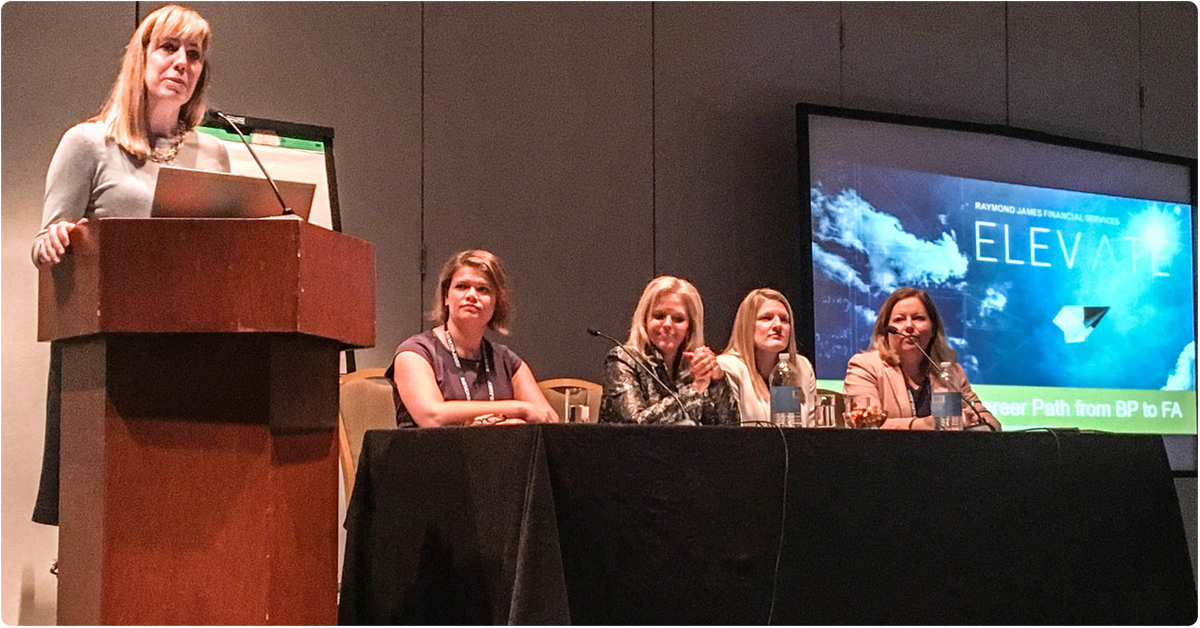
The Center Team recently attended the Raymond James National Conference for Professional Development in Orlando, Florida.

Melissa Joy, CFP®, on the far right of the panel.

Melissa Joy, CFP®, on the far right of the panel.

Our Center’s own Melissa Joy spoke as a panelist for the session titled “Following the Career Path from Branch Professional to Financial Advisor.” Melissa and several of her co-panelists discussed their transitions from the client service role to financial planner. The panel’s discussion outlined available resources and educational opportunities for those who wish to chart their career path to the position of Financial Planner. The real life examples and life lessons that were shared were inspiring!

In addition to presentations centered on enhancing client service, the conference also provided us the opportunity to catch up on the latest industry standards as well as subjects of universal interest. Here are just a few of the sessions that we enjoyed:

  • “Seeing How We Think”– We learned about individual communication styles based on our strengths in the right, left, top and bottom of our brains.

  • “Cybersecurity: Threats and Solutions”– Ask us how Raymond James Investor Access dual authentication can help protect your online account.

  • The Science of Happiness:  Fred Luskin, Director, Stanford Forgiveness Projects” taught us to stop and check our perspective, then be sure to have fun!

After the first full day of educational sessions it was time for a little fun! Raymond James invited us to visit Universal Studios for a few hours Monday evening. Several of our Center Team Associates braved a roller coaster ride through the jungles of Jurassic Park. While at the Marvel Super Hero Island, Center Team Associates posed for photographs along side their favorite Comic book Heroes and Villains.

201704_RJConference (1 of 5).jpg

Each year almost the entire Center Team attends the Raymond James National Conference as a way for each individual to grow personally and professionally. This year was no exception. Our entire team had a blast meeting other Raymond James professionals as well as learning new tricks of the trade. We’re excited to see what next year has to offer!

Jeanette LoPiccolo, CRPC® is a Client Service Manager at Center for Financial Planning, Inc.®


Raymond James is not affiliated with Fred Luskin or the Stanford Forgiveness Projects.

Guidance for Caregivers

Our experience with clients at The Center has shown us that caregivers come in all shapes, sizes, ages, and circumstances...no one is like another. What we do know, however, is that being a caregiver to someone needing assistance for a physical or mental incapacity of some kind is no “walk in the park,” as they say. According to AARP and the National Alliance for Caregiving, there are some 40 million Americans acting as unpaid caregivers in the United States – helping parents, grandparents, spouses, relatives and neighbors with basic needs – often while working, parenting, or both. Suffice it to say, caregivers themselves experience advances levels of physical, emotional, and often financial stress as a result of their caregiving responsibilities.

What can caregivers do to help those their caring for AND help themselves?

  1. Understand the financial and legal situation of the person you are caring for. Understand what the financial resources are, what legal documents are in place (and where they are), and who the powers of attorney, Trustees, and important advisors are in the relationship. Knowing who is involved in helping make important decisions will be key going forward, and knowing where important documents are is invaluable (to help get this organized, find our Personal Record Keeping Document and Letter of Last Instruction document here).

  2. Have conversations in advance about how the person wants to be cared for. Knowing (before it’s too late) what kind of care is desired, where that care should take place, and who should perform that care, as well as other end-of-life conversations, are important talks to have. These conversations, if had earlier rather than later, can help you avoid conflicts with the person your caring for and with others (particularly if you document the results!).

  3. Ask for help! There is absolutely no shame in calling uncle if you feel like you need assistance for any number of reasons:

    • Maybe you feel like you need training for some kind of caregiving you are providing that you don’t feel prepared to give

    • Maybe you are just overwhelmed and need additional help – from another family member or friend, a community resource, or from a paid resource – there is help out there – ASK FOR IT!

    • Maybe you just need a break – there are respite services available to take your loved one for a few days to care for them to give you a few days off, even if you have no one else to take over the caregiving duties; this might be just what you need to rejuvenate you and to help get you back on your feet!

We understand that being a caregiver for someone you love can pause your personal goals and plans. Our job is to help you prevent the caregiving role from permanently halting your goals and plans due to overwhelming stress. Let me be a resource when it comes to planning for and managing your caregiving role – if there is anything I can do to help, contact me at Sandy.Adams@CenterFinPlan.com.

Sandra Adams, CFP® , CeFT™ is a Partner and Financial Planner at Center for Financial Planning, Inc.® Sandy specializes in Elder Care Financial Planning and is a frequent speaker on related topics. In addition to her frequent contributions to Money Centered, she is regularly quoted in national media publications such as The Wall Street Journal, Research Magazine and Journal of Financial Planning.


The information has been obtained from sources considered to be reliable, but we do not guarantee that the foregoing material is accurate or complete. Any opinions are those of Sandy Adams, CFP®, and not necessarily those of Raymond James.

Funding the Future - A Rockin’ Good Time

Contributed by: Clare Lilek Clare Lilek

On April 18th, The Center proudly sponsored the band Gooding, through the non-profit Funding for the Future, to play at Hazel Park High School. The event was a little over an hour and involved fun rock music, excited high schoolers, and important lessons in financial literacy.

Funding for the Future is a nonprofit that coordinates bringing the band Gooding to different high schools, student groups, and kid oriented organizations to not only provide a free concert, but also give a crucial and entertaining lesson in financial literacy. All too often, some of our children reach adulthood without ever hearing about the impact of weekly savings, the perils of credit cards and credit scores. “Put your money away and let it work for you,” was a common sentiment that was said throughout the event, encouraging students to save money each week in an account like a Roth IRA, in order to let that money grow over time—a practice we heartily support at The Center!

The band Gooding is passionate about financial literacy and sharing that message with music. Their songs aren’t about stocks and bonds, however; they play exciting and down to earth rock music which endears them to the kids, allowing their message after the songs are over to sink in with more credibility. The band is inspired to bring financial literacy to students all over the country because of their own lack of education when it came to handling money as they grew up. We see examples of celebrities and pro-athletes that go broke shortly after making it big. The band explained that mindset comes from growing up and thinking one check, one lottery ticket, one record deal is going to change it all; but he encourages the kids to realize that change is within them and doesn’t come from the outside.

Gooding also talked about the perils of opening up too many credit cards, of not knowing your credit score and what affects it. He stresses, though, that money isn’t bad, it’s our lack of knowledge around money that can mess us up financially. That’s why he encourages good financial behavior, like putting $50 a week in a Roth IRA once you start working. You start young and have that money grow for you exponentially over time. He showed the students real examples and charts in order to encourage the students to take the idea of retirement savings seriously. He also talked about creating SMART goals; having Specific, Measurable, Attainable, Realistic, and Time oriented goals in order to plan and budget successfully. It was a lesson mixed with long term planning and tangible strategies the students could implement right away.

After thirty minutes of fun rock music and a thirty minute crash course in basic financial literacy, the students left smiling and so did we! It’s a part of The Center’s mission to spread financial literacy to the community around us, and sponsoring Funding for the Future and the band Gooding was just one way in which we do so. We look forward to many future partnerships in order to spread the word!

Clare Lilek is a Challenge Detroit Fellow / Client Service Associate at Center for Financial Planning, Inc.®


Any opinions are those of Clare Lilek and not necessarily those of Raymond James.

What are Investment Policy Statements?

Contributed by: Angela Palacios, CFP® Angela Palacios

Each investor is unique. You have your own attitudes, expectations, objectives, and guidelines for your investments. These factors are important to communicate to, not only your team of investment managers, but also to your family if needed (not to mention to remind yourself during turbulent times). An investment Policy Statement (IPS) that is revisited regularly can keep everyone on the same page.

We carefully craft a tailored Investment Policy Statement with you and review and update it each year or when something changes. We first define an asset allocation target (ratio of stocks and bonds) for your portfolio that is appropriate to help you achieve your goals while balancing your tolerance for risk. Also important is the amount of cash you need to hold within each account, carefully evaluating potential withdrawal needs coming in the next year. Lastly, we add your goals and unique preferences we should take into account while managing your investments. 

Unique preferences could include holding a position in a taxable account because selling would cause you to incur a large capital gain. Or, it could mean incorporating socially responsible (ESG) investment strategies into the portfolio. It could also mean excluding any investment strategies you prefer not to have included in your portfolio, like real estate, for example.

Laying out your goals and objectives is a great way to focus on and determine future success. Success in financial planning and investing goes far beyond beating a benchmark. Goals like making sure you can travel during the first 10 years of retirement or obtaining sufficient health coverage during the early years of retirement are things that cannot be measured by a stock index. These goals become personal benchmarks that you can track achievement of over the years.

It is not expected that the IPS will change frequently. In particular, short-term changes in the financial markets should not require adjustments to the IPS. Major life events, however, can prompt an update. For example, marriage or divorce, retirement or deciding to extend your working years, entering a nursing home or receiving an inheritance are examples of reasons that could prompt you to update your IPS.

Investors who fail to plan may then plan to fail! Developing an IPS is an important step to take in order to help you make rational decisions about your investments no matter what the markets may tempt you to do! If you have questions about or wish to update your Investment Policy Statement, please contact your planner!

Angela Palacios, CFP® is the Director of Investments at Center for Financial Planning, Inc.® Angela specializes in Investment and Macro economic research. She is a frequent contributor The Center blog.


The information has been obtained from sources considered to be reliable, but we do not guarantee that the foregoing material is accurate or complete. Any opinions are those of Angela Palacios, CFP®, and not necessarily those of Raymond James. There is no guarantee that these statements, opinions or forecasts provided herein will prove to be correct. Investing involves risk and you may incur a profit or loss regardless of strategy selected. Every investor's situation is unique and you should consider your investment goals, risk tolerance and time horizon before making any investment. Prior to making an investment decision, please consult with your financial advisor about your individual situation.

A Closer Look at Medicare Part D (Prescription Drug Coverage)

Contributed by: James Smiertka James Smiertka

Today, we will take a more in-depth look at an important aspect of Medicare coverage: Part D, which covers prescription medications. Each Medicare Prescription Drug Plan has a unique list of covered drugs which is called a formulary.

Here are some important notes regarding Medicare Part D coverage:

  • Drugs may be placed into different cost “tiers” within the specific formulary

  • More common, generic, drugs will often be in a lower tier that will cost you less

  • You can choose your Part D plan based on your current list of medications to help you obtain the most appropriate plan for you

  • Commercially available vaccines that are medically necessary to prevent illness must be covered by a Medicare drug plan (if not already covered under Medicare Part B)

  • Formularies are unlikely to cover every existing drug and will often have drugs placed outside of tiers that require special approval to be covered

  • You should receive an “Evidence of Coverage” (EOC) each September from your plan which explains what your Medicare drug plan covers, how much you pay, etc.

    • You should review this notice each year to determine if your current plan will continue to meet your needs for the next calendar year or if you may need to consider another plan

    • If you do not receive this important document, contact your plan

      • Your plan’s contact information should be available via “Personalized Search” on the Medicare website.

      • You can also search by your plan name.

Common Coverage Rules:

  • Prior Authorization: Your prescriber may be required to show that the drug is medically necessary for the plan to authorize coverage

  • Quantity Limits: Different medications may have limits on quantity fillable at one time (ex: 10 days, 14 days, 30 days, 60 days, etc.)

  • Step Therapy: You must attempt treatment with one or more similar, lower cost drugs before the plan will cover the prescribed drug

If you or your prescriber believe one these coverage rules should be waived, you can contact your plan for an exception. Your plan’s contact information should be available via “Personalized Search” on the Medicare website.

  • You can ask your prescriber or other health care provider if your plan has special coverage rules and if there are alternatives to an uncovered drug

    • It is not uncommon to be required to attempt treatment with other similar drugs (often less expensive, lower tier) on your formulary first

  • You can obtain a written explanation from your plan which should include the following:

    • Whether a specific drug is covered

    • Whether you have met any requirements to be covered

    • How much you will be required to pay

    • If an exception to a plan rule may be made if requested

  • You can request an exception if:

    • You or your prescriber believes you need a specific drug that is absent from your plan’s formulary

    • You or your prescriber believes a coverage rule should be waived

    • You believe you should pay less for a more expensive, higher tier drug since your prescriber believes you cannot take any of the less expensive, lower tier options for your condition

  • If you disagree with your plan’s denial of coverage there are five additional levels in the appeals process

Additional Considerations:

  • Your Medicare Part D plan is allowed to make changes to its formulary during the year

    • These changes must be made within existing Medicare guidelines

    • If a change is made to your formulary:

      • You must be provided written notice at least 60 days prior to the effective date of the formulary change

      • OR your plan will be required to provide the current drug for 60 days under the previous plan rules

  • Many Medicare Advantage Plans (Part C) cover prescription medication coverage, and you cannot have concurrent coverage of prescriptions through both a Medicare Advantage Plan and a Medicare prescription drug plan. You’ll be unenrolled from your Advantage Plan and returned to Original Medicare if you have an Advantage plan with prescription coverage in addition to a Part D Prescription Drug Plan.

  • Even if a desired medication is covered, it is important to note that some plans may require fulfillment via mail order services in lieu of local retail pharmacy pickup

  • This may be very inconvenient for some (ex: people that travel often) and may be avoidable when comparing plans

If you have any questions, please contact your financial advisor at The Center. We are more than happy to help you or refer you to one of our expert resources.

James Smiertka is a Client Service Associate at Center for Financial Planning, Inc.®


Sources: www.medicare.gov
The information has been obtained from sources considered to be reliable, but we do not guarantee that the foregoing material is accurate or complete.

Saying Goodbye to the Joe Louis Arena is just like Entering Retirement

Contributed by: Nick Defenthaler, CFP® Nick Defenthaler

As most of you are probably aware, the iconic Joe Louis Arena held its final Red Wings game several weeks ago on a gorgeous, 72 degree, sunny April day in Detroit. “The Joe,” as most Wings fans called it, has been a staple in the city of Detroit for the past 38 years since it was completed in 1979. As someone who has played hockey all his life, some of my best memories growing up were either spent at The Joe watching games live or catching them on TV where you could feel the electricity from the rink radiating through the television during certain games. The game of hockey has taught me so much – teamwork, comradery, leadership, service, hard work, just to name a few. I firmly believe the lessons the sport has offered me have made me a better person, both personally and professionally. 

As I watched the final game from my living room that bittersweet Sunday evening, I couldn’t help but see the parallels that existed between phasing into retirement and the new chapter the Red Wings and the City of Detroit are entering as the hockey team moves into Little Caesars Arena. Think about it, most of our working careers are going to last about as long as The Joe. The Red Wings who first played at The Joe when it opened in 1979 struggled for many years. But over time, the team and the organization evolved and came together as players found themselves and fine-tuned their skills, both individually and as a team. This is also very similar to what many of our career paths look like. When we first enter the work force out of school, we’re all pretty green. We may think we have it all figured out early on, but it takes years to get to a level of greatness like the Wings did when they won their first Stanley Cup in 1997. 

As the Joe Louis Arena era ends, a new one begins. Looking back over the course of those nearly four decades the Wings spent at The Joe, they were some of best times the Red Wings organization had, just like the time in our lives throughout our working career. Just think about how much probably occurred during this time frame in your own life. Getting married, having children, traveling, being promoted, earning more money, helping children get through college, and welcoming grandchildren to name a few. As one door closes, however, a new one opens and it can be a pretty amazing one, just like the new stage the Red Wings are stepping into. 

Although The Joe was not a glamourous building, it had so much grit and character. It embodied the hard working attitude our state and area have and I feel very lucky to be able to have experienced so many good times there. I must say, however, I’m anxiously looking forward to attending many games at the new rink. I can only hope Little Caesars Arena will produce as much fun and great memories as The Joe did! For those of you soon entering that new phase in your life, the phase of retirement, this can also be an exciting time. As you gear up for this transition, please reach out to us in order to make this time as smooth and memorable as possible.

Nick Defenthaler, CFP® is a CERTIFIED FINANCIAL PLANNER™ at Center for Financial Planning, Inc.® Nick works closely with Center clients and is also the Director of The Center’s Financial Planning Department. He is also a frequent contributor to the firm’s blogs and educational webinars.


Opinions expressed are those of Nick Defenthaler and are not necessarily those of Raymond James. This information has been obtained from sources deemed to be reliable but we cannot guarantee that is accurate or complete.

Money Sense for Young Kids

Contributed by: Matt Trujillo, CFP® Matt Trujillo

As a dad of two young boys, I read and think a lot on how to teach my sons about how to handle money.

Even before my boys could count, they already knew something about money: it's what they had to give the ice cream man to get a cone, or put in the slot to ride the rocket ship at the grocery store. So, as soon as your children begin to handle money, start teaching them how to handle it wisely.

Making Allowances

Giving children an allowance is a good way to begin teaching them how to save money and budget for the things they want. How much you give them depends in part on what you expect them to buy with it and how much you want them to save.

Some parents expect children to earn their allowance by doing household chores, while others attach no strings to the purse and expect children to pitch in simply because they live in the household. A compromise might be to give children small allowances coupled with opportunities to earn extra money by doing chores that fall outside their normal household responsibilities.

When it comes to giving children allowances:

  • Set parameters. Discuss with your children what they may use the money for and how much should be saved.

  • Make allowance day a routine, like payday. Give the same amount on the same day each week.

  • Consider "raises" for children who manage money well.

Take it to the Bank

Piggy banks are a great way to start teaching children to save money, but opening a savings account in a "real" bank introduces them to the concepts of earning interest and the power of compounding.

While children might want to spend all their allowance now, encourage them (especially older children) to divide it up, allowing them to spend some immediately, while insisting they save some towards larger ticket items they really want but can't afford right away. Writing down each goal and the amount that must be saved each week toward it will help children learn the difference between short-term and long-term goals. As an incentive, you might want to offer to match whatever children save toward their long-term goals.

Shopping Sense

Television commercials and peer pressure constantly tempt children to spend money. Therefore, children need guidance when it comes to making good buying decisions. Teach children how to compare items by price and quality. When you're at the grocery store, for example, explain why you might buy a generic cereal instead of a name brand.

When it comes to shopping with children who want you to buy them every little thing they see, take a moment to explain your “yes” and “no” decisions. By explaining that you won't buy them something every time you go to a store, you can lead children into thinking carefully about the purchases they do want to make. Then, consider setting aside one day a month when you will take children shopping for them. This encourages them to save for something they really want rather than buying on impulse. For those big-ticket items, suggest that they might put those items on a birthday or holiday list.

Finally, don't be afraid to let children make mistakes. If a toy breaks soon after it's purchased or doesn't turn out to be as much fun as seen on TV, eventually children will learn to make good choices even when you're not there to give them advice. For more tips on how to raise Money Smart Kids, check out our webinar on the topic!

Matthew Trujillo, CFP®, is a Certified Financial Planner™ at Center for Financial Planning, Inc.® Matt currently assists Center planners and clients, and is a contributor to Money Centered.


The views expressed herein are those of Matthew Trujillo and are not necessarily those of Raymond James.

Saving for Education for a Future Grandchild: Roth IRA vs. 529 Plan

Contributed by: Matthew E. Chope, CFP® Matt Chope

Congrats – you have a new grand-baby on the way! During all the excitement, the reality of the future may set in: future education expenses. “Where is one of the best places to save for our unborn grand-baby?” This very question was asked by a couple in their mid-50s a few weeks back. They have modest income, earn about $100,000 a year, and are currently funding retirement based plans at work. Furthermore, they take advantage of the full match by their employers and benefit from a deduction at the 25% bracket. The folks that asked the question will most likely not be in the 25% bracket during their non-working years of retirement. So, they likely are correctly benefiting from the personal tax arbitrage within their income brackets now vs the expected future. These folks are working towards being on track for retirement by 68 which is a little longer than most trying to achieve such a goal. But they are doing OK with that timeframe and are working as long as they need to. They also have some limited discretionary income remaining ($200-$300 a month) to save for this new goal of potential education for future grandchildren.

Why a Roth IRA might be better than a 529 Plan in this situation:

  • In this case, while both vehicles provide tax-free growth, the Roth IRA can help provide added flexibility.

  • There is no impact on the FAFSA (Free Application for Federal Student Aid) calculation with the Roth IRA (there is generally no impact with a 529 if a grandparent is the owner of the account, but if the owner is changed to a parent, that could have a negative impact just about the time you don’t want it to!).

  • There is generally more investment flexibility with the Roth. There are more investment options offered and 529s are limited on the number of trades allowed on an annual basis.

  • Probably one of the largest benefits for the Roth IRA is that you don’t have any tax or tax penalties if the grandchild decides not to go to school, or if the money is needed for an emergency or for your retirement safety net instead.

College saving is never one size fits all. Please contact us with assistance in helping to determine the most suitable college savings strategy to help implement for your family. We are always happy to help!

Matthew E. Chope, CFP ® is a Partner and Financial Planner at Center for Financial Planning, Inc.® Matt has been quoted in various investment professional newspapers and magazines. He is active in the community and his profession and helps local corporations and nonprofits in the areas of strategic planning and money and business management decisions.


The information contained in this blog does not purport to be a complete description of the securities, markets, or developments referred to in this material. The information has been obtained from sources considered to be reliable, but we do not guarantee that the foregoing material is accurate or complete. Any opinions are those of Mathew Chope and not necessarily those of Raymond James. Expressions of opinion are as of this date and are subject to change without notice. There is no guarantee that these statements, opinions or forecasts provided herein will prove to be correct. Investing involves risk and you may incur a profit or loss regardless of strategy selected. Unless certain criteria are met, Roth IRA owners must be 59½ or older and have held the IRA for five years before tax-free withdrawals are permitted. As with other investments, there are generally fees and expenses associated with participation in a 529 plan. There is also a risk that these plans may lose money or not perform well enough to cover college costs as anticipated. Most states offer their own 529 programs, which may provide advantages and benefits exclusively for their residents. The tax implications can vary significantly from state to state. Investments mentioned may not be suitable for all investors. This material is being provided for information purposes only and is not a complete description, nor is it a recommendation. Every investor's situation is unique and you should consider your investment goals, risk tolerance and time horizon before making any investment. Prior to making an investment decision, please consult with your financial advisor about your individual situation.