

 Contributed by: Center Investment Department

The third quarter came and went in what felt like the blink of an eye. It brought with it important reminders that markets rarely move in a straight line. When looking “under the hood” of the market, performance was very uneven. During the quarter, domestic U.S. large-cap equities ended up around 2% (S&P 500 Index) while U.S. small-cap equities retreated over 7% (Russell 2000 Index). Overseas markets were mixed with developed international investments up about 0.5% (MSCI ACWI Ex USA Index) while emerging markets were down almost 0.4% (MSCI EM Index). Energy stocks were among the strongest performers as geopolitical tensions in the Middle East pushed oil prices higher, while portions of the technology and broader growth complex experienced bouts of volatility. At the same time, rising interest rates created a challenging environment for fixed income as bonds were down about 3.5% for the quarter, illustrating once again the importance of diversification across asset classes and investment styles.
As we turn our attention to fall, the election is grabbing much of our attention now with midterm elections on November 3rd. All 435 seats in the U.S. House of Representatives and 35 U.S. Senate seats will be decided, creating the potential for a change in congressional control. With change comes volatility. Yet history offers a useful reminder that elections tend to create more uncertainty in the headlines than they do lasting changes in market direction. Please join us for our upcoming webinar, Elections & Markets, where we discuss the unique challenges that elections pose to equity and bond markets and the investing fundamentals that are so important to follow during these times.
Iran, Inflation and Interest Rates
The Federal Reserve returned to center stage in September. They raised the federal funds target range by 25 basis points to 3.75%-4.00%, its first interest rate increase since 2023, as policymakers try to combat inflation stemming from increased energy prices. The Fed is projecting core PCE inflation of 3.4% for the year while it currently stands at 3%. Remember, the Fed is still targeting 2.0% inflation over the long term. Higher inflation can be directly tied to the ongoing conflict in Iran. The June cease-fire agreement with Iran quickly fell apart in early July causing continued restrictions on the movement of oil out of the region. Now with strategic national reserves dipping down to all-time lows, the U.S. is running out of levers to pull to stem the rise in gas and diesel prices. The quarter ended with no meaningful agreement in place. The price of oil, and therefore gas, will continue to remain volatile as talks continue.
Volatility in the Bond Market
Speaking of raising rates, it isn’t just the Fed Funds rate being increased due to sticky inflation. Bond rates across the yield curve have been increasing in response to higher inflation, better-than-expected economic data, strong stock earnings, and increased borrowing from the world’s largest companies looking to raise capital for the ongoing AI buildout. There have been a lot of competing forces causing investors to sell bonds or at least demand a higher interest rate in order to hold those bonds. The headlines have been loud, but context always matters – the Bloomberg U.S. Aggregate Bond Index is down 2.9% year-to-date. Rising yields can be worrisome to investors, but volatility in any asset class is normal, and with the “Agg” index yielding near 5%, much of this price movement is being offset by the current yield. For more details on this topic, see our full post: “What’s Going On With the Bond Market?”
AI
It seems like you can’t separate the market and AI lately; the two topics go hand in hand as the world’s largest tech companies continue to drive the market forward with the strongest earnings gains and, in many cases, the best stock performance so far for the year. Semiconductors and energy are the two top-performing sectors YTD driven by the AI trend, and of course higher energy prices from the Iran conflict. From roaring stock prices to literal doomsday headlines, AI is giving us a little bit of everything this quarter. Large tech companies, federal and local governments, investors, and users of the technology are figuring out what and how exactly this new technology will be utilized going forward and what it’s impact to our economy will be.
Elections and Markets
It’s rare that, in an election year, many of the headlines surround international conflicts rather than domestic issues, but that is where we find ourselves. Historically, midterm elections are difficult for the president’s party, and this year is unlikely to be an exception as the president’s approval rating has been steadily declining and is near historic lows.
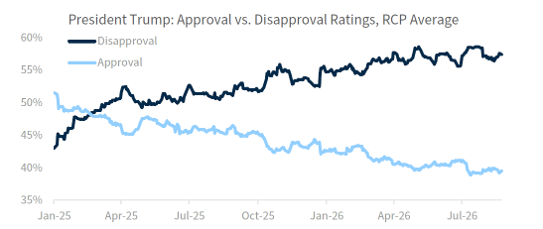
Source: Raymond James and RealClearPolitics. Data as of 9/14/2026
While the Senate could go either way, it is likely that the House will flip to Democratic control. Michigan is considered one of these crucial battleground states for our Senate race. Republicans have been in full control over the past two years, albeit by a very small margin. Markets have historically responded well to divided government, as gridlock can reduce the likelihood of significant policy changes. That said, the past two years under unified government have also produced strong market returns. It is always important to zoom out and remember that politics should never dictate our investment strategy. It is important to stay focused on investing fundamentals at this time, such as rebalancing.
What Are We Doing Now? Rebalancing & Tax-Aware Portfolio Management
Periods of market volatility can create an opportunity to reinforce disciplined portfolio management through rebalancing. As markets move, asset allocations often drift from their intended targets, potentially increasing risk or reducing exposure to areas that may offer future long-term value. Regular rebalancing is an integral part of our ongoing portfolio monitoring process. It helps bring portfolios back in line with strategic objectives by trimming positions that have outperformed and adding to areas that have lagged. While this approach may feel counterintuitive during times of uncertainty, it encourages investors to remain focused on long-term asset allocation rather than short-term market fluctuations.
Market volatility can also create favorable conditions for tax-loss harvesting, a strategy designed to enhance after-tax returns. Taxes can represent a meaningful drag on long-term investment performance, making tax management an important consideration within the investment process. When appropriate, we may realize losses in select investments to offset current or future capital gains while maintaining strategic market exposure through carefully selected replacement holdings. Although tax considerations should not drive investment decisions on their own, thoughtful tax-loss harvesting can add value and improve tax efficiency during periods of market dislocation. For readers interested in a deeper understanding of how tax-loss harvesting works and its potential benefits, we invite you to read our blog on the topic.
Periods of heightened market uncertainty often create discomfort, but they can also create opportunities. During these periods, our focus remains on adhering to the disciplined investment process established for each of you that can go hand in hand with responding to opportunities created by short-term market movements. Rebalancing and tax-aware portfolio management are two practical ways we seek to add value, helping maintain strategic portfolio alignment while enhancing tax efficiency when appropriate. Together, these strategies reinforce our long-term approach to investment management and our commitment to helping you navigate market volatility with confidence and discipline.
As we enter the final quarter of the year, investors continue to face a landscape shaped by geopolitical tensions, evolving monetary policy, shifting market leadership, and an approaching election. While these events may drive short-term volatility and dominate headlines, history reminds us that long-term investment success is rarely determined by any single news cycle or market event. Instead, disciplined decision-making, diversification, and adherence to a thoughtfully constructed investment plan remain among the most reliable drivers of positive outcomes over time. At The Center, we remain committed to helping clients navigate uncertainty with perspective and purpose, utilizing tools such as rebalancing and tax-aware portfolio management while staying focused on what matters most: helping you achieve your long-term financial goals with confidence.
Angela Palacios, CFP®, AIF®, is a partner and Director of Investments at Center for Financial Planning, Inc.® She chairs The Center Investment Committee and pens a quarterly Investment Commentary.
Nicholas Boguth, CFA®, CFP® is a Senior Portfolio Manager and Associate Financial Planner at Center for Financial Planning, Inc.® He performs investment research and assists with the management of client portfolios.
Mallory Hunt is a Portfolio Administrator at Center for Financial Planning, Inc.® She holds her Series 7, 63 and 65 Securities Licenses along with her Life, Accident & Health and Variable Annuities licenses.
Opinions expressed are those of the author/speaker and are not necessarily those of Raymond James. All opinions are as of this date and are subject to change without notice. Investing involves risk and you may incur a profit or loss regardless of strategy selected, including diversification and asset allocation. Past performance may not be indicative of future results. Prior to making an investment decision, please consult with your financial advisor about your individual situation. Every investor’s situation is unique and you should consider your investment goals, risk tolerance and time horizon before making any investment. The forgoing is not a recommendation to buy or sell any individual security or any combination of securities. The indexes mentioned are unmanaged and cannot be invested into directly. Past performance is no guarantee of future results.