Estate Planning

Monitor Your Savings Bonds Through Treasury Direct

Jeanette LoPiccolo Contributed by: Jeanette LoPiccolo, CRPC®

Monitor your savings bonds through Treasury Direct

Throughout the years, savings bonds have been popular gifts. Before college savings accounts became so popular, grandparents sometimes gave bonds for birthdays, encouraging their grandchildren to save for the future. Could you have any savings bonds lying around in files or locked up in a safety deposit box?

If you have bonds that you have not looked at in years, now may be the right time to bring them into the digital age with Treasury Direct.

Recently, the U.S. Treasury stopped issuing paper bonds to save costs. Instead, you can create an online account and monitor your bonds as you would an investment account. If you use Raymond James Client Access, you can create an external link to your savings bonds account. Then, you and your financial planner can track your bonds.

In addition to preventing your bonds from being forgotten (or tossed away in a Marie Kondo cleaning frenzy), here are a few good reasons to try the online account:

  • You can cash your electronic bonds, in full or in part, at any time – 24 hours a day, seven days a week – and move the funds to a savings or checking account that you specify. You don’t need to go to a financial institution, and there are no restrictions on the number of bonds or the value that can be cashed, once minimum requirements are met.

  • Online holdings and their current values can be viewed at any time.

  • When electronic bonds reach final maturity and are no longer earning interest, they will be automatically paid to a non-interest bearing account.

The process is fairly simple. Step 1 is to locate your savings bonds. Then visit https://www.treasurydirect.gov/indiv/research/indepth/smartexchangeinfo.htm and scroll down to “How Do You Use SmartExchange?”. Follow the prompts and get started!

Jeanette LoPiccolo, CFP®, CRPC®, is an Associate Financial Planner at Center for Financial Planning, Inc.® She is a 2018 Raymond James Outstanding Branch Professional, one of three recognized nationwide.


Opinions expressed in the attached article are those of the author and are not necessarily those of Raymond James. All opinions are as of this date and are subject to change without notice. The information has been obtained from sources considered to be reliable, but we do not guarantee that the foregoing material is accurate or complete.

A Dementia Diagnosis and Your Financial Plan

dementia diagnosis and your financial plan

The inevitable has happened. You or someone you love has received the dreaded diagnosis of Alzheimer’s disease or one of many related dementias. You feel like your world is in a tail spin; you don’t know which end is up, and you certainly don’t know where to start planning…especially from a financial perspective. What should you do?

First, discuss the diagnosis with your financial advisor. Communicate your fears and concerns, and ask for help to make sure that all of your financial “ducks” are in row.

You can check these things off the list now:

  • Make sure that important documents are in place assigning advocates who will handle health care and financial affairs when you (or your loved one) are unable to handle them. **Coordinate this with your estate planning attorney.

  • Also, make sure that beneficiaries and estate planning documents are updated to reflect current wishes.

  • From an organizational standpoint, this is a perfect time to make sure everything is organized, documented (see our Personal Financial Record Keeping Document for help), simplified as much as possible (think consolidating accounts held by multiple firms), and titled properly.

At some point, your financial advisor may want to help you look at additional retirement/financial independence scenarios that include long-term care expenses faced by those who have dementia/Alzheimer’s. This will give you the opportunity to look at the adjustments you may need to make immediately or in the near term.

As time goes on and costs increase, which may be a few months or years depending on disease progression, additional retirement distribution planning may both stretch available dollars and strategize tax efficiencies based on tax law at the time. For instance, in years with very high medical costs/deductions, it may make sense to take distributions from IRAs, so the medical deductions offset the taxable income from the distributions.

It is also extremely important to review all insurances (Long Term Care, life insurances with terminal illness or LTC riders, annuities with such riders, etc.) to understand how they work and how they may benefit you in the future.

Planning with your family

Aside from the purely financial considerations, it is critical to have a conversation with your family about your care (who, where, etc.), your money, your quality of life, and the overall plan for your last phase of life with your new diagnosis, so that everyone is on the same page, with a coordinated plan.

Everyone should know the available resources, the players, and your desires. Having helped families in these situations, I know those who work together and understand the desires of their loved one, no matter what the financial situation, are able to get through tough times and support their loved one much more successfully than those who don’t.

Above all, ask for help, from your advisors, from your family, from your friends and community supports (church, community groups, etc.). You can’t, and shouldn’t, go it alone. If you or someone you know is facing a dementia challenge and needs to plan, please let us know. We are here to help.

Sandra Adams, CFP®, CeFT™ is a Partner and CERTIFIED FINANCIAL PLANNER™ professional at Center for Financial Planning, Inc.® She specializes in Elder Care Financial Planning and serves as a trusted source for national publications, including The Wall Street Journal, Research Magazine, and Journal of Financial Planning.


Raymond James does not provide tax or legal services. Please discuss these matters with the appropriate professional.

Are You Retirement Ready?

Sandy Adams Contributed by: Sandra Adams, CFP®

In our work with clients, one of the most common questions we get is, “How will we know when we are ready (and able) to retire?”  That can be a tricky question, because there are two sides to being ready for the next phase of your life – the technical side and the personal side.  While certainly you need to be financially secure for the next decades of your life, you also need to be comfortable with the transition from your life as a career individual to what you now wish to become in your next phase – and that is not as easy as it sounds.

20181120.jpg

From a financial-readiness perspective, many clients target age, monetary or benefit milestones to help them determine when they will be ready to retire:

  • “When I have $1 million in assets saved, I will be ready to retire.”

  • “When I am eligible to collect Social Security, I will be ready to retire.”

  • “When I am eligible to collect my company pension OR I have reached my XX anniversary with my company, I will be ready to retire.”

  • “When I am eligible to receive Medicare, I will be ready to retire.”

The real answer is, some or all of these may be true for you, and some or all of these may be false.Every client situation is different and no general guideline can determine whether or not you are financially ready to retire. Unfortunately, it is far more complicated than that. There are numerous financial factors that go into determining financial readiness.Let’s take a deeper look into the issues.

Financial Readiness Issues:

Retirement Savings:

Do you have enough saved?

  • What might your other retirement income sources be (Social Security, Pensions, etc.)

  • How much income will you need (what are your fixed costs versus lifestyle wants in retirement), and

  • What are your longevity expectations (how long might you expect to live based on health, family history, etc.—expect it will be longer than you think!).

Where are your savings?

  • Do you have retirement savings outside of retirement plans?

  • Do you have some after-tax and reserve cash/emergency reserve savings?

  • Do you have different types of accounts to provide tax diversification going into retirement (i.e. IRAs/401(k)s, ROTH IRAs, after tax investment accounts)?

Debt:

Have you paid down your debt or do you have a plan to be as debt free as possible by the time you retire?  This will allow you to control your retirement income for other fixed expenses and wants; it is desirable to have as little debt/fixed expenses as possible going into retirement as possible.

Retirement Income:

A large part to being retirement ready is understanding your retirement income sources, options and strategies and using them to your best advantage.  Take the time to consult with your planner to choose the option that works best for you and your family circumstance.

  • Pensions: Do you understand all your options, including the income options available to your spouse as a survivor upon your death.  We find that in many cases it makes sense to choose an option that includes a lifetime income option for you with at least a 65% survivor income benefit for your spouse if you were to die first.

  • Social Security: While many are under the false impression that because you are allowed to take Social Security benefits as early as age 62, they should, we might recommend otherwise.  For most individuals now approaching Social Security claiming age, Full Retirement Age for claiming Social Security is now age 66 and delaying benefits until age 70 results in an 8% per year increase in benefits.  Knowing and understanding the Social Security benefits, rules and strategies that can be employed, especially for married couples, to ensure the largest lifetime benefit can be an added supplement to long-term retirement income. We find that our most successful married couples in retirement employ a strategy where the lower Social Security earner draws at Full Retirement age while the higher Social Security earner waits to draw at age 70, insuring the highest possible Social Security benefit for the spouse that lives the longest.

Investments:

Preparing for retirement involves making appropriate adjustments to your investment strategy.  You should work with your financial planner to adjust your asset allocation to one that is appropriate for your new goals and time horizon. We find that our most successful retirees tend to have asset allocations ranging from 40% Bond/60% Stock to 50% Bond/50% Stock.

Insurance:

  • For those retiring before age 65 (Medicare eligibility) and without retiree healthcare, finding health insurance to bridge them to Medicare is a must. 

  • Retirement readiness does require addressing the issue of Long Term Care funding Having a plan, no matter what your choice, is something that must be done before retirement.

Estate Planning:

While not exactly monetary, having your estate planning documents (Durable Powers of Attorney, Wills and possibly Trust or Trusts in place) updated prior to retirement is a good idea.Part of this is making sure accounts are titled properly, beneficiaries are updated, and account holdings/locations and management are as simplified as possible going into your last phase of life.

Once you have determined your financial retirement readiness, you need to determine your personal retirement readiness, which may be even more difficult for many folks.  Why?  Many have spent the majority of their lifetimes to this point building careers that established them with titles, credentials and stature. They built reputations, networks, social and business circles and were well respected because of the work that they have done.  And now they are moving from that phase of their lives to another and that means starting over.  What will they be now?  What will their lives mean?  And to whom?

Until you are ready to start the next phase of your life knowing your purpose – what you want to wake up for every day – you are likely not ready for retirement.  Those that have not given the thought to their mission, values, and their “why” for their next phase will be left feeling lost and will likely fail at retirement and find themselves wanting to go back to their former lives.

How can you find your purpose?

  • Ask yourself what is most important to you? (family, friends, spirituality, charity,etc)

  • Ask yourself what are your life priorities? (family, health, knowledge, etc.)

  • Ask yourself what you want to let go of and what you want to give yourself to.

  • Realize that the rest of your life can be the best of your life if you embrace it with an open mind and enthusiasm.

  • Consider reading the book “Purposeful Retirement” by Hyrum Smith if you need more help!

“Am I ready to retire?”  It is not a simple question and there is no simple answer.  It may take months or years to answer all of the questions and make all of the preparations.  If you think that retirement is in your not too distant future, the time is NOW to start planning.  Don’t let retirement sneak up on you…work with your financial planner and be Retirement Ready!

Sandra Adams, CFP® is a Partner and Financial Planner at Center for Financial Planning, Inc.® Sandy specializes in Elder Care Financial Planning and is a frequent speaker on related topics. In addition to her frequent contributions to Money Centered, she is regularly quoted in national media publications such as The Wall Street Journal, Research Magazine and Journal of Financial Planning.

Webinar in Review: The Big Four - Understanding Estate Documents

Tim Wyman Contributed by: Timothy Wyman, CFP®, JD

Missed the webinar? Don’t worry, there’s a recording!

See the below time stamps to listen to the topics you’re most interested in:

  • What is estate planning? (Minute 0:30)

  • Current Estate Tax Environment: (1:40)

  • Last Will & Testament: (5:20)

  • Revocable Living Trust (11:30)

  • Durable Power of Attorney- Finances/ Property (12:10)

  • Durable Power of Attorney- Healthcare (13:20)

  • Asset Titling & Beneficiary Designations (14:30)

  • Resources (15:50)

Timothy Wyman, CFP®, JD is the Managing Partner and Financial Planner at Center for Financial Planning, Inc.® and is a contributor to national media and publications such as Forbes and The Wall Street Journal and has appeared on Good Morning America Weekend Edition and WDIV Channel 4. A leader in his profession, Tim served on the National Board of Directors for the 28,000 member Financial Planning Association™ (FPA®), mentored many CFP® practitioners and is a frequent speaker to organizations and businesses on various financial planning topics.

Seven Summer Financial Planning Strategies

20180814.jpg

It is summer time! So, if you get a few minutes in between all of the outdoor activities here are 7 quick financial planning strategies to review.  As always, if we can help tailor any of these to your personal circumstances feel free to reach out.

By now you have heard there is a new tax law.  Because we will not experience the actual affects until next April, many of us are not sure how it applies to our specific circumstances.

  1. Do a quick tax projection with your tax preparer and check your tax withholding. Many of us will have an overall tax decrease – but withholdings from our paychecks also went down. Do not get caught off-guard. More importantly, some folks will see higher taxes due to the new limitations on certain itemized deductions. Combine this with lower withholding and you have a double whammy (read: you will be writing a bigger check to the IRS).

  2. Lump and clump itemized deductions. The standard deduction has increased to $24k for married couples filing jointly. In addition, miscellaneous itemized deductions have been removed completely. $10k cap. For some. Lumping charitable deductions in one year to take advantage of itemizing deductions and then taking the standard deduction for several years might be best.

  3. Utilize QCD’s. If you are over age 70.5 and making charitable contributions, you should consider utilizing QCD. Don’t know what QCD stands for? Call us now.

  4. Consider partial ROTH conversions to even out your tax liability. If you are retired, but not yet age 70.5 (when RMD’s start). Don’t know what an RMD is? Talk with us today! If you are in this group, multiyear tax planning may be beneficial.

  5. Most estates are no longer subject to the estate tax given the current exemption equivalent of $11.2M (times 2 for married couples). However, income taxes remain an issue to plan around. One of my favorites: Transfer low basis securities to aging parents and then receive it back with a step up in basis. If you think you might be able to take advantage of this let us know.

  6. Review your distribution scheme in your Will or Trust. Are you using the old A-B or marital/credit shelter trust format? Do you understand how the increased exemption affects this strategy?

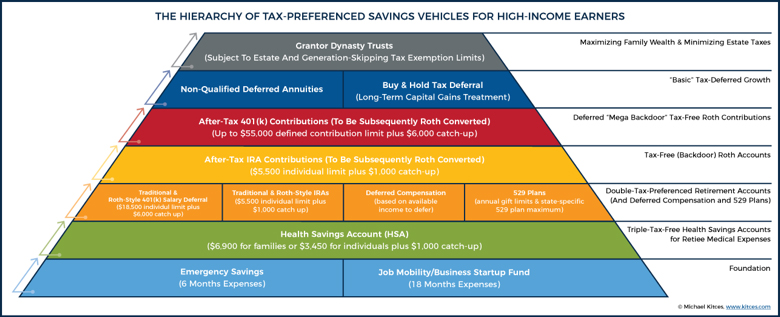
  7. How should high-income folks prioritize their savings?
    Are you in the new 37% marginal bracket? If so, consider contributing to a Health Savings Account IF eligible. Next, consider making Pretax or traditional IRA/401k contributions. However, if you reasonably believe that you will be in the highest marginal tax bracket now AND in retirement – then the ROTH may be suggested. Know that for the great majority of us this will not be the case. Meaning, we will be in a lower bracket during our retirement years than our current bracket. Next, use Backdoor ROTH IRA contributions. If your employer offers an after tax option to your 401k plan, take advantage of it. You can then roll these funds directly into a ROTH. Next, consider a non-qualified annuity that provides tax deferral of earnings growth followed by taxable brokerage account.

20180814a.jpg
20180814b.jpg

If you have not received a copy of our 2018 Key Financial Data and would like a copy let us know

Timothy Wyman, CFP®, JD is the Managing Partner and Financial Planner at Center for Financial Planning, Inc.® and is a contributor to national media and publications such as Forbes and The Wall Street Journal and has appeared on Good Morning America Weekend Edition and WDIV Channel 4. A leader in his profession, Tim served on the National Board of Directors for the 28,000 member Financial Planning Association™ (FPA®), mentored many CFP® practitioners and is a frequent speaker to organizations and businesses on various financial planning topics.


The foregoing information has been obtained from sources considered to be reliable, but we do not guarantee that it is accurate or complete, it is not a statement of all available data necessary for making an investment decision, and it does not constitute a recommendation. Any opinions are those of Tim Wyman and not necessarily those of Raymond James. Investments mentioned may not be suitable for all investors. Unless certain criteria are met, Roth IRA owners must be 591⁄2 or older and have held the IRA for five years before tax-free withdrawals are permitted. Additionally, each converted amount may be subject to its own five-year holding period. Converting a traditional IRA into a Roth IRA has tax implications. Investors should consult a tax advisor before deciding to do a conversion. Raymond James and its advisors do not offer tax or legal advice. You should discuss any tax or legal matters with the appropriate professional. A fixed annuity is a long-term, tax-deferred insurance contract designed for retirement. It allows you to create a fixed stream of income through a process called annuitization and also provides a fixed rate of return based on the terms of the contract. Fixed annuities have limitations. If you decide to take your money out early, you may face fees called surrender charges. Plus, if you're not yet 591⁄2, you may also have to pay an additional 10% tax penalty on top of ordinary income taxes. You should also know that a fixed annuity contains guarantees and protections that are subject to the issuing insurance company's ability to pay for them. Every investor's situation is unique and you should consider your investment goals, risk tolerance and time horizon before making any investment. Prior to making an investment decision, please consult with your financial advisor about your individual situation.

5 Estate Planning Action Steps to Stay in Control of Your Future

Contributed by: Sandra Adams, CFP® Sandy Adams

20180619.jpg

I recently attended a 2-day training in Elder Mediation.  Coming from a world in which we work with our clients on a regular basis to make sure estate planning documents are in place and up-to-date, I was alarmed to learn that less than 45% of the U.S. adult population has an active will or durable powers of attorney in place (2017 Caring.com Study). Unfortunately, when these documents are not in place, and the adult (at any age) becomes unable to make decisions for themselves, the court must appoint someone...and families aren’t always in agreement.

According to a 2013 AARP report, there was an estimated 1.5 million older adults with court-appointed guardians; record keeping in many constituencies is not accurate nor complete.  A guardian is appointed to make medical and care decisions for someone who is unable to make decisions for themselves; a conservator is appointed to make financial decisions and handle financial affairs for someone who is unable to handle those duties on their own behalf.  And if the family disagrees about who should be appointed to any/either of these roles, they can voluntarily seek mediation to resolve their differences or the court may order mediation.  In many cases, a family member is ultimately appointed to these roles, but in some cases a third party is appointed to serve in these roles as ordered by the court, leaving the fate of the older adult in the hands of someone who doesn’t know them or their wishes well.

Doing the work now to get documents and plans in place can save you and your family unnecessary stress and anxiety in the future, and can help to make sure that the wishes you have for yourself and your future are carried out even if you are no longer the director of those decisions. 

What action steps can you take now to make sure you maintain ultimate control over what happens to you if/when you can no longer make decisions for yourself?

To ensure that you have the ability to name who you wish to make decisions for you when it is time, I recommend taking the following steps:

1. Make sure you have up-to-date estate planning documents and review them often.  The most important documents to have in place during your lifetime are Durable Powers of Attorney — General/Financial AND Health Care (also known as a Patient Advocate Designation).  Additionally, you may want/need to have a Revocable Living Trust and a Will.

2. Consider drafting your Durable Power of Attorney documents as “Immediate” rather than “Springing”.  Immediate Powers of Attorney allow your advocate to act on your behalf immediately or at any time that you need them to, while a Springing Power of Attorney generally requires two doctors to declare you incompetent to make your own decisions before your advocate can act on your behalf.

3. Be clear and specific about your wishes for your future medical care, personal care and handling of your financial affairs.  Put things in writing and communicate your wishes to your family members and/or key people in your life.  Consider a family meeting to discuss your future wishes and ensure that everyone is on the same page.

4. Plan ahead.  It is never possible to plan for every contingency, but if you are able to plan for things that might happen (chronic health issues, incapacity, etc.), you and your finances can have a better chance of surviving.  Document your plans and communicate them to those that may be in charge of handling your affairs in the future if/when you cannot.

5. Put a team in place before it becomes necessary.  Make sure your financial planner, CPA, Attorney, any healthcare professionals and your family know your plan and your wishes and know one another so that they can carry out your plan when you might not be able to give clear directions.

If you or your family have questions or would like guidance on how to get these plans in place, please do not hesitate to reach out.  We are always here to help!

Sandra Adams, CFP® is a Partner and Financial Planner at Center for Financial Planning, Inc.® Sandy specializes in Elder Care Financial Planning and is a frequent speaker on related topics. In addition to her frequent contributions to Money Centered, she is regularly quoted in national media publications such as The Wall Street Journal, Research Magazine and Journal of Financial Planning.


The information contained in this blog does not purport to be a complete description of the securities, markets, or developments referred to in this material. The information has been obtained from sources considered to be reliable, but we do not guarantee that the foregoing material is accurate or complete. Any opinions are those of Sandra Adams and not necessarily those of Raymond James. There is no guarantee that these statements, opinions or forecasts provided herein will prove to be correct. Raymond James and its advisors do not offer tax or legal advice. You should discuss any tax or legal matters with the appropriate professional.

Finding Your Social Security Information and Social Security Widow Benefits

Contributed by: Josh Bitel Josh Bitel

20180306.jpg

There are many ins and outs of Social Security and I want to help you stay on top of them (without boring you with a pile of information). Here are easy explanations of two topics that can help you make the most of your benefits:

Where’s my Social Security statement?  

Remember when you used to get a statement each year a few months before your birthday from the Social Security Administration (SSA)?  Well if you haven’t seen it in a while that’s because the SSA stopped mailing to most folks back in 2011 (at a savings of $70M). 

The SSA will begin mailing benefit statements every 5 years to those who haven’t signed up for online statements (those already receiving benefits get an annual statement).  Paper statements are also mailed to workers age 60 and older three months before their birthday if they don’t receive Social Security benefits and don’t yet have a ‘My Social Security’ account.  If you haven’t checked out the SSA website, I suggest doing so: www.ssa.gov.  You may receive your statement, project future benefit amounts, as well as learn more about one of the nation’s largest expenditures.

Widowed? Research suggests that you might not be getting your fair share.

According to a recent report from the Social Security Administration Office of the Inspector General, as many as one-third of spouses age 70 and older are not getting the maximum social security benefit. The issue arises when a spouse initially receives “widow” benefits as early as age 60 (benefits based on your spouse’s earnings) and then later is eligible based on their own earnings record for a higher amount. As an example, Jan’s husband Paul passed away and Jan decided to begin receiving a widow’s benefit at age 60.  At age 62-70, Jan may want to switch to benefits based on her earnings record if they are higher.  Jan will need to be proactive as the SSA will not inform Jan if she is eligible for a higher amount.  When in doubt – call the SSA and give them your social security number and the social security number of your spouse to learn about all of your options. That way, you can be sure you are receiving the maximum amount allowed.

Josh Bitel is a Client Service Associate at Center for Financial Planning, Inc.®


Links are being provided for informational purposes only. Raymond James is not affiliated with and does not endorse, authorize or sponsor the listed website or its respective sponsor.Raymond James is not responsible for the content of any website or the collection or use of information regarding any website's users and/or members.

Why it’s Time to Start Asking More Questions

Contributed by: Sandra Adams, CFP® Sandy Adams

20180116.jpg

I recently took a week-long family trip with my husband and son (a senior in high school).  This was a rare occasion for the three of us to spend some time together and communicate — away from the TVs, devices and to actually get my son out of his room and away from his Xbox. Getting information out of teenagers — especially boys — about what is going on in their lives is like “getting blood out of a turnip” as they say. 

As with many of our family members, friends and co-workers that we may have difficulty communicating with, rather than become frustrated that we are not getting the information we are looking for, or find that we are “stuck” trying to help or plan for someone that is not helping in the process, we took a different path on our trip.  We decided that I would try to open the door by asking some open ended questions...and then try being quiet.  We just listened and gave space.  It took several days into our trip for our son to start opening up, but once he started, the results were amazing — he talked to us about things that he had never spoken about, asked our advice about some things that were going on at school, and began taking part in “adult” conversations right before our eyes.

Such conversations can and need to take place in many circumstances in our lives.  Whether it be our aging parents that we are beginning to assist, and we aren’t sure of their future desires for their own aging futures; our children as they transition into adulthood; or conversations with ourselves as we determine our next steps in life (transitioning into retirement, transitioning into a new career, figuring out what life looks like after divorce or the death of a spouse).  All of these conversations start with asking the right questions...and then listening...to others or ourselves.  Spending time on this process is important and does not happen overnight, but the results can be life changing.

Start the New Year by committing to start asking questions of those people you want to communicate more clearly with, or about those situations you want to move forward on.  If you are not sure what questions you need to be asking or how to start this process, please feel free to reach out for our help!

Sandra Adams, CFP® is a Partner and Financial Planner at Center for Financial Planning, Inc.® Sandy specializes in Elder Care Financial Planning and is a frequent speaker on related topics. In addition to her frequent contributions to Money Centered, she is regularly quoted in national media publications such as The Wall Street Journal, Research Magazine and Journal of Financial Planning.


Any opinions are those of Sandra Adams, CFP®, and not necessarily those of Raymond James.

Helping Older Relatives? How to Help Without Jeopardizing Your Own Finances

Contributed by: Matthew E. Chope, CFP® Matt Chope

20180215.jpg

Helping elderly family members with financial issues can be tricky.  In many cases, you may feel an obligation to assist, especially if the older adult is on a fixed budget and has limited financial resources. In fact, a recent MetLife study found that 68% of American caregivers have been found to spend their own money to support the needs of their older adult relatives, which drained funds that they had planned to use for their own financial independence. If you sense that an elder you care about is on a trajectory for financial ruin, what can you do to help? 

How do you step in and assist without putting your own financial security in jeopardy? 

The first thing to do is to gather some information to get a better sense of your loved one’s financial picture.  You’ll want to have an understanding of their assets and debts, and their budget:  their sources of income and their expenses. With the understanding of what income and what bills and expenses the older adult is dealing with, you can better connect with resources that may be able to assist them.

A client (let us call him John) told me a story recently about how he helped his older sister in-law (let us call her Bonnie) make some difficult decisions.  Bonnie was not a high-income earner in her working years. Although she was able to purchase her home and pay off her mortgage; she didn’t save much, and she had now depleted her savings.  At age 75, the reverse mortgage that Bonnie had put in place, in addition to her minimal Social Security income were not enough to keep up with her rising costs for health care (Medicare premiums and prescription drug co-pays), property taxes, insurances and utilities.

Here are the actions John took to help Bonnie with her situation:

  1. John discovered that the county would allow her to apply for a reduced or total removal of real estate taxes through the property tax poverty exemption. As a result, Bonnie received a full exemption from her property taxes. Each county has a program for low-income folks - you need to complete an application and appear before a board of review annually. Here is a link with more information: https://www.michigan.gov/documents/treasury/Bulletin7of2010_322157_7.pdf

  2. John contacted low-income home energy assistance (LIHEAP) and received a reduction in electricity and heating costs for Bonnie. https://www.benefits.gov/benefits/benefit-details/1545

  3. John contacted Human ARC Premium Assist about receiving a significant reduction in Medicare Part B premiums; as an added bonus, they also provided assistance with Bonnie’s prescription drug costs. https://screening.humanarc.com/PremiumAssist

  4. While online at the premium assistance site, John found more information about special coverages for things like medical alert, ambulance/transportation assistance, and a 1.25% copay for prescriptions.

  5. John contacted Social Services about food stamps and Bonnie is now receiving about $97 more a month through a program called SNAP. http://www.feedingamerica.org/need-help-find-food/

  6. For Bonnie’s auto insurance, John pays the whole year upfront and Bonnie pays John back monthly so she can take advantage of the discount for paying the premium annually.

  7. John pays Bonnie’s utility bills via automatic payments from his account to avoid late fees, which in the past were a wasteful and unnecessary expense. Bonnie also reimburses John monthly for this.

  8. To save money on her cell phone bill, John added Bonnie’s phone line to his plan as an additional line.

  9. Bonnie was willing to give up cable TV – John found that an inexpensive antenna works fine and they were able to rid Bonnie of her monthly cable bill.

With a little bit of creativity and resourcefulness, John was able to assist Bonnie while also preserving his own financial resources.  If you or someone you know is in the position of assisting an older adult and needs help putting together a strategy, please let us know.  We are here to help!

Matthew E. Chope, CFP ® is a Partner and Financial Planner at Center for Financial Planning, Inc.® Matt has been quoted in various investment professional newspapers and magazines. He is active in the community and his profession and helps local corporations and nonprofits in the areas of strategic planning and money and business management decisions.


This information has been obtained from sources deemed to be reliable but its accuracy and completeness cannot be guaranteed. The case study provided is hypothetical and has been included for illustrative purposes only. Individuals cases will vary. Links are being provided for informational purposes only. Raymond James is not affiliated with and does not endorse, authorize or sponsor any of the listed websites or their respective sponsors. Raymond James is not responsible for the content of any website or the collection or use of information regarding any website's users and/or members. Neither Raymond James Financial Services nor any Raymond James Financial Advisor renders advice on tax, legal, or mortgage issues, these matters should be discussed with the appropriate professional. 

Tax Reform Series: Business & Corporate Tax, and Pass-Through Entities

Contributed by: Timothy Wyman, CFP®, JD Tim Wyman

20180125.jpg

The Tax Cuts and Jobs Act (TCJA) is now officially law. We at The Center have written a series of blogs addressing some of the most notable changes resulting from this new legislation. Our goal is to be a resource to help you understand these changes and interpret how they may affect your own financial and tax planning efforts.

The elimination of the corporate Alternative Minimum Tax (“AMT”) and a new single 21% tax rate provides significant tax savings for corporations. In general, this is viewed by most as a net positive, at least in the shorter term, for earnings that can influence stock prices and the overall economy.

The purpose of this blog post is to focus on how the TCJA provisions may affect our clients that own businesses and specifically Pass-Through Entities such as partnerships, LLCs, or S corporations.

At this early stage, we see a few potential opportunities and potential trends:

  • Many business owners will want to review the appropriate legal structure of their company in 2018.

  • Pass-Through entities may see significant tax reductions

  • Due to the “Pass-Through entity” changes discussed below, some employees will likely consider becoming independent contractors

  • Large service businesses may consider converting to C corporation status

Pass-Through Entities

Pass-Through entities general include partnerships, LLCs, and S corporations.  Essentially, the net income from the business flows through to the owners; meaning they pay federal income tax at their personal marginal rate, as high as 39.6% in the past.

The good news is that many of these entities, and therefore their owners, will experience meaningful reduction in income taxes. The quid pro quo is that the tax system in this area has become more complex.

How might Pass-Through Entities benefit?

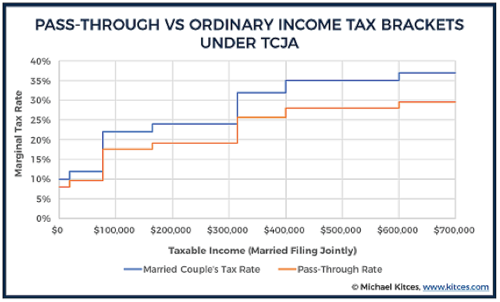
The TCJA provides for a 20% deduction on what is termed Qualified Business Income (“QBI”).  In the end, those that would normally be taxed at the new highest marginal rate of 37% may pay at a top rate of 29.6% (80% of their rate). The chart below, from www.Kictes.com, illustrates the lower Pass-Through rate at different income levels.

20180125a.jpg

As you might expect, the devil is always in the details. Do all Pass-Through entities receive said benefits? What exactly is considered Qualified Business Income? In addition, will the provisions truly be “permanent” to name a few. To further complicate the issue, the actual deduction will be claimed on the business owner’s personal tax return and not as an above the line deduction or itemized deduction.  Essentially, the affect is that it will not lower Adjusted Gross Income (which can have an effect on taxation of social security, Medicare premiums, and deductibility of some itemized deductions).  On the plus side, this method of reporting will not affect the ability to take the new increased standard deduction if that is of greater value than your itemized deductions.

Ok, what is the big deal? Paraphrasing commentator Michael Kitces, “for the first time ever, self-employed individuals (either as sole proprietors or as owners of partnerships, LLCs, or S corporations) will have a lower tax rate than employees doing substantively similar work, thanks to the 20% QBI deduction.” 

Switch to Independent Contractor status? Proceed with Caution

As you might imagine, the new rules contemplate and try to prevent owners from simply reclassifying their income or wages to benefit from the 20% deduction. Much like under current rules covering social security taxes, “reasonable compensation” to an S corporation owner does not qualify for the 20% deduction. Additionally, there are other limits that are beyond the scope of this article designed to reduce the 20% deduction that generally come into play once the owner’s taxable income exceeds $157,500 for individuals or $315,000 for married couples and become totally phased out at $207,500 and $415,000 respectively.

A special note to our Medical, Legal, Accounting, and Consulting Clients:

Your lobbying groups were not as effective as those representing engineers and architects! The TCJA defines your business as a “specific service trade or business” and special rules apply that essentially limit or eliminate a Qualified Business Income Deduction.  By the way, this also includes financial services practices such as ours. The law is designed to exclude “any other trade or business where the principal asset of the business is the reputation or skill of 1 or more of its employees.” As a result, some commentators have opined that large service business may consider converting to a C corporation as the top corporate rate is now 21%.

How are specific service trade or businesses affected? If you are a specified service business and your taxable income exceed the thresholds described above ($207,500 for individuals and $415,000 for married couples filing jointly), then you lose the deduction completely. This means you are subject to the old pass-through rules and therefore pay tax at your individual tax rate.

We hope that you enjoyed our early take on the changes that will likely affect businesses and specifically Pass-Through entities. While tax simplification it is not, many business owners should experience a net gain.   We will continue to monitor the tax landscape, including any Technical Corrections to the legislation and look forward to working with you in 2018.

Timothy Wyman, CFP®, JD is the Managing Partner and Financial Planner at Center for Financial Planning, Inc.® and is a contributor to national media and publications such as Forbes and The Wall Street Journal and has appeared on Good Morning America Weekend Edition and WDIV Channel 4. A leader in his profession, Tim served on the National Board of Directors for the 28,000 member Financial Planning Association™ (FPA®), mentored many CFP® practitioners and is a frequent speaker to organizations and businesses on various financial planning topics.


The information contained in this blog does not purport to be a complete description of the securities, markets, or developments referred to in this material. The information has been obtained from sources considered to be reliable, but we do not guarantee that the foregoing material is accurate or complete. Any information is not a complete summary or statement of all available data necessary for making an investment decision and does not constitute a recommendation. Any opinions are those of Timothy Wyman and not necessarily those of Raymond James. Expressions of opinion are as of this date and are subject to change without notice. There is no guarantee that these statements, opinions or forecasts provided herein will prove to be correct. Please note, changes in tax laws may occur at any time and could have a substantial impact upon each person's situation. While we are familiar with the tax provisions of the issues presented herein, as Financial Advisors of RJFS, we are not qualified to render advice on tax or legal matters. You should discuss tax or legal matters with the appropriate professional. Prior to making an investment decision, please consult with your financial advisor about your individual situation.