General Financial Planning

Rising College Costs Make Early Savings Crucial

Contributed by: Melissa Parkins Melissa Parkins

If you have school-aged kids, what will a college education cost by the time they get there? According to J.P. Morgan Asset Management, if the cost of college continues to increase 5% each year, the cost will be more than double what it is today by 2032.  Colleges are spending more to attract students, hiring more to reduce student-to-faculty ratios, and receiving less financial support from the states.  Add these factors up and costs go up too. And with the rapidly increasing costs, we hear people asking more and more, “Is a college education worth it anymore?” The short answer is: Yes! The value of a college education is growing faster than the cost to attend. A college diploma opens the door to career opportunities, increased earnings potential, and job security.

Graph Source: JPMorgan Asset Management College Planning Essentials

Graph Source: JPMorgan Asset Management College Planning Essentials

Where do you Start Saving for College Costs?

Wondering how to begin saving for this huge financial goal? Well, you have to start somewhere, and it’s never too early. By starting to save early, you can take advantage of not only potential investment returns, but the power of compounding. Choosing the right savings plan and investment mix can help you maximize growth potential and also help on taxes (and who doesn’t want to reduce taxes?!). You may not make the goal of saving enough to cover all the costs, but check out this chart to compare the investment in college savings vs. taking out loans:

Source: JPMorgan Asset Management College Planning Essentials. This is a hypothetical example for illustration purpose only and does not represent an actual investment. Actual investor results will vary.

Source: JPMorgan Asset Management College Planning Essentials. This is a hypothetical example for illustration purpose only and does not represent an actual investment. Actual investor results will vary.

What are my College Savings Plan Choices?

There are many ways to set aside money for college expenses. Some families use traditional savings accounts while others use tax-advantaged accounts, like 529 plans. These give you the opportunity to grow your contributions faster than using a taxable investment account earning the same exact returns. Not only can you withdraw money for qualified expenses tax free, but many 529 plans offer state tax deductions as well. This chart illustrates the impact of investing in a tax efficient way for college:

Source: JPMorgan Asset Management College Planning Essentials. This is a hypothetical example for illustration purpose only and does not represent an actual investment. Actual investor results will vary.
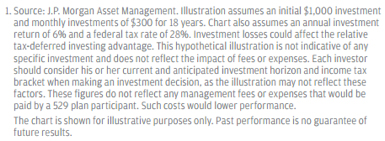
Source: JPMorgan Asset Management College Planning Essentials. This is a hypothetical example for illustration purpose only and does not represent an actual investment. Actual investor results will vary.

What about other Ways to Pay for College?

Perhaps you’re hoping to rely on financial aid, grants, or scholarships? Remember, not all aid is free and not everyone qualifies. According to www.finaid.com, only 0.3% of college students receive enough grants and scholarships to cover all costs. And loans? Well, it costs more to borrow and pay interest than to save and earn interest. Not to mention the burden it causes not only to the student, but their family as well.

Source: JPMorgan Asset Management College Planning Essentials

Source: JPMorgan Asset Management College Planning Essentials

Need help getting started on saving for college costs? We can work with you to find a plan that fits your family. Also, look for details to come out soon for our September webinar on Ways to Raise Money Smart Kids.

Melissa Parkins is a Registered Client Service Associate at Center for Financial Planning, Inc.


This material is being provided for information purposes only and is not a complete description, nor is it a recommendation. Any opinions are those of Center for Financial Planning, Inc. and not necessarily those of Raymond James. The information has been obtained from sources considered to be reliable, but Raymond James does not guarantee that the foregoing material is accurate or complete. Investing involves risk and investors may incur a profit or a loss.

Investors should carefully consider the investment objectives, risks, charges and expenses associated with 529 plans before investing. This and other information about 529 plans is available in the issuer's official statement and should be read carefully before investing. Investors should consult a tax advisor about any state tax consequences of an investment in a 529 plan.

As with other investments, there are generally fees and expenses associated with participation in a 529 plan. There is also a risk that these plans may lose money or not perform well enough to cover college costs as anticipated. Most states offer their own 529 programs, which may provide advantages and benefits exclusively for their residents. The tax implications can vary significantly from state to state. Links are being provided for information purposes only. Raymond James is not affiliated with and does not endorse, authorize or sponsor any of the listed websites or their respective sponsors. Raymond James is not responsible for the content of any website or the collection or use of information regarding any website's users and/or members.

3 Things a Widow can do to Gain Financial Control

Contributed by: Sandra Adams, CFP® Sandy Adams

Typical of most couples, my clients “Mike and Sue” split the household chores evenly.  She handled the house – decorating, cleaning, meals, etc.  He handled the cars, and the finances, including paying the bills.  He was a retired engineer – he loved cars and he loved numbers and details.  She hated all of that numbers stuff – so much so that for the most part she didn’t even attend annual meetings with their financial advisor -- until the last few years that I offered to go out to their home to meet so she would be involved in the annual meeting. I felt like it was important that Sue at least have a basic understanding of what was going on.

Mike was killed unexpectedly in a car accident; a man taken way too young in his mid-70’s.   Sue was taken completely by surprise and was unprepared, as most of us are, to be alone.  Her children live nearby, so that was comforting.  From a financial perspective, she was at least knowledgeable about what she had to work with and knew who to call, and we were able to speak immediately.

In the coming months, Sue gave herself time, as we recommended, not to make any big decisions; to find her new normal without Mike.  This involved figuring out what her new cash flow looked like; she got rid of some services and added some others, etc.  Sue also worked her way through Mike’s bill paying system.  It was very detail oriented and complicated – way too rigorous for her tastes.  But she felt, somehow, like she needed to stick to his system because it had always worked for them.  My advice to Sue (and to any widow) as they take control of their own financial affairs after the death of a loved one is this:

  1. Take the time to figure out what your new normal is and what changes can be made to fit your new lifestyle;

  2. Use a system that makes things easy for you, don’t stick to a system that makes you crazy just because it’s the one that your deceased spouse used for years;

  3. Use your financial advisor as a partner/coach to help guide you through the process as you take control of your financial life.  If this is new to you, it could take a year or two for you to feel comfortable with the process.  And that’s okay.

Becoming a widow at any age is challenging enough, without facing the additional hurdles of handling things you weren’t responsible for in the past.  Use your resources and give yourself permission to design your financial life to fit your new normal. 

Sandra Adams, CFP® is a Partner and Financial Planner at Center for Financial Planning, Inc. Sandy specializes in Elder Care Financial Planning and is a frequent speaker on related topics. In 2012-2014 Sandy has been named to the Five Star Wealth Managers list in Detroit Hour magazine. In addition to her frequent contributions to Money Centered, she is regularly quoted in national media publications such as The Wall Street Journal, Research Magazine and Journal of Financial Planning.


Five Star Award is based on advisor being credentialed as an investment advisory representative (IAR), a FINRA registered representative, a CPA or a licensed attorney, including education and professional designations, actively employed in the industry for five years, favorable regulatory and complaint history review, fulfillment of firm review based on internal firm standards, accepting new clients, one- and five-year client retention rates, non-institutional discretionary and/or non-discretionary client assets administered, number of client households served.

This material is being provided for information purposes only and is not a complete description, nor is it a recommendation. Any opinions are those of Sandy Adams, CFP® and not necessarily those of Raymond James.

Part 8 – A Year of Lessons on Money Matters for your Children and Grandchildren

Contributed by: Matthew E. Chope, CFP® Matt Chope

What motivates you? You might get out of bed in the morning and go to work because you want shelter, nutrition and safety. You might do it because you love your job and can’t wait to get to the office. Understanding what incentivizes you can help you accomplish what is most important and help you prioritize to do the hardest things first.  These are important – yet sometimes overlooked – lessons to share with your children, whether they are tackling tough assignments in school or facing obstacles at the beginning of their career.

Rewards = Results

Try figuring out how to motivate yourself to get results suggests Charlie Munger, Vice Chairman of Warren Buffett’s Berkshire Hathaway Corporation. He calls it the “reward and punishment super response tendency” in his book On Success.  Great employers have managed this for their key employees; but you can do this for yourself.  When you achieve the results you want, reward yourself.

Early in my career, at age 25 I needed to make calls to people I did not know and ask them to considering doing financial planning with me.  This was a difficult task, but I knew it was necessary to build a business.  At the time I enjoyed coffee so it became my reward. If I made my calls each day and achieved the results I needed to succeed, the next morning I treated myself to a coffee.  At the end of the week, if I meet my weekly goal, I bought myself a Twix candy bar to enjoy. Your personal rewards may be different, but they should be motivating. And expect them to evolve over time. Maybe that Twix becomes a vacation if you reach your quarterly goal or new car if you meet your annual goal.

Setting Your Priorities

If you have 5 projects or jobs and one is going to be the most difficult (but also the most important), where do you begin? I suggest if you are having a difficult time in a certain aspect of your business, begin by tackling a portion of the problem first.  Then go to something that’s easier and come back to the subject that is troubling before ending your day. Back to me at age 25, I didn’t like making calls to people I didn’t know but needed to make 20 a day.  I found if I started by doing the difficult part – I wasn’t looking at that list all day. 

If you can determine what motivates you to accomplish your daily tasks, you can reach your work goals. As a bonus, linking incentives to challenging tasks and prioritizing your time can also lead to personal growth and accomplishment.

Matthew E. Chope, CFP ® is a Partner and Financial Planner at Center for Financial Planning, Inc. Matt has been quoted in various investment professional newspapers and magazines. He is active in the community and his profession and helps local corporations and nonprofits in the areas of strategic planning and money and business management decisions. In 2012 and 2013, Matt was named to the Five Star Wealth Managers list in Detroit Hour magazine.


Five Star Award is based on advisor being credentialed as an investment advisory representative (IAR), a FINRA registered representative, a CPA or a licensed attorney, including education and professional designations, actively employed in the industry for five years, favorable regulatory and complaint history review, fulfillment of firm review based on internal firm standards, accepting new clients, one- and five-year client retention rates, non-institutional discretionary and/or non-discretionary client assets administered, number of client households served.

The information has been obtained from sources considered to be reliable, but we do not guarantee that the foregoing material is accurate or complete. Any opinions are those of Matthew Chope, CFP® and not necessarily those of Raymond James.

What You Need to Know about Stock Options

Contributed by: Nick Defenthaler, CFP® Nick Defenthaler

As a professional, there are various ways you can be compensated for your work.  Although not as prevalent as they once were, stock options still exist in many different companies and can often be negotiated into your overall compensation package.  Stock options are intended to give you motivation and incentive to perform at a high level to help increase the company’s stock price which will, in turn, have a positive impact on the value of your own stock options.  There are various forms of stock options and they can certainly be confusing and even intimidating.  If you’ve ever been offered options, your initial thought might have been, “I know these things can be great, but I really don’t have a clue what they are or know what to do with them!” For starters, there are two common forms of stock options NSOs & RSUs.

NSO: Non-qualified Stock Options

Non-qualified stock options, or NSOs, have been around and very popular for decades.  The mechanics, however, can be a bit tricky which is partly why you don’t see them quite as much as you used to.  There are various components to NSOs, but to keep things simple, the company’s stock price must rise above a certain price before your options have value.  Taxes are typically due on the difference between the market value of the stock upon “exercising” the stock option and what the stock price was when the option was “granted” to you.  Upside potential for NSOs can be significant but there’s also a downside. The options could expire making the stock worthless if it does not rise above a certain price during the specified time frame.

RSU: Restricted Stock Units

Restricted Stock Units, or RSUs, have become increasingly popular over the past 5 – 10 years and are now being used in place of or in conjunction with NSOs because they are a little more black and white.  Many feel that RSUs are far easier to manage and are a more “conservative” form of employee stock option compared to NSOs because the RSU will always have value, unless the underlying company stock goes to $0.  As the employee, you do not have to decide when to “exercise” the option like you would with an NSO.  When the RSUs “vest”, the value of the stock at that time is available to you (either in the form of cash or actual shares) and is then taxable.  Because you do not truly have any control over the exercising of the RSU, it makes it easier and less stressful for you during the vesting period.  However, because the RSUs vest when they vest, it does take away the opportunity to do the kind of pro-active planning available with NSOs.

Stock Options and Tax Planning

As you can see, stock options have some moving parts and can be tough to understand.  There are many other factors that go into analyzing stock options for our clients and we typically also like to coordinate with other experts, like your CPA because tax planning also plays a large part in stock option planning. If stock options are a part of your compensation package, it is imperative to have a plan and make the most of them because they can be extremely lucrative, depending on company performance and pro-active planning.  Please reach out if you ever have questions about your stock options – we work with many clients who own them and would be happy to help you as well!

Nick Defenthaler, CFP® is a CERTIFIED FINANCIAL PLANNER™ at Center for Financial Planning, Inc. Nick is a member of The Center’s financial planning department and also works closely with Center clients. In addition, Nick is a frequent contributor to the firm’s blogs.


6 Ways to Get Healthy AND Spend Less

Contributed by: Gerri Harmer Gerri Harmer

If you could choose one of these items in retirement, which would you pick?

  1. A vacation home

  2. Shiny red convertible

  3. Good health

A younger version of yourself would have probably gone for option 1 or 2. But many of us find when we get to retirement, our priorities change.  Without good health, all the other choices are irrelevant if you can’t enjoy them. Many of us dream of living a very active lifestyle when we retire with some money in our pockets.  Wouldn’t it be amazing if we could have all the options? Wouldn’t it be even more amazing if it only took adapting just a few new habits to improve our long-term health?

Here are 6 ways to lean into better health while spending less:

1.     Start giving up that bad habit.  Most things that are bad for your health are bad for your wallet.  Smoking, junk food, fast food and pop can all be eliminated, adding money to your bottom line.

2.     Go outside.  Breathe the air and get fit by walking, gardening or bike riding.  Better yet, head to the park to toss a Frisbee, join in on a sport, or hit a trail. No need to pay fees for gym memberships during the summer.

3.     Buy local or grow your own.  Farmers markets usually have a great variety of organic fruits and vegetables.  You support your community and pay a fraction of the grocery store prices.  Better yet, start your own garden and save even more.

4.     Sleep 15 minutes more.  Give your body a little more time to repair itself.  Go to bed early or prep for your morning the night before so you can sleep an extra 15 minutes. 

5.     Drink water.  Experts recommend drinking 8 glasses a day. Before you allow yourself even a drop of anything else, drink a glass of water first. You’ll be surprised how much energy you gain while flushing all the bad stuff. Water is one of the least expensive beverage options especially when it comes from your filtered fridge instead of a bottle.

6.     Sit with nature.  Reset your stress levels by simply listening to the birds, taking in the scenery or feeling the breeze on your face.  It costs nothing and gives you peace and calm.

It might be difficult to change radically overnight, but leaning toward better habits may lead to a smoother, more permanent change in your health. And it doesn’t hurt that you’ll be saving money along the way!

Gerri Harmer is a Client Service Manager at Center for Financial Planning, Inc.

Why Financial Planners are a lot like Personal Trainers

Contributed by: Matt Trujillo, CFP® Matt Trujillo

I recently had the opportunity to work with a personal trainer at my local gym. My wife was kind enough to purchase some sessions for me, and it was her gentle way of letting me know I’ve added on a few pounds! When I sat down with the trainer at my initial session I couldn’t help but notice the similarities between what I do for a living and what personal trainers do.

Personal Trainer's line of questioning: (I’m paraphrasing)

Trainer: What were you hoping to accomplish over the next 8 weeks?

Me: I would like to develop some good habits so I can get back on a systematic workout routine.

Trainer: Ok, I can certainly help with that…anything else on your mind?

Me: Yes I would like to lose 10 pounds.

Trainer: That’s definitely doable, but you’re going to have to push yourself in the gym as well as practice disciplined eating habits outside of the gym. Losing weight is a science and your body is a machine.  Most people lack the mental discipline and have a hard time reaching their goals because of their behavior.

When I left the gym I couldn’t help but think about his comments the whole drive home. At The Center, our entire focus is on goals-based financial planning.

Our initial line of questioning with our clients is very similar to a personal trainer:

We Ask: How can we help you? What were you hoping to accomplish? What matters most to you with regards to your finance and money?

We Get Answers Like: I want to retire at 65. I want to be financially independent by 60. I want to leave a financial legacy.  I want to make sure my family is taken care of if something were to happen to me. I need help with my investment decisions.

These are just a few of the most common answers. Our mission is to provide world class service in helping our clients achieve their goals.  We do this by practicing a disciplined investment approach and by looking at all facets of a client’s financial life. 

If you haven’t taken the time to establish specific financial goals then I strongly encourage you to do so. Financial planners can help you identify and define those goals, just like your personal trainer can help you build and define your muscles.

Matthew Trujillo, CFP®, is a Certified Financial Planner™ at Center for Financial Planning, Inc. Matt currently assists Center planners and clients, and is a contributor to Money Centered.


Any opinions are those of Matthew Trujillo, CFP® and not necessarily those of Raymond James. Investing involves risk and investors may incur a profit or a loss.

Women & Investing: How to get more Engaged with Finances

Contributed by: Laurie Renchik, CFP®, MBA Laurie Renchik

How does a busy, multi-tasking woman make sure the important financial stuff does not get missed? A statistic in a 2015 Fidelity Investments study recently caught my attention.  According to the study:

83% of women would like to become more engaged with their finances within the next year. 

Working with women over the last 20 years has taught me that the first step is usually the most difficult.  Once the decision is made to pull a financial plan together, the pieces start to fall nicely into place. But getting over that initial hurdle of getting started can seem daunting.

Here is some practical advice to get you started:

  • Give your personal financial life the attention that is needed. If you feel like life is whizzing by, take time to step back and ask, “Am I on the right track?”

  • Start creating a mental picture of your goals. You probably have at least a vague picture in your head of what you want in the future.  The beauty of the financial planning process is that it makes conversations happen especially with the help of a financial planner who serves as a thinking partner.

  • Pull a team together.  Your financial planner, tax preparer and attorney can help you keep your arms around the different aspects of your financial plan. They’ll also help you make important course corrections when necessary and chart the progress as you go.

Practical advice to keep you on track:

  • Continue to ask questions. Financial planning means asking, “Where do I want to be in 3 years?, 10 years?, 20 years?” This may change as you go along.

  • Stick to your plan.  Good financial habits are a foundation you can build on for a lifetime.

  • Stay focused on your priorities. A good plan will help you remind yourself what is most important in your life and decide how your financial resources can help you get there. 

The future is not the finish line; it is just the beginning if you have the resources to lead the life you want.  Is there a better reason to become more engaged with your finances and put your plan together? 

Laurie Renchik, CFP®, MBA is a Partner and Senior Financial Planner at Center for Financial Planning, Inc. In addition to working with women who are in the midst of a transition (career change, receiving an inheritance, losing a life partner, divorce or remarriage), Laurie works with clients who are planning for retirement. Laurie was named to the 2013 Five Star Wealth Managers list in Detroit Hour magazine, is a member of the Leadership Oakland Alumni Association and in addition to her frequent contributions to Money Centered, she manages and is a frequent contributor to Center Connections at The Center.


Five Star Award is based on advisor being credentialed as an investment advisory representative (IAR), a FINRA registered representative, a CPA or a licensed attorney, including education and professional designations, actively employed in the industry for five years, favorable regulatory and complaint history review, fulfillment of firm review based on internal firm standards, accepting new clients, one- and five-year client retention rates, non-institutional discretionary and/or non-discretionary client assets administered, number of client households served.

This material is being provided for information purposes only and is not a complete description, nor is it a recommendation. Any opinions are those of Laurie Renchik and not necessarily those of Raymond James. The information has been obtained from sources considered to be reliable, but Raymond James does not guarantee that the foregoing material is accurate or complete. Investing involves risk and investors may incur a profit or a loss regardless of strategy selected.

Green Money: Tracking the Socially Responsible Investing Trend

Contributed by: Laurie Renchik, CFP®, MBA Laurie Renchik

The concept of using investment dollars to support environmental and societal initiatives is not a new idea.  For decades socially responsible investing, also called SRI, has been recognized as a broad investment category spurred on by religious values, social movements and concerns about health and the environment. Today the SRI landscape is changing.  There are new strategies that fall under the responsible investing umbrella with differing objectives, more exposure to a wider range of asset classes and a growing number of investment dollars being put to work.  This is good news for investors who have personal and financial goals to incorporate responsible investment strategies into their portfolios.

Navigating this emerging landscape is nuanced because there is no single term that describes the multiple approaches evolving from the original concept of responsible investing. Socially responsible investing (SRI), ESG investing (environmental, social and governance) and Impact investing make up three main categories. There are some distinct differences between the three.

At the most basic level, here are the philosophical guideposts:

SRI Investing:  Creating a portfolio that attempts to avoid investments in certain stocks or industries through negative screening according to defined ethical guidelines.

ESG Investing:  Integrating environmental, social and governance factors into fundamental investment analysis to the extent they are material to investment performance.

Impact Investing:  Investing in projects or companies with the express goal of effecting mission-related social or environmental change.

What does responsible investing mean to you? 

Incorporating responsible investment strategies into your portfolio is not a one-size-fits-all solution.  Your goals are specific to you and your objectives for the future.  Talk with your financial planner to better understand the opportunities available today to integrate responsible investment strategies in your portfolio.    

Laurie Renchik, CFP®, MBA is a Partner and Senior Financial Planner at Center for Financial Planning, Inc. In addition to working with women who are in the midst of a transition (career change, receiving an inheritance, losing a life partner, divorce or remarriage), Laurie works with clients who are planning for retirement. Laurie was named to the 2013 Five Star Wealth Managers list in Detroit Hour magazine, is a member of the Leadership Oakland Alumni Association and in addition to her frequent contributions to Money Centered, she manages and is a frequent contributor to Center Connections at The Center.


Five Star Award is based on advisor being credentialed as an investment advisory representative (IAR), a FINRA registered representative, a CPA or a licensed attorney, including education and professional designations, actively employed in the industry for five years, favorable regulatory and complaint history review, fulfillment of firm review based on internal firm standards, accepting new clients, one- and five-year client retention rates, non-institutional discretionary and/or non-discretionary client assets administered, number of client households served.

The information has been obtained from sources considered to be reliable, but we do not guarantee that the foregoing material is accurate or complete. Any opinions are those of Laurie Renchik and not necessarily those of Raymond James. Investing involves risk and investors may incur a profit or a loss. Every investor's situation is unique and you should consider your investment goals, risk tolerance and time horizon before making any investment. Prior to making an investment decision, please consult with your financial advisor about your individual situation.

Part 6: A Year of Lessons on Money Matters for your Children and Grandchildren

Contributed by: Matthew E. Chope, CFP® Matt Chope

When it comes to keeping track of finances, my advice for the young is to keep it simple and straightforward and get qualified help if needed. That starts by finding a way to track your money without making it an obsession. Begin by tracking your finances at least once a month.  To do this, simply add up what’s coming in and then look at where it’s going. Once you’ve established that you are indeed living within your means, it is time to establish two kinds of savings accounts that you contribute to each month:

1. Build a “Save to Spend” account

2. Build a long-term financial security account (i.e. 401k or IRA)    

The Save to Spend account is where you park money for the short term to be spent on things that lead you toward the 100 things you want to accomplish in life (read this blog if you don’t have your 100 things list yet).  The long-term security account is for financial independence, which will eventually allow you to work because you want to not because you have to.

Investing does not need to be overly complicated either. For some good reading to help you build knowledge about investing, here are a few books I recommend:

Once you understand the basic principles -- like diversification, pay yourself first, don’t miss a match, maximizing deductions and credits, and dollar costs averaging -- and if you have the interest to follow those principles, then do it on your own but keep it simple.  Remember to review my previous blog about using time to your advantage (start early – start now!). It might make sense though, to consider getting qualified help managing your money, especially if this is something you’re not interested in doing. If you’re looking for help, here are 7 key components to help you find the right person.

Matthew E. Chope, CFP ® is a Partner and Financial Planner at Center for Financial Planning, Inc. Matt has been quoted in various investment professional newspapers and magazines. He is active in the community and his profession and helps local corporations and nonprofits in the areas of strategic planning and money and business management decisions. In 2012 and 2013, Matt was named to the Five Star Wealth Managers list in Detroit Hour magazine.


Five Star Award is based on advisor being credentialed as an investment advisory representative (IAR), a FINRA registered representative, a CPA or a licensed attorney, including education and professional designations, actively employed in the industry for five years, favorable regulatory and complaint history review, fulfillment of firm review based on internal firm standards, accepting new clients, one- and five-year client retention rates, non-institutional discretionary and/or non-discretionary client assets administered, number of client households served.

The information has been obtained from sources considered to be reliable, but we do not guarantee that the foregoing material is accurate or complete. Any opinions are those of Matthew Chope, CFP® and not necessarily those of Raymond James. Investing involves risk and investors may incur a profit or a loss.