

The 3 Missing Bull Market Killers

 Every day I get questions from clients regarding the market being high.  Yes, the market’s nominal price is at an all-time high.  But consider the following situation: Over 20 years, with an average annual gain of 9% per year, the equity market could be looking at a DOW JONES average in the 80,000 range.  Twenty years ago the Dow Jones was hovering around 3,500 and since then we have had a 12 year period when the Dow did not make a new high, but still averaged almost 9% a year.   

The three things that tend to kill a bull market are inflation, interest rates, and valuations, and none of them are present yet.

A Look at Inflation

Notice that we are tracking at one of the lowest rates in history. You’ll see the Consumer price Index is well below the 10-year average. Just compare the difference between the price level of consumer goods and services in 2013 and in early 1980’s:
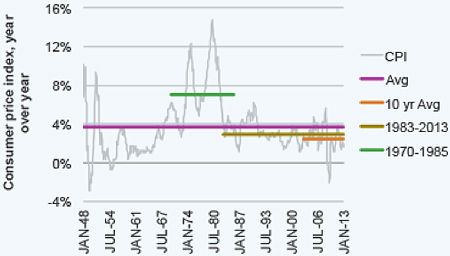
Sources: Bloomberg and Legg Mason. Past performance is no guarantee of future results. Please note that an investor cannot invest directly in an index, and index performance does not include transaction costs or other fees, which will affect actual investment performance.  Individual investor’s results will vary. The graph above is for illustrative purposes only and is not reflective an actual investment.

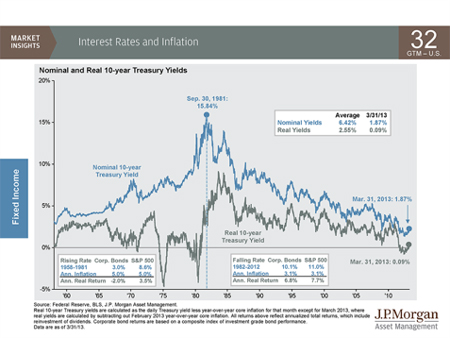
I don’t think I would be the first to remind you that interest rates are still at the lowest levels in history. This chart tracks interest rates and inflation as both trended down in recent years.

Interest Rates and Inflation
And when looking at the final potential bull killer, equity valuations, you’ll see the measures are in line with historical averages.  Not expensive and not cheap.

Equity Valuations
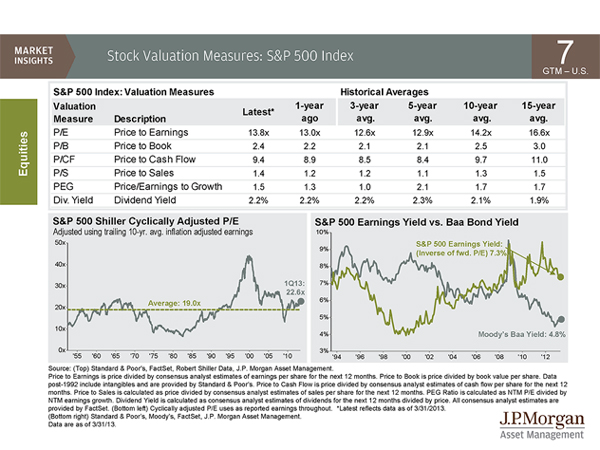
History as our guide would tell us that until all three or at least one of the bull market killers are present this bull is still alive and well.

Matthew E. Chope, CFP ® is a Partner and Financial Planner at Center for Financial Planning, Inc. Matt has been quoted in various investment professional newspapers and magazines. He is active in the community and his profession and helps local corporations and nonprofits in the areas of strategic planning and money and business management decisions. In 2012 and 2013, Matt was named to the Five Star Wealth Managers list in Detroit Hour magazine.


Five Star Award is based on advisor being credentialed as an investment advisory representative (IAR), a FINRA registered representative, a CPA or a licensed attorney, including education and professional designations, actively employed in the industry for five years, favorable regulatory and complaint history review, fulfillment of firm review based on internal firm standards, accepting new clients, one- and five-year client retention rates, non-institutional discretionary and/or non-discretionary client assets administered, number of client households served.

The information has been obtained from sources considered to be reliable, but we do not guarantee that the foregoing material is accurate or complete.  Any opinions are those of Center for Financial Planning, Inc., and not necessarily those of RJFS or Raymond James.  The Dow Jones Industrial Average (DJIA) is an index representing 30 stocks of companies maintained and reviewed by the editors of the Wall Street Journal.

Matt Chope Attends Due Diligence Meeting

 Matt Chope, CFP® recently traveled to California to attend due diligence meetings at PIMCO. This was an opportunity for Matt to attend informational sessions where members of the PIMCO management team and mutual fund managers led discussions and investment forums.  He was impressed with the organization and their global perspective.

The most interesting views Matt gleaned from the meetings were commentary about the healing housing market as well as a presentation focused on the strides America is making toward energy independence in the near future.

Meetings like this help Center team members keep a pulse on the managers and corporate cultures of the companies we use to build client investment portfolios.

The Changing Tax Landscape

 Many of us hone in on financial planning from a wealth-building perspective, considering things like asset allocation and comfort with risk.  But there is also another key component to financial planning: the tax perspective.  Our own Julie Hall, CFP® recently attended the American Institute of CPAs financial planning conference in Las Vegas where taxes were top of mind.  Session topics included Advanced Tax and Estate Financial Planning Strategies for the mass affluent and high net worth.

Julie found the conference very timely.  "Due to the recent presidential election, successful fiscal cliff negotiations and The American Taxpayer Relief Act of 2012, everyone needs to be planning for the fluctuating tax landscape."  She said the sessions helped her to understand the impact of these tax changes and how the changes will affect the Center's clients and came back from Las Vegas ready to share her newly-acquired knowledge, proving that what happens in Vegas doesn't always have to stay in Vegas.


Any opinions are those of Julie E. Hall, CFP, MS-Finance and not necessarily those of RJFS of Raymond James.  You should discuss any tax matters with the appropriate professional.

What Do Organ Donation and 401(k)s Have In Common?

 While taking a Duke University course on Behavioral Finance, which is a topic I find fascinating, the professor presented the following scenario on organ donation: 

While individuals around the world generally approve of organ donation, very few actually sign a donor card to grant permission, especially here in the US

According to the chart below, some countries like Austria and France have an extremely high participation rate, 100% of the population.  Why, then, is there such a difference from a country like Germany with only a 12% participation rate to Austria with a 100% participation rate?  They share a border and culturally don’t have vastly different beliefs.  

“Do Defaults Save Lives?”  www.sciencemag.org

The answer is actually much simpler than cultural differences or beliefs. It is Defaults.  Individuals love to take the easiest way out.  The fewer decisions we have to make the better.  Requiring people to opt out of something rather than opt in is a very effective way to push us toward a choice.

Defaults can be a very powerful tool, not only to increase organ donors, but also in investing for your retirement.  Many 401(k)s offered by employers opt to automatically enroll their employees in the plan.  If just a few percent is automatically deducted from employee’s paycheck, most individuals will not go out of their way to stop this as shown in the graphic below.

Automatic enrollment plans actually encourage individuals who are younger and have lower incomes to start saving for retirement much earlier than they normally would, when the effects of compounding interest are the most powerful.

While I will likely never live to regret being an organ donor, 401(k) contributions make me cringe just a little precisely every other Monday.  Hopefully though this delayed gratification will pay off in retirement!


Angela Palacios, CFP®is the Portfolio Manager at Center for Financial Planning, Inc. Angela specializes in Investment and Macro economic research. She is a frequent contributor to Money Centered as well asinvestment updates at The Center.

The information has been obtained from sources considered to be reliable, but we do not guarantee that the foregoing material is accurate or complete.  Any opinions are those of Center for Financial Planning, Inc., and not necessarily those of RJFS or Raymond James.

Save the Date: May 5, 2013 Cystinosis Fun Run/Walk

 On May 5th we will hold the 7th Annual Cystinosis Fun Run/Walk in honor of Kacy Wyman.  In the past we have had over 300 walkers and runners support the event and Kacy. We understand that there are many worthy causes and feel very fortunate that so many have chosen to support Kacy’s cause in the past – and appreciate you considering a financial contribution for our May 5th event. All proceeds benefit Cystinosis Research Network. CRN is an all-volunteer, non-profit 501(c)(3) organization. The CRN Federal Tax ID# is 04-3323789.

Thanks to 37 pills a day, eye drops 8-10 times per day and 7 liters of water Kacy’s condition is stable – but we need a cure. Your financial support is making a difference in Kacy’s life and all of the children enduring this rare disease called Cystinosis (Sis-ta-know-sis). Your support drives research and gives us hope that a cure will be found during Kacy’s lifetime.  Thank you again for considering.

 Checks should be made payable to:
Cystinosis Research Network

Investment Performance - 1st Quarter 2013

invcom_performance_2013q1.jpg

Source: Morningstar

Bonds represented by Barclay's Aggregate Bond Index a market-weighted index of US bonds. US Large Companies per S&P 500 Index a market-cap weighted index of large company stocks. Barclay’s Global Bond index is a market-cap weighted index of global bonds. US Small Companies per Russell 2000 Index a market-cap weighted index of smaller company stocks. International stocks measured by MSCI EAFE is a stock market index designed to measure the equity market performance of developed markets outside of the US and Canada. Commodities per Morgan Stanley Commodity Index a broadly diversified index designed to track commodity futures contracts on physical commodities. Barclays Capital US Corporate High Yield Index is an unmanaged index that covers the universe of fixed-rate, noninvestment-grade debt. Barclays Capital US Corporate High Yield Index is an unmanaged indexthat covers the universe of fixed-rate, noninvestment-grade debt.

Inclusion of these indexes is for illustrative purposes only. Keep in mind that individuals cannot invest directly in any index, and index performance does not include transaction costs or other fees, which will affect actual investment performance. Individual investor’s results will vary. Past performance does not guarantee future results.

Got Savings Bonds?

 Ahhh….savings bonds.  Throughout the years, savings bonds have been popular gifts. Grandma and grandpa have given their grandchildren savings bonds for birthdays to encourage saving for the future.  They were easily available savings vehicles that you could purchase at your local bank or, in some instances, through payroll deduction.  The paper certificates are those you might stumble across in a stack of old papers or locked away in your safety deposit box. 

What do you do if you find that you have savings bond certificates?

  • Check the dates.  All savings bonds have a maturity date; a date at which they stop accruing interest (i.e. Series EE bonds accrue interest for 30 years).  You can use any number of online savings bond calculators to find out if your bonds have matured.
  • Transition to Electronic Bonds.  The U.S. Treasury recently stopped issuing paper bonds to save costs.  If you own paper bonds that are still accruing interest, consider establishing a Treasury Direct account to convert your paper bonds to electronic bonds.  This helps eliminate the risk of loss or damage to the physical bond certificates.  If/when your bonds have matured, you can cash them in and have the proceeds deposited to your bank through Treasury Direct.
  • Check the registration on the bonds.  Savings bonds seem to be easily forgotten.  It is not uncommon for a client to find a bond in the name a deceased relative, in a former/maiden name, or in custodial registration for a child who is now a well-established adult.  Updating the registration on active savings bonds now can prevent headaches later.  Registration changes can be handled through Treasury Direct.
  • Last but not least, document that you own savings bonds.  List these holdings with your financial planner and on your Personal Record Keeping Document to ensure that these assets are not forgotten if something happens to you.

While savings bonds are not as en vogue today as they were in past decades, they can still be valuable assets.  It is worth taking the time to bring the old bonds into the current century with Treasury Direct.

Sandra Adams, CFP® is a Financial Planner at Center for Financial Planning, Inc. Sandy specializes in Elder Care Financial Planning and is a frequent speaker on related topics. In 2012 and 2013, Sandy was named to the Five Star Wealth Managers list in Detroit Hour magazine. In addition to her frequent contributions to Money Centered, she is regularly quoted in national media publications such as The Wall Street Journal, Research Magazine and Journal of Financial Planning.


Five Star Award is based on advisor being credentialed as an investment advisory representative (IAR), a FINRA registered representative, a CPA or a licensed attorney, including education and professional designations, actively employed in the industry for five years, favorable regulatory and complaint history review, fulfillment of firm review based on internal firm standards, accepting new clients, one- and five-year client retention rates, non-institutional discretionary and/or non-discretionary client assets administered, number of client households served.

The information contained in this report does not purport to be a complete description of the securities, markets, or developments referred to in this material.  Any opinions are those of Center for Financial Planning, Inc., and not necessarily those of RJFS or Raymond James.