
Newest Team Member Already Calling Us Family

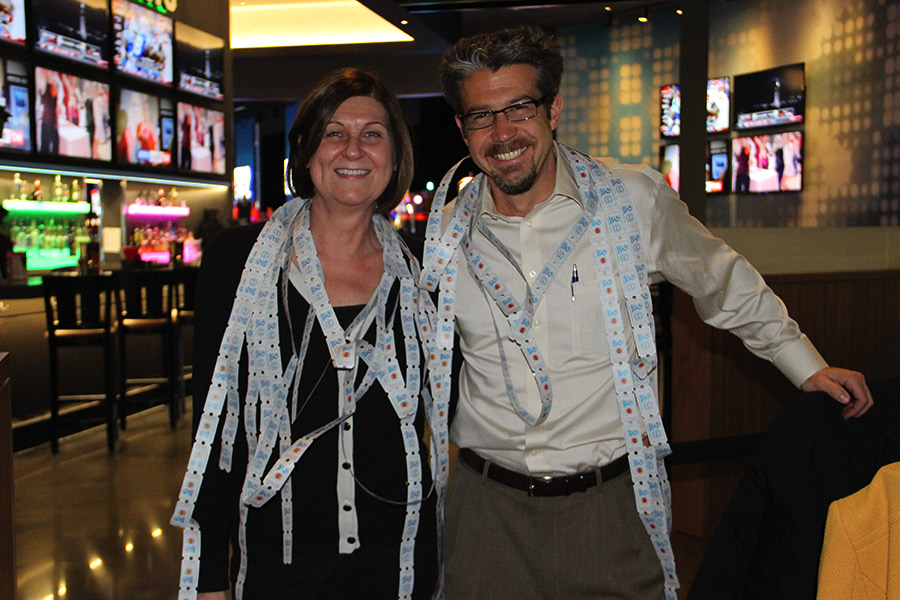
 There are a lot of things that wouldn’t get done around here without an Office Manager. That’s why we’re more than thrilled to welcome our newest staff member Nancy Sechrist to The Center team. Nancy joined us on February 3rd and after a few weeks, we’re happy to report that it looks like she’ll stick around for a while! In fact, when asked how it’s going so far, Nancy replied,

Everyone at The Center is great! It truly feels like an extended family.”  

Nancy comes with vast experience in human resources, finances and personnel management, making her a perfect fit for our team. Nancy and her husband reside in Macomb with their two daughters. So, the next time you stop by The Center, make sure to track her down and welcome her to the family.

Curtain Call

 The Center's Team enjoys sharing their knowledge with the press to help stories come to life, share facts and bring important topics to the forefront.  We are also honored when we are recognized by media and publications for our work and service to our profession. Here's what's new:

CNBC.com

Angela Palacios, CFP®: Angela was quoted on CNBC.com on January 30, 2014, in an article titled, “5 ETF myths that keep investors away” by Leslie Kramer.

Financial Advisor Magazine

Melissa Joy, CFP®: Melissa was quoted in Financial Advisor Magazine in October 2013, in an article titled, “Uncommon Talents” by Karen DeMasters.

Center Honored as an AHA 2014 Start! Fit-Friendly Platinum Status Company

For six consecutive years The Center has been recognized as an American Heart Association Start! Fit-Friendly Company. For the most recent two years the firm received Platinum status, the highest recognition level. To achieve this award the health and wellness program met the following criteria:

• Physical activity options in the workplace
• Healthy eating options at the worksite
• Promotion of a wellness culture
• Implement at least nine criteria outlined by the AHA in the areas of physical activity, nutritition and culture
• Demonstrate measurable outcomes related to workplace wellness


A14-002767, A14-003915

Taking Charge: Why Every Woman Should Get Involved in Financial Planning

You may have spent decades building a life with a significant other or spouse, perhaps even leaving the important questions about assets and investments up to them. In fact, it is not uncommon for couples to pick and choose household responsibilities and slide into a routine to divide and conquer.  All the ducks are in a row so what is missing?  Some things like picking up the laundry, getting your oil changed or planning that much-needed vacation can easily be delegated.  But a mistake I see women making is delegating away personal financial planning.  You can leverage your time by letting others take on this task, but there are some pitfalls that come with this strategy. 

Risks of Delegating Financial Decisions

  • If you are suddenly put in a position where there is no one but you to make the decisions, you may be unprepared.

  • Others may not fully understand the vision you have for your future. If you aren’t actively involved, you risk losing your say.

  • You may be delegating to save yourself time, but playing catch-up when the duties fall on you can be very time-consuming.

Making Yourself a Priority

If properly planning for the future of your design has been shuffled to the bottom of your inbox, it is time to reprioritize and here is why:

  1. Your vision is like a best friend.  It reminds you of what is most important in your life.

  2. Putting your vision in the context of a financial plan helps connect values and money.

  3. Financial planning doesn’t mean planning for the day your health begins to fail, it means asking, “Where do I want to be in 3 years?”

  4. For those who are more risk-averse, having a plan can change unknowns into quantifiable nuggets of information to reflect upon and serves as the basis for decision making.

  5. While it might seem ok now to let a spouse or someone you trust steer your financial plan, if you don’t have an active role or solid understanding of desired goals you may be disappointed at the end result.

Here’s my challenge to women of all ages and stages of life:  Let’s not kid ourselves – things get missed.  Think of yourself first and give your personal financial life the kind of attention it deserves!

Laurie Renchik, CFP®, MBA is a Senior Financial Planner at Center for Financial Planning, Inc. In addition to working with women who are in the midst of a transition (career change, receiving an inheritance, losing a life partner, divorce or remarriage), Laurie works with clients who are planning for retirement. Laurie was named to the 2013 Five Star Wealth Managers list in Detroit Hour magazine, is a member of the Leadership Oakland Alumni Association and in addition to her frequent contributions to Money Centered, she manages and is a frequent contributor to Center Connections at The Center.

Five Star Award is based on advisor being credentialed as an investment advisory representative (IAR), a FINRA registered representative, a CPA or a licensed attorney, including education and professional designations, actively employed in the industry for five years, favorable regulatory and complaint history review, fulfillment of firm review based on internal firm standards, accepting new clients, one- and five-year client retention rates, non-institutional discretionary and/or non-discretionary client assets administered, number of client households served.

Any opinions of Center for Financial Planning, Inc. are not necessarily those of Raymond James C14-004276

The Center finds balance at Dave & Busters

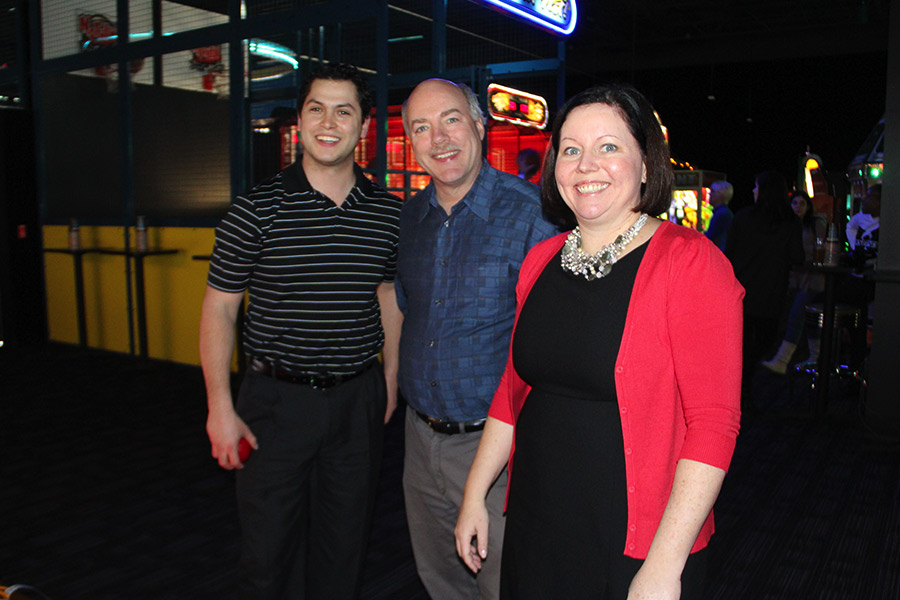
How do you beat the winter blues? It was a question the Center for Financial Planning Social Committee had been pondering.  We kicked around many ideas but finally decided on Dave and Buster’s.  For those of you not familiar, Dave and Buster’s is a complex where food, drink, gaming, and fun collide.  We could beat the blues while trying to beat one another at some of the best games around. 

On the afternoon of February 6th, we headed to Dave and Buster’s in Livonia.  It was a great afternoon filled with lots of food, drink, and camaraderie.  We found out we are a pretty competitive bunch.  There was a fierce Pac-Man tournament that took place between Tim Wyman, Amada Toia, Kali Hassinger, and Jennie Bauder.  Matt Chope and Melissa Joy found a video-enhanced Soccer Game.  Matt Trujllio stationed himself at a cool skee ball game that paid out lots of tickets while many others spent some time shooting hoops, playing air hockey, and various arcade games.

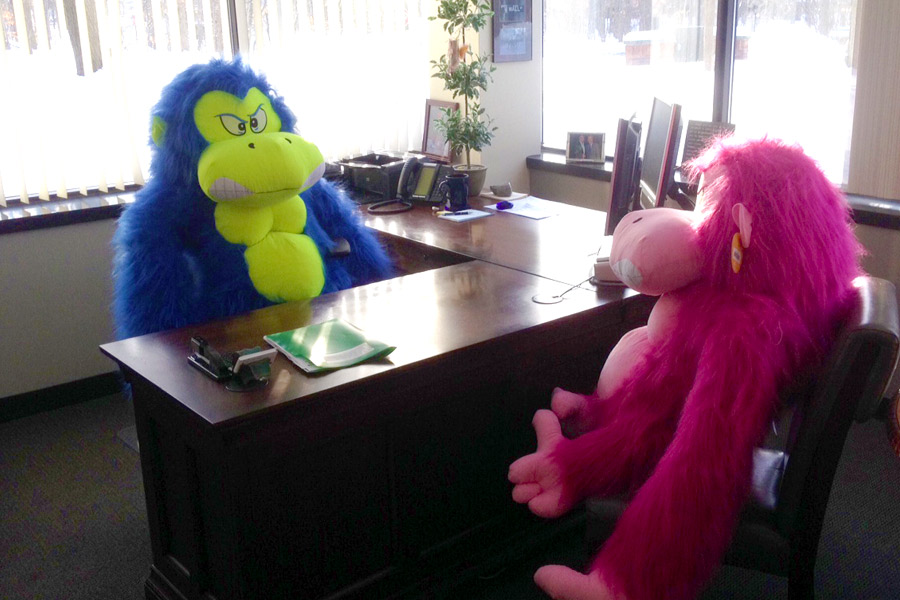
We decided as a group we would pool the tickets we won and get something for the office.  The number of tickets won totaled somewhere around 19,000 (told you we had fun!). Walking through our office you may spy two large, brightly colored gorillas (stuffed, of course).  They are our happy reminders of the day our office beat the winter blues!

Downside Hedging: The Diversified Portfolio Effect

 Wow, what a year for the markets in 2013!  Despite a rough end to 2012, uncertainty regarding the affordable care act and fiscal cliff, political tension in Syria and a government shutdown, U.S. stock markets surged and reached record highs.  When all was said and done, the Dow was up 26.5% and the S&P 500 rose by 29.6% for the year.  When you see numbers like that, you may think, “My accounts did very well this year, but they aren’t up close to 30%!”  That is a perfectly natural reaction. One reason you most likely did not see these types of returns is due to diversified asset allocation

Building a diversified portfolio using asset allocation can be tricky.  Let’s use a 60% stock, 40% bond portfolio as our example. Stocks are typically more risky and bonds tend to be more conservative and they often work inversely with one another.  When one is doing well, the other may be lagging.  This can help to even out returns and reduce the large swings in account values.  Within those two categories, one may see several different classes that comprise the 60% stock and 40% bond allocation. The stock side may include domestic large and small cap equities, international, emerging markets, energy, real estate, etc.  The bond side may include options such as short-term corporate debt, international, emerging markets or government bonds, etc.  The key is to build a portfolio that fits an investor’s individual long-term goals and needs so that the proper amount of stock and bonds can be utilized to help achieve those goals over different market conditions. 

In the chart below, we compare a $500,000 portfolio that is invested in  60% stock, 40% bonds and one that is 100% invested in stocks, as represented by the S&P 500 from 2000 – 2013.  The results are pretty staggering.  As you can see, in years the market did well, the diversified 60/40 portfolio lagged the performance of the S&P 500.  This is something we would expect because of the portfolio’s exposure to bonds.  However, in years where the S&P 500 did very poorly, such as 2001 and 2008, the 60/40 portfolio was down significantly less compared to its counterpart.  The downside hedging is what I want to focus on.  When one loses 40% of their account values like many investors experienced in 2008, he or she would need to realize a 67% gain to get back to even.  It can take a very long time to recover such substantial losses like we saw in 2008.  Diversification is the main reason why the 60/40 portfolio is worth $272,000 more than the all-stock portfolio during the same time period.

Indices Used: S&P 500, MSCI EAFE, & Barclays Cap Agg

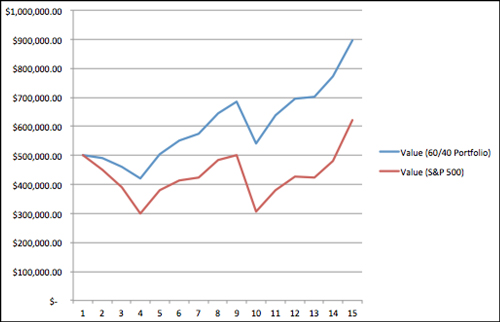
 

Sources: Barclays Cap Agg Indices, Standard & Poor’s Indices, MSCI EAFE, and Bloomberg Markets

The S&P 500 is an unmanaged index of 500 widely held stocks that is generally considered representative of the U.S. stock market. Individuals cannot invest directly in any index, and index performance does not include transaction costs or other fees, which will affect actual investment performance. Individual investor’s results will vary. Past performance does not guarantee future results. 

Let’s be honest – we all wish we could have the best of both worlds.  Who wouldn’t want to eat poorly, not exercise and still have that six pack?  The same can go for investing.  Many investors want to achieve 30% returns like we saw in 2013, but they don’t want to lose money in an environment where stocks decline 30%.  This is why The Center builds diversified portfolios for clients using asset allocation.  Asset allocation is not necessarily a “flashy” way of investing, nor does it get a dedicated nightly television show like Jim Cramer.  However, the lack of media attention has no bearing on its potential effectiveness for long-term, disciplined investing.  We understand and can empathize with clients when they are concerned that their accounts may not be participating in a market run up as much as they are seeing in the headlines. However, it is our job as your financial planning team to discuss the reasoning for this discrepancy and to help keep you focused on the long-term plan, which is what ultimately leads to investor confidence.

Nick Defenthaler, CFP® is a Support Associate at Center for Financial Planning, Inc. Nick currently assists Center planners and clients, and is a contributor to Money Centered and Center Connections.


Any information is not a complete summary or statement of all available data necessary for making an investment decision and does not constitute a recommendation. Prior to making an investment decision, please consult with your financial advisor about your individual situation. Any opinions are those of Center for Financial Planning, Inc. and not necessarily those of Raymond James. Diversification and asset allocation do not ensure a profit or protect against a loss. Investing involves risk and you may incur a profit or loss regardless of strategy selected. C14-003064

Losing a Spouse: When to Tackle the Financial Details

 There are few times in life that are worse to make financial decisions than immediately following the death of a spouse. Whether sudden and unexpected or the result of a longtime illness, the loss can be overwhelming. Unfortunately, even during this time of grief, some financial issues need to be addressed. But our advice is to avoid making any major financial decisions right away. Big decisions may be left for weeks or months down the road, once you have had time to deal with your grief and can make rational decisions about your future.

So, what's most important to do right away?

Find Help: Identify a family member or close friend who can help you keep track of things that need to get done.

Make Copies: Get 10 - 20 copies of the certified death certificate to use in settling financial matters.

Call List: 

  • The Office: If your spouse was still working, notify his/her employer and get information on health insurance, any life insurance survivor benefits, and retirement benefits.
  • Financial Advisor: Contact your financial advisor for help in making sure needed cash is available for immediate expenses. Also, contact your financial advisor and financial institutions where you and your spouse have bank or investment accounts.
  • Claims Calls: Contact life insurance and/or annuity companies to notify them for claim purposes. Also contact the Social Security Administration and, if your spouse was a veteran, contact Veteran's Affairs.

While making these contacts is necessary to make sure your financial affairs will be handled going forward, it does not mean that decisions need to be made right away. There will be a lot of forms to be completed and, in some cases, decisions that need to be made about benefits to be paid to you, titling of assets, and beneficiaries to be updated. Your financial planner can be invaluable in helping you navigate this unchartered territory -- from assisting with paperwork to helping you make the most appropriate benefits choices. And most important of all, working with your financial planner will help you determine WHEN it is the right time to make the bigger financial decisions, helping you avoid making mistakes based on emotion and grief.

Sandra Adams, CFP® is a Financial Planner at Center for Financial Planning, Inc. Sandy specializes in Elder Care Financial Planning and is a frequent speaker on related topics. In 2012 and 2013, Sandy was named to the Five Star Wealth Managers list in Detroit Hour magazine. In addition to her frequent contributions to Money Centered, she is regularly quoted in national media publications such as The Wall Street Journal, Research Magazine and Journal of Financial Planning.


Five Star Award is based on advisor being credentialed as an investment advisory representative (IAR), a FINRA registered representative, a CPA or a licensed attorney, including education and professional designations, actively employed in the industry for five years, favorable regulatory and complaint history review, fulfillment of firm review based on internal firm standards, accepting new clients, one- and five-year client retention rates, non-institutional discretionary and/or non-discretionary client assets administered, number of client households served.

Any opinions are those of Center for Financial Planning, Inc. and not necessarily those of Raymond James. C14-003511

Center Recognized for Living the Balanced Life


From the snacks in our lunchroom to the support of our colleagues, we have a healthy dose of proof that The Center is a fit place to work. The American Heart Association has named us as a Fit-Friendly Worksite for the 7th year running! The credit for the award and recognition goes to Center team members who routinely make health and wellness a priority in their lives.

It all started back in 2007 when Jen Hackmann came up with the idea of a committee focused on health at our Annual Retreat. Firm leaders loved the idea because it dovetails with our firm vision of creating a worksite environment that encourages and fosters healthier and more balanced living. Our current Health & Wellness Committee is comprised of Jennie Bauder, Gerri Harmer, and Kali Hassinger. Our health and wellness efforts continue to reduce stress, facilitate greater well-being and encourage camaraderie.

We spread the fit mentality by bringing in professional speakers, a personal trainer, and a massage therapist. Quarterly luncheons promote team members to share goals and achievements and increase social interaction and support with colleagues. We currently have 2 teams and have friendly competitions to increase our physical activity. Our Center shopper, Angie Palacios, assists us by purchasing healthier snack options that are available in our lunchroom. Our lunch coordinator, Gerri Harmer, helps us choose healthier options for our staff lunches. To keep the energy levels up, and activity levels high we encourage walking, stretch breaks and flex time.

Center team members are encouraged to contribute ideas for promoting a healthier and more supportive environment. We look for ways to reduce stress in the workplace and provide tools for effectively dealing with stressful situations. Our most important asset and tool we have in promoting a culture of health is our staff. Living the balanced life value is vital to maintaining and improving our work environment and our wellness program.


A14-003510

The January Barometer

 We’re off to an icy start, both in the weather and the markets. The weather forecast for this year has been cold, cold and colder in Michigan as well as across the country. It seems the temps are below zero more days than not this year.  Is it much the same in the forecast for the equity markets in 2014 or will they continue the sizzle of 2013?  As goes January so can go the rest of the year.  The chart below forecasts the likelihood of this:

As we finish the month of January with the S&P 500 down almost 3.5%, this means that we are more likely to have an overall negative calendar year than a positive one.  Our chances of being up overall this year are less than 42%.  Things could warm up though as the year progresses. Historical performance from February through the end of the years with negative Januarys have more often than not provided positive returns.

So even though the Groundhog saw his shadow predicting six more weeks of this harsh winter, it isn’t necessarily a given that the markets will remain icy. You’re probably familiar with the disclaimer, “Past performance is no guarantee of future returns.” Sticking with your long-term investment strategy amidst the noise and backward-looking statistics is the most important to the long-term achievement of your financial goals!

Angela Palacios, CFP®is the Portfolio Manager at Center for Financial Planning, Inc. Angela specializes in Investment and Macro economic research. She is a frequent contributor to Money Centered as well asinvestment updates at The Center.


Source: http://blogs.wsj.com/moneybeat/2014/01/31/morning-moneybeat-january-slump-is-nothing-to-fret/

The information has been obtained from sources considered to be reliable, but we do not guarantee that the foregoing material is accurate or complete. Any opinions are those of Center for Financial Planning, Inc. and not necessarily those of Raymond James. The S&P 500 is an unmanaged index of 500 widely held stocks that is generally considered representative of the U.S. stock market, that individuals cannot invest directly in any index, and index performance does not include transaction costs or other fees, which will affect actual investment performance. Individual investor’s results will vary. C14-003065