Can You Have a Purposeful Retirement?

Contributed by: Sandra Adams, CFP® Sandy Adams

20180725.jpg

It is quite often we find ourselves as financial planners delivering the good news to clients that their financial plans are on solid footing and their retirement goals are on track, only to hear from the client that they still don’t feel that they are “ready” to retire.  These clients, while financially prepared, express that they don’t feel they have put enough planning into the practical side of retirement – what will we do every day that will give our lives meaning, purpose and joy?

A book I found recently gives guidance for clients struggling to design the next phase of their lives. Hyrum Smith, the author of Purposeful Retirement: How to Bring Happiness and Meaning to Your Retirement, provides tips, tools, and stories based on his journey through this very process.  In his words, “The rest of your life can be the best of your life” if you have the right attitude, embrace this stage, and bring enthusiasm to the process.  He finds that folks entering this phase are in one of two camps – those who can’t wait and those who will need to be dragged into it kicking and screaming.  It is important to identify which camp you are in and check your attitude at the door.

Takeaways from “Purposeful Retirement”:

  • Being proactive is the key to transitioning well into retirement. If you simply let yourself drift into retirement, you can become lost without the purpose or structure that your work life provided.

  • Take charge of planning your next phase by defining your mission, your purpose and core values which will help direct how you spend your time in retirement.

  • The book offers options for how to take your purpose and translate it into action on a weekly and daily basis.

  • Fear or losing your identity or role is a key fear for many entering retirements. For those folks, asking, “How will I make a difference?” will help fill that gap.

  • For many, retirement is not a solo endeavor (we do it with our spouse). The book offers lessons on how to retire well as a couple and make adjustments that may need to be discussed and made to make retirement successful for both of you.

  • Just because you are entering into the last phase of your life doesn’t mean you are dead yet! This can be your most successful, joyful, fulfilling phase of your life – if you are intentional and embrace it with enthusiasm.

Financially planning for your retirement is just the first step in the process.  Emotionally and psychologically planning for the last phase of your life may be the more challenging part for some – especially if you don’t want to coast to the end.  “Purposeful Retirement” may be a good place to start, and/or or have a conversation with your financial planner about other ways to help you plan your NEXT best phase of life.  We are always here to help!

Sandra Adams, CFP® is a Partner and Financial Planner at Center for Financial Planning, Inc.® Sandy specializes in Elder Care Financial Planning and is a frequent speaker on related topics. In addition to her frequent contributions to Money Centered, she is regularly quoted in national media publications such as The Wall Street Journal, Research Magazine and Journal of Financial Planning.

500 Books Donated…and counting!

Contributed by: Jeanette LoPiccolo, CRPC® Jeanette LoPiccolo

20180719.jpg

The Center is just half way through our book collection drive for Rx for Reading Detroit.  I am thrilled to report that over 500 hundred books have been donated so far!  As we packed up the books to donate, we smiled to see some of our childhood favorites… remember the Hardy Boys adventures?  There were also more recently published classics like the Harry Potter series. I’m excited to know that these old and new stories will be filling the Little Libraries in Detroit soon!

When my parents recently relocated, my siblings and I were all handed a box of childhood mementos.  My mom said she could not throw them away, but the box did not make “the cut” to move to their new house.  Sound familiar to anyone?  After laughing at my childhood arts and crafts efforts, I found several books that I loved as a kid. I can’t think of a better way to show my appreciation for those stories than to share with the next generation of young readers.

We are so appreciative of the donations from clients, team members, and Center friends to this worthy charity.  If you are wondering if you can still participate, it’s not too late! We will continue collecting books through July 31st. 

If you are interested in donating, we are collecting gently used or new books, appropriate for elementary through high-school aged students. Rx for Reading Detroit is able to purchase books at a deep discount, so if you’d like to make a cash donation, please send directly to: Rx for Reading Detroit, University of Detroit Mercy, 4001 W. McNichols Road, Detroit, MI 48221. The Little Libraries used by Rx for Reading are constructed by Center client, John Mio.  

For more information about our event, please click here: Collecting-books-for-donation-to-rx-for-reading.

Jeanette LoPiccolo, CRPC® is a Client Service Manager at Center for Financial Planning, Inc.®

2018 2nd Quarter Investment Commentary

20180716.jpg

Helping our clients achieve their goals is truly a team effort here at The Center.  You may not have met or spoken to the investment team here at The Center, but we are an important resource leveraged to help you achieve your goals.  Watch the video below to learn more about the investment team and how we help you reach your financial planning destination!   We are always here to help so please don’t hesitate to reach out to us! 

Rebalancing

The investment team monitors and rebalances your portfolio, in addition to portfolio construction.  It is equally important to continue to monitor portfolios and their compliance with your investing preferences and objectives as it is to determine what the proper investments are.  Rebalancing is a key part of this process.  See our recent blog post on how to rebalance a portfolio to understand the reasons and mechanics behind the process.  The most important way to be successful is to get invested and stay invested.  Rebalancing your portfolio on occasion will help you stay the course for the long-term.

Market Update

The story has stayed much the same over the past quarter with trade tensions remaining center stage.  Volatility remains, while trade war talks have spilled over into action and interest rates continue to rise.  Synchronized global growth is slowing but is not yet slow; so, do not expect growth to immediately fall off the cliff from a peak to a trough. 

U.S. markets remain in consolidation mode after a strong 2017 as investors waffle between getting comfortable with the lower rate of growth while having a strong economic and earnings outlook.  The U.S. market ended the quarter on a higher note up 3.43% for the S&P 500 despite the ups and downs throughout the quarter with China and U.S. relations.  Despite being up as much as 6.6% and down as much as 4.4% throughout the year so far we are up 2.65% through the end of the second quarter for the S&P 500. 

Bond markets have continued to struggle with bonds giving back what they are earning via interest payments, and then some, as the Bloomberg Barclays US Aggregate bond index is down 1.6% year to date.  Interest rates continue to increase at a well-telegraphed pace by the Federal Reserve with two more increases expected this year. 

In contrast to the U.S. market, international markets are struggling for the year with the MSCI EAFE posting a -2.75% so far.  In stark contrast, domestic small company stocks are enjoying a nice tailwind from the corporate tax reform so far this year.  The Russell 2000 is posting a startling 7.6% return year-to-date, all of which occurred in the second quarter.

Inflation continues its slow creep back into our economy with wages slowly starting to increase.  Just as slowing growth in the economy is not yet slow, rising inflation is not high inflation.  We are still at very low levels of inflation when you look at the history of our domestic economy.  Our investment committee has decided to add an allocation to an inflation-focused real asset strategy.  We want to add exposure within the portfolios to a strategy that would have the potential to respond more favorably than the broad equity markets to rising inflation. 

Preview of exciting changes

The investment team has been working on some exciting developments for your experience.  We will soon have a “Center for Financial Planning, Inc®” app for your smartphone where you can view returns, asset allocation and even your probability of success for your financial plan.  This new portal will be available to all who are interested.  More information and training on how to set up and view information will be coming later this year so watch your inboxes!  As always, please feel free to reach out if you ever have any questions.

On behalf of everyone here at The Center,
Angela Palacios, CFP®, AIF®
Director of Investments
Financial Advisor 

Angela Palacios, CFP®, AIF® is the Director of Investments at Center for Financial Planning, Inc.® Angela specializes in Investment and Macro economic research. She is a frequent contributor The Center blog.


The information contained in this report does not purport to be a complete description of the securities, markets, or developments referred to in this material. The information has been obtained from sources considered to be reliable, but we do not guarantee that the foregoing material is accurate or complete. Any opinions are those of Angela Palacios and not necessarily those of Raymond James. Expressions of opinion are as of this date and are subject to change without notice. There is no guarantee that these statements, opinions or forecasts provided herein will prove to be correct. Investing involves risk and no strategy can ensure success. The process of rebalancing may carry tax consequences. Raymond James and its advisors do not offer tax or legal advice. You should discuss any tax or legal matters with the appropriate professional. Diversification and strategic asset allocation do not ensure a profit or protect against a loss. The S&P 500 is an unmanaged index of 500 widely held stocks. The Bloomberg Barclays US Aggregate Bond Index is a market capitalization-weighted index, meaning the securities in the index are weighted according to the market size of each bond type. Most U.S. traded investment grade bonds are represented. Municipal bonds, and Treasury Inflation-Protected Securities are excluded, due to tax treatment issues. The index includes Treasury securities, Government agency bonds, Mortgage-backed bonds, Corporate bonds, and a small amount of foreign bonds traded in U.S. The MSCI EAFE (Europe, Australia, Far East) index is an unmanaged index that is generally considered representative of the international stock market. These international securities involve additional risks such as currency fluctuations, differing financial accounting standards, and possible political and economic instability. The Russell 2000 index is an unmanaged index of small cap securities which generally involve greater risks. Inclusion of these indexes is for illustrative purposes only. Keep in mind that individuals cannot invest directly in any index, and index performance does not include transaction costs or other fees, which will affect actual investment performance. Individual investor's results will vary. Past performance does not guarantee future results. Bond prices and yields are subject to change based upon market conditions and availability. If bonds are sold prior to maturity, you may receive more or less than your initial investment. Holding bonds to term allows redemption at par value. There is an inverse relationship between interest rate movements and bond prices. Generally, when interest rates rise, bond prices fall and when interest rates fall, bond prices generally rise.

Under the Hood: Investment Allocation for 529 Savings Plans

Contributed by: Matthew E. Chope, CFP® Matt Chope

20180710.jpg

As many parents and grandparents know, 529 plans can be a wonderful strategy for families to help build college tuition savings for their children.  Not only do the plans benefit students, but they also carry advantages for the account creators or donors. The student can potentially enjoy tax-deferred growth with federally tax-free distributions if used for qualified educational expenses. Advantages to the donor include complete control of the account, high contribution limits, and no age restrictions or income limitations to inhibit investing.  It’s no surprise that 529 savings plans have become popular savings vehicles.

Have you ever wondered how 529 college savings plans are invested to meet time-sensitive tuition expenses? 

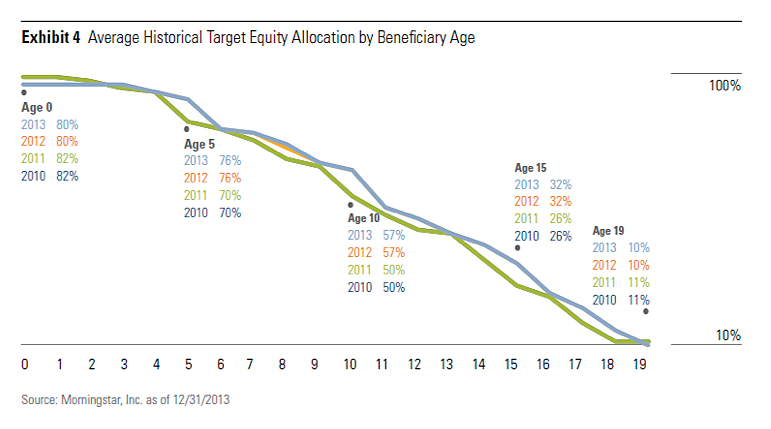
Age-based investment funds make this challenge easily manageable.  The graph below shows the glide path of equity allocations for 529 savings plans at various ages of the beneficiary from 2010 to 2013.

20180710a.jpg
  • Generally, 80% of the portfolio is invested in equities at age 0 and reduces to 10% by the time the beneficiary is enrolled in college.

  • Since 2010, plan investment managers have become more conservative in the beginning (age 0) and end (age 19) stages of plans.

  • Investment managers have become 6-7% more equity aggressive during ages 5-15 to meet tuition goals.

To meet tuition needs within 18 years, the graph reveals that investment managers are becoming more aggressive during the middle of a student’s investment time horizon, but they are also growing more cautious about preserving money closer to the end of the student’s investment time frame.  Interestingly, the graph also reveals that investment managers still rely on bonds as one of the safest places to preserve money (90% of the portfolio by age 19), despite the negative reputation bonds have received in our current rising rate environment. 

The glide path is designed to allow for an outcome with minimal surprises to all investors, no matter the economic environment when it’s time for college.  Some cycles will end on a poor note with markets crashing, while in other times markets will be soaring as students begin to tap the funds.  Ultimately, the guide path is designed to gradually reduce investors’ risk and exposure to market disruptions in the final years of saving, when investors are closest to needing the money they’ve worked so hard to save.  

Investors should carefully consider the investment objectives, risks, charges and expenses associated with 529 plans before investing. This and other information about 529 plans is available in the issuer's official statement and should be read carefully before investing. Investors should consult a tax advisor about any state tax consequences of an investment in a 529 plan.

As with other investments, there are generally fees and expenses associated with participation in a 529 plan. There is also a risk that these plans may lose money or not perform well enough to cover college costs as anticipated. Most states offer their own 529 programs, which may provide advantages and benefits exclusively for their residents. The tax implications can vary significantly from state to state.

Matthew E. Chope, CFP ® is a Partner and Financial Planner at Center for Financial Planning, Inc.® Matt has been quoted in various investment professional newspapers and magazines. He is active in the community and his profession and helps local corporations and nonprofits in the areas of strategic planning and money and business management decisions.


The foregoing information has been obtained from sources considered to be reliable, but we do not guarantee that it is accurate or complete, it is not a statement of all available data necessary for making an investment decision, and it does not constitute a recommendation. Any opinions are those of the author and are not necessarily those of Raymond James.

5 Estate Planning Action Steps to Stay in Control of Your Future

Contributed by: Sandra Adams, CFP® Sandy Adams

20180619.jpg

I recently attended a 2-day training in Elder Mediation.  Coming from a world in which we work with our clients on a regular basis to make sure estate planning documents are in place and up-to-date, I was alarmed to learn that less than 45% of the U.S. adult population has an active will or durable powers of attorney in place (2017 Caring.com Study). Unfortunately, when these documents are not in place, and the adult (at any age) becomes unable to make decisions for themselves, the court must appoint someone...and families aren’t always in agreement.

According to a 2013 AARP report, there was an estimated 1.5 million older adults with court-appointed guardians; record keeping in many constituencies is not accurate nor complete.  A guardian is appointed to make medical and care decisions for someone who is unable to make decisions for themselves; a conservator is appointed to make financial decisions and handle financial affairs for someone who is unable to handle those duties on their own behalf.  And if the family disagrees about who should be appointed to any/either of these roles, they can voluntarily seek mediation to resolve their differences or the court may order mediation.  In many cases, a family member is ultimately appointed to these roles, but in some cases a third party is appointed to serve in these roles as ordered by the court, leaving the fate of the older adult in the hands of someone who doesn’t know them or their wishes well.

Doing the work now to get documents and plans in place can save you and your family unnecessary stress and anxiety in the future, and can help to make sure that the wishes you have for yourself and your future are carried out even if you are no longer the director of those decisions. 

What action steps can you take now to make sure you maintain ultimate control over what happens to you if/when you can no longer make decisions for yourself?

To ensure that you have the ability to name who you wish to make decisions for you when it is time, I recommend taking the following steps:

1. Make sure you have up-to-date estate planning documents and review them often.  The most important documents to have in place during your lifetime are Durable Powers of Attorney — General/Financial AND Health Care (also known as a Patient Advocate Designation).  Additionally, you may want/need to have a Revocable Living Trust and a Will.

2. Consider drafting your Durable Power of Attorney documents as “Immediate” rather than “Springing”.  Immediate Powers of Attorney allow your advocate to act on your behalf immediately or at any time that you need them to, while a Springing Power of Attorney generally requires two doctors to declare you incompetent to make your own decisions before your advocate can act on your behalf.

3. Be clear and specific about your wishes for your future medical care, personal care and handling of your financial affairs.  Put things in writing and communicate your wishes to your family members and/or key people in your life.  Consider a family meeting to discuss your future wishes and ensure that everyone is on the same page.

4. Plan ahead.  It is never possible to plan for every contingency, but if you are able to plan for things that might happen (chronic health issues, incapacity, etc.), you and your finances can have a better chance of surviving.  Document your plans and communicate them to those that may be in charge of handling your affairs in the future if/when you cannot.

5. Put a team in place before it becomes necessary.  Make sure your financial planner, CPA, Attorney, any healthcare professionals and your family know your plan and your wishes and know one another so that they can carry out your plan when you might not be able to give clear directions.

If you or your family have questions or would like guidance on how to get these plans in place, please do not hesitate to reach out.  We are always here to help!

Sandra Adams, CFP® is a Partner and Financial Planner at Center for Financial Planning, Inc.® Sandy specializes in Elder Care Financial Planning and is a frequent speaker on related topics. In addition to her frequent contributions to Money Centered, she is regularly quoted in national media publications such as The Wall Street Journal, Research Magazine and Journal of Financial Planning.


The information contained in this blog does not purport to be a complete description of the securities, markets, or developments referred to in this material. The information has been obtained from sources considered to be reliable, but we do not guarantee that the foregoing material is accurate or complete. Any opinions are those of Sandra Adams and not necessarily those of Raymond James. There is no guarantee that these statements, opinions or forecasts provided herein will prove to be correct. Raymond James and its advisors do not offer tax or legal advice. You should discuss any tax or legal matters with the appropriate professional.

WEBINAR IN REVIEW: SAFE, or Success After Financial Exploitation

Contributed by: Emily Moore Emily Moore

SAFE is a program created by Dr. Peter Lichtenberg, Ph.D., which is being run by LaToya Hall, MSW, of Wayne State University’s Institute of Gerontology.  SAFE was developed to educate seniors on how to protect themselves from fraud and scams, AND how to pick up the pieces after financial exploitation.

During our recent webinar with LaToya, we learned the basics about financial exploitation targeted to seniors: 

  1. What to look for.

  2. How to protect yourself and your loved ones.

  3. What you can do if you have ever been a victim.

The main goals of SAFE:

  1. Free education offered to seniors through presentations.

  2. Helping seniors take control of their financial health through an educational four-part financial series.

  3. Provide one-on-one services to older adults who have been a victim of scams, helping them to get back on their feet.

Key points to take away from the webinar are some common scams and what criminals specifically look for in targeting older adults. 

Criminals look for seniors because they tend to be more vulnerable. They look for people who are typically lonely and socially isolated. They’re also looking for people who have a regular income (such as receiving Social Security), and older adults who are typically more trusting and polite.

Many of the common scams are successful because they represent organizations considered to be legitimate:  Social Security, Medicare and the IRS. A lot of these are done over the phone or by e-mail. It’s important to remember never to give any information over the phone to an incoming caller or respond to an e-mail requesting your personal information.

Another phone scam is called spoofing, where a person calls the senior but looks like they are calling from another number deemed safe (caller ID might identify them as person’s doctor, bank, etc.), so always make sure to double check on a statement. The safest most effective thing to do is to hang up and call the number you have in your records.

These are only a few of the many scams and tactics LaToya goes over in the “Success after Financial Exploitation (SAFE)” Webinar. To learn more and get information along with the free SAFE services listed above, contact LaToya Hall, SAFE Program Coordinator, at L.hall@wayne.edu or 313-664-2608.

Emily Moore is a Client Service Administrator at Center for Financial Planning, Inc.®


Raymond James is not affiliated with and does not endorse the opinions or services of SAFE, LaToya Hall, or Dr. Peter Lichtenberg.

What Should I Do With My Old 401k Plan?

Contributed by: Josh Bitel Josh Bitel

20180612.jpg

If you have recently retired or changed jobs, you may be wondering what will happen to the 401k you’ve been diligently contributing to over the years.  As with almost every financial decision, there is no “one size fits all” answer, it truly will depend on your own unique goals and desire to receive professional guidance on the account.  In most cases, however, there are three options that you will want to consider:

Leaving your 401k where it is

  • Limited investment options

    • Especially in bonds/fixed income

    • 401k plans can be great for accumulating but when one is in distribution mode, in many cases, having access to a wider array of investment options is preferred

  • Creditor protection

    • 401k plans can offer additional protection compared to IRAs in certain circumstances

  • Self-directed in most cases aka you’re responsible for managing the account

    • In many cases, your 401k is your largest financial asset that will be used to support your retirement lifestyle; you should evaluate if you have the time and knowledge to adequately manage the account

*If you are changing jobs, some 401k plans offer you the ability to roll an old plan into your new one for consolidation.

  • Some additional flexibility on distributions

    • As long as you are over age 55 and no longer working, or over 59 ½ regardless of employment status, you can avoid the additional penalty on this distribution.

Rolling your 401k to an IRA

  • Access to a wider range of investment options

    • In many cases will allow you to better diversify your account and potentially reduce the overall risk level of your portfolio

  • Professional management

    • Investing funds within an IRA will allow a financial advisor to actively manage and provide advice on your account

    • Our processes at The Center allow us to review your individual investments and accounts every single day to see if changes are warranted

    • Good option for those who would prefer to delegate the financial matters in their life

  • Taxes

    • When rolling funds from a 401k to an IRA, it is typically recommended that you process the transfer as a direct rollover – this will make sure the transfer will not be a taxable event

Lump-sum distribution

  • Taxable event

    • Simply put, this is a full liquidation of the account which will result in a taxable event

      • Could pay upwards of 40% in tax between federal and state and possibly a 10% penalty if funds are withdrawn before age 55

    • In most cases will push you into a higher bracket

  • Bottom line, typically not recommended

    • In most cases, due to the severity of the tax implications, we would not recommend a total lump-sum distribution of funds

      • As always, be sure to consult your tax adviser when making decisions on large retirement plan distributions

Determining what to do with your old 401k plan is an important financial decision you won’t want to take lightly.  I can’t tell you how many times we have seen new clients come to us who left their employer years ago and the overall investment allocation of the 401k plan they still have is nowhere close to where it should be given their stage in life and other financial goals.  Please let us know how we can be a resource for you or those you care about when faced with the question, “what should I do with my old 401k plan?”

Josh Bitel is a Client Service Associate at Center for Financial Planning, Inc.®


The information contained in this report does not purport to be a complete description of the securities, markets, or developments referred to in this material. The information has been obtained from sources considered to be reliable, but we do not guarantee that the foregoing material is accurate or complete. Any opinions are those of Josh Bitel and not necessarily those of Raymond James. Expressions of opinion are as of this date and are subject to change without notice. There is no guarantee that these statements, opinions or forecasts provided herein will prove to be correct. Investing involves risk and you may incur a profit or loss regardless of strategy selected.  For additional information and what is suitable for your particular situation, please consult us.

Jeanette LoPiccolo, CRPC® Branch Professional of the Year

Contributed by: Lauren Adams, CFA®, CFP® Lauren Adams

2018_jeanette_branch_professional.jpg

The Center is thrilled to announce that our very own Client Service Manager, Jeanette LoPiccolo, was recognized as one of three Outstanding Branch Professionals at the 2018 Raymond James National Conference. Raymond James’s 1000+ branches had the opportunity to nominate candidates for the award, and Raymond James chose Jeanette from among this elite group.

As you can see from this nomination form excerpt, we are very lucky to have her as part of our team:

“Jeanette is the consummate service professional.  She combines superior technical ability with genuine care for clients. Jeanette consistently anticipates client needs and is always looking for WOW moments. 

Jeanette is a true joy to have on our team. Her knowledge and skills are extremely deep, and our whole team benefits from her leadership and example. From securities based lending to K-1 procurement to cost basis issues, she is adept at nearly every complex operational area available. And, if she ever does not know the answer, she is the first to volunteer to find out and report back to the group. She is always willing to help newer coworkers and assist with a complex problem.

She is a wonderful example of our firm’s Core Value of Continuous Learning and Personal Growth. In addition to holding her securities licenses and the Chartered Retirement Planning Counselor℠ designation, she is preparing to take the CERTIFIED FINANCIAL PLANNER™ exam this fall.

On top of all of this, she is a champion for our firm’s charitable causes, organizing team-wide volunteer days, company matching activities, and community sponsorship events.”

Please join The Center Team in congratulating Jeanette on this well-deserved award!

Lauren Adams, CFA®, CFP® is Director of Client Services at Center for Financial Planning, Inc.®

The RJFS Outstanding Branch Professional Award is designed to recognize support professionals in RJFS branches who contribute to the success of their advisors and teams. Each year, three winners are selected and recognized during this year's National Conference for Professional Development. To be considered for this award, Branch Professionals must have been affiliated with Raymond James for at least one year and could not have won the award in the past.


Tick, Tock: Impact of the New Tax Law on Alimony and Divorce

Contributed by: Jacki Roessler, CDFA® Jacki Roessler

20180626.jpg

Getting divorced in 2018 and planning to pay or receive alimony?  You may not realize it, but there’s a tax “timer” hanging over your head and the buzzer is set to go off.

Current Law  

Based on current tax law, the payer of alimony may deduct the full amount from their taxable income which, in turn requires the recipient to treat it as taxable income.

How does this work in the real world?

Suppose Harry pays Sally $5,000 per month in alimony. Sally doesn’t get to keep  $5,000 because it’s treated as taxable income to her.  Based on her tax bracket, her actual monthly net is $3,750. Conversely, since Harry is in a higher tax bracket than Sally, when he writes a check to Sally for $5,000, the deduction translates to an out-of-pocket cost to him of $3,000.

What about the difference between the $3,750 that Sally nets and the $3,000 that it costs Harry? Uncle Sam has been footing the bill on the $750 differential in tax revenue. That is exactly what this new regulation is structured to eliminate.  

The New Tax Law and Alimony

The new tax law does away with the tax deduction for alimony. Of course, alimony also won’t be treated as taxable income to the recipient. The new law goes into effect for divorce cases finalized (not filed) with the Court after December 31, 2018. Cases finalized by December 31, 2018 will be grandfathered into the old tax law.

Why divorcing couples (especially the recipient of alimony) should care about the tax law change

In practical terms, taxable alimony shifts income from a high tax bracket to a lower one.  Some have argued that it gives divorced couples an unfair financial advantage not available to married couples. However, for the past 75 years, the tax deduction has made alimony a valuable negotiation tool used by attorneys across the country to help settle divorce cases. In fact, it’s often one of the only ways to help provide a fair (or) equal resolution during a difficult financial time for both parties.

When is the timer set to go off?

Although divorce attorneys and their clients may think they have until year-end before they need to worry about the changes, many states have a mandatory cooling off period once the case has been filed with the Court. Michigan, for example, has a 60 day waiting period; however for couples with minor children, the waiting period is typically extended to 180 days. Therefore, depending on where you live and if you have minor children, you may only have until the end of June 2018 to file and take advantage of tax deductible alimony.

As always, every case is different. Consult with a tax preparer, attorney and/or divorce financial professional to help you understand how the tax law changes may affect your divorce.

Jacki Roessler, CDFA® is a Divorce Financial Planner at Center for Financial Planning, Inc.®


The information contained in this blog does not purport to be a complete description of the securities, markets, or developments referred to in this material. The information has been obtained from sources considered to be reliable, but we do not guarantee that the foregoing material is accurate or complete. Any opinions are those of Jacki Roessler, CDFA®, Divorce Financial Planner and not necessarily those of Raymond James. Expressions of opinion are as of this date and are subject to change without notice. There is no guarantee that these statements, opinions or forecasts provided herein will prove to be correct. This material is being provided for information purposes only. Any information is not a complete summary or statement of all available data necessary for making an investment decision and does not constitute a recommendation. Please note, changes in tax laws may occur at any time and could have a substantial impact upon each person's situation. While we are familiar with the tax provisions of the issues presented herein, as Financial Advisors of RJFS, we are not qualified to render advice on tax or legal matters. You should discuss tax or legal matters with the appropriate professional. The hypothetical example above is for illustration purposes only.

Get to Know Jacki Roessler, CDFA® Certified Divorce Financial Analyst

Contributed by: Jacki Roessler, CDFA® Jacki Roessler

Financial errors in divorce are unfortunately as common as the divorce rate in the United States. Several factors contribute to that today including the increase of “grey divorce” (divorce over the age of 50), tax law changes just put into effect by the current Administration, as well as complications in the way we save for retirement and local housing market value fluctuations.

However, none of the above factors are as significant as the real issue for most errors, which is the underlying emotional currents that impact divorce settlements. After all, these aren’t simply business entities breaking up. The break-up of a marital estate is fraught with emotional factors that impact a couple’s ability to make sound financial decisions.

That’s where a divorce financial advisor comes in. CDFA’s, or financial professionals who have received specialized training in the financial and tax aspects of divorce, may be an invaluable member of any team of divorce professionals. Working hand in hand with attorneys, CDFA’s guide clients to make decisions based on black and white numbers, projections and sound financial information - not psychological attachments to the house or the pension. 

I’ve been privileged to work as a CDFA for over 24 years, and it’s just as rewarding today as when I first received my designation.  Often, clients will come to me with a plan in mind. They’re determined to keep their home. They are on the fence about returning to the job market because they’re not sure how much income they need to target. Most often, they’ve received a settlement from the other side and didn’t know how to evaluate it. “Is this a good deal for me?” is the most common concern I hear. Once we work on their post-divorce budget and review long-term financial projections together, they have clarity. It allows them to make a decision based on a position of knowledge. Even if they can’t afford to keep the house, they feel empowered having that information today. Also, focusing on the “business” side of the divorce is often good therapy to get their mind focused on the positive aspects of the new life ahead of them.

Jacki Roessler, CDFA® is a Divorce Financial Planner at Center for Financial Planning, Inc.®